Eleven to fourteen minutes, three parts, one examiner. The IELTS Speaking test is a recorded conversation in three parts, and four marking criteria turn it into a band score from 1 to 9. The marking section here crosses the two lists that every other page keeps apart: which criterion each part decides.
This page covers what the test is, its format, and what happens in Part 1, Part 2 and Part 3. It then covers the questions examiners ask, the marking, the vocabulary, pronunciation and fluency it rewards, the common mistakes, how to prepare, where to practise, and the tips that raise a band.
What Is the IELTS Speaking Test?
The IELTS Speaking test is a one-to-one spoken interview with a certified examiner, lasting 11 to 14 minutes, taken in three parts and marked on four criteria. Academic and General Training candidates sit exactly the same Speaking paper, which is not true of Reading or Writing.
You take it face to face at a test centre or by video call, and either way it is a recorded interview. Speaking is the only component a human marks in the room rather than a marker scores afterwards. The examiner follows a fixed script in Part 1 and Part 2, then has room to follow your answers in Part 3.
Test centres often schedule Speaking on a different day from the other three components. Before Part 1 begins the examiner runs an identity check and asks your name and where you are from. That exchange is not marked, so treat it as a warm-up for your voice.
What Is the IELTS Speaking Test Format?
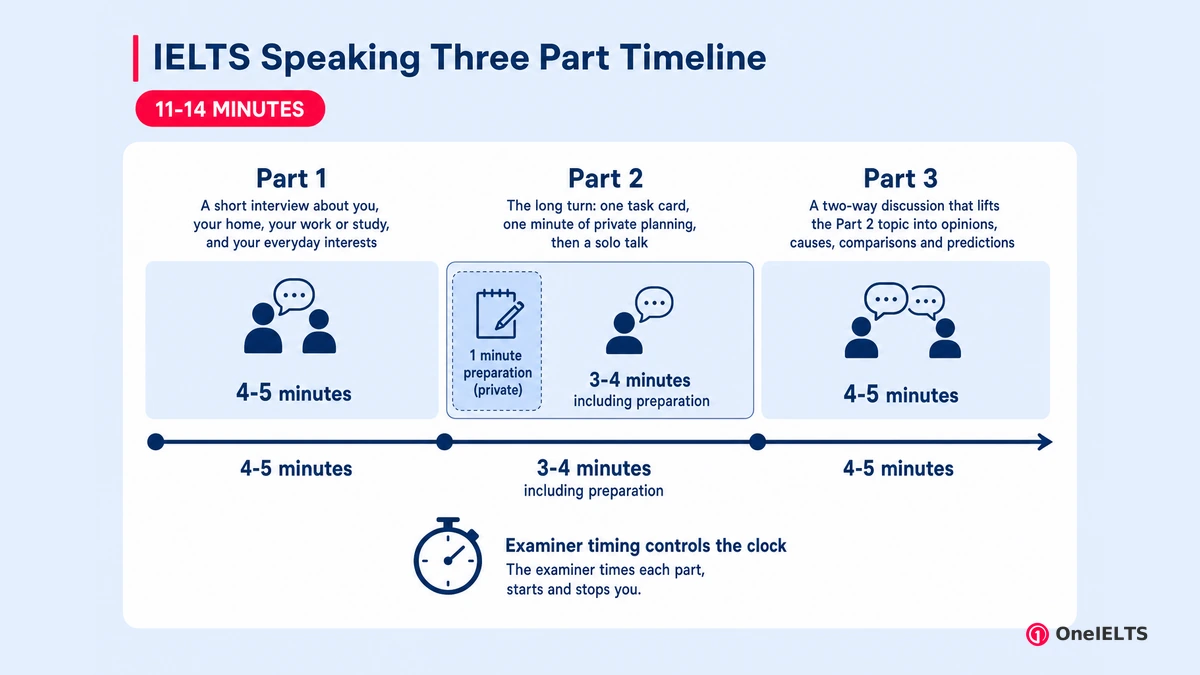
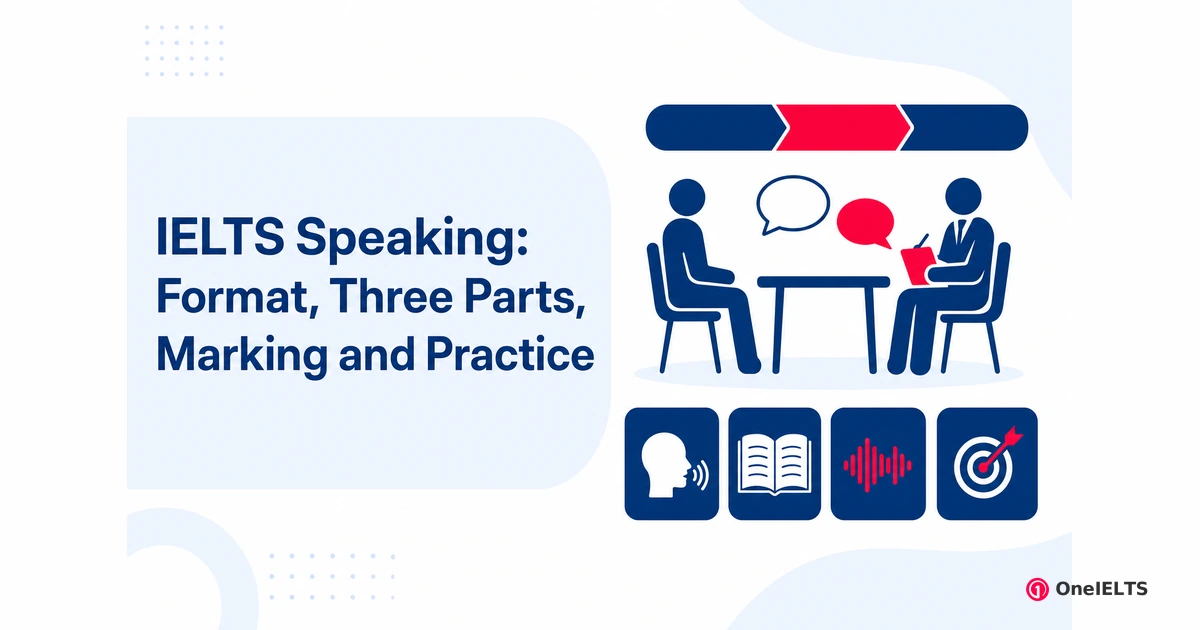
Three parts fit inside eleven to fourteen minutes: a 4 to 5 minute interview, a 3 to 4 minute long turn that already includes one minute to prepare, and a 4 to 5 minute discussion. Each part has its own job, and the table sets out who does what in each one.
| Part | What it is | Time | What the examiner does | What you do |
|---|---|---|---|---|
| Part 1 | A short interview about you, your home, your work or study, and your everyday interests | 4-5 minutes | Works through three familiar topic sets, asking three or four short questions inside each one | Answer in two or three sentences, adding a reason or an example to every reply |
| Part 2 | The long turn: one task card, one minute of private planning, then a solo talk | 3-4 minutes | Hands over the card, times the minute, starts and stops you, asks one short follow-up | Make brief notes, then speak for one to two minutes covering every prompt on the card |
| Part 3 | A two-way discussion that lifts the Part 2 topic into opinions, causes, comparisons and predictions | 4-5 minutes | Asks abstract questions, presses you for reasons, and sometimes disagrees to draw out more language | Give a position, justify it with a reason, extend it, and treat pushback as an invitation |
The parts always run in this fixed order and none can be skipped. Examiner timing controls the clock, so being stopped mid-sentence signals good pacing rather than a bad answer. Every test is recorded, which is what makes a remark possible if you appeal.
How Long Is the IELTS Speaking Test?
Eleven to fourteen minutes in total: 4 to 5 minutes for Part 1, 3 to 4 minutes for Part 2, and 4 to 5 minutes for Part 3. The preparation minute sits inside Part 2, not on top of it. Part timing shifts within those bands because examiner pace sets the total, so a short test is not a weak one. Our IELTS Speaking test format page tracks what happens minute by minute.
Is the IELTS Speaking Test Face to Face or Online?
Both exist. You either sit with an examiner at the test centre or meet one over a video call, and the format, the timing and the same marking apply either way. The video-call version still uses a live examiner on screen, not a recording and not software. Our guide to IELTS on computer covers how the other three components are delivered.
What Happens in Part 1 of the IELTS Speaking Test?
Part 1 is a 4 to 5 minute interview of short, familiar questions about you: your home, your work or studies, and the things you do in ordinary weeks. The Part 1 interview opens the test and sets the examiner’s first impression of your fluency.
The examiner works from a fixed question set, usually three topic sets with three or four questions each. Aim for two to three sentences per answer. One word sounds uncooperative, and a ninety-second speech in Part 1 gets cut off.
Familiar topics are the whole point here, and they repeat year after year. That makes Part 1 the only part where prepared content genuinely pays, because you can rehearse how you talk about home and work without rehearsing a script. It feels like a warm-up. It is fully marked from the first answer.
To drill this stage on its own, the IELTS Speaking Part 1 practice filter isolates the introduction and interview sets. Practising there needs a free account.
What Questions Come Up in Part 1 of IELTS Speaking?
Nine recurring sets carry almost every Part 1 question: personal information, home and accommodation, work or study, hobbies and free time, travel, technology, food, weather, and daily routine. Those Part 1 topics have barely moved in a decade, which is why this part rewards prepared content more than any other. Our IELTS Speaking questions bank groups them topic by topic.
What Happens in Part 2 of the IELTS Speaking Test?
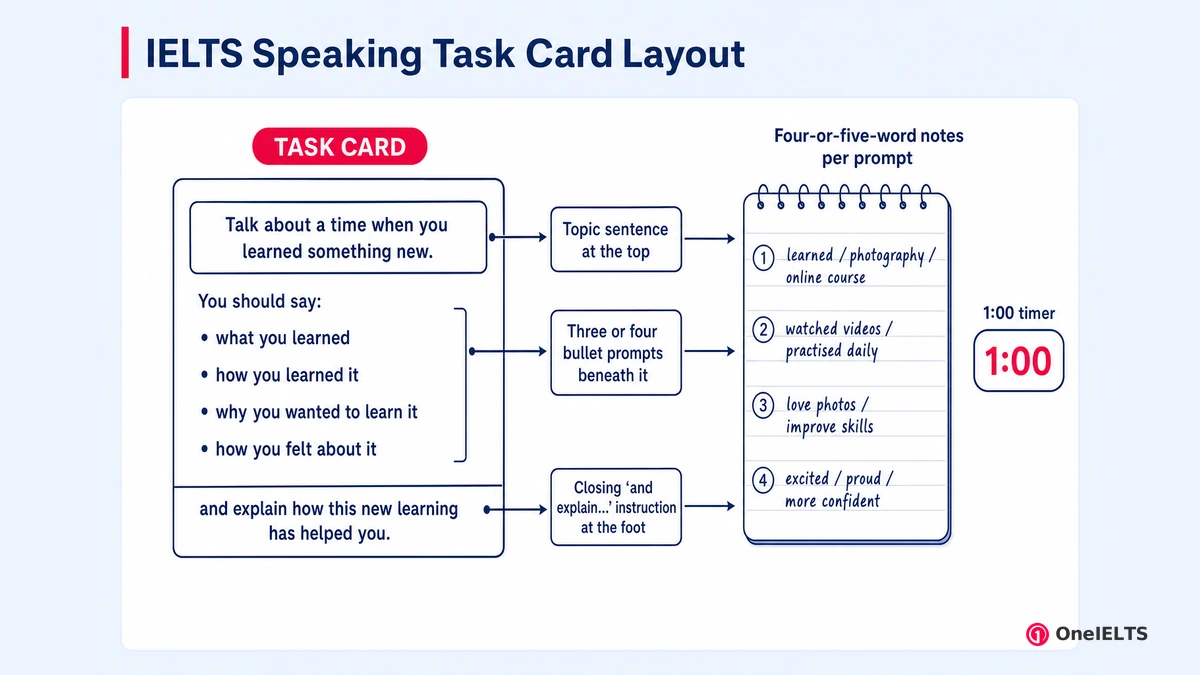
Part 2 is the long turn. The examiner hands you a task card, gives you one minute of notes and a pencil, and you then speak alone for one to two minutes before one short follow-up question.
The card names a topic and lists three or four prompts you should cover. That minute is the only planning time in the whole test, and most of it gets wasted. The pattern shows up in almost every practice recording we review: a candidate writes three full sentences, then reads them aloud at half their normal speed.
Being stopped at two minutes means you filled the time, which is the intended outcome. Part 2 is where fluency is really measured, because speaking unaided is the one condition the other parts never create. Nobody interrupts to help you, and nobody asks a rescue question.
What Is an IELTS Speaking Cue Card?
The cue card is the printed task card used in Part 2: a topic sentence, three or four bullet prompts, and a closing instruction to explain something about the Part 2 topic. “Cue card” is the candidate’s word; the test owners call it the task card, and the two mean the same object. Our IELTS Speaking cue cards library shows the layout.
How Do You Speak for Two Minutes in IELTS Speaking Part 2?
Use the card prompts as your structure and hang one concrete example on each. Four prompts with an example apiece fill two minutes without a single repetition.
The note-taking rule that makes it work: write four or five words per prompt and never a sentence, because reading aloud flattens your delivery. Our IELTS Speaking Part 2 guide walks through a full worked answer.
What Happens in Part 3 of the IELTS Speaking Test?
Part 3 is a 4 to 5 minute two-way discussion that takes the Part 2 topic and makes it abstract: opinions, comparisons, causes and predictions rather than your own life.
The examiner sometimes disagrees with you, or pushes the other way. Examiner pushback is a request for more language, not a correction, and answering it with “yes, you are right” throws away the marks it was offering. Answers here run longer than in Part 1, and a qualified opinion beats a flat one.
Abstract questions are the reason Part 3 separates band 6 from band 8. Part 3 allows no preparable content: you cannot memorise an opinion about whether cities should limit cars. Taking two seconds to think before you answer costs nothing, and thinking aloud with a phrase like “that’s an interesting one” costs less than silence.
How Do You Answer Abstract Questions in IELTS Speaking Part 3?
Answer, justify, illustrate. Give a position and reason in the first two sentences, then extend with an example or a comparison. Extending an answer is what turns a correct reply into a band 7 one on any abstract topic.
Hedging language such as “it depends”, “in most cases” and “arguably” scores as range, not as weakness. Read our IELTS Speaking Part 3 guide for modelled answers.
What Questions Does the Examiner Ask in IELTS Speaking?
The same topic families come round year after year. What changes is what the examiner does with them: your life in Part 1, one topic in depth in Part 2, and the idea behind it in Part 3. The parts are not three subjects; they are three depths of the same subject. Eight families cover most of what candidates meet, traced here from a Part 1 question through a cue card topic to a Part 3 discussion.
| Topic family | A Part 1 question | A Part 2 card | A Part 3 question |
|---|---|---|---|
| Personal information | “Can you tell me about the area of your home town that you like most?” | “Describe a person you have known for a long time, and say why you stay in touch.” | “How have family relationships in your country changed over the last thirty years or so?” |
| Home and city | “Do you live in a house or a flat, and what do you like about it?” | “Describe a building in your city that you find interesting, and explain what makes it stand out.” | “Should governments protect old buildings when a city needs more housing space?” |
| Work and study | “What do you study, and what made you choose that subject in the first place?” | “Describe a skill you learned at work or at school that you still use today.” | “Do employers value practical experience more than formal qualifications in your country now?” |
| Hobbies and free time | “How do you usually spend your weekends when you are not working or studying?” | “Describe an activity you took up recently, and say what first attracted you to it.” | “Why do people in busy cities find it harder to keep up hobbies?” |
| Travel | “Do you prefer travelling by train or by car, and why is that?” | “Describe a journey that did not go to plan, and explain how you handled it.” | “Has cheap air travel improved cultural understanding, or mostly damaged local places?” |
| Technology | “What is the one app on your phone that you open most often?” | “Describe a piece of technology that changed how you work, and say what it replaced.” | “Do you think older people are excluded when public services move online?” |
| Environment | “Do people in your area recycle much, and how easy is it to do?” | “Describe a place near you that has become cleaner or greener, and explain the change.” | “Should the cost of cutting emissions fall on companies or on individual households?” |
| Health | “What do you do to stay healthy during a normal working week?” | “Describe a habit you changed for health reasons, and say how difficult that was.” | “Are governments right to tax sugary drinks in order to change what people eat?” |
Where Can You Find IELTS Speaking Questions With Answers?
Two places, used for different jobs: the official sample tasks from the test owners give you authentic wording, and a topic-by-topic question bank with model answers gives you volume. Take a model answer’s structure and its two or three collocations, never its content. A memorised answer is audible within about ten seconds. Our IELTS Speaking questions and topics page holds the bank.
How Is IELTS Speaking Marked?
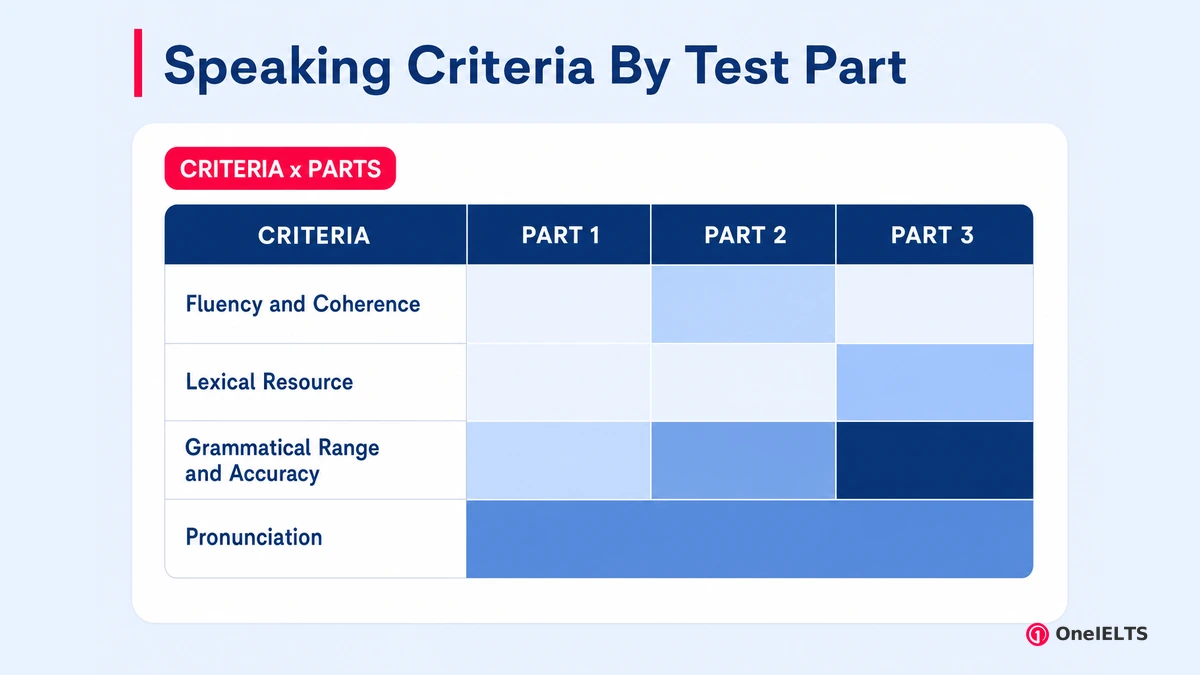
Four criteria, each scored 1 to 9 and then averaged: Fluency and Coherence, Lexical Resource, Grammatical Range and Accuracy, and Pronunciation. The four scores are averaged rather than added, so one weak criterion caps the whole band. The four criteria are equally weighted and averaged; the published rounding rule covers the overall band across the four skills.
Every competing page lists the three parts, then lists the four criteria, and never crosses them. This matrix does, because where a criterion is decided tells you where to spend your preparation.
| Criterion | What it measures | Which part decides it | Why |
|---|---|---|---|
| Fluency and Coherence | Speech without unnatural pauses, and ideas a listener can follow from one to the next | Part 2 | The long turn is the only stretch where you sustain speech with nobody helping you along |
| Lexical Resource | Range and precision of vocabulary, including collocation, paraphrase, and the natural phrasing that sounds unrehearsed | Part 3 | Abstract topics strip away prepared phrases, so what is left is the vocabulary you actually own |
| Grammatical Range and Accuracy | Variety of sentence structures, how often errors appear, and whether complex forms stay accurate under load | All three, pressure-tested in Part 3 | Longer and more qualified answers force the complex structures that short Part 1 replies never require |
| Pronunciation | Intelligibility, word stress, sentence stress and intonation, measured across every answer in the whole test | Every part, continuously | It runs from your first sentence to your last, and it is the one criterion you cannot repair in the room |
The examiner marks live while managing the clock, which is why an averaged band rewards steady quality over one brilliant answer.
What Do the IELTS Speaking Band Descriptors Say?
The public descriptors define every band from 1 to 9 on all four criteria, and that wording is exactly what the examiner matches you against. Two lines decide most tests.
At band 7 the band descriptors allow occasional hesitation and errors that do not block meaning. At band 8 the error tolerance narrows: hesitation is allowed only while you search for an idea, not for language. Compare the wording in our ielts speaking band descriptors breakdown.
Is 7 a Good Score in IELTS Speaking?
Yes. Band 7 clears the majority of university and visa component requirements, and it is the band most candidates are actually aiming at. In behaviour rather than numbers, band 7 sounds like this: you keep speaking at length, hesitation is occasional, you reach for some less common vocabulary, and your errors never obscure meaning. See where it sits in our good IELTS score guide.
What Vocabulary Do You Need for IELTS Speaking?
Enough topic vocabulary to talk about ordinary life with precision, plus the collocations and paraphrases that Lexical Resource actually rewards. A list of impressive words is not what raises the score.
Lexical Resource credits range and precision together. A common word used exactly beats a rare word used loosely, every time. “Crowded” placed correctly earns more than “congested” dropped into the wrong noun.
Learn vocabulary in topic groups, because the topic families repeat and a group gives you a whole answer rather than a single word. A “big” word inserted for effect is heard as inserted, and examiners hear dozens a week. Paraphrase is the quiet winner here: rewording the examiner’s question in your first clause is itself scored lexis, and it buys you two seconds of thinking time.
Which Words Raise Your IELTS Speaking Vocabulary Score?
Three kinds pay: collocations that sound native, precise verbs for everyday actions, and the phrases that show how two ideas relate. Learn them by topic group, never alphabetically.
The test for whether a word earns its place is fluent use: could you drop it into a Part 3 answer without slowing down? If not, it is a reading word. Our IELTS Speaking vocabulary lists are grouped that way.
Should You Use Idioms in IELTS Speaking?
Yes, sparingly. The descriptors credit idiomatic language at the higher bands, but an idiom used wrongly costs more than it earns. The safe rule: use only idioms you have heard in real speech, and keep natural use to two or three across the whole test. An overused idiom marks you out faster than a plain sentence ever would. Our idioms for IELTS Speaking page sorts the safe ones.
How Important Is Pronunciation in IELTS Speaking?
Pronunciation carries a full quarter of the mark, and it is the only criterion measured continuously from your first sentence to your last. Criterion weighting is equal across the four, so a weak Pronunciation score drags the average exactly as hard as weak grammar does.
What gets scored is intelligibility: word stress, sentence stress and intonation, judged on whether a listener follows you without effort. Your accent is not penalised. Unclear word stress is, because “photograph” and “photography” stop being different words when the stress lands in the wrong place.
Candidates neglect this criterion because it feels fixed at birth. It is the one where a few weeks of targeted work moves a half band. Slowing down slightly raises intelligibility and lowers nothing else, which makes it the cheapest gain in the test.
Do You Need a British or American Accent for IELTS Speaking?
No. No accent is required or rewarded, and examiners are trained on a wide range of them. What gets marked is whether you are easy to understand.
Three things cost marks regardless of accent: misplaced word stress, dropped word endings, and flat intonation held across a long answer. Intelligibility is the whole test here. The english pronunciation rules inside the descriptors spell it out.
How Do You Improve Fluency and Coherence in IELTS Speaking?
Keep going, and signpost. Fluency is scored as speech without an unnatural pause, and coherence as whether a listener can follow how your ideas connect.
Fluency is not speed. Speaking fast to sound fluent usually damages pronunciation and buys nothing. Self-correction once is allowed and reads as control; restarting the same sentence three times reads as breakdown. The pauses that cost you are the ones spent hunting for a word, not the ones spent choosing an idea.
A discourse marker is what turns a pile of sentences into an answer, because it tells the listener whether the next clause is a reason, a contrast or an example. Part 2 decides this criterion, since nobody helps you through the long turn. Two minutes of unbroken speech provides the only evidence the examiner gets.
Which Linking Words Help in IELTS Speaking?
The spoken connectors do the work here: “the thing is”, “what I mean is”, “having said that”, “that’s why” and “in my case”. Each one is a discourse marker people actually say out loud. A written linker such as “moreover” sounds rehearsed in speech and lowers coherence rather than lifting it. Our ielts speaking linking words list separates spoken from written.
What Are the Most Common Mistakes in IELTS Speaking?
Most lost bands come from behaviour rather than from a gap in English. Candidates who hold a fluent conversation in a cafe still lose half a band by giving a one-word answer, by reciting, or by stopping early. Examiner disagreement in Part 3 catches out more people than any grammar rule. Nine habits cost the most, and each one carries a named criterion cost.
- Giving a one-word answer in Part 1. Short replies starve the examiner of evidence, which caps Fluency and Coherence before Part 2 begins.
- Reciting a memorised answer. Rehearsed rhythm is audible, and it pulls down Lexical Resource and Fluency at the same time.
- Writing sentences in the Part 2 minute. Notes you read aloud kill natural delivery, so Fluency and Pronunciation both drop together.
- Stopping early in the long turn. Forty seconds of talk gives the examiner too little speech to award a high Fluency score.
- Treating disagreement in Part 3 as a correction. Backing down removes the extended reasoning that Grammatical Range is measured on.
- Inserting idioms and big words for effect. Vocabulary used loosely damages Lexical Resource more than plain accurate wording ever could.
- Speaking fast to seem fluent. Speed blurs word endings and stress, so Pronunciation falls while Fluency gains nothing at all.
- Apologising for your English. Every apology spends seconds that carry no language and shifts the tone away from your evidence.
- Answering a different question. An off-target reply reads as weak Coherence, however good the sentences inside it happen to be.
Which IELTS Speaking Mistakes Cost the Most Marks?
The memorised answer and the short long turn. A recited reply is heard as unnatural language, and a forty-second Part 2 removes the fluency evidence the examiner needs before scoring. An audibly memorised answer pulls down Lexical Resource and Fluency in one go, which makes it the most expensive habit in the test. Our ielts speaking tips page fixes both.
How Should You Prepare for IELTS Speaking?
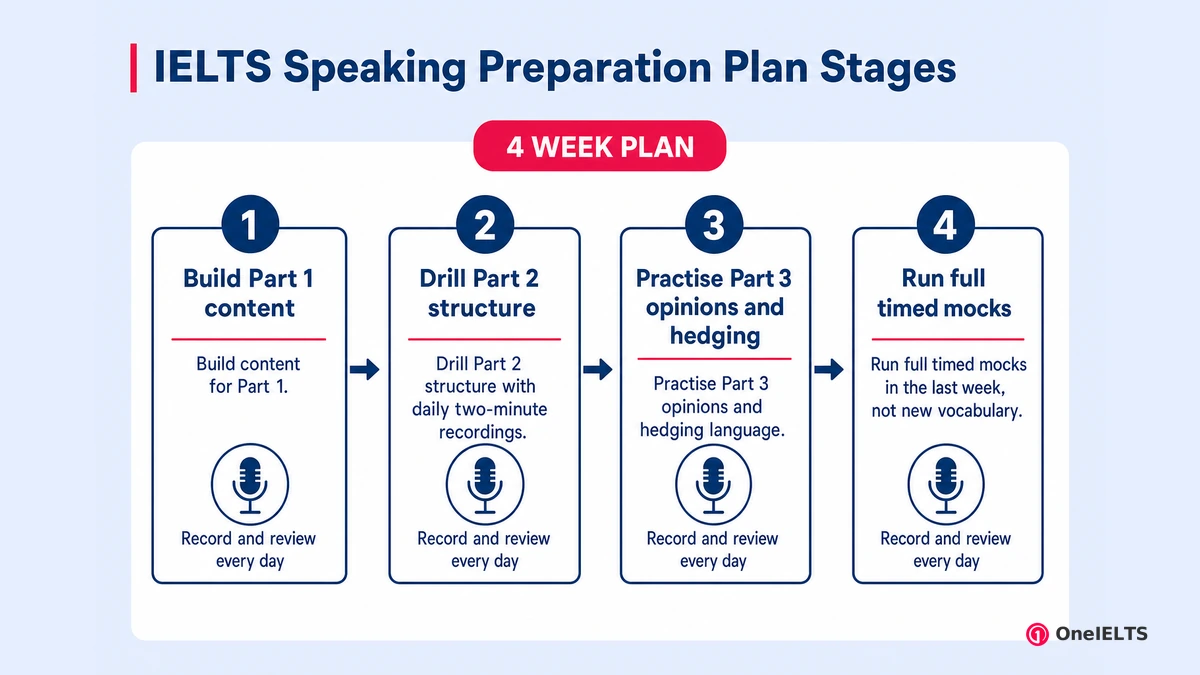
Per-part preparation beats general practice. Build content for Part 1, structure for Part 2, and opinions plus hedging language for Part 3. Then record yourself, because you cannot hear your own hesitation while you are producing it.
Recording yourself is the single highest-return habit in this component. One two-minute answer a day, played back once, listening for pauses rather than for mistakes. Candidates who do this for three weeks usually hear the difference before anyone tells them about it.
A speaking partner helps and is not required. Part 3 preparation is thinking practice more than language practice: read a news story, form an opinion, argue the other side out loud. Save the last week for a full timed mock rather than new vocabulary, because new words are the least reliable thing you own on test day.
How Long Should You Prepare for IELTS Speaking?
Two to four weeks of short daily sessions is a realistic window for a half band, and a full band usually takes six to eight weeks of the same. Treat both as our editorial estimates rather than published data. One week covers behaviour change, such as killing one-word answers and short long turns, but not a change in your language. Plan it with our ielts speaking preparation timeline.
Where Can You Practise IELTS Speaking?
Start with the test owners’ official sample tasks for authentic wording. Then move to timed practice with a partner, a tutor or a recorder, and finish with a full mock that runs all three parts without a break.
The official sample tasks and the free practice questions from the test partners are the authentic starting point. A real card’s wording differs from a rewritten one in ways you notice under pressure. Practising a single part in isolation misses what the test measures, which is holding quality across eleven to fourteen minutes. A full mock with three parts unbroken is the only rehearsal for that.
Speaking to yourself counts as recorded practice if you actually review it. Review by cause, not by symptom: mark where you paused, which words you repeated, and whether each answer answered the question asked.
A free IELTS Speaking mock test is the timed version, with all three parts in one sitting.
How Can You Practise IELTS Speaking Alone?
Record a cue card answer on your phone every day, transcribe one recorded answer a week, and mark your own pauses and repeated words against the descriptors. Transcription is the fastest way to see the gap between how fluent you felt and how fluent you sounded. Build self-marking into our IELTS Speaking practice sets and the wider IELTS preparation plan.
What Are the Best Tips to Score Higher in IELTS Speaking?
The tips that move a Speaking band are about behaviour under pressure rather than knowing more English. Everything above describes the test itself. From here the page narrows to the band you are chasing.
Nothing on this list needs a new word learned. Eight habits, drilled in a fortnight, separate a candidate who knows English from one who shows it. Each tip below maps to a part and a criterion.
- Answer in two to three sentences in Part 1, then stop. One sentence starves the examiner; a speech invites an interruption.
- Use the note-taking minute for notes, never for sentences. Four or five words per prompt keeps your delivery sounding spoken.
- Keep talking until the examiner stops you. Being cut off at two minutes proves you can sustain speech without help.
- Take examiner pushback in Part 3 as an invitation. Defend your position with a reason, and the marks follow the extra language.
- Slow down slightly rather than speed up. A steadier pace lifts Pronunciation and costs Fluency nothing at all.
- Try paraphrasing the question in your first clause. It is scored as lexis and buys you two seconds of thinking time.
- Use only idioms you have actually heard in speech. A collected idiom lands wrong and costs more than a plain sentence.
- Let yourself self-correct once rather than restart. One clean self-correction reads as control; three restarts read as a breakdown.
How Do You Get Band 7 in IELTS Speaking?
Band 7 needs speech at length with only occasional hesitation, some less common vocabulary, and errors that never obscure meaning. In practice that means fixing behaviour before language. Three changes produce it more often than any others: longer Part 1 answers, a full two minutes in Part 2, and a hedged opinion instead of a flat one in Part 3. Our IELTS band 7 guide sets out the same target across all four components.
How Can You Get 8.5 in IELTS Speaking?
At band 8.5 the examiner is listening for effortless language rather than correct language, so the work is removing the last hesitations and widening precision. Adding vocabulary at this stage changes little.
Averaged criteria are why an 8.5 usually means three 9s and an 8, which puts the whole job on your weakest criterion. That is most often Pronunciation. Our IELTS band 9 guide covers the top of the scale.
Is IELTS Speaking Difficult?
No more than the other components. It is the one candidates fear most, because it is a live test with a person and cannot be revised the way Reading can.
The reframe that helps: eleven to fourteen minutes of ordinary conversation about ordinary topics, with the examiner on a fixed script for most of it. Test anxiety shrinks after twenty recordings. Our IELTS difficulties page compares all four components.
Is It Okay to Lie in IELTS Speaking?
Yes. The examiner marks your English, not the truth of your answers, so an invented detail that keeps you talking is not penalised. The examiner marks language not content.
Sustaining an answer sets the real limit: an invented answer you cannot defend under a follow-up question costs you fluency. Invent something ordinary, not something impressive. Our answer to is it okay to lie in ielts speaking has examples.
Written by Rifah Binte Faruk, reviewed 14 August 2026.
Last verified: 14 August 2026
Practice for the Real IELTS Exam
Apply what you’ve learned with free, exam-style practice:
- Take a free IELTS mock test — all four skills, real exam timing, AI band scoring
- Sit a Speaking section mock — timed Parts 1–3 with voice recording and band feedback
- Practise all three parts — sample questions with feedback