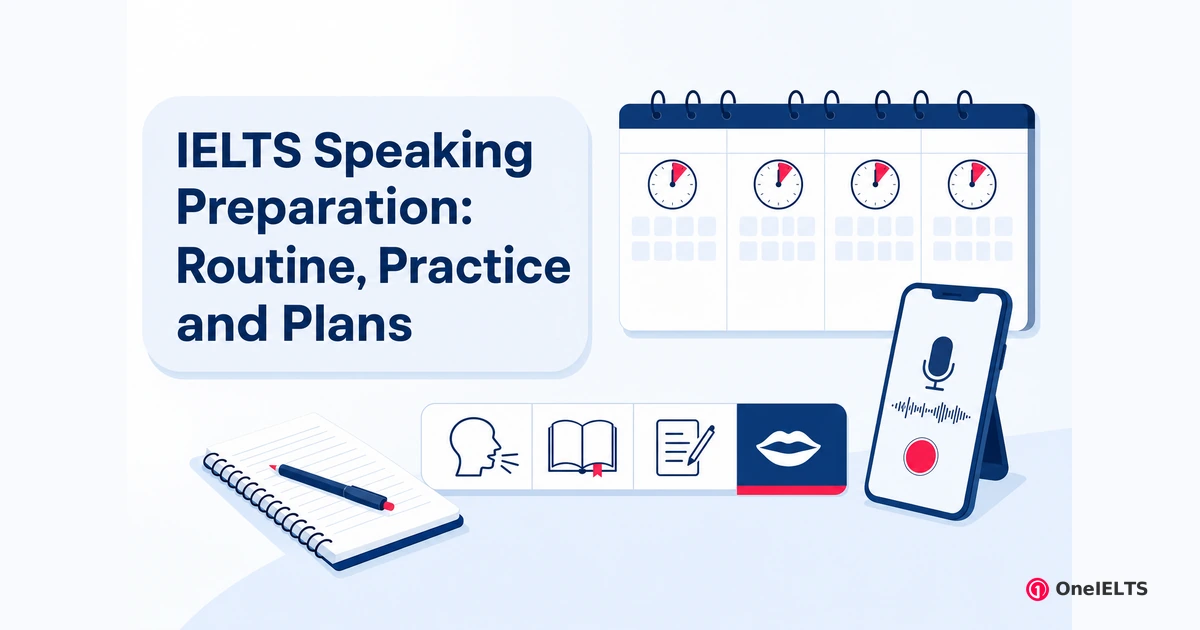
Four to eight weeks of short daily practice moves IELTS Speaking by one band, and seven days only stops you losing marks you already had. A preparation routine that works is small and repetitive: a fifteen-minute daily session, recorded practice you listen back to, and one fix per session aimed at a single criterion.
This page runs the six-step sequence first, then the seven-day question and what to expect on the day. Next come the four core tips, the session itself, practising without a partner, and how to review a recording.
After that comes a band-level plan for your current band and the resources worth keeping. The last sections cover where to take a free practice test, which samples to study, the four marking criteria, and the route to 7.5.
How Should You Prepare for IELTS Speaking?
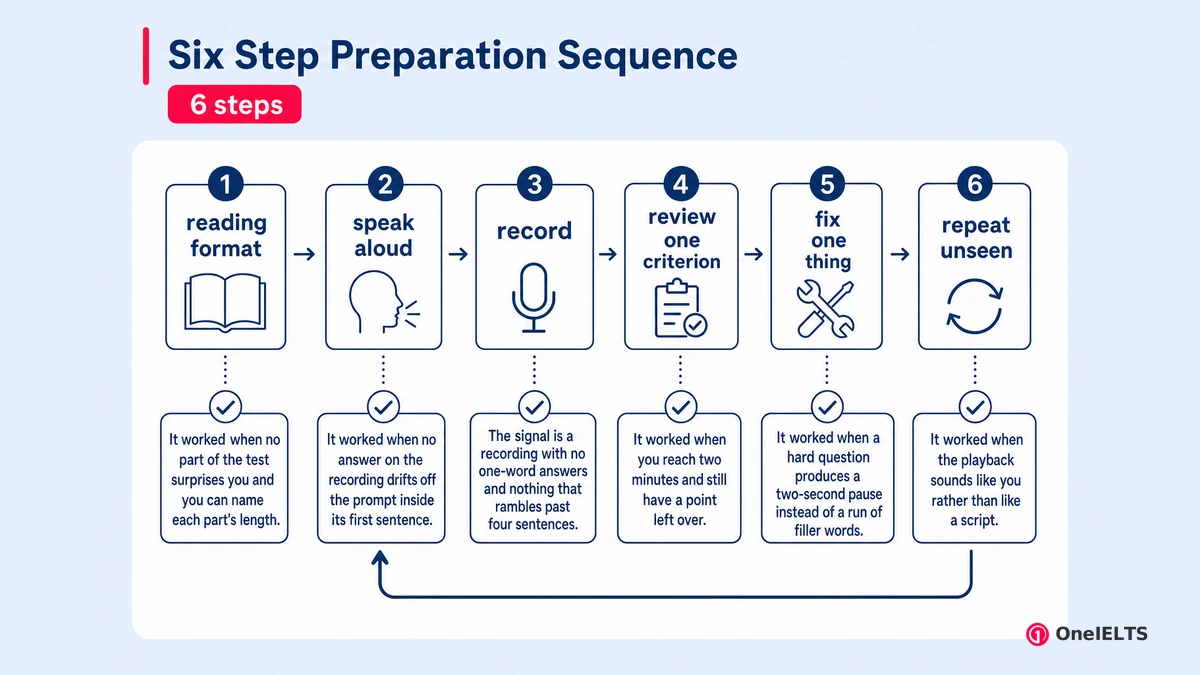
Preparation runs in six steps, in a fixed order: format first, then answering aloud, then a recorded session. The last three steps are a review against one criterion, one fix, and a repeat on an unseen question.
Order matters more than volume. Two hours of unrecorded talking leaves you roughly where you started, because nothing gets measured and nothing gets changed. Fifteen minutes that ends in a recording hands you one fault to work on tomorrow.
IDP India publishes this six-step sequence on its Speaking preparation page, and the steps here follow it. Google’s own AI Overview on this query lists recording as one of only four core tips, and three of the pages ranking here name it independently. Each step below carries the time it takes and the signal that tells you it worked.
- Understand the test format. Read the three-part structure once and watch one full mock, about forty minutes in total. It worked when no part of the test surprises you and you can name each part’s length.
- Listen carefully to the questions. Spend five minutes a session answering the exact question asked rather than the topic around it. It worked when no answer on the recording drifts off the prompt inside its first sentence.
- Expand your answers. Push every Part 1 reply to two or three sentences, roughly ten minutes a day. The signal is a recording with no one-word answers and nothing that rambles past four sentences.
- Organise your ideas for Part 2. Use the one-minute preparation slot to write four short notes, then speak for two minutes. It worked when you reach two minutes and still have a point left over.
- Stay calm during Part 3. Answer two abstract questions per session, taking a breath before each one. It worked when a hard question produces a two-second pause instead of a run of filler words.
- Speak naturally. Talk to the recorder the way you would talk to a colleague, for the last five minutes of the session. It worked when the playback sounds like you rather than like a script.
Can You Crack IELTS Speaking in 7 Days?
No, seven days cannot gain you a band, though it is enough to stop you losing marks you already had. A one-band move usually takes four to eight weeks of short daily practice.
Be careful with that figure, because nobody publishes it. Not one of the six pages ranking on this question states any preparation duration at all, so treat four to eight weeks as experience-based guidance rather than a rule from a test owner.
The reason a week cannot move a band sits in the official band 7 fluency descriptor. It describes hesitation that happens “often mid-sentence”, and it attributes that hesitation to “problems with accessing appropriate language”. That is a retrieval speed problem, and retrieval speed responds to repetition across weeks.
A week still buys you four real things. Learn the format so nothing on the day surprises you. Fix your answer length, upward in Part 1 and downward in Part 2.
Then drill two or three phrases until each one is an automatic phrase you reach for without thinking, and finish with a single full recorded mock you actually listen to. That is a worthwhile week. Test-day tactics and the last-day checklist sit on the OneIELTS Speaking tips page.
What Should You Expect in the IELTS Speaking Test?
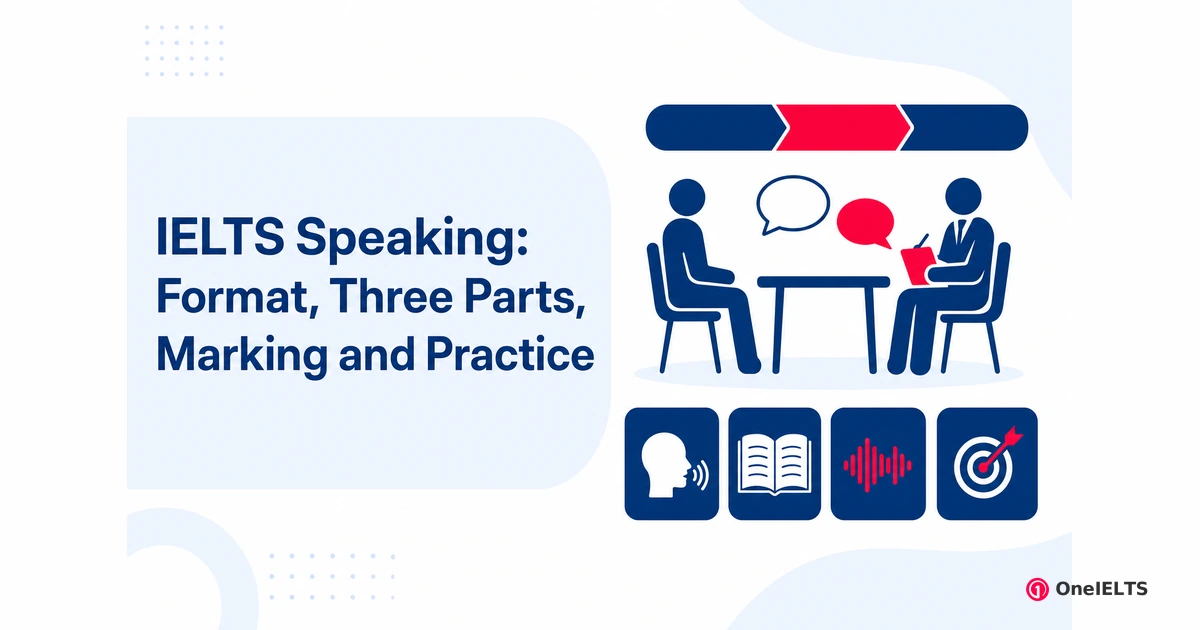
Expect three parts in a fixed order, inside eleven to fourteen minutes: a four-to-five-minute interview, a three-to-four-minute long turn, and a four-to-five-minute two-way discussion.
This section exists only so you know what the routine aims at. The timings come from Google’s AI Overview on this query and match what IDP publishes per part. The three parts sit in the table with their length and the job each one asks of you.
| Part | Length | What you are asked to do |
|---|---|---|
| Part 1 | 4 to 5 minutes | Answer questions about yourself, your home, work, studies and other familiar topics, in two or three sentences each |
| Part 2 | 3 to 4 minutes | Take one minute to plan a cue card topic, then speak alone for two minutes before one short rounding-off question |
| Part 3 | 4 to 5 minutes | Discuss abstract questions tied to the Part 2 theme, giving reasons, comparisons and opinions rather than personal facts |
The official reference is the Speaking format page on ielts.org, and OneIELTS covers the same ground in depth on its Speaking format page. Everything after this section is the routine that gets you ready for those fourteen minutes.
What Are the Core Preparation Tips for IELTS Speaking?
Four tips carry most of the gain: speak naturally, extend every answer, replace vague adjectives with precise ones, and record yourself.
Google publishes exactly these four in its AI Overview on this query, and four is the right number because a short list survives contact with a real week. A forty-item checklist gets read once and abandoned. Each tip names the criterion it moves and the drill that moves it.
- Speak naturally. Google’s wording is to “avoid memorizing long, robotic speeches” and to keep a steady, calm pace. Natural delivery protects fluency and coherence, so answer a card cold, with no script.
- Extend answers. Google says not to leave a Part 1 reply at “yes” or “no”, but to add one or two sentences of explanation. An extended answer feeds lexical resource and grammatical range, so set a two-sentence floor.
- Use precise words. Swap basic adjectives like “good” or “bad” for specific ones like “enjoyable” or “challenging”. Pick five vague adjectives you overuse, give each two replacements, then use every precise adjective in a recorded answer that day.
- Record yourself. Google’s fourth tip is to listen back and “catch awkward pauses or repeated filler words”. Recording turns daily practice into feedback, and it makes the other three tips measurable rather than aspirational.
IELTS Advantage puts the habit more bluntly, as “speak some English every day”. The words themselves belong to the OneIELTS Speaking vocabulary page; this list only covers the drill.
How Do You Practise IELTS Speaking?
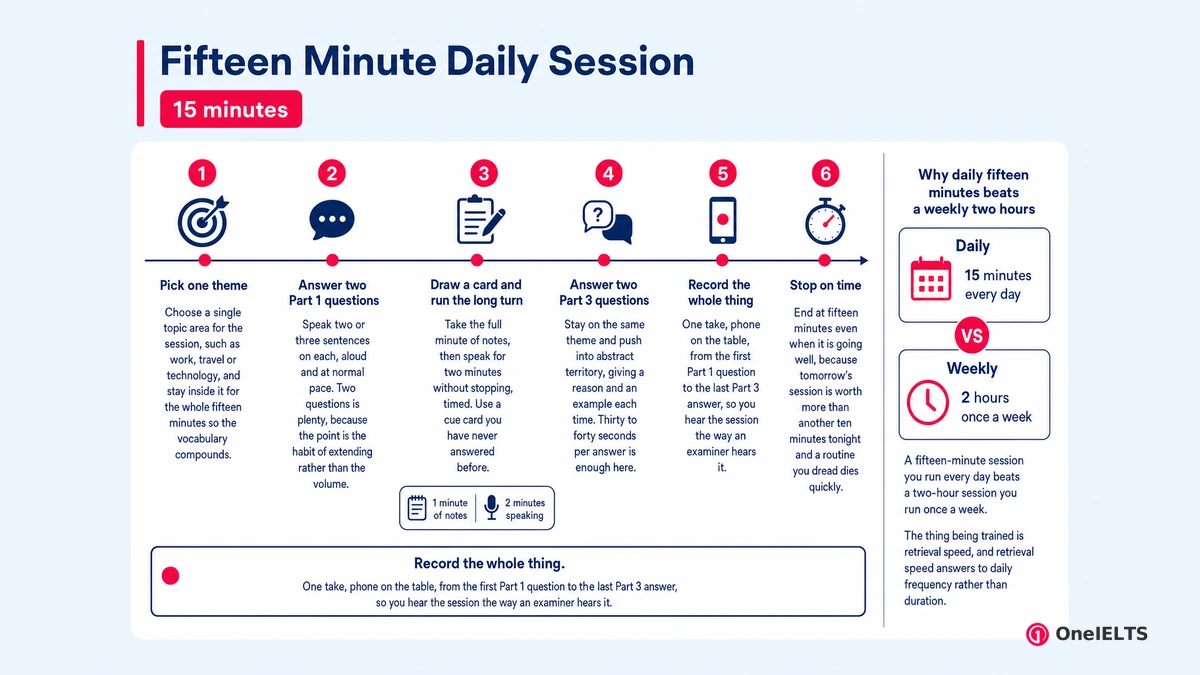
Practise fifteen to twenty minutes a day: two Part 1 answers, one full long turn against a timer, and two Part 3 questions, all spoken aloud and recorded.
The design reason for keeping it short is worth stating plainly. A fifteen-minute session you run every day beats a two-hour session you run once a week. The thing being trained is retrieval speed, and retrieval speed answers to daily frequency rather than duration.
One rule makes the practice count. Always answer an unseen question, because rehearsing a question you have already answered trains recall, and the exam does not test recall. On top of the daily work, do one full three-part run a week, unbroken, since holding quality across the whole test is a separate skill. The session runs in six moves, timed end to end.
- Pick one theme. Choose a single topic area for the session, such as work, travel or technology, and stay inside it for the whole fifteen minutes so the vocabulary compounds.
- Answer two Part 1 questions. Speak two or three sentences on each, aloud and at normal pace. Two questions is plenty, because the point is the habit of extending rather than the volume.
- Draw a card and run the long turn. Take the full minute of notes, then speak for two minutes without stopping, timed. Use a cue card you have never answered before.
- Answer two Part 3 questions. Stay on the same theme and push into abstract territory, giving a reason and an example each time. Thirty to forty seconds per answer is enough here.
- Record the whole thing. One take, phone on the table, from the first Part 1 question to the last Part 3 answer, so you hear the session the way an examiner hears it.
- Stop on time. End at fifteen minutes even when it is going well, because tomorrow’s session is worth more than another ten minutes tonight and a routine you dread dies quickly.
Can You Practise IELTS Speaking Without a Partner?
Yes, almost all of it works alone, and recording yourself replaces a partner for everything except the unpredictability of a real person asking follow-up questions.
The sources openly disagree here, so it is worth naming the disagreement. The British Council says that “this practice material is designed for two people working together, so you’ll need to find a study partner to help you”. IELTS Liz says “you can improve your speaking skills at home on your own”. IELTS Advantage goes further: “It is better to practice on your own than not practice at all.”
The resolution is not a compromise. The British Council is describing its own two-person practice materials, not the skill itself. Nothing in the four criteria requires a second person in the room while you train, so solo practice costs you nothing except unpredictability.
Replace that unpredictability deliberately. Record every session. Write a self-generated question or two from the card’s theme so you meet a Part 3 question you did not choose. Read a card’s follow-up prompts aloud before you answer, so you have not quietly pre-planned them.
A partner earns their place in the last two weeks, when someone has to interrupt your unbroken three-part run and a recorded session cannot.
How Do You Review Your IELTS Speaking Practice?
Listen to the recording twice, once for one criterion and once for a second, never for everything at once, and write down one thing to change tomorrow.
Reviewing is harder than practising, and most candidates skip it for that reason. The common mistake is listening for mistakes in general, which produces a list too long to act on and a session that feels demoralising rather than useful. Review one criterion at once and the list stays short enough to use.
Know what you are listening for under fluency. Hesitation that lands mid-sentence, where you are visibly hunting for a word, is the band 7 symptom. Hesitation between sentences while you decide what to say next is not a fault at all, and the band 9 descriptor permits it outright. The review takes two passes and one decision, in this order.
- Listen once for fluency only. Count the long pauses and the repeated repairs, where you restart a clause you have already begun. Write the two numbers down and ignore every other fault this pass.
- Listen again for one other criterion. Pick lexical resource, grammatical range or pronunciation, and listen only for that. Two passes on one recording beat six passes that blur into general disappointment.
- Note one change. A single change, written in a line, such as “stop restarting sentences with because”. More than one instruction per session is one instruction too many to remember.
- Do that change tomorrow. Run the next day’s session with the note in front of you, and check the new recording for that one thing only rather than reopening the whole list.
- Re-listen a week later. The week-later re-listen on the same cue card is the only honest measure of whether the change stuck, because your memory of how you sounded is unreliable.
The descriptor wording per criterion lives on the OneIELTS Speaking band descriptors page rather than here.
What Should You Practise at Each Band Level?
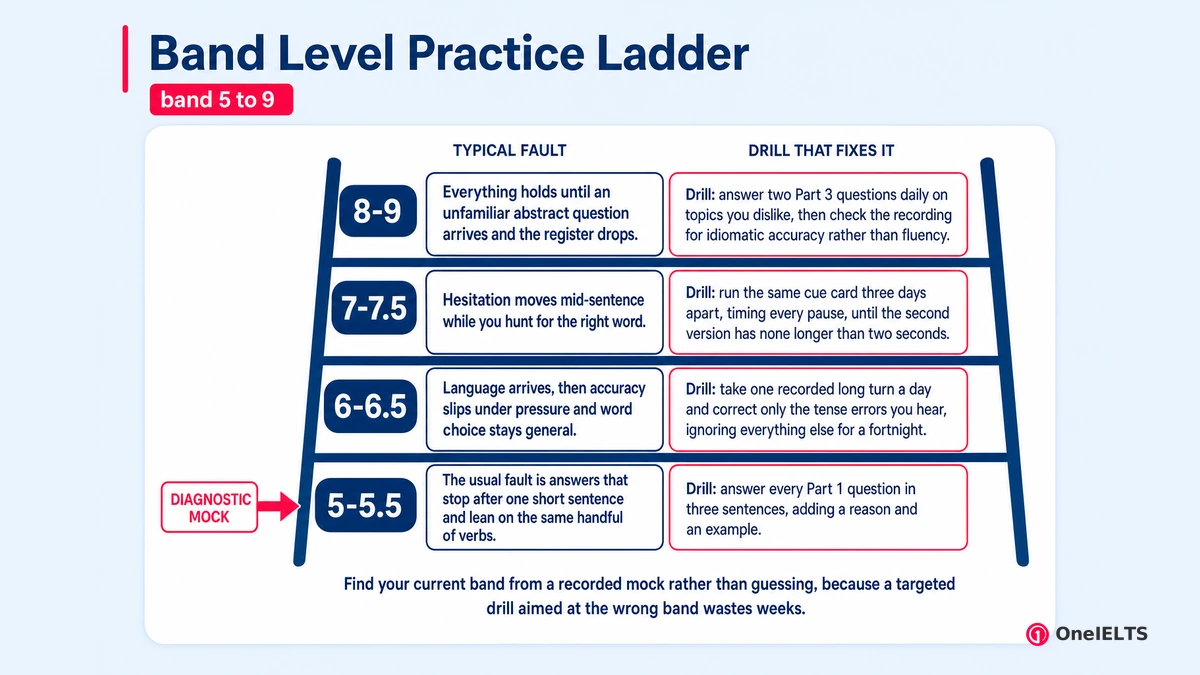
What you practise depends on where you are: at 5 to 6 the work is producing more language, at 6 to 7 it is precision, and at 7 to 8 it is making flexibility automatic.
One routine cannot serve every level. The jump from band five to six asks for volume, the jump from band six to seven asks for accuracy, and band seven to eight asks for range under pressure. IDP India is the only page on this query that organises preparation by the candidate’s current band, with a section per range and a “how to improve” block under each.
Find your current band from a recorded mock rather than guessing, because a targeted drill aimed at the wrong band wastes weeks. Four band ranges follow, each with its typical fault and the drill that fixes it.
- Band 5 to 5.5. The usual fault is answers that stop after one short sentence and lean on the same handful of verbs. Drill: answer every Part 1 question in three sentences, adding a reason and an example.
- Band 6 to 6.5. Language arrives, then accuracy slips under pressure and word choice stays general. Drill: take one recorded long turn a day and correct only the tense errors you hear, ignoring everything else for a fortnight.
- Band 7 to 7.5. Hesitation moves mid-sentence while you hunt for the right word. Drill: run the same cue card three days apart, timing every pause, until the second version has none longer than two seconds.
- Band 8 to 9. Everything holds until an unfamiliar abstract question arrives and the register drops. Drill: answer two Part 3 questions daily on topics you dislike, then check the recording for idiomatic accuracy rather than fluency.
Which IELTS Practice Resources Should You Use for Speaking?
Keep four kinds of resource and no more: official practice tasks, a question bank, a recording device you already own, and one mock test with feedback.
More resources make preparation worse, not better. Six of the eight related searches on this query ask for material rather than method: a preparation book, a tips and tricks PDF, free preparation, topics with answers. Material collecting is the most common way candidates feel prepared without becoming prepared, because a downloaded PDF produces no recording and no fault to fix.
The format signal is worth acting on. All three of the AI Overview’s citations on this query are YouTube channels, and an official mock-test video with roughly 44,700 views ranks in the live results. A full mock you can watch beats another PDF. The four kinds sit here with what each is for and how often to touch it.
- Official practice tasks. Use the test owners’ own tasks weekly, because only they guarantee the real wording and the real timings. One Part 2 card and its Part 3 questions is a full weekly dose.
- A question bank. Draw one unseen theme from it daily. The OneIELTS Speaking topics and cue cards pages hold the questions, so this page does not repeat them.
- A recording device. Your phone’s voice memo app is the whole requirement, used every single session. Nothing you buy improves on it, and a device you already own removes the last excuse.
- A mock test with feedback. Book or record one full mock every fortnight, marked by someone who knows the criteria, since a band you award yourself is a guess rather than a measurement.
The question bank splits by part, so filter it to the one you are drilling. Each filter opens with a free account.
Where Can You Take a Free Online IELTS Speaking Practice Test?
The test owners publish free Speaking practice tasks with audio and transcripts, and those are the only samples guaranteed to match the real format.
The British Council’s free Speaking practice tests are the highest-traffic result on this query, at roughly 1,767 estimated visits a month. Its material is written for two people, which the partner section above already answers. IDP publishes practice cards for Part 1, Part 2 and Part 3 as well.
Know what an official sample can and cannot do. A free practice task gives you the real task shape, the real timings and a model to compare yourself against. It cannot give you a band, because only a marked mock with an examiner does that.
Use one properly. Do the task as a cold attempt before you look at the model, record yourself, then compare. Reading a practice test without speaking it aloud is the most common way a good resource gets wasted.
Which IELTS Speaking Samples Should You Study?
Study samples that carry a transcript and an audio track, because the value is hearing where the speaker pauses and seeing what they chose to say, not what the topic was.
Study a sample in three passes. Listen once for overall impression. Then read the transcript, marking only the places where the speaker paused and why. Then re-record your own answer to the same question and compare the pause pattern rather than the content.
Pick the right band to study. Candidates default to band 9 and it is usually the wrong choice, because a performance two bands above yours is discouraging and teaches nothing you can copy this week. A sample one band above yours is imitable, which is the whole point.
The trap is memorising. Examiners score how you answer rather than what you answer, so a studied sample should change your delivery and never your content. A memorised sample is penalised hard under fluency. The band-by-band comparison lives on the OneIELTS Speaking band descriptors page, and the per-part model answers sit on the part pages.
What Are the Key Skills Assessed in IELTS Speaking?
IELTS marks four criteria, not five: fluency and coherence, lexical resource, grammatical range and accuracy, and pronunciation. The official British Council Speaking band descriptors PDF names exactly those four.
The count is worth pinning down, because a test owner’s own page gets it wrong. IDP India’s Speaking preparation page lists five key skills by adding “Interactive Communication”, which is a Cambridge English criterion that IELTS does not mark. The Marking section of the Speaking format page on ielts.org names the same four.
Each criterion behaves like a different drill. Fluency and coherence is trained by frequency, so it moves with daily sessions. Lexical resource is trained by themed batches used aloud, not by word lists read silently. Grammatical range is trained by answering question types that force different structures, such as past-tense narration and hypothetical Part 3 questions. Pronunciation is trained by imitation, one recorded sentence at a time.
One fact decides where the hours go. The four criteria are averaged, so your highest-value hour is always spent on your lowest one.
How Can You Get 7.5 in IELTS Speaking?
A 7.5 is the rounded average of your four criterion bands, so reaching it almost always means lifting the single lowest criterion. At that level the lowest criterion is usually pronunciation or grammatical range rather than vocabulary.
Three things follow from the routine above. Its job is raising the floor rather than the ceiling, so the routine raises your worst day instead of your best one, and consistency beats intensity. Because the bands are averaged, a diagnostic mock is worth more than another week of undirected practice. And the band 7 fluency descriptor names a retrieval problem, which is why the unit of preparation is weeks not days.
This page owns the routine, not the arithmetic. The four questions below hand the band wording and the numbers over to the pages that own them.
How Can You Get 8.5 in IELTS Speaking?
An 8.5 usually means three nines and an eight, so at this level the work is one criterion deep rather than broad. That last criterion is most often pronunciation, because it is under continuous measurement from your first word to your last and it is the slowest to move. Months of imitation work shift it; a fortnight rarely does. The IELTS Speaking band descriptors page sets out what a nine requires.
How Is the IELTS Speaking Score Calculated?
The examiner awards a band on each of the four criteria, and your Speaking score is the average of those per-criterion bands, rounded to the nearest half band. Any rounding rule finer than that belongs to the band page. In practice, two strong criteria cannot carry a weak criterion far, which is why a diagnostic recording beats an extra week of guessing. The IELTS Speaking band descriptors page holds the per-band wording.
How Long Is the IELTS Speaking Test?
The test runs eleven to fourteen minutes in total: four to five minutes for Part 1, three to four for Part 2 including the preparation minute, and four to five for Part 3. That per-part timing is why a weekly full run costs only a quarter of an hour, and why sustained quality across it is its own skill. The IELTS Speaking test format page has the detail.
Which Part of IELTS Speaking Should You Practise Most?
Practise Part 2, because the long turn is the only part you can rehearse as a whole, the only one with a clock, and the only one that needs no second person. A timed monologue is built for solo rehearsal.
One exception is worth knowing: if your recordings show you running out of ideas rather than out of language, make Part 3 the target, because that is a thinking problem rather than a fluency one. Our IELTS Speaking Part 2 page has the cue-card mechanics, and IELTS Speaking practice needs a free OneIELTS account.
Written by Rifah Binte Faruk, reviewed 14 August 2026.
Last verified: 14 August 2026
Practice for the Real IELTS Exam
Apply what you’ve learned with free, exam-style practice:
- Take a free IELTS mock test — all four skills, real exam timing, AI band scoring
- Sit a Speaking section mock — timed Parts 1–3 with voice recording and band feedback
- Practise all three parts — sample questions with feedback