Yes, you can invent an answer in IELTS Speaking, and it costs you nothing. You are marked on language, and the examiner never checks your facts. One moment is different. At the ID check you must not, and that single limit is missing from the answer Google puts at the top of this search.
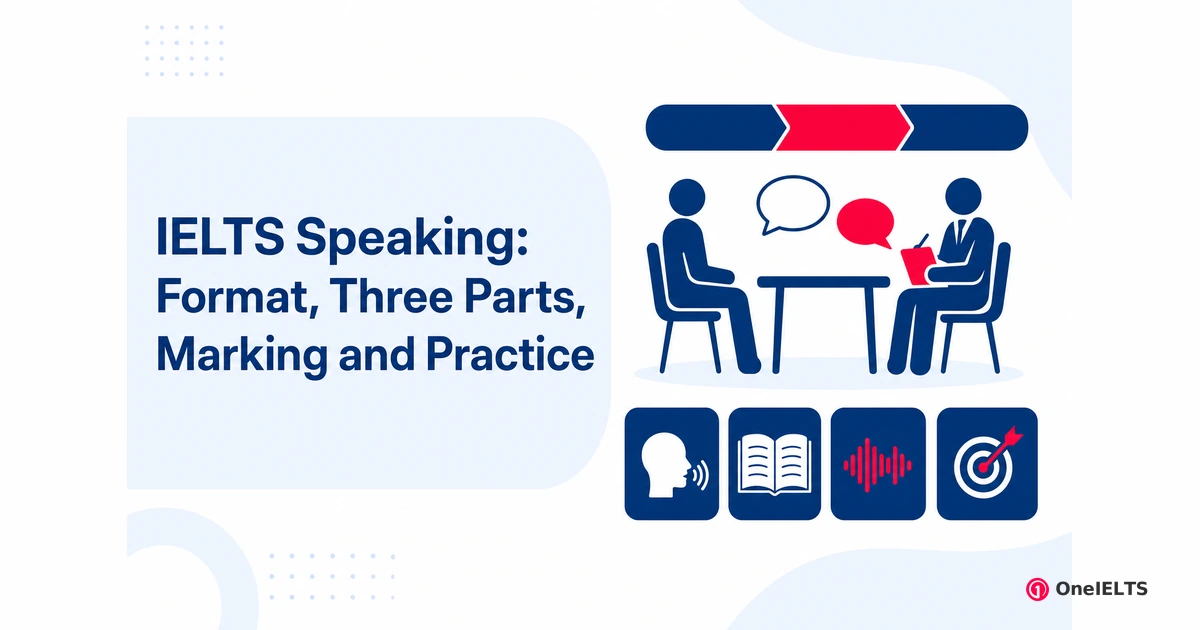
This page covers why an invented answer is free, the practical risks, and the ID check itself. It then works through informal register and “wanna”, bad language, going silent for two minutes, and faking a native accent. The last sections handle disagreeing with the examiner, going off-topic, memorised answers, and the principle underneath all of them. Where no published rule exists, this page says so rather than filling the gap.
Can You Lie in the IELTS Speaking Test?
Yes. An invented answer does not affect your score, because the examiner marks your English and never tests whether your story is true. You are marked on language, and no fact-checking step exists anywhere in the Speaking test. Two sources put this in blunt words, and both are worth quoting.
IELTS Liz runs the niche’s dedicated authority page on this question, live since 2020. It states: “Yes, you can lie. It won’t affect your score. But it isn’t necessary. It’s better to tell the truth”.
IDP IELTS goes further and calls it “a license to lie, within reason of course!”. Its example is a candidate placing the Great Wall in Japan. The examiner, it says, “doesn’t verify the information before they assign the score”. There is one exception, and it sits outside the marking altogether. It arrives at the ID check, which has its own section below.
Why Can You Fabricate Answers Without Losing Marks?
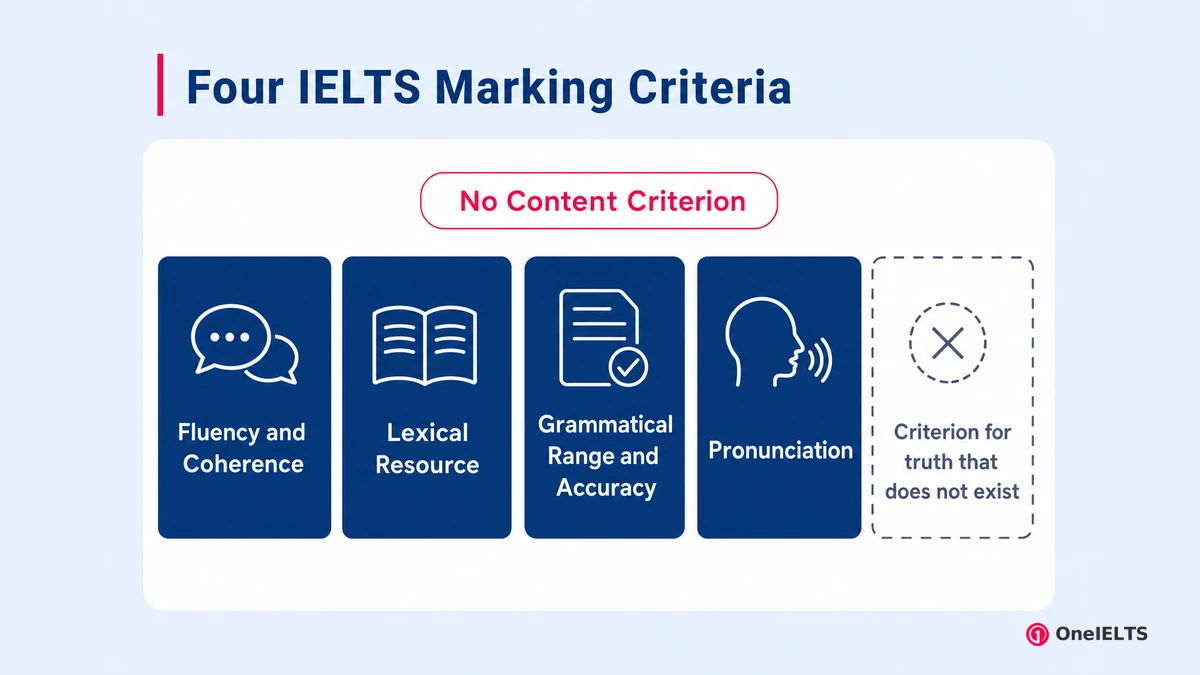
Because none of the four marking criteria measure content. Fluency and Coherence, Lexical Resource, Grammatical Range and Accuracy and Pronunciation all measure language. No fifth criterion exists for truth, interest or knowledge.
IDP IELTS words it the same way: “You are assessed on linguistic ability rather than content”. The blunter version on the same page reads, “The IELTS exam is not a test of content”. Three mechanisms produce that freedom, and each is about marking rather than permission.
- The criteria are linguistic, so content has no score to win or lose.
- Nobody checks your claims, so no verification step exists that could catch a false detail.
- A chosen scenario can sit inside vocabulary you already control.
This explains why invented content is free. It does not make the test informal, and it does not reach the identity check.
What Are the Risks of Lying in IELTS Speaking?
The risks are practical, not disciplinary. Nothing in the marking punishes an invented answer, but a made-up story is harder to keep going, and Fluency and Coherence is where that shows.
IELTS Liz lists three of them directly. Lying “requires imagination”, “it’s hard to add extra details when you lie”, and “under exam pressure, it is hard to lie and create an answer at the same time”. Four costs follow, and every one is a delivery problem rather than a rule.
- A sustained story is hard to hold together for two minutes under pressure.
- Adding the extra detail an examiner asks for is harder with no memory to draw on.
- A Part 3 contradiction surfaces when the topic returns as an abstract question.
- Inventing carries an attention cost you owe to the language itself.
None of this is a penalty for lying. It is an accidental fluency cost, paid by candidates who never meant to pay it.
Can You Lie at the ID Check?
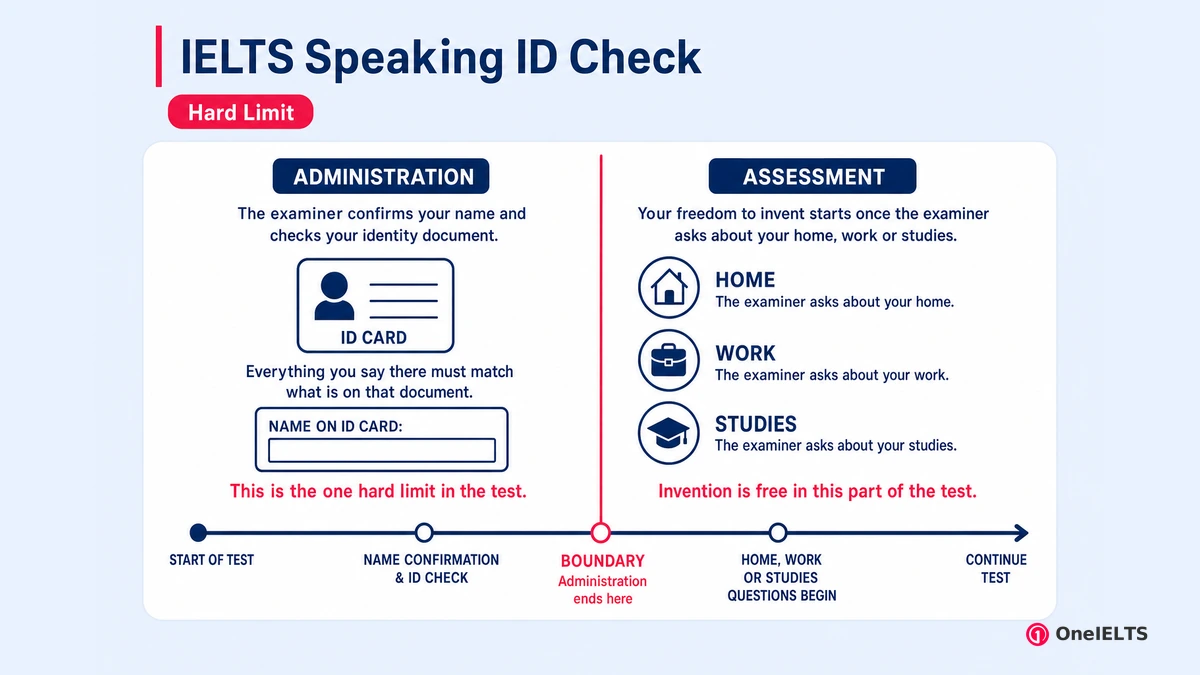
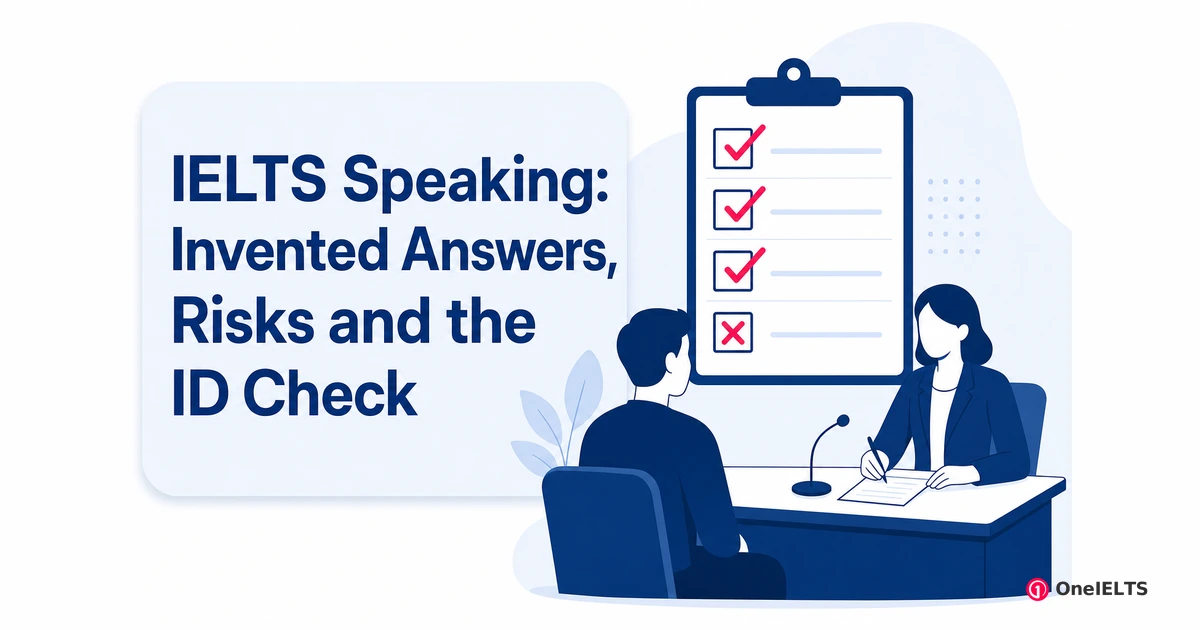
No. At the start of the test the examiner confirms your name and checks your identity document, and everything you say there must match what is on that document. This is the one hard limit in the test.
Exactly one source in a twelve-page harvest names it. IELTS Liz writes: “Do NOT lie at this point. The information you provide must match the information given on your ID card”.
The boundary itself takes two sentences. That opening exchange is administration not assessment, so the name confirmation and the matching information on your document are records rather than answers. Your freedom to invent starts once the examiner asks about your home, work or studies. This section exists because the answer at the top of this search never mentions the identity check.
Can You Say “Wanna” in IELTS Speaking?
Contractions and everyday spoken forms are normal here, because the Speaking test is a conversation, not an essay. Each of “wanna” and “gonna” is a spoken reduction rather than a word, and the safe line is natural spoken English, neither written formality nor slang.
The evidence limit matters. Of twelve pages harvested here, only two address informal register, and neither mentions a contraction, “wanna” or “gonna”. No published rule covers it, so what follows reasons from what is published.
Lexical Resource measures appropriacy, so the question is whether a word fits the situation. IDP IELTS sets the conversational register: “Use the way you speak (tone) over dinner with colleagues in your IELTS Speaking test. Not too formal, but also not too casual”. A reduction like “wanna” sits at the casual end of that band, so it is not wrong and buys you nothing.
Use full contractions freely, I’m, don’t, it’s, I’d, and let “wanna” pass if it does. The register error that guidance warns about is the opposite: it names “furthermore”, “moreover” and “firstly/secondly” as too formal for speech.
Can You Curse in IELTS Speaking?
There is no published rule that penalises it, and no reason to do it either. So the honest answer is that swearing is not scored, and that is not the same as swearing being a good idea.
Here is the gap, stated plainly. No page ranking on this question, and no test-owner page in this harvest, states a rule about bad language. Two published facts still settle it.
The four criteria measure language, so manners not marked is the starting point. No criterion exists under which a swear word counts as wrong. Lexical Resource does measure appropriacy, which makes any word a lexical choice you have made, and a formal interview setting is not the place for one.
It will not be marked as an error, and it gains nothing. If a topic calls for reporting what someone said, report it without repeating it. That is the stated limit here: no rule found, no penalty claimed.
What Happens If You Don’t Speak for 2 Minutes?
The question has two readings and two answers. Stopping early in Part 2 costs you the chance to show language, while running past two minutes only means the examiner stops you. Each half rests on a different test-owner statement.
Silence costs you more than a weak answer. IDP IELTS is direct: “The worst thing you can do is not say anything at all. If you don’t speak there is nothing that the examiner can use to assign a score”.
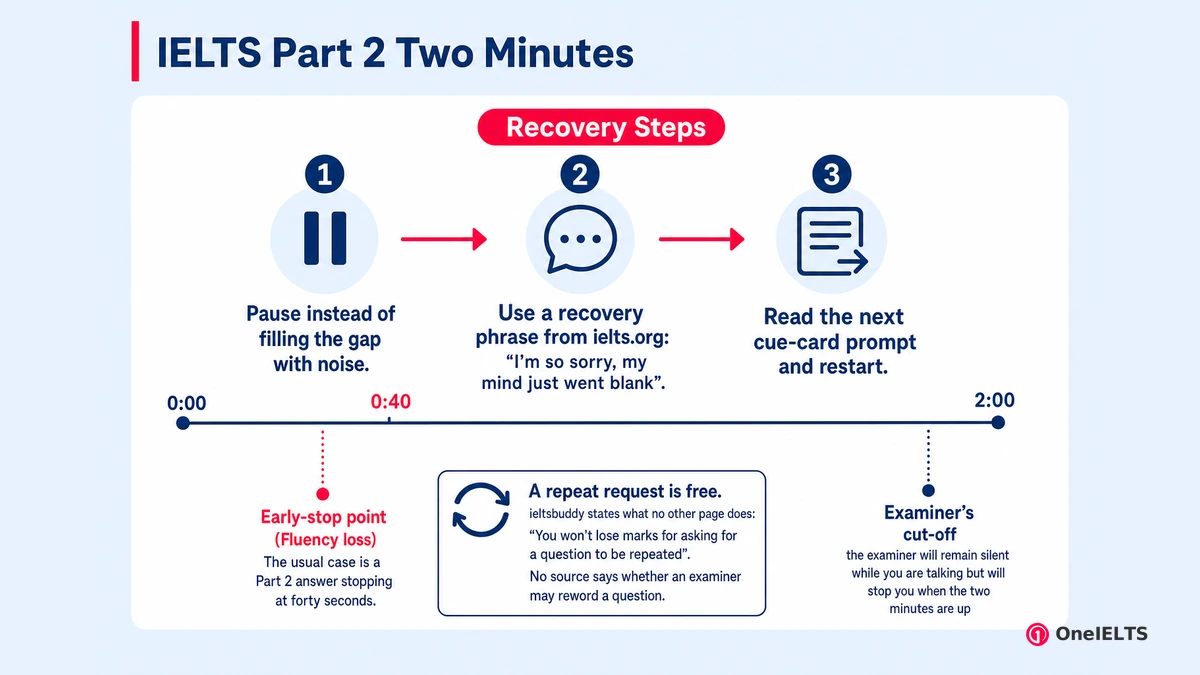
The same page gives the detail. An answer that drifts off topic still scores in three of four criteria, and only Fluency and Coherence drops. Total silence is rare; the usual case is a Part 2 answer stopping at forty seconds.
Running long is harmless. IDP IELTS again: “the examiner will remain silent while you are talking but will stop you when the two minutes are up”. The two-minute cut-off is the timing working as designed, not a penalty. Three moves get you speaking again when you go blank.
- Pause instead of filling the gap with noise.
- Use a recovery phrase from ielts.org: “I’m so sorry, my mind just went blank”.
- Read the next cue-card prompt and restart.
A repeat request is free. ieltsbuddy states what no other page does: “You won’t lose marks for asking for a question to be repeated”. No source says whether an examiner may reword a question.
Can You Fake a Native Accent or Use Slang?
There is no need, and the attempt works against you. Your own accent is not penalised, so faking one adds effort and risk for nothing. Two test-owner sentences settle it.
The ielts.org guidance says “Having a natural accent or slang will not have any effect on your test score”. IDP IELTS adds that “an IELTS examiner won’t penalise you for Speaking with an accent, as long as you pronounce you words clearly and correctly”.
Pronunciation measures intelligibility and the features that carry meaning, which is why “clearly and correctly” is the operative phrase there. A borrowed accent runs as a second task alongside the speaking task, and it usually surfaces as hesitation. That hesitation cost lands in Fluency and Coherence, not in Pronunciation.
Can You Disagree with the Examiner’s Opinion?
Yes, and disagreeing is often the better answer. A Part 3 discussion invites a view, and the examiner’s stated opinion is often not even theirs. The ielts.org guidance is unusually direct here.
It says “don’t worry too much about the examiner’s opinion of you. All you need to focus on is yourself and your delivery”. The reason follows: “The only thing examiners are after is to assess your use of language and how well you demonstrate your speaking ability”. Opinion not tested, language tested.
The same page gives the technique: “If you happen to disagree with any of their statements, think of a way to acknowledge it in a respectful manner”. Treat it as language, not politeness. Acknowledge then counter is a complex structure, and Grammatical Range and Accuracy measures exactly that.
Interruption is normal too. One ielts.org page tells you to “expect to be interrupted by the examiner from time to time”; another calls it “perfectly normal”. The trap it names is over-agreeing to sound agreeable.
Can You Go Off-Topic in IELTS Speaking?
Partly, and this is the one question in the cluster where the published sources genuinely disagree. Two pages on the same test-owner domain say opposite things. One states “You are not penalised for speaking off-topic”, while the other lists “Going off-topic” as a mistake to avoid.
Both are right, and the mechanism shows why. An off-topic answer still earns marks in three of four criteria, meaning vocabulary, grammar and pronunciation. It loses ground in Fluency and Coherence, because coherence measures whether your answer answers.
So there is no penalty label for going off-topic, and there is a real coherence cost. Two statements, two criteria, no contradiction left standing.
The practical rule comes from the source itself, which calls an off-topic answer “not an invitation to speak about anything”. Aim at staying close to the question. If that proves impossible, give the little you have, then make a natural transition to something related.
Is Trying to Memorise Answers Allowed?
Nothing forbids it, and it is the one habit here that reliably lowers a band, because a delivered script stops sounding like speech.
The distinction saves you. Memorising language, meaning a structure, an opening move, a set of collocations, is preparation. Memorising answers produces a memorised script, and a script is what the examiner hears.
The test owners agree on where this ranks. “Trying to memorise answers” is the first mistake listed on IDP IELTS’s seven-mistakes page, and “Avoid sounding rehearsed” is a numbered tip on another of its pages.
A rehearsed delivery runs at a different rate from spontaneous speech, and it does not move when the examiner narrows the question. Question adaptation is exactly what a script cannot do, and both faults land in Fluency and Coherence. What to practise instead belongs to the preparation routine at the end of this page.
How Do You Ace the IELTS Speaking Test Without Overdoing It?
Every section above follows from one principle. The marking measures your English, so you are marked on language, and almost everything you worry about being allowed is allowed. The two things that reliably cost you are silence and performance. The ielts.org guidance frames the whole topic as not overdoing it, and that frame is the right one. A candidate who invents one small detail and keeps talking finishes ahead of one who tells the truth and stops.
Can You Lie in IELTS Speaking, According to Reddit?
The short answer is that forum consensus matches the published position, with one caution added. Threads warn that an invented answer leaving you sounding as if you are not understanding your own topic is the version that hurts. This border exists because Google’s AI Overview sources its answer partly from a forum, in its words “Most users on Quora agree”. Our IELTS Speaking tips page collects test-taker experience.
How Do You Prepare for IELTS Speaking?
The difference is simple: knowing what is allowed removes the worry, and a routine is what actually moves the band. A routine means a short daily session, recorded practice, and a review against a single criterion at a time. Our IELTS Speaking preparation page owns the schedule.
Written by Rifah Binte Faruk, reviewed 14 August 2026.
Last verified: 14 August 2026
Practice for the Real IELTS Exam
Apply what you’ve learned with free, exam-style practice:
- Take a free IELTS mock test — all four skills, real exam timing, AI band scoring
- Sit a Speaking section mock — timed Parts 1–3 with voice recording and band feedback
- Practise all three parts — sample questions with feedback