IELTS has no pass or fail, so a good IELTS score is simply one that clears your target’s cut-off rather than any global average. Read by goal, a 6.0 can pass a bachelor’s program yet fall short of a 7.0 immigration stream, which is why the score by goal matters more than the average.
Most candidates land a good IELTS score in the 6.5 to 7.5 range. This guide explains what counts as good, what is good in each IELTS section, the good ranges for study, work and migration, and the tips that get you there.
What Counts as a Good IELTS Score?
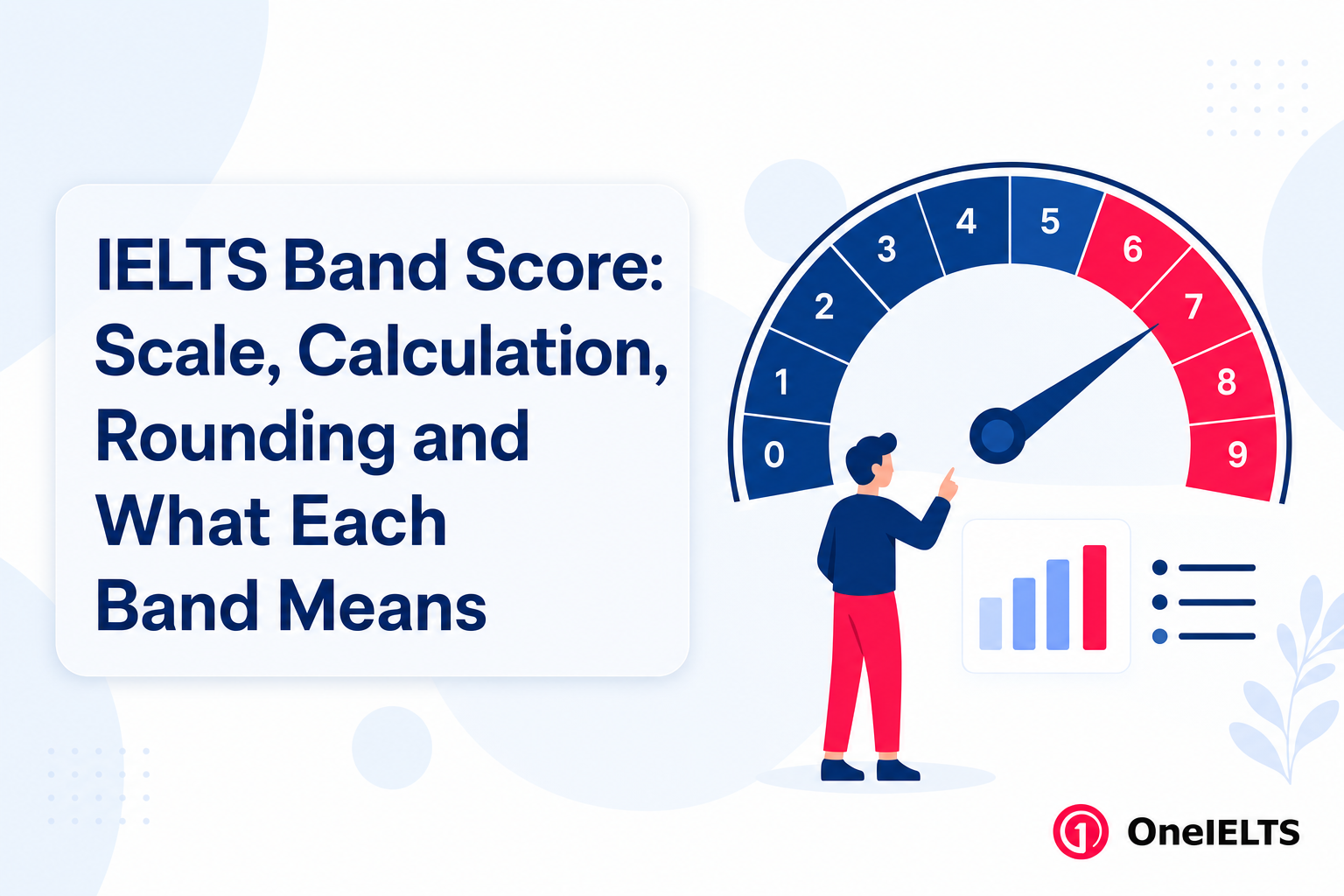
A good IELTS score generally falls between 6.5 and 7.5, a band the British Council scale labels competent to good command of English. IELTS has no pass or fail, so the same competent to good result that fits one route can miss another. What counts as good therefore depends on goal, not on a fixed mark.
What Is a Good Score in Each IELTS Section?
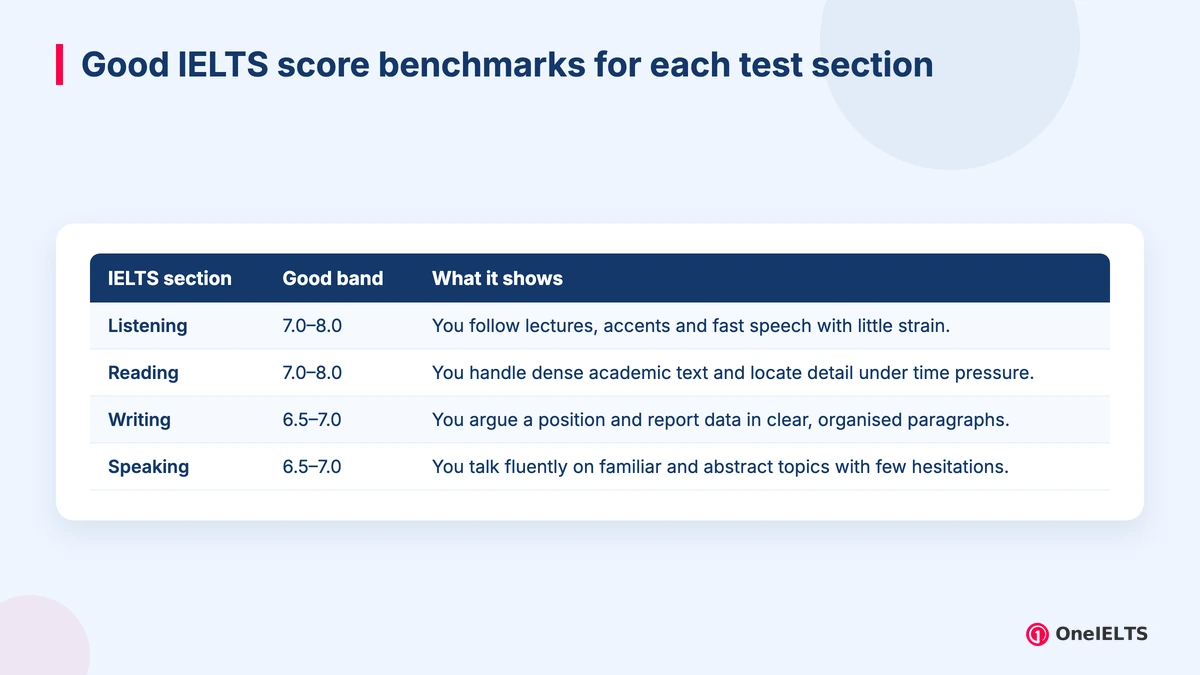
A good per-section score is the band per skill that signals you can cope with each skill at your target level, and the four rarely sit level. The table sets each per-section good score against what it shows, and note that Writing often lowest and Speaking usually lag behind Listening and Reading.
| IELTS section | Good band | What it shows |
|---|---|---|
| Listening | 7.0-8.0 | You follow lectures, accents and fast speech with little strain. |
| Reading | 7.0-8.0 | You handle dense academic text and locate detail under time pressure. |
| Writing | 6.5-7.0 | You argue a position and report data in clear, organised paragraphs. |
| Speaking | 6.5-7.0 | You talk fluently on familiar and abstract topics with few hesitations. |
How Much IELTS Do You Need to Study Abroad?
Universities set their own thresholds, so the study range runs roughly 6.0 to 7.5 and varies by country and course level. Undergraduate 6.0 to 6.5 is the common entry band, while postgraduate 7.0 plus is standard for taught master’s and research degrees. The per-university cut-off is what binds you: Canadian universities such as Toronto ask 6.5, Australian ones like Melbourne sit at 6.5-7.0, US universities including NYU expect 7.0, and UK institutions such as Manchester require 6.5 overall.
Which IELTS Score Do Employers and Work Visas Require?
Work requirements vary by country and role, and the work visa score rises with how much English the job uses. English-mediated professions, from nursing to teaching, often expect roughly 6.5 to 7.0 overall, which maps to a B2 to C1 level of command. The exact band is role-specific. Canada’s skilled trades accept CLB 5, Australia rewards 7.0 and above with points, US employers rarely fix a band, and UK skilled-worker routes need 4.0 in each skill plus more for the job.
Which IELTS Score Do Immigration Programs Require?
Migration scores vary by country and program, and the immigration score is often read as points rather than a single overall figure. The clearest case is the CLB conversion Canada uses: IELTS 6.0 in each skill equals CLB 7, the floor for Express Entry. Higher per-skill bands lift your points by band, so 7.5 in Listening and 6.5 elsewhere scores more. Australia rewards 7.0 (Proficient) and 8.0 (Superior) on skilled migration, and the UK ties settlement to IELTS Life Skills B1.
What Tips Help You Reach a Good IELTS Score in 2026?
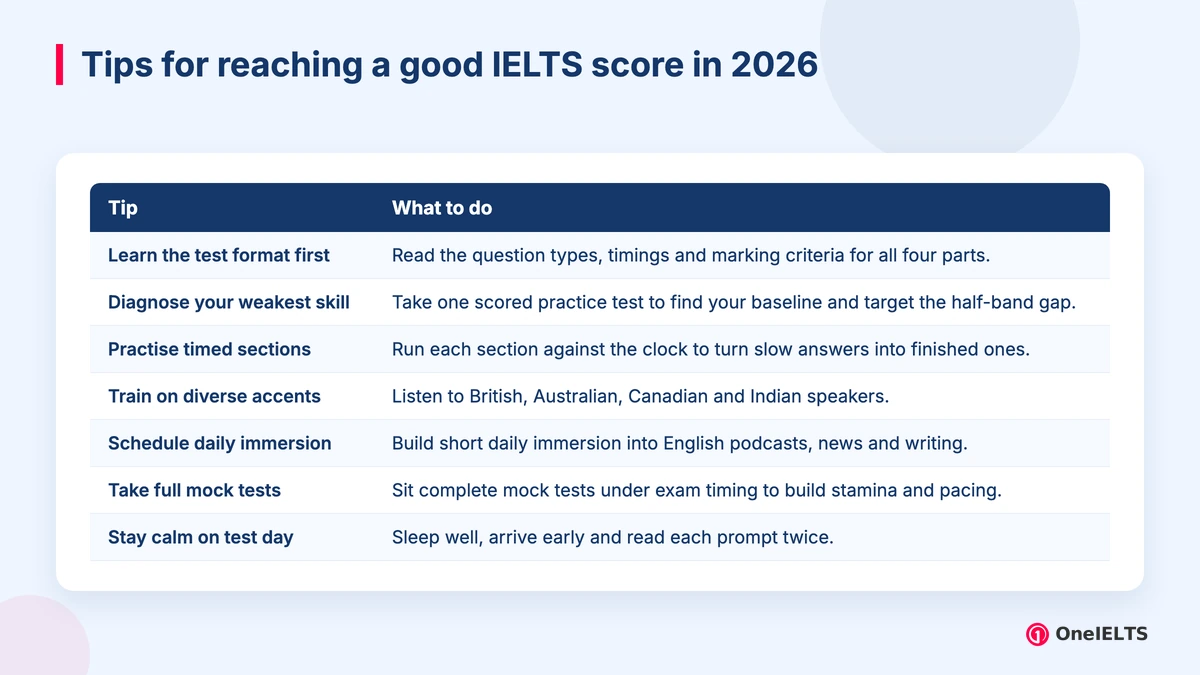
Reaching a good score is a matter of learning the test, fixing your weakest skill and rehearsing under real conditions rather than studying English in the abstract. Seven habits that move candidates from a plateau to their target band are set out here.
- Learn the test format first. Read the question types, timings and marking criteria for all four parts so no task surprises you on exam day.
- Diagnose your weakest skill. Take one scored practice test to find your baseline and aim your study time where the half-band gap actually sits.
- Practise timed sections. Run each section against the clock, since timed practice is what turns accurate-but-slow answers into ones you finish.
- Train on diverse accents. Listen to British, Australian, Canadian and Indian speakers so the Listening recordings never throw your ear off mid-question.
- Schedule daily immersion. Build short daily immersion into English podcasts, news and writing so the language feels routine well before test day.
- Take full mock tests. Sit complete mock tests under exam timing to build stamina and learn how a three-hour paper paces across all four skills.
- Stay calm on test day. Sleep well, arrive early and read each prompt twice, because nerves cost more marks than gaps in your English ever will.
Is Preparation Necessary for a Good IELTS Score?
Yes – even strong English users need format practice and timing drills to score well, because fluency and exam technique are different skills. Format familiarity lifts scores by removing the surprises that waste minutes, and targeted practice on the exact question types trains you to answer them the way examiners reward. Build a routine around our IELTS preparation guidance to turn timing drills into marks.
Is a 7.5 a Good IELTS Band Score?
Yes – a 7.5 is a Very Good User score that clears almost every requirement, from top universities to skilled-migration streams. On the British Council band scale it equals CEFR C1, the level that signals full working command of English. Few routes ask for more, so a 7.5 clears requirements that a 6.5 would miss; see what the band means in our IELTS 7.5 score breakdown.
What Is the Minimum IELTS Score?
There is no fixed minimum – each institution or visa sets its own threshold, so no universal minimum exists. The threshold varies with the route, and common floors cluster around a 5.5 to 6.0 floor for many foundation and undergraduate programs, with stricter streams setting higher. Check how the nine bands map to these floors in our IELTS band score reference.
How Long Is a Good IELTS Score Valid?
A score is normally valid for two years from the test date, the standard recognition window the test owners apply from test date. A shorter window is possible too, since some bodies and professional registers ask for a more recent sitting; treat a shorter window possible as the default for regulated routes. Confirm the exact rule for your route through our IELTS score validity guide.
Last verified: 30 June 2026
Practice for the Real IELTS Exam
Apply what you’ve learned with free, exam-style practice:
- Take a full IELTS mock test
- Practice by section: Listening, Reading, Writing, Speaking
- Structure your essays with IELTS Writing templates