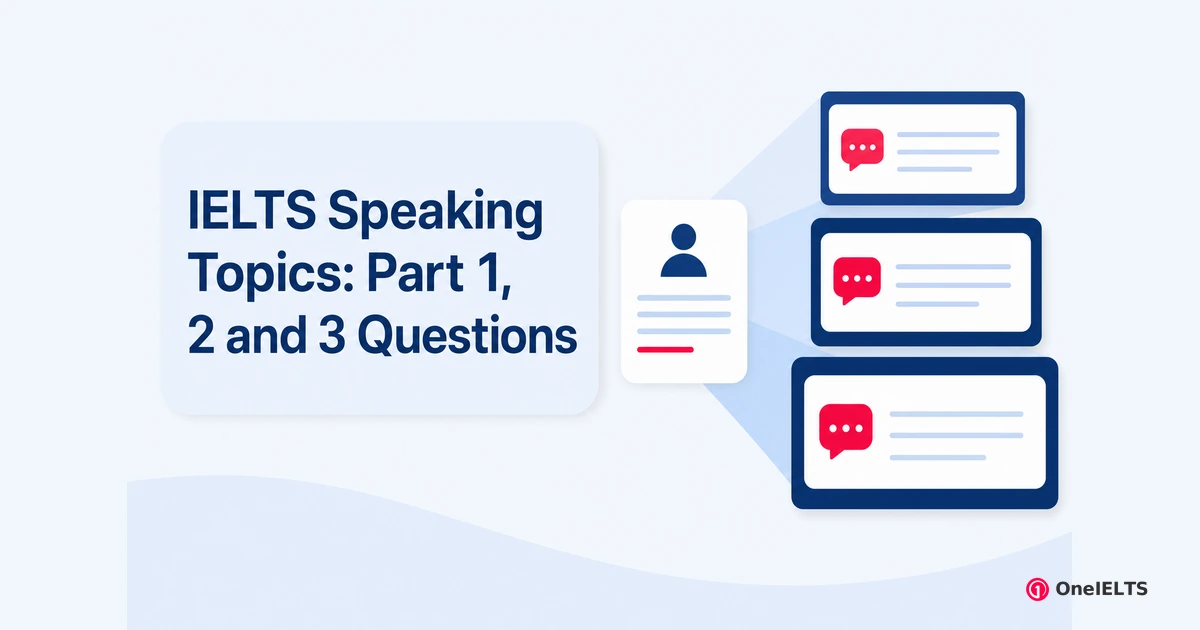
IELTS Speaking questions follow one shape: the same subject at three depths. Part 1 asks “Do you like music?”, Part 2 hands you a cue card reading “Describe a concert you attended”, and Part 3 asks why musical taste changes. This page counts the questions, covers the unmarked introduction, and lists the Part 1 topics with the wording examiners use.
It then sorts those questions into types and gives an answer pattern instead of scripts, because a memorised answer is audible. Part 2 and Part 3 questions, how answers are assessed, where model answers live, and how to prepare all follow.
What Are the IELTS Speaking Questions?
IELTS Speaking questions are the examiner’s spoken prompts across the three parts of the test: short familiar questions about you in Part 1, one printed card topic in Part 2, and abstract follow-ups in Part 3. They come from a question bank the test owners control, and that bank is never published in advance. Every list online, this one included, is compiled from what candidates report after sitting the test.
The exact wording moves around from year to year. The topic families repeat anyway: work, hometown, food, music, travel. Part 1 and Part 2 use scripted questions the examiner reads aloud. Part 3 does not, because those questions follow what you have just said. Academic and General Training candidates answer identical questions, since Speaking is one test for both.
The framing the rest of this page depends on is simple. The three parts are not three subjects. They are one subject at three depths.
How Many Questions Does the Examiner Ask in IELTS Speaking?
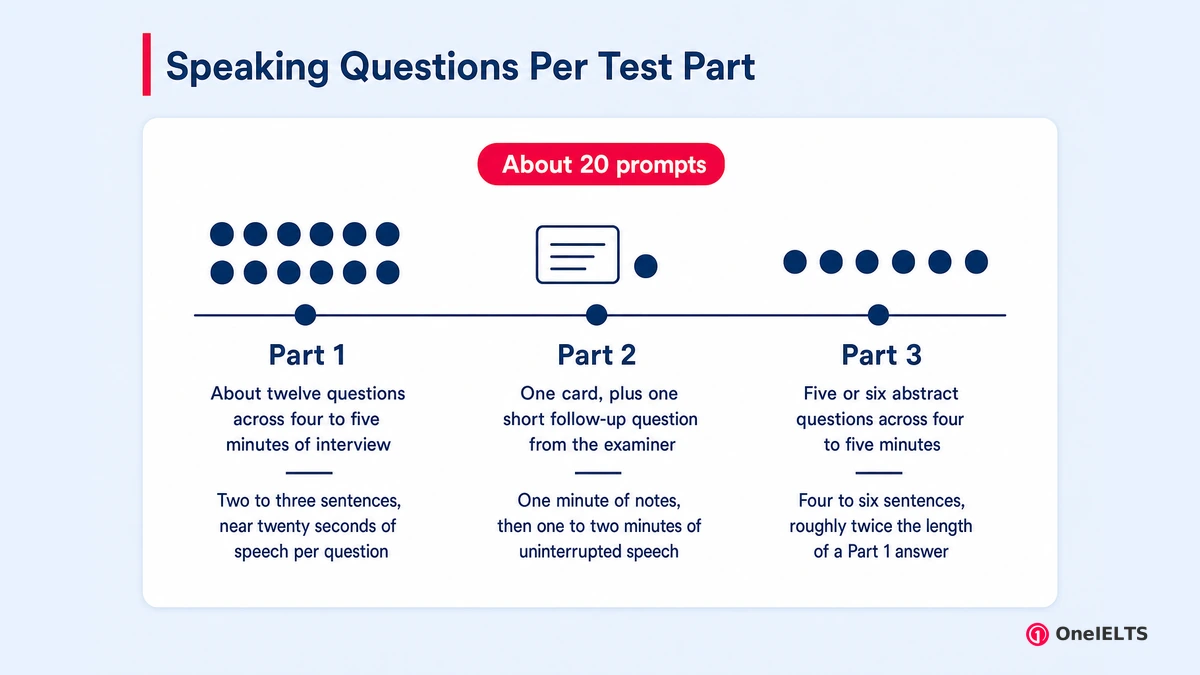
Roughly twelve questions come in Part 1, exactly one card in Part 2 plus one short follow-up question, and and a handful of abstract questions in Part 3. The test owners publish time ranges rather than question counts, so treat any total as typical rather than fixed. Treat those counts as typical rather than fixed, because the test owners publish time ranges instead of question numbers.
Each part carries a different load, and the count, the grouping and the answer length sit side by side here.
| Part | Number of questions | How they are grouped | How long each answer should be |
|---|---|---|---|
| Part 1 | About twelve questions across four to five minutes of interview | Three topic sets of roughly four questions each, opening with work or study | Two to three sentences, near twenty seconds of speech per question |
| Part 2 | One card, plus one short follow-up question from the examiner | One card topic carrying three or four printed prompts and a closing instruction | One minute of notes, then one to two minutes of uninterrupted speech |
| Part 3 | Five or six abstract questions across four to five minutes | Discussion built from the theme of your Part 2 card, not from your life | Four to six sentences, roughly twice the length of a Part 1 answer |
The count works as a budget. Candidates who plan long Part 1 answers run the examiner out of questions before the four minutes close. Candidates who reply in one word collect more questions and less credit, because a bare reply hands the examiner nothing to score.
What Happens in the Introduction of the IELTS Speaking Test?
The examiner greets you, runs an identity check against your passport, and asks your full name and where you come from. That opening is not marked. This introduction exchange happens before Part 1 begins and sits outside every band criterion.
It still matters. This is the first English the examiner hears from you, and a steady answer settles the opening minute. The standard warm-up questions ask your name, whether you can confirm your identification, and where you are from. Candidates who have rehearsed a long self-introduction should drop it, because the examiner moves straight into Part 1 without asking for one.
One misconception deserves killing here. “Tell me about yourself” is not an IELTS Speaking question. It is a job-interview question that circulates in preparation material and wastes the time you rehearse it in. The recording starts at this greeting, so the microphone is live before the marked part of the test does.
What Are the IELTS Speaking Part 1 Topics?
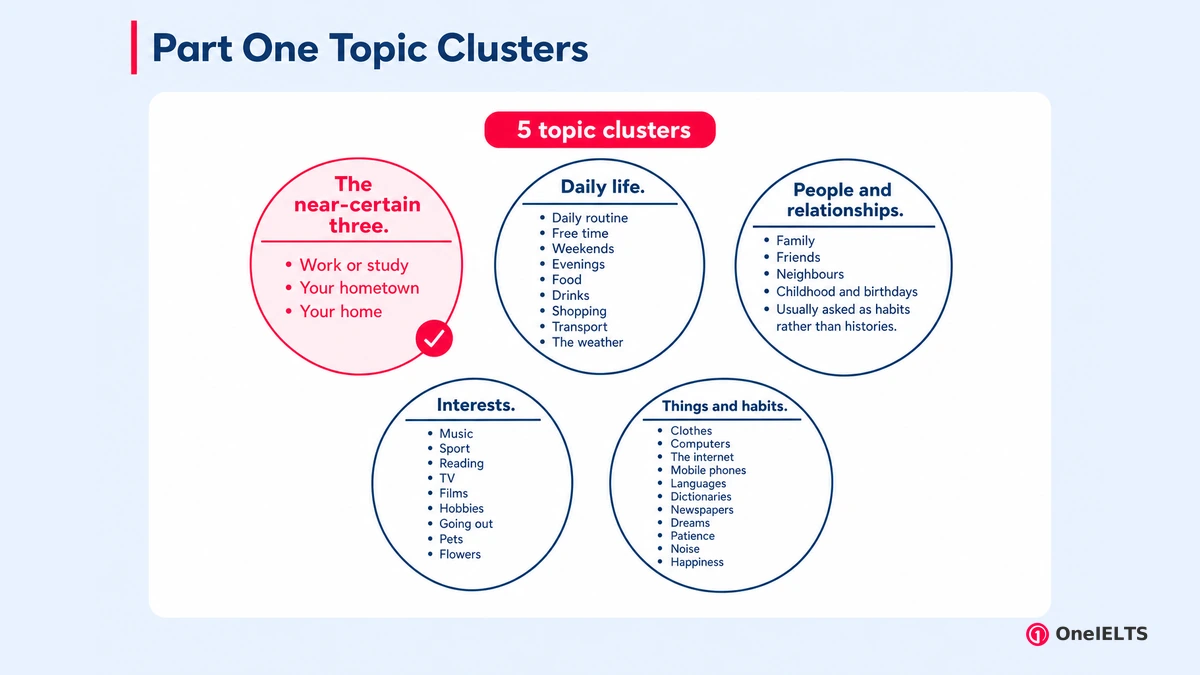
About thirty recurring topics make up the Part 1 topics, and three of them (work or study, your hometown, and your home) appear in almost every test. Part 1 always opens with work or study, then moves through two more topic sets pulled from the rest of the bank.
Grouped the way you would actually revise them rather than alphabetically, the recurring topics fall into five clusters.
- The near-certain three. Work or study, your hometown, and your home, which open almost every Part 1 interview.
- Daily life. Daily routine, free time, weekends, evenings, food, drinks, shopping, transport, and the weather.
- People and relationships. Family, friends, neighbours, childhood and birthdays, usually asked as habits rather than histories.
- Interests. Music, sport, reading, TV, films, hobbies, going out, pets, and flowers.
- Things and habits. Clothes, computers, the internet, mobile phones, languages, dictionaries, newspapers, dreams, patience, noise, and happiness.
The topic is fixed and the wording is not. Preparing content per topic works. Preparing sentences does not.
What Are the Most Common IELTS Speaking Part 1 Questions?
The openers barely change: do you work or study, where is your hometown, what do you like about it, what do you do in your free time. The eleven topics here account for most of what candidates report, and the examiner wording in the middle column follows the phrasing they report hearing.
Set against each topic are the common questions and the material your answer needs to carry.
| Topic | The questions as the examiner asks them | What the answer should contain |
|---|---|---|
| Work or study | Do you work or study? What is your job? Do you like your job? | The role, one reason you like or dislike it, and one concrete daily detail |
| Hometown | Where is your hometown? What do you like about it? How has it changed? | The place name, one feature you value, and one change you have noticed |
| Home | Do you live in a house or a flat? What is your favourite room? | The type of home, the room you choose, and why you spend time there |
| Free time | What do you do in your free time? What do you do at weekends? | One activity, how often you do it, and who you usually do it with |
| Daily routine | What time do you get up? Is your routine the same every day? | The time, the weekday pattern, and one exception that breaks it |
| Food | What food do you like? Do you cook? Who cooks in your family? | A named dish, how often you eat it, and who prepares it |
| Music | Do you like music? What music did you like as a child? | A genre, one change since childhood, and where you listen now |
| Weather | What is the weather like there? Which season do you prefer? | The typical climate, your preferred season, and one reason for it |
| Transport | How do you travel to work? Do you prefer buses or trains? | The mode, the journey time, and one reason for the preference |
| Friends | How often do you see your friends? Do you prefer a few close friends? | The frequency, your preference, and one example of what you do together |
| Mobile phones | How often do you use your phone? What do you use it for most? | The usage, the main purpose, and one habit you have changed |
The third column is what separates this from a question list. It tells you what to put in an answer, never what to say.
Rehearse them against real sets on the IELTS Speaking Part 1 practice filter. It lists introduction and interview questions only, and opens with a free account.
What Types of Questions Are Asked in IELTS Speaking Part 1?
Five shapes cover almost every Part 1 prompt, and the question shape tells you how long the answer should be. Once you can name the shape, answer length stops being guesswork. Each shape below carries a real example and the length it calls for.
- Factual question about you. “Do you work or study?” One clause of fact plus one detail, roughly two sentences, because the examiner only needs to place you.
- Preference question. “Do you like your job?” Never answer yes or no alone. Give the preference, then the reason behind it, in two or three sentences.
- Frequency question. “How often do you listen to music?” Give a frequency, then say when or where the habit happens. One-word answers cluster here more than anywhere.
- Comparison-over-time question. “Has your hometown changed?” Name the change, then contrast then and now. Two sentences, and your past tense is being scored.
- Reason question. “Why do you like it?” A reason question wants one cause developed properly, not three causes listed. Give the cause and one example.
A yes-or-no question is never asking for yes or no. Treat every one of them as a preference question with the reason left implied.
How Should You Answer IELTS Speaking Part 1 Questions?
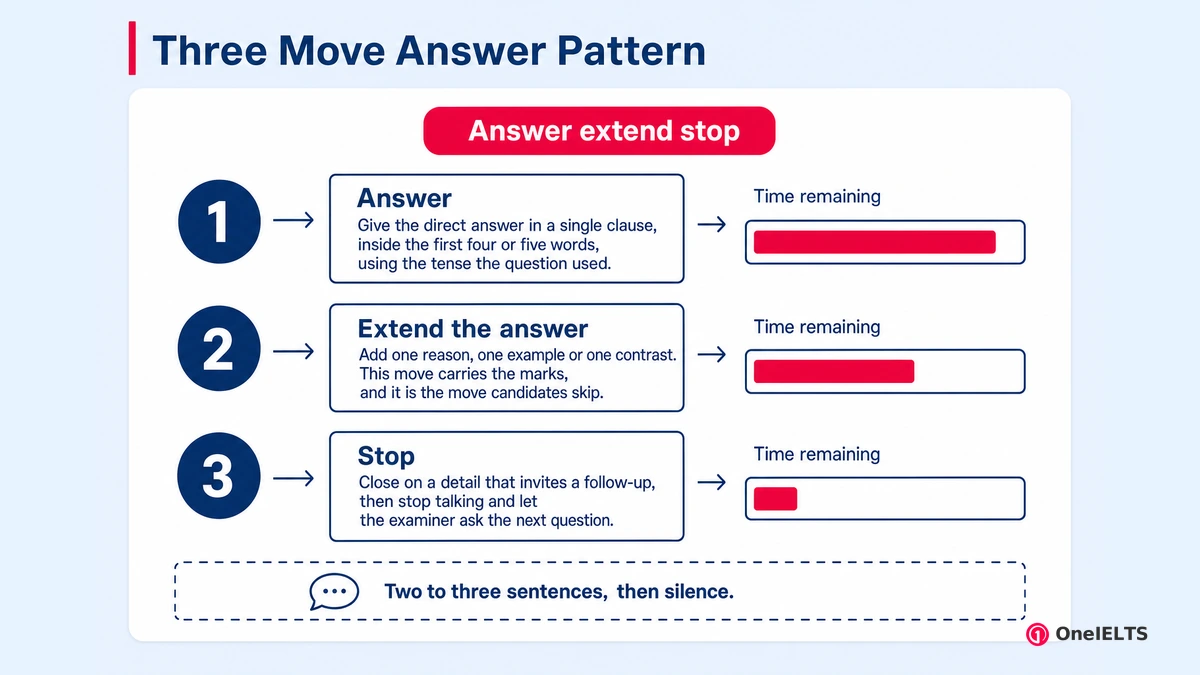
Answer with a repeatable three-move answer pattern: answer, extend, stop. Two to three sentences, then silence. The highest-ranking page on this query publishes no sample answers at all, on purpose, because a memorised answer is audible. A pattern survives a question you never prepared. A script does not.
The three moves always run in this order.
- Answer. Give the direct answer in a single clause, inside the first four or five words, using the tense the question used.
- Extend the answer. Add one reason, one example or one contrast. This move carries the marks, and it is the move candidates skip.
- Stop. Close on a detail that invites a follow-up, then stop talking and let the examiner ask the next question.
Three worked pairs, written for this page rather than lifted from a question bank, show the same pattern on three different shapes.
- “Do you work or study?” “I work. I’m a junior accountant at a logistics firm in Pune, and I’ve been there about two years. The commute is the part I’d change.”
- “How often do you cook?” “Most evenings, though not always well. I cook properly maybe twice a week and reheat the rest. Sundays are when I actually try something new.”
- “Has your hometown changed much?” “Quite a lot. Ten years ago the riverside was warehouses, and now it’s cafés and a walking path. My parents preferred the warehouses.”
Each runs two to three sentences and ends on a detail the examiner can pick up. In mock sessions the tell is consistent: a rehearsed candidate delivers answer one smoothly and answer four at half the speed, and that gap is audible. Stopping matters as much as extending. A Part 1 answer running forty seconds costs you two later questions and shows no extra language. The pattern never changes with the topic, which is the whole point of learning it.
What Questions Come Up in IELTS Speaking Part 2?
One card, and the cards fall into four families: describe a person, describe a place, describe an object, or describe an event or experience. Every card is built the same way. A topic sentence names what to describe, three or four card prompts tell you what to include, and a closing instruction asks you to explain something. You then get one minute of notes and one to two minutes of speech, which is why Part 2 is called the long turn.
Sorted by what you are asked to describe, the four cue card families cover almost every card in circulation.
- Describe a person. A family member you admire, an old person you know, or a teacher who influenced you.
- Describe a place. A place where you would like to study, your favourite shop, or a quiet place you visit.
- Describe an object. An important gift you received, a book you read recently, or a device you use daily.
- Describe an event or experience. A memorable trip, an occasion when you helped someone, or a celebration you enjoyed.
This page keeps Part 2 at summary depth. The full card inventory, the recent-topic lists and the sample answers belong to the dedicated cue-card page, and the note-taking method belongs to the Part 2 page.
What Questions Come Up in IELTS Speaking Part 3?
Part 3 asks abstract questions built out of your Part 2 topic: opinions, comparisons, causes, consequences and predictions, with almost nothing about you. Whatever your card was, Part 3 lifts it to the general case. A card about a gift you received turns into a discussion of why people give gifts at all.
Five question types account for most of what the examiner raises in the discussion.
- Opinion question. “Do you think education is important for success?” State a position in the first clause, then defend it with one reason and one example.
- Comparison. “Do young and older people enjoy the same things?” Set the two groups against each other instead of describing them one after the other.
- Change over time. “How is education changing in your country?” Name the change, give a then-and-now contrast, and attach a rough timeframe to it.
- Cause. “Why do people travel less than they used to?” Give one cause and develop it fully rather than listing four causes shallowly.
- Prediction. “Will this change in the next twenty years?” Commit to an answer, hedge once if you must, then justify it with a current trend.
Answers here run four to six sentences, roughly twice a Part 1 answer. The examiner may also disagree with you deliberately. That is not a trap. It is a device for pulling more language out of you, and instant agreement wastes it.
How Are You Evaluated on Your IELTS Speaking Answers?
Your speaking is marked on four criteria applied to everything you say across all three parts: fluency and coherence, lexical resource, grammatical range and accuracy, and pronunciation. The questions are not marked. Your answers are.
There is no single answer scored in isolation, so one weak reply does not sink the test. Content not judged is a real rule as well: the examiner rates the language of an answer, never its truth, which is why an invented example costs nothing if you can keep it going. A one-word answer still costs you, because it hands the examiner no fluency to measure.
Part 1 answers and Part 3 answers feed the same four scores even though they feel like different tests. The band-by-band wording lives in the descriptors, and the criteria-by-part breakdown lives on the Speaking pillar, so this page states the four criteria and moves on.
Where Can You Get IELTS Speaking Questions With Answers?
Take question wording from the official sample tasks on ielts.org, and take answers from practice sets you can record yourself against. Three of the eight related searches on this query ask for answers or an answer PDF, so the demand is explicit and worth serving honestly.
The best-ranked page on this query publishes no sample answers on purpose, and its reasoning holds. A memorised answer is audible, and it damages fluency and pronunciation at the same time. The useful way to read a model answer is to strip it. Keep the shape and two or three collocations, discard the content, then rebuild the answer out of your own life.
Question lists also go stale. A page or answer PDF carrying no last checked date is a warning sign, so treat any undated bank with suspicion. The question sets on this page were last checked on 14 August 2026.
How Do You Prepare Answers for IELTS Speaking Questions Without Memorising Them?
Prepare content per topic and a pattern per question shape, and never a sentence you intend to say. Content is the facts and opinions you own. A pattern is the answer-extend-stop shape you apply to whatever arrives. Sentences are the one thing of the three an examiner can hear you retrieving.
Five steps convert that distinction into a week of usable practice.
- Pick ten topics. Choose the ten Part 1 topics most likely for you, starting with work or study, hometown and home.
- Prepare content, not lines. For each topic, note three facts about yourself and two opinions, written as words rather than finished sentences.
- Drill the answer pattern aloud. Speak from those notes, holding the answer-extend-stop shape, until the shape arrives faster than the wording.
- Record one session a week. Play the recorded session back and mark anything with a rehearsed sound, especially openings that arrive too smoothly.
- Test yourself cold. Answer an unprepared topic you deliberately skipped. That is the only honest check on whether the pattern works.
Do You Have to Tell the Truth in IELTS Speaking?
No — the examiner marks your English, not the accuracy of your answers, so inventing a detail to keep an answer moving is perfectly safe. The criteria measure language not content. The one limit is sustaining an answer: a Part 3 follow-up question on an invented detail costs you fluency once the story runs dry. Build invented answers on real memories, then practise them against our is it okay to lie in ielts speaking.
Can You Choose Your IELTS Speaking Questions?
No — the examiner works from a set script in Part 1 and Part 2, so you cannot request a topic, swap a card or skip a question. No card swap is allowed, even when the card lands on something you know nothing about. You can ask for one repeated question in Part 1, and you can take a beat of thinking time in Part 3. The IELTS Speaking test format sets out everything the examiner script controls.
Which Cue Card Topics Come Up Most in IELTS Speaking Part 2?
The most frequent cue card families are person, place, object and event cards, with “describe a person you admire” and “describe a place you like” recurring more than any others. That repetition buys a shortcut. One well-built, adaptable story about a person or a trip covers several recurring cards. Check the current IELTS Speaking cue card topics before fixing any Part 2 topic in your head.
How Do You Extend a Short IELTS Speaking Answer?
The four extensions are a reason, an example, a contrast or a time comparison, and any one of them turns a one-line reply into an extended answer. Reasons and examples carry Part 1, where the examiner expects two or three sentences. Contrast and time comparison are what Part 3 rewards, because both force a structure onto an opinion. Our IELTS Speaking Part 3 guide drills the longer version.
Written by Rifah Binte Faruk, reviewed 14 August 2026.
Last verified: 14 August 2026
Practice for the Real IELTS Exam
Apply what you’ve learned with free, exam-style practice:
- Take a free IELTS mock test — all four skills, real exam timing, AI band scoring
- Sit a Speaking section mock — timed Parts 1–3 with voice recording and band feedback
- Practise all three parts — sample questions with feedback