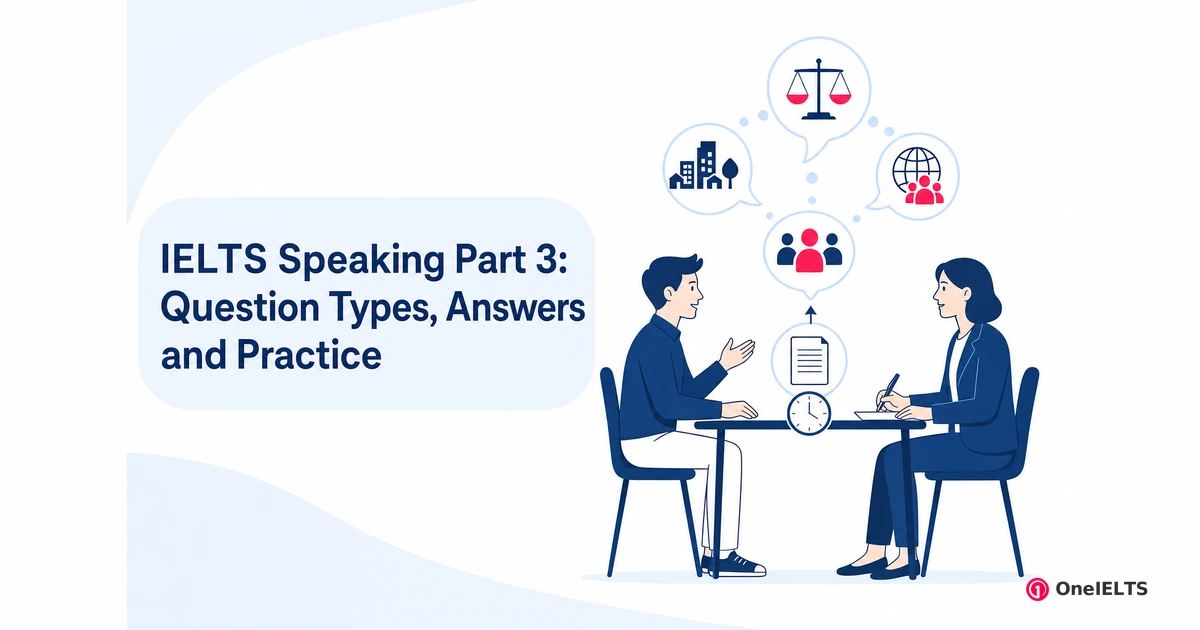
IELTS Speaking Part 3 runs four to five minutes, and neither test owner publishes how many questions it holds. The examiner takes the theme of your Part 2 card, turns it away from you towards people in general, and keeps pushing until the time is gone. IDP describes this two-way discussion as a test of your ability to express and justify opinions and to analyse, discuss and speculate about issues.
This page sets out the duration, the question count, the structure of the escalation, the seven question types, a four-move answer framework and the right answer length. It then covers five language functions, eight linking jobs, the grammar each type demands, a practice routine, and what a high score on abstract issues takes.
What Is IELTS Speaking Part 3?
IELTS Speaking Part 3 is the final section of the Speaking test: a four-to-five-minute two-way discussion built on the theme of your Part 2 card. IDP states that it tests your ability to express and justify opinions and to analyse, discuss and speculate about issues. The British Council calls it a chance to talk about more abstract issues and ideas.
It starts as soon as the rounding-off questions end, with no break and no preparation time. The questions move to general topics rather than your own life, so the pronoun shifts from I to people or they.
The examiner can interrupt, follow up on a weak reason, or push back, which makes this a discussion rather than an interview. It is also the only part you cannot prepare content for, because the theme comes from a card you have not seen. The question bank lives on our IELTS Speaking topics page, while this page teaches the discussion itself.
How Long Is IELTS Speaking Part 3?
Part 3 lasts four to five minutes, which makes it the longest part of the three and roughly a third of the whole Speaking test. The British Council publishes the figure directly, stating that the section will last 4-5 minutes, and ieltsliz corroborates it. IDP, the deepest method page on this query, never states it at all.
Treat that as an attributed range rather than a guaranteed personal allowance. Four to five minutes of unprepared discussion is longer than the long turn and the introduction combined, so this is usually where a Speaking band gets decided. It is also the part where running out of ideas stops being theoretical.
The clock belongs to the examiner. An examiner clock ends the part when the time is gone, mid-topic if it has to. Giving short answers does not shorten the section either; it only raises the number of questions you face. That test proportion is why Part 3 deserves at least a third of your speaking practice.
How Many Questions Are Asked in IELTS Speaking Part 3?
There is no published number of questions in Part 3. Neither test owner sets one, and the examiner asks as many as fit the four to five minutes, which in practice usually means four to six. Treat that as a typical range rather than a rule.
This section exists because of a gap in the results. Three keyword rows and one related-search chip ask how many questions the part contains, and no page ranking on the query answers it, including the British Council and IDP. So the useful move is to state the absence and hand over the arithmetic that replaces it.
The count is a function of your answer length, not of the exam. Thirty-second answers across five minutes produce about eight or nine questions. Ninety-second answers produce three or four. Longer answers therefore reduce the number of questions you face, which is why extending an answer is a strategy and not just a language exercise.
Examiner discretion shapes the count as well. An examiner may abandon a line of questioning that is not producing language and move to another, so a change of direction is not a sign that you answered badly.
What Is the Structure of IELTS Speaking Part 3?
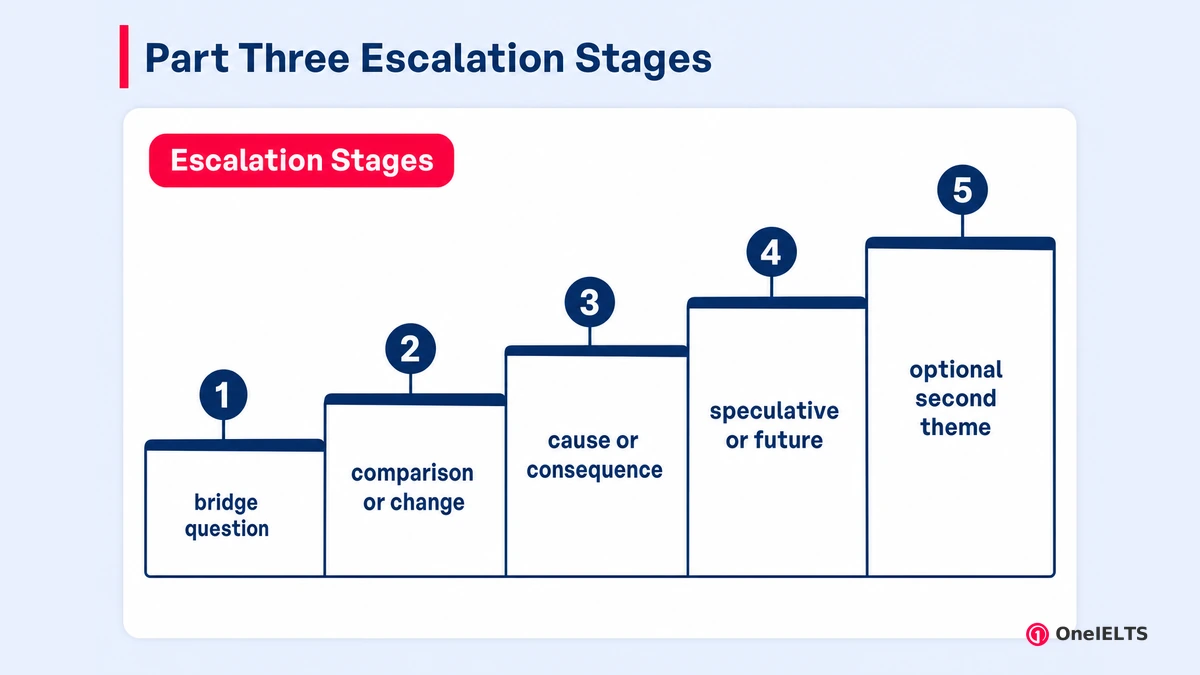
The examiner starts from the theme of your Part 2 card and moves the first question away from you towards people in general. From there it escalates through comparison, then cause, then the future, and the examiner may switch to a second theme if time allows.
The escalation is visible rather than asserted. The British Council publishes three consecutive questions for this part. The first asks ‘What kind of things give status to people in your country?’. The second asks ‘Have things changed since your parents’ time?’. The third asks ‘Do you think advertising influences what people buy?’.
The first generalises, the second asks about change over time, and the third opens a new theme. Those published sample questions make escalating difficulty visible without anyone having to claim it. Each question is harder than the last by design, so finding the fourth harder than the first means the test is working.
Five stages carry the discussion from your card to its most abstract edge.
- The bridge question. The examiner generalises your card’s theme. A card about a person you admire becomes a question about why societies admire particular people at all, which shifts the pronoun from I to they.
- The comparison or change question. Contrast arrives next, usually across time or place, as in the British Council’s ‘Have things changed since your parents’ time?’. You are being asked to describe change over time.
- The cause or consequence question. The examiner asks why the change happened or what it produced. This is the first question you cannot answer from memory, because it needs a reason rather than a fact.
- The speculative or future question. You are asked what will happen, or what would happen under different conditions. Certainty is impossible here, so a defensible guess is what earns the marks.
- The optional second theme. If minutes remain, the examiner drops the current theme and opens another, as the advertising question does. Treat the switch as routine rather than as a verdict on your last answer.
What Are the Common Question Types in IELTS Speaking Part 3?
Seven types cover nearly every question you will hear: opinion, evaluation, future, cause and effect, hypothetical, compare and contrast, and past. Recognising which one you have been asked decides the grammar of your answer before you say a word.
The topic is not the variable. Two candidates can get the same theme and face completely different grammar, because the question type is signalled by the verb and the time reference rather than by the topic word. A question can also belong to two types at once, in which case answer the dominant one and let the second surface in a later clause.
Each type below carries the wording that identifies it, the grammar it demands and a model opening.
- Opinion question. ‘Do you think…?’ or ‘What is your view on…?’. Answer in present simple with an opinion marker. Model opening: ‘I’d say the biggest factor is cost, mainly because most families budget monthly.’
- Evaluation question. ‘How important is…?’ or ‘How effective is…?’. These want comparatives and a scale word rather than a flat yes. Model opening: ‘It matters far more now than it did twenty years ago.’
- Future question. ‘Will…?’ or ‘What will happen to…?’. A modal of prediction carries it, so reach for will, is likely to or could. Model opening: ‘I think it’ll probably get cheaper, and the reason is supply.’
- Cause and effect question. ‘Why has…?’ or ‘What effect does that have?’. Use a because clause or a result clause with so or which means. Model opening: ‘That happened mainly because rents rose faster than wages.’
- Hypothetical question. ‘What would happen if…?’. This one cannot be answered with a fact, and it demands a conditional form that most speakers avoid under pressure. Model opening: ‘If that changed, people would travel a lot less.’
- Compare and contrast question. ‘What is the difference between…?’. Carry it with a while or whereas clause so both sides sit inside one sentence. Model opening: ‘Older people tend to save, whereas younger ones spend on experiences.’
- Past question. ‘How have things changed…?’ or ‘What was it like…?’. Use used to or would for habitual past actions. Model opening: ‘People used to shop locally, and that has shifted because delivery got cheap.’
The hypothetical question is where candidates lose the most ground, because it is the only type that no fact can answer and the conditional deserts people under pressure.
How Do You Answer an IELTS Speaking Part 3 Question?
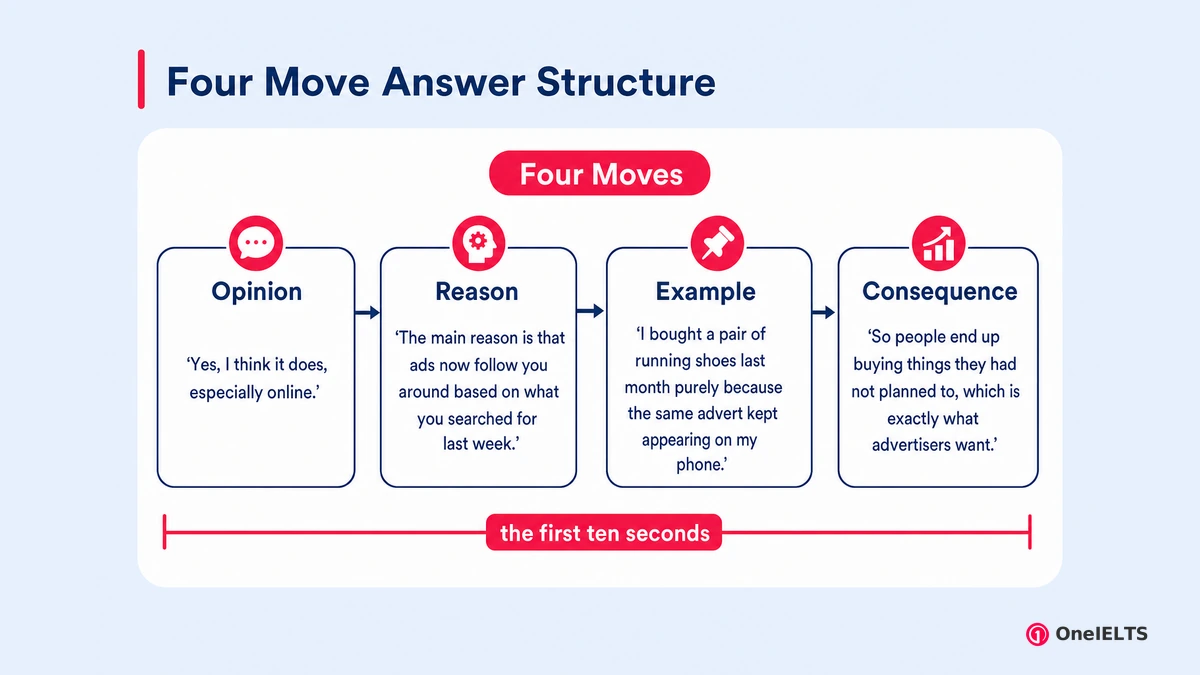
Use a four-move answer: state the opinion, give the reason, add an example, then name the consequence. That is enough language for a full answer without needing a second idea.
Improvising costs you the first ten seconds, and those are the seconds an examiner uses to place your fluency. A framework removes the decision. Its real value is survival rather than elegance, because the reason and the consequence can each be extended by one more step. A candidate with an opinion and nothing else can still produce forty seconds of language.
The four moves are shown here on the British Council’s question ‘Do you think advertising influences what people buy?’.
- The opinion move. Commit in one sentence. ‘Yes, I think it does, especially online.’ No hedge about how complex the question is, because that preamble buys nothing and costs marks.
- The reason move. Say why. ‘The main reason is that ads now follow you around based on what you searched for last week.’ One reason, stated plainly.
- The example move. Ground it. ‘I bought a pair of running shoes last month purely because the same advert kept appearing on my phone.’ A specific instance beats a general claim.
- The consequence move. Name what follows. ‘So people end up buying things they had not planned to, which is exactly what advertisers want.’ That sentence closes the answer cleanly.
The framework covers all seven question types, though the first move changes with the type. An opinion question wants an opinion, a future question wants a prediction, and a hypothetical question wants a supposition.
How Long Should Your IELTS Speaking Part 3 Answers Be?
Aim for thirty to forty-five seconds, which is three to five sentences. That is long enough to show the language and short enough that the examiner does not have to interrupt.
Both edges matter. Too short is the obvious failure, and IDP asks candidates to be willing to extend your answers. Too long fails as well, because an answer past a minute invites an interruption, and an interrupted answer reads as poor coherence rather than enthusiasm.
You can feel the stopping point in the room. Stop once you have made a point and supported it once. If you are still talking and have added nothing new since your last sentence, you went past it.
Because the part is time-boxed, longer answers mean fewer questions, so answer length is the one variable you control. The short answer habit does the most damage here, because an examiner cannot mark language that was never produced. In recorded practice the candidates who lose most are rarely the ones with weak grammar; they are the ones who stop one sentence early.
Which Language Functions Do You Need in IELTS Speaking Part 3?
Five functions do the work in this part: giving an opinion, giving a reason, justifying, evaluating and speculating. They match the abilities the test owner names.
A language function is a job a sentence does rather than a topic it covers. Part 3 is built on functions because the examiner marks what your sentences accomplish, not what they are about.
Two unrelated sources reach the same five from opposite directions. IDP, a test owner, states that the part tests your ability to express and justify opinions and to analyse, discuss and speculate about issues. keithspeakingacademy, a niche method page, heads exactly five functions under the same names. A taxonomy that two unrelated sources converge on is a specification rather than an opinion.
Each function below comes with two phrases that perform it and the question type it answers.
- Giving an opinion. Puts your position on the table in the first sentence. Use ‘I’d say…’ or ‘From what I’ve seen…’. This one answers the opinion question directly.
- Giving a reason. Explains why the position holds up. Use ‘The main reason is…’ or ‘That’s largely down to…’. It answers the cause and effect question.
- Justifying. Defends the reason after the examiner pushes back. Use ‘Even so…’ or ‘The evidence for that is…’. It answers a follow-up on any type.
- Evaluating. Weighs two things against each other. Use ‘It’s far more effective than…’ or ‘The bigger problem is…’. It answers evaluation and compare-and-contrast questions.
- Speculating. Guesses at what nobody knows yet. Use ‘It could well be that…’ or ‘I imagine…’. It answers the hypothetical and future questions.
Speculating is the one candidates skip. It is the only function that requires being wrong on purpose, and it is exactly what the hypothetical and future types are asking for.
Which Linking Words and Phrases Should You Use in IELTS Speaking Part 3?
Eight jobs need doing in this part: sequencing, adding, signalling an opinion, comparing, exemplifying, buying thinking time, generalising and stating a result. Two phrases for each is enough.
Linking in speech is judged differently from linking in writing. Written connectors such as furthermore and moreover sound wrong in a spoken register, and examiners hear them as recital. The plainer spoken equivalent carries the same idea and scores better because it sounds like a person talking.
The eight linking jobs sit here with two spoken phrases apiece, drawn from IDP’s own list.
- Sequencing. Order your points so the structure is audible. Use ‘first off’ and ‘and then after that’ instead of the written ‘firstly’.
- Adding information. Attach a second idea to the first without a new sentence. Use ‘on top of that’ and ‘the other thing is’.
- Indicating opinion and attitude. Flag that the claim is yours rather than general fact. Use ‘personally’ and ‘if you ask me’.
- Comparing and contrasting. Set two things side by side in one breath. Use ‘whereas’ and ‘compared with how it used to be’.
- Giving examples. Ground the claim in a single instance. Use ‘take my own city’ and ‘a good example of that is’.
- Stalling. Buy a second of thinking time with a stalling phrase. Use ‘that’s an interesting one’ and ‘let me think’.
- Generalising. Widen a claim to most cases without overclaiming. Use ‘on the whole’ and ‘more often than not’.
- Result. Name what the reason produced. Use ‘so what happens is’ and ‘which means that’.
Stalling is the surprise on that list. IDP, a test owner, names it as a linking function in its own right, so buying a moment with language is sanctioned rather than penalised. The phrase has to be a real phrase, though, not a hesitation noise. The exhaustive connector set belongs on our linking-words page; eight jobs with two phrases each is the working kit here.
How Do You Use a Wider Range of Grammar in IELTS Speaking Part 3?
Let the question type choose the structure. A hypothetical question asks for a conditional, a future question for a modal of prediction, and a past question for used to, so grammatical range comes from answering accurately rather than from inserting complexity.
Candidates try to display grammar by bolting clauses onto answers that never needed them. The result is inaccuracy, which is marked, in pursuit of range, which is also marked. Seven question types demand seven different structures, so answering each one properly produces the variety by itself.
Compare two questions on one theme. Ask ‘How has shopping changed in your country?’ and the present perfect answers it. Supermarkets have taken over most of what small shops used to sell. Ask ‘What would happen if online shopping disappeared?’ and the second conditional answers it. If it disappeared, high streets would recover, though prices would probably rise.
Three structures carry the most weight here and get avoided most often. They are the second conditional for hypotheticals, the present perfect for change over time, and a modal of degree such as might well or is bound to for speculation. Accuracy under pressure beats ambition, and one correctly used complex structure counts for more than three attempted ones.
How Should You Practise for IELTS Speaking Part 3?
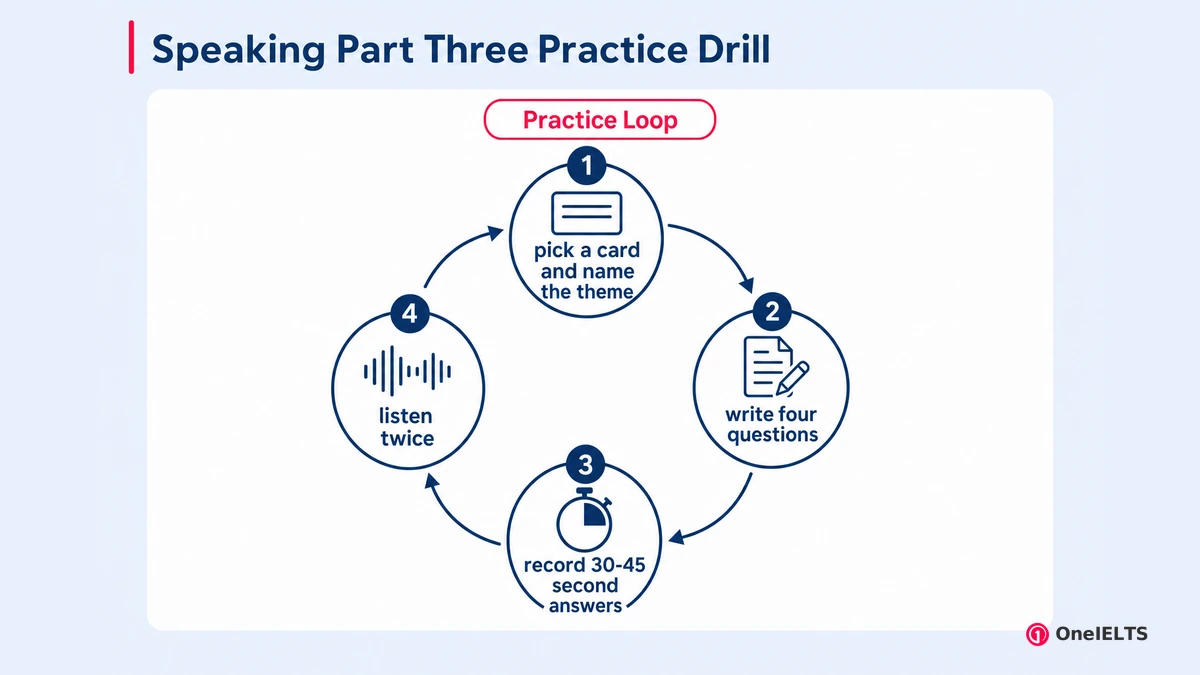
Practise the escalation rather than the topics. Take any Part 2 card, generalise it yourself, then answer four increasingly abstract questions on it against a clock.
Topic practice does not transfer here, because you cannot predict which theme your card will belong to. What does transfer is the move from a concrete card to a general question, and any card at all will drill it. Solo practice works for this part, since the answers are monologues even though the format is a discussion.
Four steps make up the escalation drill.
- Pick a card and name its theme. Take any Part 2 card and write the general theme sitting behind it in one line. A card about a childhood toy sits under play, memory and spending.
- Write four questions yourself. Produce one question per escalation stage: bridge, comparison, cause and speculation. A self-generated question trains the generalising move, which is the thing Part 3 actually tests.
- Answer each against a clock. Speak for thirty to forty-five seconds per question while recording. Do not stop and restart, because restarting is the habit that costs fluency marks in the room.
- Listen twice to each recorded answer. Play it once checking length only, then again marking where the four moves appeared. Whatever is missing on the second pass becomes your next drill.
One extra drill targets this part’s specific weakness. Take a question you have no opinion on and answer it anyway, on purpose. Part 3 never tests whether your view is interesting, so the skill is producing a defensible position at speed. That can only be trained on questions you do not care about. For the multi-week schedule, our preparation page carries the plan this drill sits inside.
Ready-made questions for the drill sit on the IELTS Speaking discussion practice filter. A free account is all it asks for.
How Do You Get a High Score in IELTS Speaking Part 3?
At the top of the scale the difference is no longer the framework but the willingness to commit. Committing means taking a position on an unfamiliar issue, defending it with a real reason, and letting the examiner push back without abandoning it.
Three things follow from the method above. The framework is a structural floor rather than a ceiling, so a correctly shaped answer with no content stalls in the middle bands. The part rewards demanded range, meaning range the question type asked for, not range you inserted. The only genuinely unteachable element is speed of thought, which gets trained by answering questions you do not care about.
No amount of topic preparation beats the ability to generalise an unfamiliar theme, because the examiner picks the theme from your card and you do not see it until the test starts. A committed position, held under pressure, is what separates the top of the scale from the middle of it.
What Does a Band 9 IELTS Speaking Part 3 Performance Sound Like?
A band nine discussion sounds like a conversation between equals. The candidate answers the question that was asked, supports it once, and stops.
Four audible markers give it away: no preamble before the opinion, a specific reason rather than a general one, a varied structure that tracks the question type, and no effort to sound impressive. The public ielts speaking band descriptors describe the same performance in criterion language.
How Do You Use a Wider Range of Vocabulary in IELTS Speaking Part 3?
Name the abstract noun the question is already about. This part is where inequality, infrastructure and incentive are the plain word rather than the impressive one, so a precise word wins.
Topic lexis helps only when it suits the register of a spoken discussion. A misused word is heard as an error, and this part offers more chances to make that mistake than the other two. Our ielts speaking vocabulary guide lists the sets worth learning.
What Should You Do If the Examiner Challenges Your Ideas in IELTS Speaking Part 3?
Treat it as a request for more language, not as a verdict. An examiner follow-up tests whether you can defend or revise a challenged position, rather than whether you were right.
Two responses work. Hold the position and add a second reason. Or offer a qualified concession, granting the point while narrowing your own claim, which costs nothing as long as you say why. Our ielts speaking tips cover defending a view across the other papers.
Which Sample Answers Should You Study for IELTS Speaking Part 3?
Study the ones that come with a transcript, because the value of a sample here is seeing where the speaker chose a structure. Read it once for the content.
Then read it again marking only each framework move and every linking phrase, which is structural reading rather than topical reading. That transferable pattern survives a question you have never seen. Our ielts speaking questions bank provides the themes to try it on.
Written by Rifah Binte Faruk, reviewed 14 August 2026.
Last verified: 14 August 2026
Practice for the Real IELTS Exam
Apply what you’ve learned with free, exam-style practice:
- Take a free IELTS mock test — all four skills, real exam timing, AI band scoring
- Sit a Speaking section mock — timed Parts 1–3 with voice recording and band feedback
- Practise all three parts — sample questions with feedback