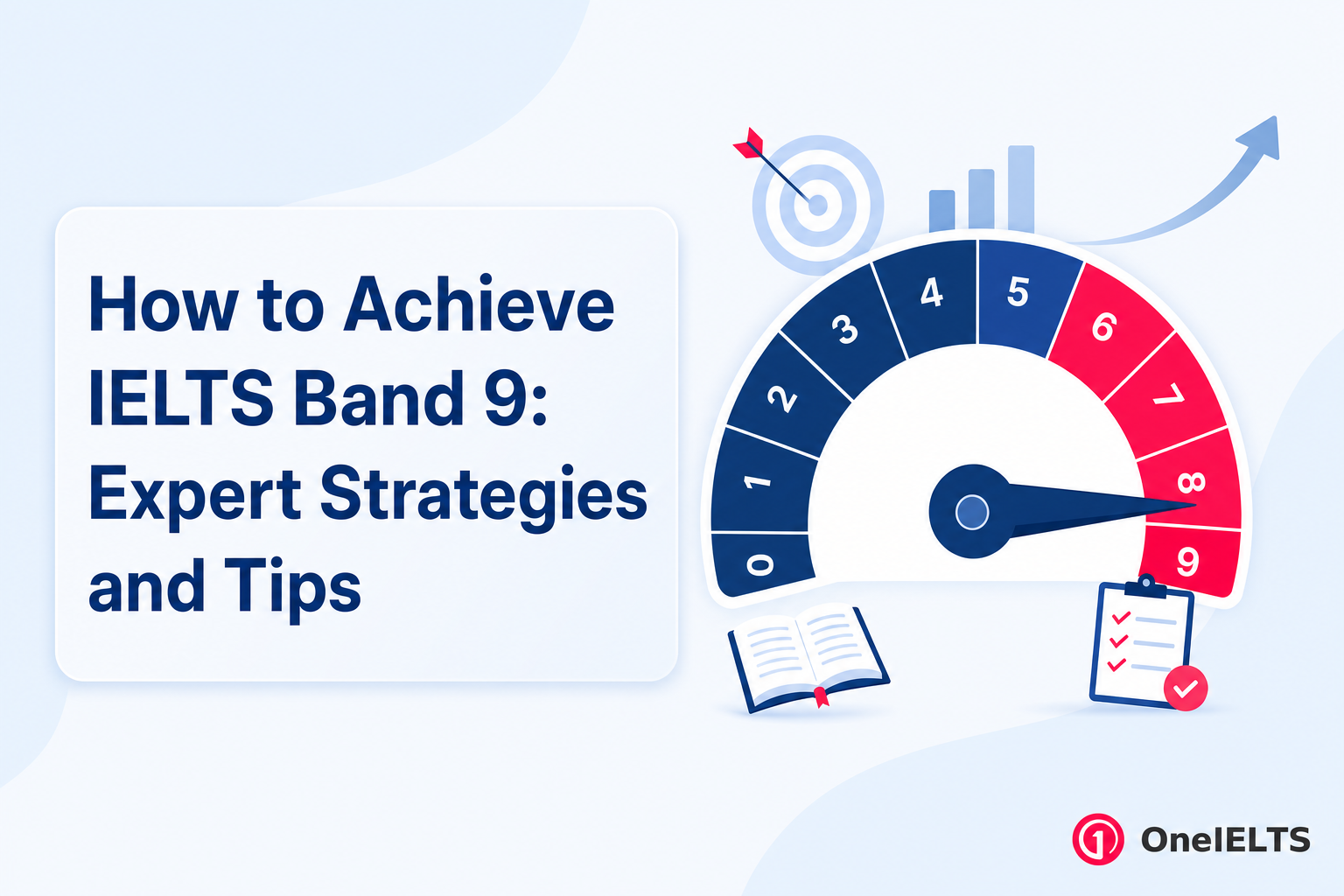
Reaching the top of the IELTS band 9 scale means demonstrating the fully operational command of an Expert User across every section. A band 9 signals near-native mastery, where you handle the language so fluently that only rare slips appear. It rewards consistency rather than flawless, robotic English.
This guide shows how to reach band 9 in Listening and Reading, in Writing, and in Speaking. It then covers how rare the score is, how it maps to the CEFR scale, and the cross-skill strategies that get you there. Under roughly 1% of test-takers ever reach a 9 overall, so treat it as a precision target, not a routine result.
How Can You Score Band 9 in IELTS Listening and Reading?
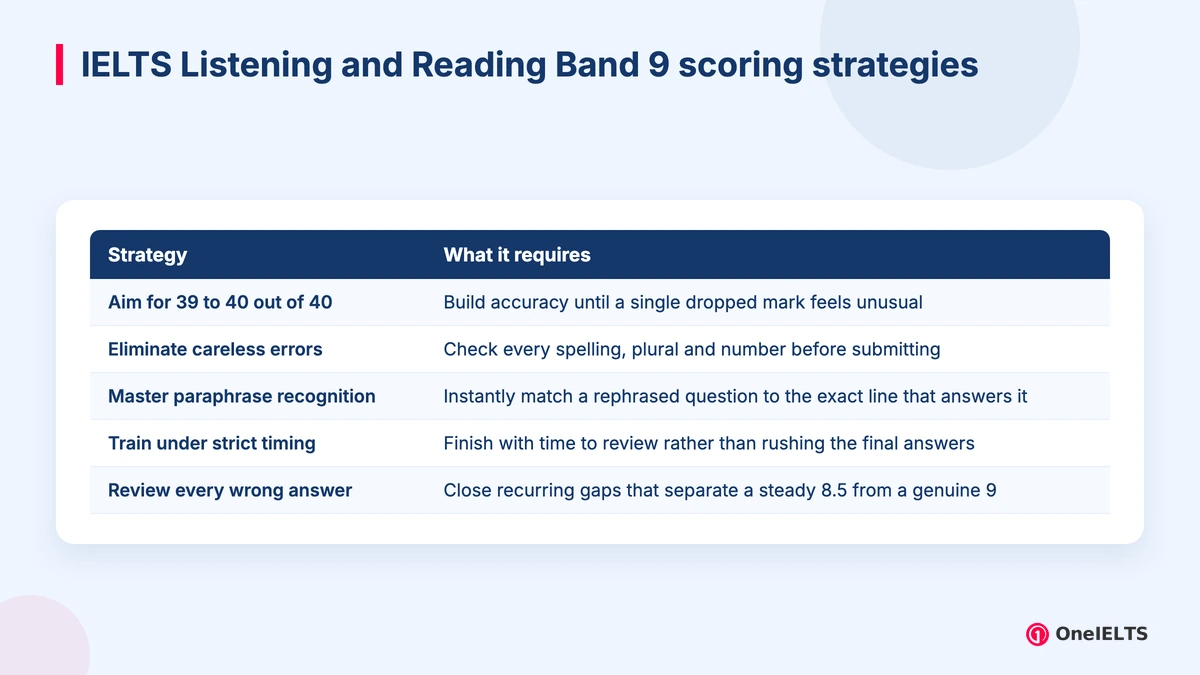
Scoring band 9 in the receptive skills comes down to near-perfect raw accuracy combined with disciplined exam habits. Both Listening and Reading convert your correct answers into a band, so the margin for slips is tiny and every careless mistake costs you. The five methods that reliably push receptive scores into band-9 territory are listed here.
- Aim for 39 to 40 out of 40. A band 9 in either paper usually needs you to score 39 to 40 out of 40, so build your accuracy until a single dropped mark feels unusual.
- Eliminate careless errors. Misspelt answers and transfer mistakes sink band-9 attempts, so make no careless errors by checking every spelling, plural, and number before you submit.
- Master paraphrase recognition. Questions rarely reuse the passage wording, so sharpen your paraphrase recognition until you instantly match a rephrased question to the exact line that answers it.
- Train under strict timing. Practise under strict timing that matches the real clock, because band-9 candidates finish with time to review rather than rushing the final answers.
- Review every wrong answer. After each practice set, study why each wrong answer was wrong, since closing recurring gaps is what separates a steady 8.5 from a genuine 9.
How Can You Score Band 9 in IELTS Writing?
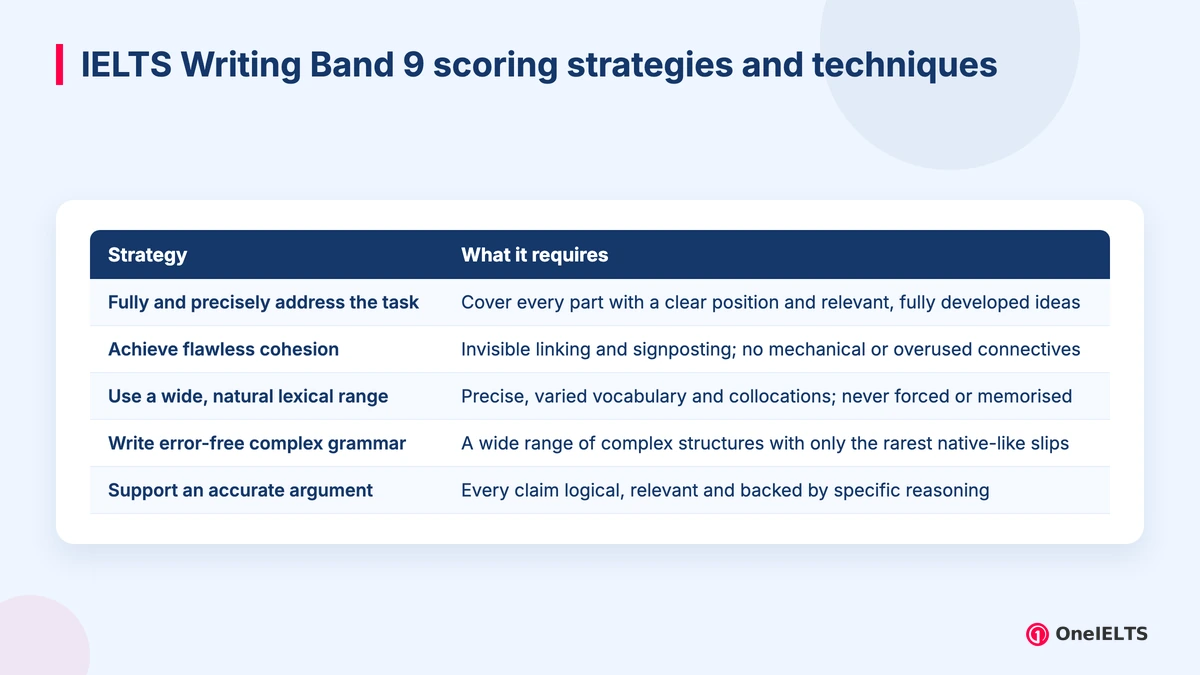
Writing is the hardest section to push to a 9 because the examiner rewards precise task response paired with error-free, natural language. The band-9 descriptor expects writing that fully addresses task demands, reads naturally, and contains almost no mistakes. The methods that lift a Writing answer to band 9 appear in the list below.
- Fully and precisely address the task. A band-9 response fully addresses task requirements, covering every part of the question with a clear position and relevant, fully developed ideas throughout.
- Achieve flawless cohesion. Manage cohesion so smoothly that linking feels invisible, with paragraphs, referencing, and signposting guiding the reader without any mechanical or overused connective phrases.
- Use a wide, natural lexical range. Show a natural lexical range by using precise, varied vocabulary and collocations with full flexibility, never forcing rare words that sound memorised or out of place.
- Write error-free complex grammar. Produce error-free grammar across a wide range of complex structures, where the only slips are the rare ones a native speaker might also make under pressure.
- Support an accurate argument. Build an accurate, well-supported argument in which every claim is logical, relevant, and backed by specific reasoning rather than vague or repetitive padding.
How Can You Score Band 9 in IELTS Speaking?
A band-9 Speaking performance shows completely natural, effortless communication that the examiner barely needs to assess. Fluency, vocabulary, grammar, and pronunciation all sit at their ceiling, and your accent is never penalised. The methods that produce a band-9 Speaking score are set out below.
- Speak with effortless fluency. Maintain effortless fluency by talking at a natural pace without unnatural pauses, self-correction, or hesitation that breaks the flow of your ideas.
- Use idiomatic language naturally. Weave idiomatic language and natural collocations into your answers the way a fluent speaker does, rather than inserting memorised phrases that feel rehearsed.
- Show full flexibility of structures. Demonstrate full flexibility across simple and complex grammar, adapting your sentences precisely to whatever the examiner asks without losing accuracy.
- Keep clear pronunciation throughout. Use clear pronunciation throughout, with the stress, rhythm, and intonation that make you effortless to follow even when your accent is non-native.
- Develop your ideas fully. Extend every answer with reasons, examples, and detail, since a band-9 candidate develops ideas fully instead of giving short or surface-level replies.
How Rare Is a Band 9 in IELTS?
A band 9 overall is extremely rare, with well under 1 percent of test-takers achieving it in any given year. The score sits at the very top of the nine-band scale because it certifies near-native mastery of English. That is the level the British Council labels an Expert User. Most strong candidates plateau at 7.5 to 8.5, and even highly proficient speakers rarely hold a 9 across all four sections at once.
Is an IELTS Band 9 CEFR Level C1 or C2?
An IELTS band 9 (‘Expert User’) maps to CEFR C2, the highest level on the Common European Framework. The confusion comes from the middle of the scale, where band 8 and band 8.5 sit within C1, so many candidates assume a 9 stays in C1 too. Only a band 9 crosses into C2. That is why the band 9 meaning carries such weight: it certifies command at the framework’s ceiling, not merely a strong advanced level.
What Strategies Help You Reach IELTS Band 9?
Reaching band 9 depends on steady habits that turn strong English into consistent, examinable accuracy across all four skills. No single section earns a 9 on its own, so the strongest candidates work on language and exam technique together over months. The cross-skill strategies that move a serious candidate toward band 9 are listed here.
- Immerse in English daily. Build daily immersion by reading, listening, and thinking in English every day, because the natural instinct band 9 needs comes from constant exposure, not occasional study.
- Eliminate recurring error patterns. Track your mistakes and eliminate error patterns one by one, since a band-9 profile has almost no repeated weaknesses in grammar, spelling, or word choice.
- Get expert feedback. Ask a qualified teacher for expert feedback on your Writing and Speaking, because productive skills are impossible to self-mark accurately at the very top of the scale.
- Simulate full exams. Run a full simulation of the complete test under exam conditions, so stamina, timing, and pressure stop costing you the marks that separate 8.5 from 9.
- Build genuine reading speed. Develop real reading speed through wide, varied reading rather than skimming tricks, so you finish the Reading paper with time to verify every answer.
Can a Non-Native Speaker Get Band 9?
Yes – non-native speakers do score band 9, though it takes exceptional, consistent command of English across every section. The test rewards accuracy and range, and it is not about accent or where you learned the language. A clear non-native accent never blocks a 9. A non-native band 9 reflects how precisely and flexibly you use English, which is exactly what the IELTS band descriptors measure at the top of the scale.
Is Band 9 Necessary for Study or Migration?
No – almost no university or visa requires a 9; it sits above all cut-offs for study and migration. Most universities ask for 6.5 to 7.5, and immigration routes rarely exceed 7, so a 9 is not required by any programme. Chasing a 9 is rarely worth the extra effort. You should target the goal your course or visa sets, which you can check against a realistic good IELTS score benchmark.
Last verified: 30 June 2026
Practice for the Real IELTS Exam
Apply what you’ve learned with free, exam-style practice:
- Take a full IELTS mock test
- Practice by section: Listening, Reading, Writing, Speaking
- Structure your essays with IELTS Writing templates