You build spoken fluency by talking out loud every day, recording two minutes of it, and listening back for long pauses rather than for grammar mistakes. That routine needs nobody else in the room. On timeframe, a few months of daily speaking usually moves a learner one level, while thirty days is enough to stop freezing and not enough to be fluent.
Confidence works the same way, because it comes from having survived the conversation before, so self-recording builds it faster than encouragement does. This guide covers the method itself, the daily habits, finding people to talk to, recording yourself, and listening. Then come mindset, whole phrases, pronunciation, daily exposure, grammar, the discomfort, idioms, immersion, thirty days, how long it really takes, and how to keep improving.
How Do You Speak English Fluently?
You speak English fluently by speaking out loud every day and dropping the habit of translating first, before your own language gets involved. The rest is bookkeeping. You record what you said, find where you stalled, and fix that gap. Five steps make up the cycle, in the order that makes it work.
- Speak out loud daily, even with nobody there.
- Make a two-minute recording of it on your phone.
- Count your long pauses instead of your grammar mistakes.
- Learn the phrases those pauses were reaching for.
- Repeat the cycle tomorrow on a new topic.
The AI Overview for this query puts the target plainly, telling readers to “focus on communicating ideas rather than memorizing complex grammar rules”. A pause in the middle of a sentence is almost always a retrieval problem, not a knowledge problem. You know the word, and it arrives two seconds late. Retrieval speed rises with use and with nothing else, which is why the cycle repeats daily.
What Daily Speaking Habits Build Fluency?
Four habits build fluency, all doable alone and all inside twenty minutes a day: narrating, shadowing, recording and reusing ready-made phrases. Every one of them works with nobody else in the room, which is the case most advice on this topic skips. Here is the routine, with the time budget attached to each habit.
- Narrate what you are doing. Five minutes narrating out loud while you cook or walk trains your brain to build sentences at speed.
- Shadow a recording. Five minutes shadowing a podcast, repeating immediately after the speaker, copies their rhythm before you can think.
- Record yourself. Two minutes on a simple topic, then a two-minute recording played back for long pauses.
- Use ready-made chunks. Practise a word chunk like “I’m looking forward to” instead of assembling the sentence word by word.
The leftover minutes go to reviewing what the recording showed you. Twenty minutes split this way asks far more of you than an hour of background listening does.
How Do You Find People to Talk To?
Three places supply a partner, ordered by how fast you can start: someone learning your language in return, a structured conversation group, and a paid tutor. The first two cost nothing, and the third buys what they cannot. Each option earns its place for a different reason.
- Language exchange. Someone learning your language trades time with you, half the session in English and half in theirs.
- Conversation group. A conversation group gives you a fixed slot, a topic, and other learners who are just as nervous.
- Paid tutor. A paid tutor supplies error correction on the sentences you actually produce, which a partner cannot.
Be honest about the trade-off before you pick. A same-level partner builds fluency because the talking never stops, and a tutor catches the errors a partner cannot hear. The highest-traffic guide on this query says to buddy up with someone learning your language, and to use an exchange app if you know nobody.
How Do You Record Yourself Speaking?
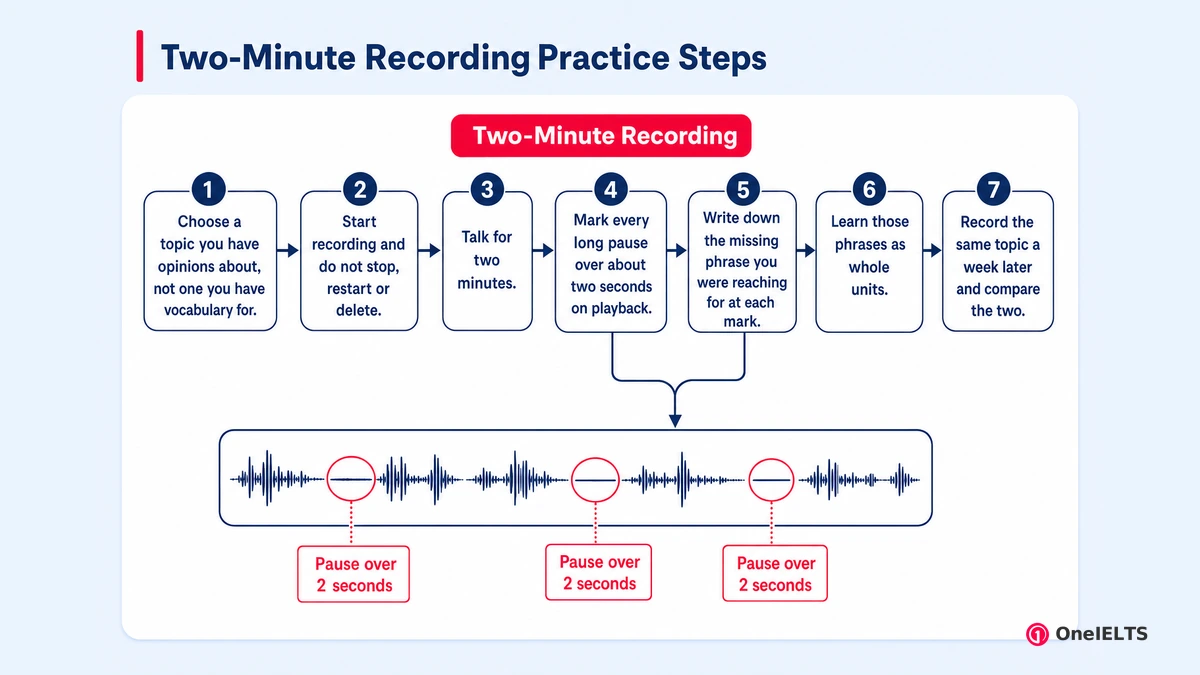
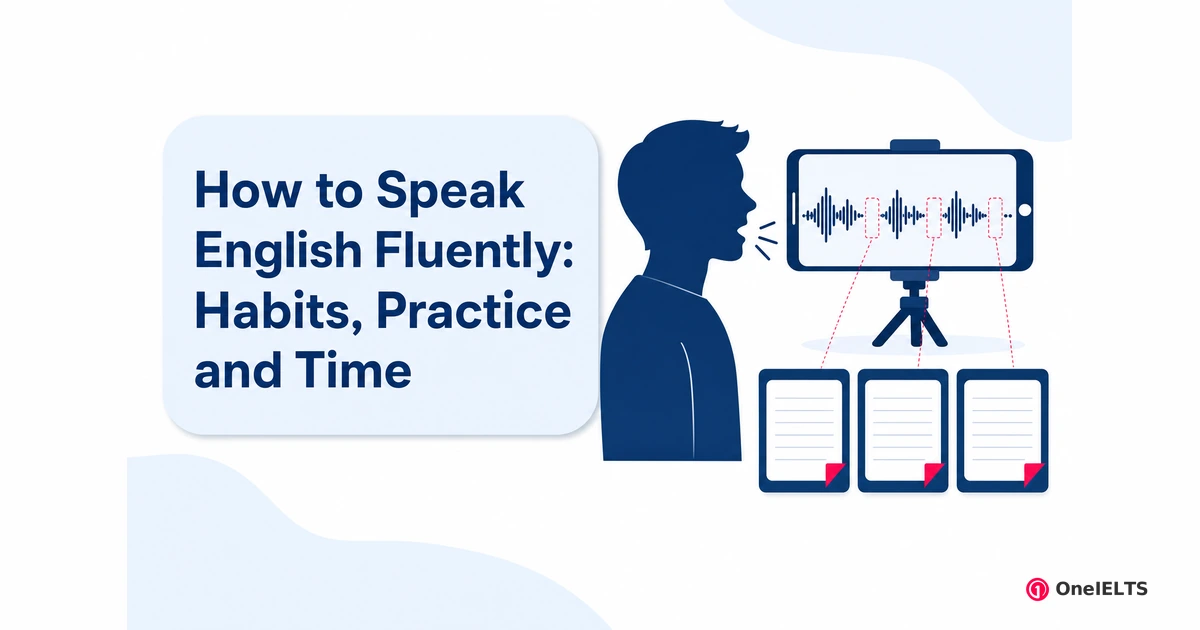
Pick a topic, speak for two minutes without stopping, then listen back twice: once for pauses and once for repeated words. The recording provides the only honest feedback available to someone practising alone. Seven steps turn a two-minute recording into a weekly measurement rather than a one-off experiment.
- Choose a topic you have opinions about, not one you have vocabulary for.
- Start recording and do not stop, restart or delete.
- Talk for two minutes.
- Mark every long pause over about two seconds on playback.
- Write down the missing phrase you were reaching for at each mark.
- Learn those phrases as whole units.
- Record the same topic a week later and compare the two.
Google’s own AI Overview for this query gives the same instruction: “Speak on a simple topic for two minutes, listen back, and check for long pauses rather than minor grammar errors.” Split the listening deliberately. Listening for everything at once means hearing nothing, so the first pass counts pauses and the second listen counts habits. On that second pass you hunt one thing: the repeated word you lean on when the better phrase does not arrive.
How Do You Work on Your Listening Skills?
Listen to the same short clip more than once, first for the meaning and then for how the words joined together. Listening feeds speaking directly, because you can only produce the rhythms you have already noticed. Repeat listening on one clip beats single passes through ten clips. Three passes over the same recording do the work.
- Listen once with no text and get the meaning.
- Listen again with the transcript in front of you.
- Listen a third time while shadowing it out loud.
On the second pass, notice three things. Notice where speakers run joined words together, where a weak vowel swallows a syllable, and where the natural pause falls. That last one surprises most learners, because the natural pause almost never sits where the punctuation does.
What Mindset and Practice Tips Actually Help?
Three shifts do most of the work: stop overthinking grammar mid-sentence, think in English instead of translating, and treat a mistake as information. Each one has an action attached, because a mindset with no action is a slogan. The three shifts, and what to do about each, are set out here.
- Stop overthinking grammar. Chasing strict rules mid-sentence is what makes speakers freeze, so let the sentence finish before you fix anything.
- Start thinking in English. Force your inner voice to label everyday objects in English, starting with the room you are sitting in.
- Treat errors as data. A mistake as information tells you which phrase was missing, while a mistake as failure tells you nothing at all.
Confidence deserves its own line here, because most advice gets it backwards. It is not a personality trait you either have or lack. What you get instead is earned confidence, built from the memory of having survived this conversation before. That is why the recording habit builds it faster than encouragement does, and why freezing fades once you have heard yourself get through two minutes.
Should You Learn Whole Phrases Instead of Single Words?
Yes, and it is the highest-return change on this page: a phrase is retrieved as one unit, so it arrives at speaking speed. Assembling a sentence word by word needs several decisions per second, and a multi-word chunk needs one. Google’s AI Overview names the same move, recommending chunks like “I’m looking forward to” rather than building sentences word by word. Seven spoken phrase patterns are worth stealing this week.
- “I’d say that…” opens an opinion without a run-up.
- “It depends on…” is a hedge that buys a second.
- “What I mean is…” restarts a sentence that went wrong.
- “The thing is,…” flags the point that matters.
- “To be honest,…” softens a strong opinion.
- “As far as I know,…” covers a fact you are unsure of.
- “I’m looking forward to…” carries a whole future construction.
Store each as a single lexical unit, like a word. Retrieval speed is the reason, and at speaking pace it is the only one that counts.
Should You Work on Your Pronunciation?
Yes, but only on the parts that decide whether you are understood: word stress and the endings that change meaning. The goal is intelligibility, not a new accent. A listener should not have to work, and listener effort is the test that matters here.
Two features carry the most meaning for the least practice. The first is word stress, the syllable that takes the beat in a longer word, because English listeners use stress to find the word at all. The second is a meaningful ending, the -ed or -s that carries tense or number, and it is the first thing learners drop when they speed up.
Say the rest plainly. Accent is not the goal. Sound patterns themselves belong to a pronunciation rules page, and none of them are restated here.
How Much Should You Expose Yourself to English Every Day?
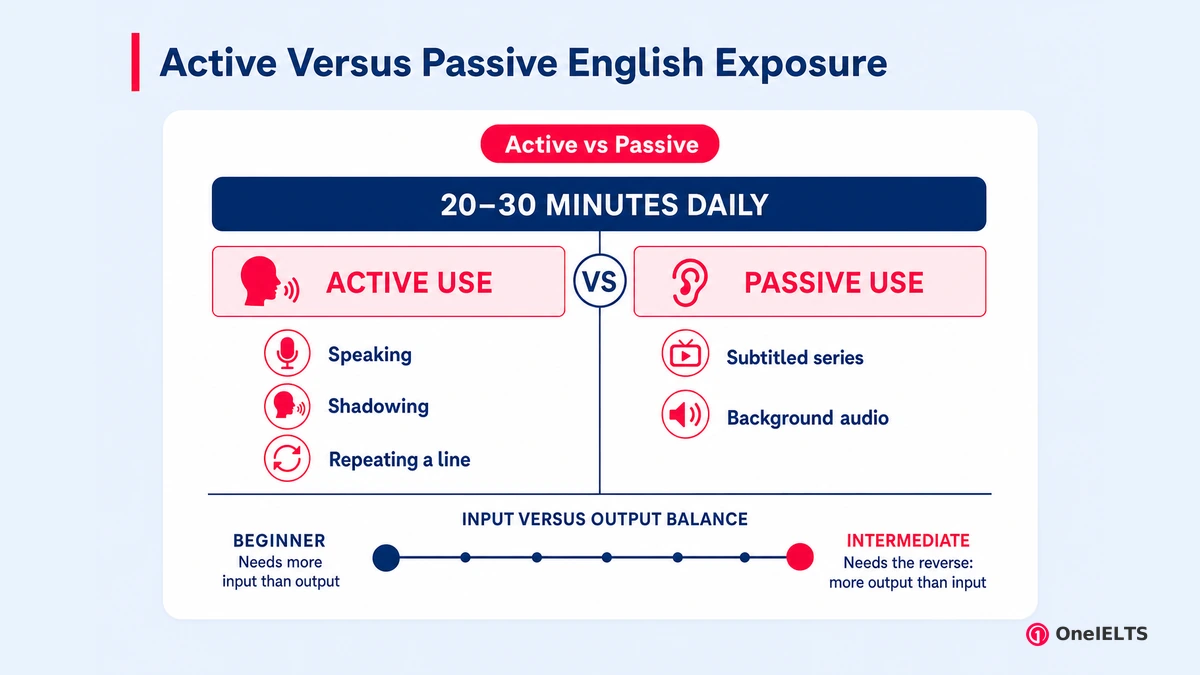
Aim for a daily minimum you will actually hit: twenty to thirty minutes of active use beats two hours once a week. The size of the number matters less than whether it survives a bad week. Split it by how much of it you produce, not by how much you sit through.
Active exposure means you produce something, such as repeating a line out loud, answering a question a podcast asks, or narrating your commute. Passive exposure means the English runs while you do something else. Watching a series with subtitles in your own language is passive exposure, and it moves almost nothing.
Most of the daily minimum goes to speaking or shadowing, and the rest to close listening. The right input and output balance changes with learner level, because a beginner needs more input than output and an intermediate learner needs the reverse. Google’s AI Overview for this query ends by asking the reader for their level before it advises, and no ranking page answers that question.
Should You Focus Too Much on English Grammar?
No, not while you are speaking. Grammar is worth studying, and it is not worth checking mid-sentence. Mid-sentence correction causes more of the pauses this page is trying to remove than any missing rule does, because it stops the sentence twice: once to notice, once to repair.
Split it by timing. Deliberate study happens when you are not speaking, at a desk, on one structure at a time. When you are speaking, the sentence finishes first and the repair waits. The AI Overview for this query says it more bluntly: “Worrying about strict rules makes you pause and freeze during real conversations.”
Speech needs two pieces of grammar more than the others. Tense consistency across a long answer keeps a listener oriented, and one reliable complex sentence pattern, usually a “because” or “which” clause, lets you extend an answer without freezing.
Why Will You Feel Uncomfortable Speaking English?
Because speaking is the only language skill performed in front of someone else, in real time, with no revision. Writing lets you delete a bad sentence, and real-time performance does not. Discomfort is the normal condition of the skill rather than a sign you prepared badly.
Three specific discomforts hide inside the vague one. The first is being judged by a listener you assume is grading you. The second is running out of words halfway through a sentence. The third is hearing your own accent come back at you.
Each has a practical answer. A sentence rehearsed alone is not brand new when it matters, so rehearse before you need it. Learn hedges, so running out of words has a script instead of a silence, because a hedge like “how do I put this” keeps the floor. And accent is not what makes a listener work; missing words are.
Which Idioms and Slang Should You Use?
Use a small number of very common ones, in situations you can name: a misused idiom is more noticeable than a plain sentence. An idiom is fixed and widely shared, while slang is regional and dates fast, so the idiom versus slang split decides what you learn and what you only understand. Seven low-risk set phrases cover most everyday conversation.
- Make up your mind fits a decision someone keeps delaying.
- Run out of time fits deadlines and unfinished plans.
- Keep in touch closes a conversation with someone leaving.
- Take your time reassures a person who is rushing.
- Get the hang of it describes learning something new.
- Off the top of my head answers without checking a source.
- In the long run compares now with later.
One rule keeps you safe with any high-frequency idiom. If you cannot say which situation it fits, you do not know it well enough to use it, and situation fit is the whole test.
How Do You Immerse Yourself in English?
Change what surrounds you rather than where you live: the useful part of immersion is unavoidable use, repeated daily. One ranking page recommends the other route, advising readers to consider “staying in an English-speaking country for at least a few months, ideally six or more”. Most readers cannot do that, and the part that transfers is not the country.
Manufactured immersion copies the one mechanism that made the country work, which is that English stopped being optional. Four changes do it.
- Switch your device language to English on your phone, laptop and apps.
- Consume what you already consume in English instead of adding new material.
- Join one recurring commitment you cannot quietly skip, such as a weekly group.
- Think in English during a fixed daily activity, like your commute or the washing-up.
The fixed daily activity matters more than its length, because a slot that repeats survives a busy week.
Can You Learn English in 30 Days?
No, not to fluency. Thirty days of daily speaking practice is enough to stop freezing and to sound noticeably more comfortable, and it is not enough to reach fluency from a low level. The honest version of the question is what thirty days does buy, and that answer is concrete.
Thirty days buys three things: a daily habit that survives without motivation, a stock of chunks you can retrieve, and a baseline recording to measure the next month against. That is real progress and it is not fluency.
The highest-traffic guide on this query answers the timeframe head-on, calling it “impossible to learn any language fluently in 10 days”. It adds that intensive work can boost your skills in ten days, while “reaching fluency (being able to talk like a native speaker) from a beginner takes a lot longer”.
Shape the month instead of planning it day by day. Week one sets the daily habit and captures a baseline recording. Weeks two and three add chunks and shadowing. Week four re-records the week-one topic and compares the two, which is the realistic gain you can actually hear.
How Long Does It Take to Speak English Fluently?
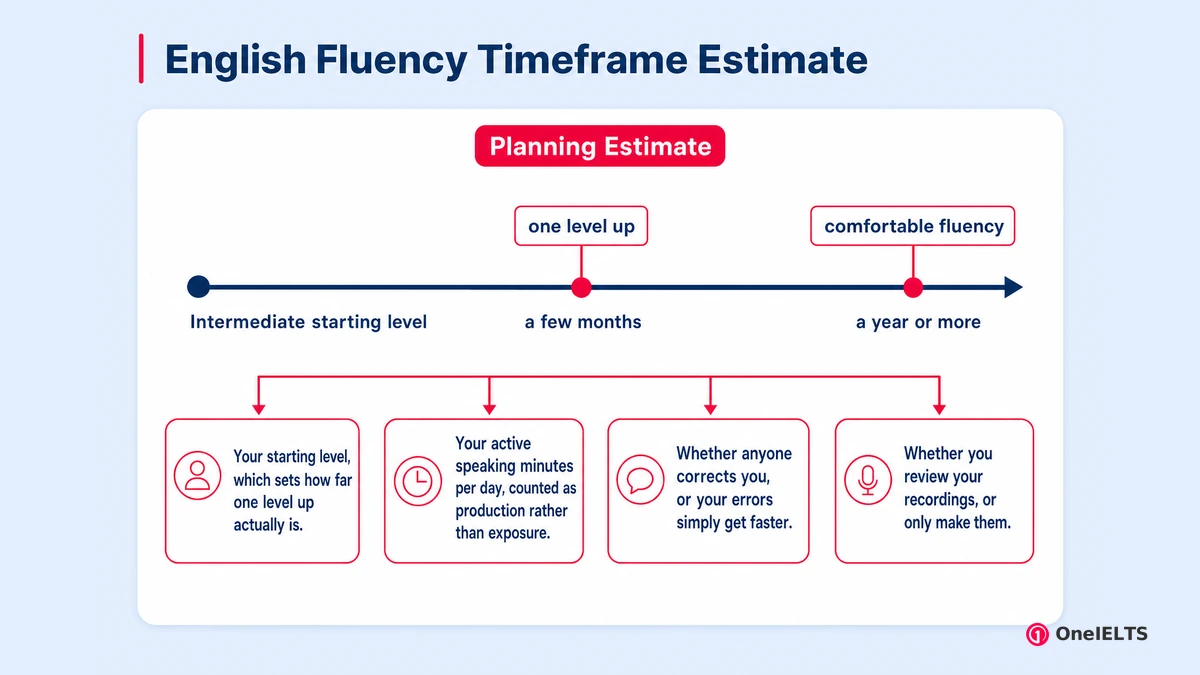
Expect a few months of daily speaking practice to move one level up, and a year or more to reach comfortable fluency from an intermediate starting level. Both figures depend on how much of the practice is speaking rather than studying.
The search results give no usable answer. Two of the three article pages ranking for this query state a timeframe and they disagree in kind. One says ten days is impossible, and the other says at least a few months in an English-speaking country, ideally six or more. Neither figure helps a learner practising at home.
Four variables change the answer more than any calendar does.
- Your starting level, which sets how far one level up actually is.
- Your active speaking minutes per day, counted as production rather than exposure.
- Whether anyone corrects you, or your errors simply get faster.
- Whether you review your recordings, or only make them.
Frame the target in levels, because “fluent” has no fixed threshold and picking one would be invented. For scale, Cambridge English puts roughly 200 guided learning hours between one CEFR level and the next, and around 500 to 600 cumulative hours to reach B2 from a standing start — figures it publishes as a guideline only. Those are taught and supervised hours rather than solo speaking practice, so read them as the size of the gap and treat the months above as a planning estimate rather than a measured finding.
How Do You Improve Your English Speaking?
Improve your English speaking by keeping the loop small and repeating it: daily speaking out loud, a two-minute recording of it, and listening for pauses rather than for mistakes. Learn the phrases those pauses were reaching for, then say them out loud tomorrow on a different topic. The whole method needs nothing but your voice, a phone, and a room with nobody else in it.
What Are the 5 Skills of English?
The skills of English are listening, speaking, reading and writing, with grammar and vocabulary underneath all four. The standard framing counts four skills, and the fifth item people add is usually grammar or vocabulary. Neither one is a skill; each is a language resource the four skills draw on. IELTS tests those same four separately.
How Do You Speak English Fluently in the IELTS Speaking Test?
Speaking fluently in the IELTS Speaking test is the same daily method, judged against a published criterion called Fluency and Coherence. The two-minute recording habit described above is the Part 2 two-minute task. What the exam listens for is the pause cause, whether you stopped to think about the idea or to hunt for a word. The IELTS Speaking band descriptors set out how that criterion is scored.
Written by Rifah Binte Faruk, reviewed 14 August 2026.
Last verified: 14 August 2026
Practice for the Real IELTS Exam
Apply what you’ve learned with free, exam-style practice:
- Take a free IELTS mock test — all four skills, real exam timing, AI band scoring
- Sit a Speaking section mock — timed Parts 1–3 with voice recording and band feedback
- Practise all three parts — sample questions with feedback