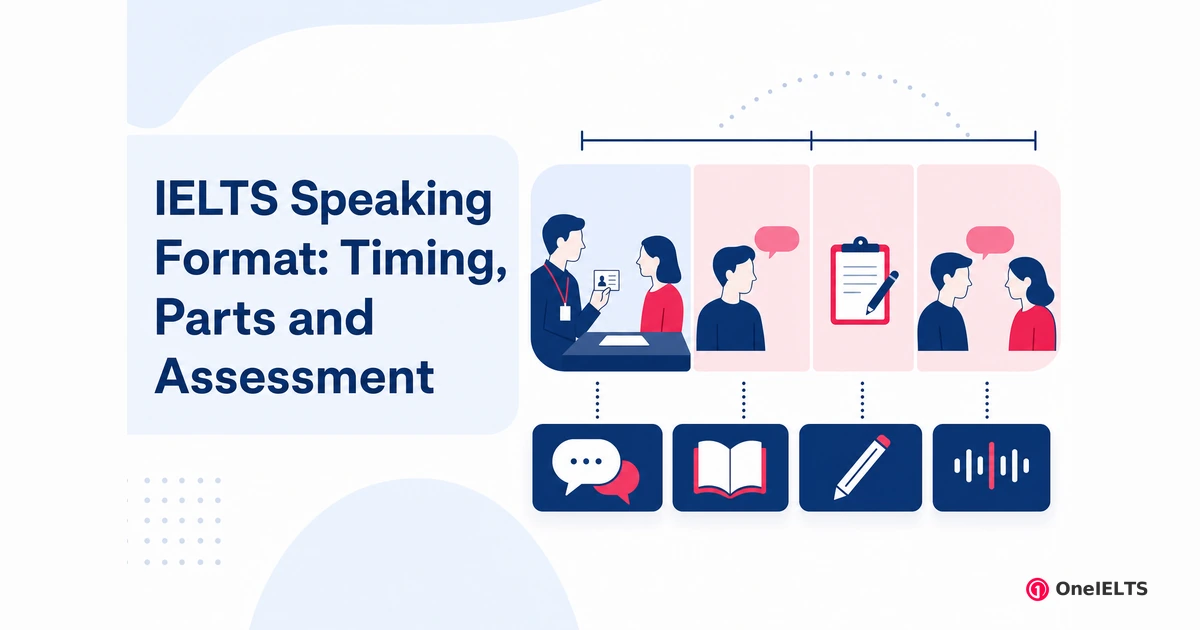
Eleven to fourteen minutes, three parts, one examiner. You arrive, your photo ID goes through an ID check, and then you talk: Part 1, a Part 2 card with one minute of preparation, then Part 3, all of it recorded. Four marking criteria produce the band, not five, and the IELTS Speaking test format sets every one of those stages.
This page covers the format itself, what happens before Part 1, the timing of each part, and what the examiner does. It then covers the assessment, the Academic and General Training answer, the video-call test, the ending, what to bring, where to find a full sample, and what the format means for preparation.
What Is the IELTS Speaking Test Format?
The IELTS Speaking test format is the fixed sequence and timing of the spoken component. You get an identity check, then three parts in a set order, inside 11 to 14 minutes, with one examiner and a recording running throughout.
That fixed sequence is the same for Academic and General Training candidates, and the same whether you sit it in the room or by video call. The order of the parts never changes, and no part can be skipped.
A certified examiner controls the clock, so being stopped mid-sentence is ordinary pacing rather than a warning sign. The British Council describes the test as interactive and as close to a real-life situation as a test can get.
Because this is a published format set by the test owners, the numbers on this page are rules rather than advice. Every session is a recorded test, which is what allows a second examiner to review it later.
What Happens in the IELTS Speaking Test Before Part 1?
Three things happen before Part 1, and the examiner marks none of them: you are called in, your identity is checked against your ID, and the examiner introduces themselves and starts recording.
This stage shapes how steady your first minute sounds, because it is the first speech the examiner hears from you. Five steps run from the waiting area to the first Part 1 question.
- You wait to be called and leave your bag, phone and notes where the centre staff tell you to.
- You show the same photo identification you booked with, and the examiner checks it against the register.
- The examiner asks your full name and where you are from, and this ID check answer carries no marks.
- The examiner names themselves, states that the test is recorded, and the recording starts before Part 1 begins.
- That examiner introduction runs straight into the first Part 1 question, with no pause and no signal.
This exchange is not marked, so a nervous answer here costs you nothing. Treating it as a warm-up for your voice rather than as a test is what steadies the first minute of Part 1. If your photo identification does not match your booking, the test cannot start, and and centres set their own procedure for this.
What Is the Structure and Timing of Each IELTS Speaking Part?
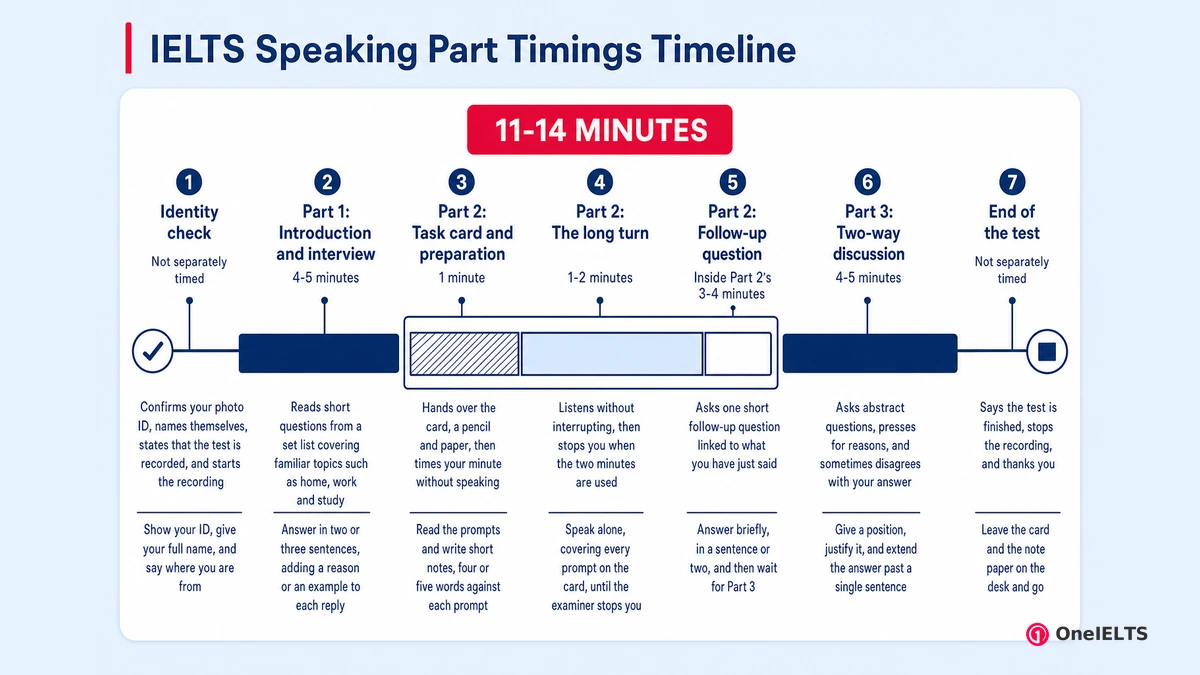
Part 1 runs 4 to 5 minutes, Part 2 runs 3 to 4 minutes including its preparation minute, and Part 3 runs 4 to 5 minutes. Those three parts total eleven to fourteen minutes.
Seven stages make up the appointment, from the ID check to the moment the recording stops, each with its own timing.
| Stage | Official name | Time | What the examiner does | What you do |
|---|---|---|---|---|
| 1 | Identity check | Not separately timed | Confirms your photo ID, names themselves, states that the test is recorded, and starts the recording | Show your ID, give your full name, and say where you are from |
| 2 | Part 1: Introduction and interview | 4-5 minutes | Reads short questions from a set list covering familiar topics such as home, work and study | Answer in two or three sentences, adding a reason or an example to each reply |
| 3 | Part 2: Task card and preparation | 1 minute | Hands over the card, a pencil and paper, then times your minute without speaking | Read the prompts and write short notes, four or five words against each prompt |
| 4 | Part 2: The long turn | 1-2 minutes | Listens without interrupting, then stops you when the two minutes are used | Speak alone, covering every prompt on the card, until the examiner stops you |
| 5 | Part 2: Follow-up question | Inside Part 2’s 3-4 minutes | Asks one short follow-up question linked to what you have just said | Answer briefly, in a sentence or two, and then wait for Part 3 |
| 6 | Part 3: Two-way discussion | 4-5 minutes | Asks abstract questions, presses for reasons, and sometimes disagrees with your answer | Give a position, justify it, and extend the answer past a single sentence |
| 7 | End of the test | Not separately timed | Says the test is finished, stops the recording, and thanks you | Leave the card and the note paper on the desk and go |
The ranges exist because the examiner paces the test, so an 11-minute test and a 14-minute test are both normal. Part 2’s 3 to 4 minutes includes the preparation minute rather than sitting on top of it, and that is the detail candidates most often get wrong.
The long turn itself lasts one to two minutes, and the follow-up question after it takes seconds. Nothing in the sequence is optional, and no stage is repeated.
What Does the Examiner Do and Say in the IELTS Speaking Test?
The examiner works from an examiner script for most of the test, with fixed wording in Part 1 and Part 2 and freedom to follow your answers in Part 3, while marking you live and managing the clock.
Part 1 questions come from a set list, and the examiner cannot rephrase them freely, which is why a question can sound oddly formal. You get one repeated question if you ask for it, word for word, and no explanation of what it means.
In Part 2 the examiner hands you the card, the pencil and the paper, times your minute, stops you at two minutes and asks one short follow-up. Part 3 is where the script loosens. Examiner pushback there, including outright disagreement, asks for more language rather than correcting you.
All of that runs alongside live marking against the four criteria. Two things candidates read as bad signs are not: being stopped mid-sentence means you filled the time, and the examiner writing while you speak means the marking is happening on schedule.
How Is the IELTS Speaking Test Assessed?
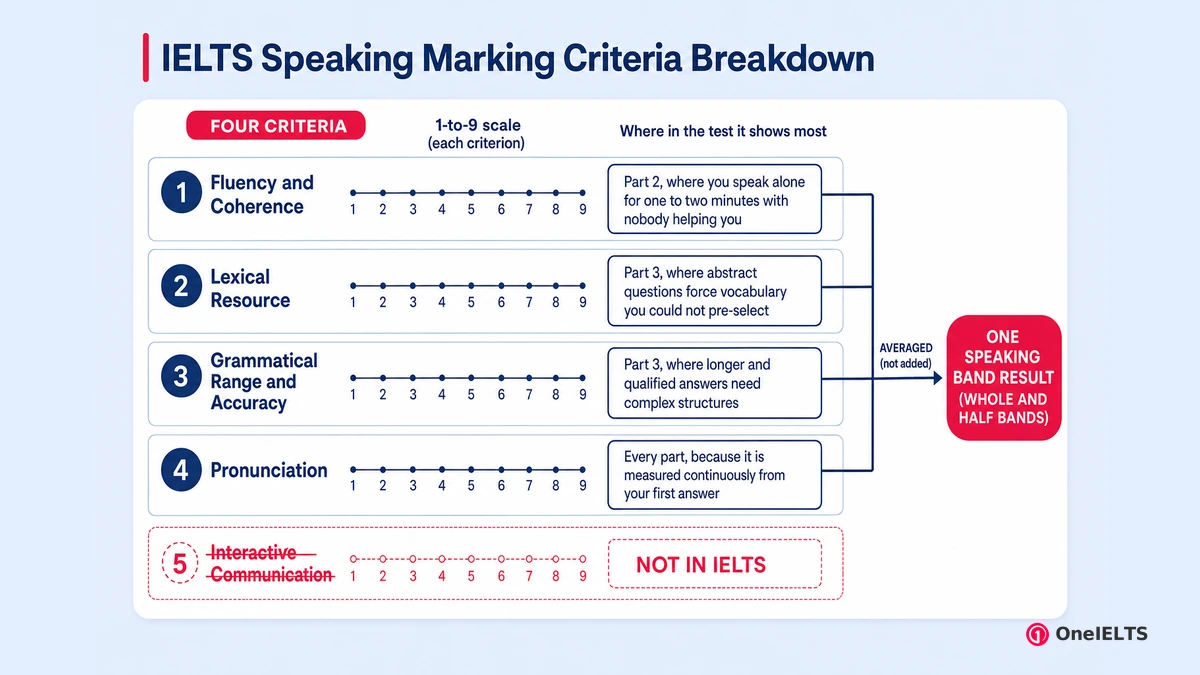
IELTS Speaking is assessed on four criteria, each scored 1 to 9 and averaged into one Speaking band: Fluency and Coherence, Lexical Resource, Grammatical Range and Accuracy, and Pronunciation.
Each criterion is measured somewhere specific in the test, and the table pairs it with the part where it shows most.
| Criterion | What it measures | Where in the test it shows most |
|---|---|---|
| Fluency and Coherence | How continuously you speak and how clearly your ideas connect, including hesitation and self-correction | Part 2, where you speak alone for one to two minutes with nobody helping you |
| Lexical Resource | The range and precision of your vocabulary, including less common words and natural word partnerships | Part 3, where abstract questions force vocabulary you could not pre-select |
| Grammatical Range and Accuracy | The variety of your sentence structures and how often an error blocks the meaning | Part 3, where longer and qualified answers need complex structures |
| Pronunciation | How easily a listener understands you, covering individual sounds, word stress and intonation | Every part, because it is measured continuously from your first answer |
Some widely-ranking pages list a fifth criterion called Interactive Communication. That criterion belongs to the Cambridge English general-English exams, and IELTS Speaking does not mark it.
Two primary sources say four. The Marking block on ielts.org names exactly four, and the British Council lists them as fluency and coherence, lexical resource, grammatical range and accuracy, and pronunciation. Google’s own AI Overview on this query also says four main criteria.
The five-item version still appears on some pages, including one from a test partner’s national site, so check any criterion list against a test owner before you build a study plan on it.
The four scores are averaged rather than added, so one weak criterion caps the band. Scores are reported in whole and half bands. The band-by-band wording sits with the descriptors rather than in this format guide.
Is the IELTS Speaking Format the Same for Academic and General Training?
Yes, completely: IELTS Academic and IELTS General Training candidates sit the same Speaking test, with the same three parts, the same timings, the same question types, the same four criteria and the same examiner.
Speaking is one of the two components that do not differ between the modules. Listening is the other identical component, while Reading and Writing use different papers.
Part 2 cards and Part 3 themes come from the same question pool regardless of module, so nobody needs to hunt for “Academic speaking topics“. A General Training candidate can use any IELTS Speaking material without adjustment.
Your module difference only decides which Reading and Writing papers you sit that day. The question keeps being asked because the page ranking first on this query buries it in an FAQ block and never gives it a heading, which makes the answer hard to find.
How Does the Video Call IELTS Speaking Test Work?
The video call Speaking test is the same test delivered over a screen, with the same live examiner, the same three parts, the same timings and the same marking.
The examiner is a real person on video, not a recording and not software. That misconception is the one worth clearing first, because it changes how candidates behave on camera.
You still sit at a test centre with a headset rather than taking it at home. The Part 2 card appears on screen or on paper depending on the centre, and your preparation minute and note paper work exactly as they do in the room.
The British Council describes the video-call version as keeping the face-to-face feature of the in-person Speaking test, with identical content and identical standards. You cannot usually choose which version you get, because the centre assigns it with your slot.
If the connection drops, the examiner or an invigilator restarts the session, and and centres set their own restart procedure.
What Happens When the IELTS Speaking Test Ends?
The examiner tells you the test is finished, stops the recording and thanks you. There is no closing question, no feedback and no score in the room.
That closing stage takes seconds. Asking how you did is normal and pointless, because examiners give no feedback and are not permitted to.
The recording kept from your test is what a second examiner listens to, and it is what an Enquiry on Results reviews when you pay for remarking. You leave the card and the note paper behind.
Your Speaking result appears with the other three components on results day rather than separately, and no method exists for knowing your band before then. A test that finishes closer to 11 minutes than 14 is not a bad ending, because the examiner sets the pace and a short test can still carry a band 9.
What Should You Bring to the IELTS Speaking Test?
Bring the same photo identification you booked with, and essentially nothing else. The examiner supplies the pencil and paper for Part 2.
Speaking is the lightest component to pack for, because the room is deliberately bare. Five items cover the whole test day rules for Speaking, from the ID you must carry to the things you must leave outside.
- The original photo identification used at booking, not a photocopy, a scan or a phone image.
- Your booking reference or confirmation email, in case the centre asks for it at the desk.
- Nothing to write with, since the examiner provides pencil and paper for the Part 2 preparation minute.
- No notes, phone, watch or bag in the room, because lockers or trays hold them outside.
- Water only if your centre allows it, since bottle rules vary by venue.
Arriving early matters more here than in the written components, because Speaking slots are scheduled individually. Your test can also fall on a separate Speaking day from the other three components, and the centre confirms that date in your booking.
Where Can You See a Full IELTS Speaking Test Sample?
The test owners publish official sample tasks and a recorded sample test, and those are the only samples where the wording and the examiner’s behaviour are authentic.
Five of the eight related searches on this query ask for a PDF or a sample, so the demand is explicit. A written transcript shows you the questions but not the pacing, which is why a recorded sample test is worth more than a question list.
Third-party model answer videos help with structure and mislead on content, because a scripted answer is audible within two sentences. When you watch a sample, watch how short the Part 1 answers are, how the examiner cuts in at two minutes, and how much longer the Part 3 answers run.
A OneIELTS mock test is where you rehearse the format under the clock instead of only reading about it.
What Does the IELTS Speaking Format Mean for Your Preparation?
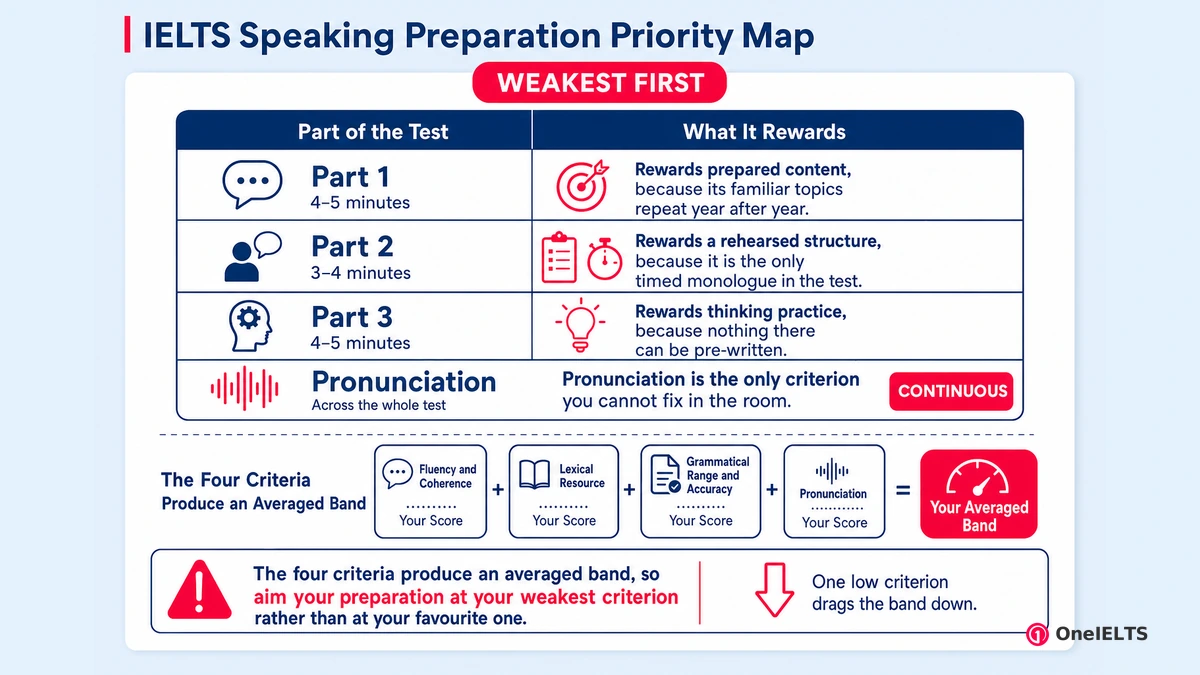
The format tells you where to spend your preparation. Part 2 is the only part you can rehearse whole, and Part 3 is the only part you cannot prepare content for. Pronunciation is the only criterion you cannot fix in the room.
Part 1 rewards prepared content, because its familiar topics repeat year after year. Part 2 rewards a rehearsed structure, because it is the only timed monologue in the test. Part 3 rewards thinking practice, because nothing there can be pre-written.
The four criteria produce an averaged band, so aim your preparation at your weakest criterion rather than at your favourite one. Most candidates rehearse the part they already enjoy, and it moves the band very little.
Which Part of the IELTS Speaking Test Should You Practise Most?
Part 2, because the long turn is the only stretch where you speak alone against a clock, and its failure mode is visible in a recording. Rehearsing that timed monologue improves fluency, which averages into the same band as everything else. It also needs no partner, so solo practice covers it. Our IELTS Speaking Part 2 guide walks through the card.
Rehearse the whole sequence in a free IELTS Speaking mock test once the weak part is steady.
How Can You Get 8.5 in IELTS Speaking?
Band 8.5 comes from averaged criteria, so it lands when your four scores average 8.5, which in practice means two 9s and two 8s. The work therefore sits on your single weakest criterion rather than on general improvement. That criterion is most often pronunciation, because it is measured continuously and candidates neglect it. Our ielts speaking band descriptors page sets out what each score describes.
What Is 7 in IELTS Speaking?
Band 7 describes speech at length with only occasional hesitation, some less common vocabulary, and errors that do not obscure meaning. Inside the format that looks like two-to-three-sentence answers in Part 1, a full two minutes in Part 2, and an extended, qualified answer in Part 3. Our IELTS band 7 guide covers that level across all four skills.
How Should You Prepare for the IELTS Speaking Format?
Per-part preparation works, because each part tests something different: content for Part 1, a structure and a timer for Part 2, and opinion practice for Part 3. The rehearsal almost nobody does is running the three parts unbroken once a week, since holding quality across eleven to fourteen minutes is what the format measures. One weekly rehearsal of timed practice beats daily single-part drills. Our ielts speaking preparation guide sets out the wider study plan.
Written by Rifah Binte Faruk, reviewed 14 August 2026.
Last verified: 14 August 2026
Practice for the Real IELTS Exam
Apply what you’ve learned with free, exam-style practice:
- Take a free IELTS mock test — all four skills, real exam timing, AI band scoring
- Sit a Speaking section mock — timed Parts 1–3 with voice recording and band feedback
- Practise all three parts — sample questions with feedback