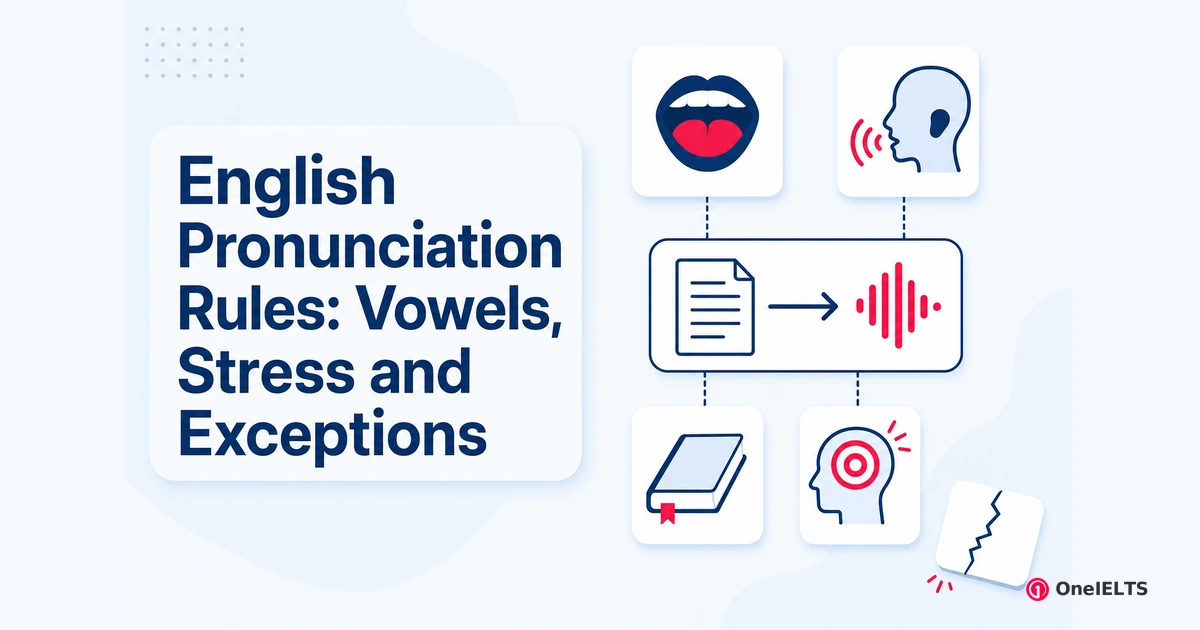
English pronunciation rules are the repeating spelling-to-sound patterns that link how a word is written to how it is said. They are patterns with exceptions rather than laws. No fixed number of them exists. One ranking guide gives 25, another gives 35, and only one answers the count honestly: ‘There are way more than five rules for English pronunciation!’
This reference page groups them into four families: vowels, consonants, endings, and stress. Every rule here carries at least two examples plus one counter-example, because Google’s AI Overview lists eleven rules and not a single exception.
Below you get the five core patterns, each vowel family, the consonant rules, silent letters, and the schwa. Then come suffix endings, word stress and the noun-verb shift, the rules that break, why English is irregular, homonyms, the words learners get wrong, how to learn the rules, and why clarity matters.
Are There Pronunciation Rules in English?
Yes, English spelling is far more regular than its reputation suggests, though the rules are patterns with exceptions rather than laws. A rule tells you what a spelling usually sounds like. That word “usually” is doing real work.
The patterns sort into four families, and the rest of this page uses them in one order. Those families are vowels, consonants, endings and suffixes, and stress.
Each family is a spelling-to-sound pattern with a predictable core and a ragged edge. The mental model to keep is pattern not law. Exceptions cluster in the oldest and most frequent words, so the common word exception is the first one you meet: ‘said’ and ‘been’ break the rules that ‘boat’ and ‘mate’ obey.
What Are the 5 Basic Rules of Pronunciation?
There is no official set of five. One ranking guide replies ‘There are way more than five rules for English pronunciation!’ and that is the only honest answer on the results page. Learn these five core patterns if you learn no others, because they cover the largest share of English words.
Each numbered rule below arrives with two examples and the words that break it.
- Silent E. A final E is silent and lengthens the vowel before it, as in ‘mate’ and ‘ride’. It fails in ‘have’ and ‘give’.
- Two vowels together. Two vowels side by side usually make a long vowel, as in ‘boat’ and ‘rain’. It fails in ‘been’ and ‘said’.
- Soft C and G. C and G soften before I, E and Y, as in ‘city’ and ‘gem’. It fails in ‘get’ and ‘girl’.
- Double consonant. A double consonant shortens the vowel before it and is said once, as in ‘apple’ and ‘carrot’. It fails in ‘roll’ and ‘ball’.
- Schwa reduction. Unstressed vowels reduce to a weak “uh”, as in ‘about’ and ‘pencil’. Schwa reduction skips the final vowel of ‘photo’ and ‘window’.
What Are the Vowel Rules in English?
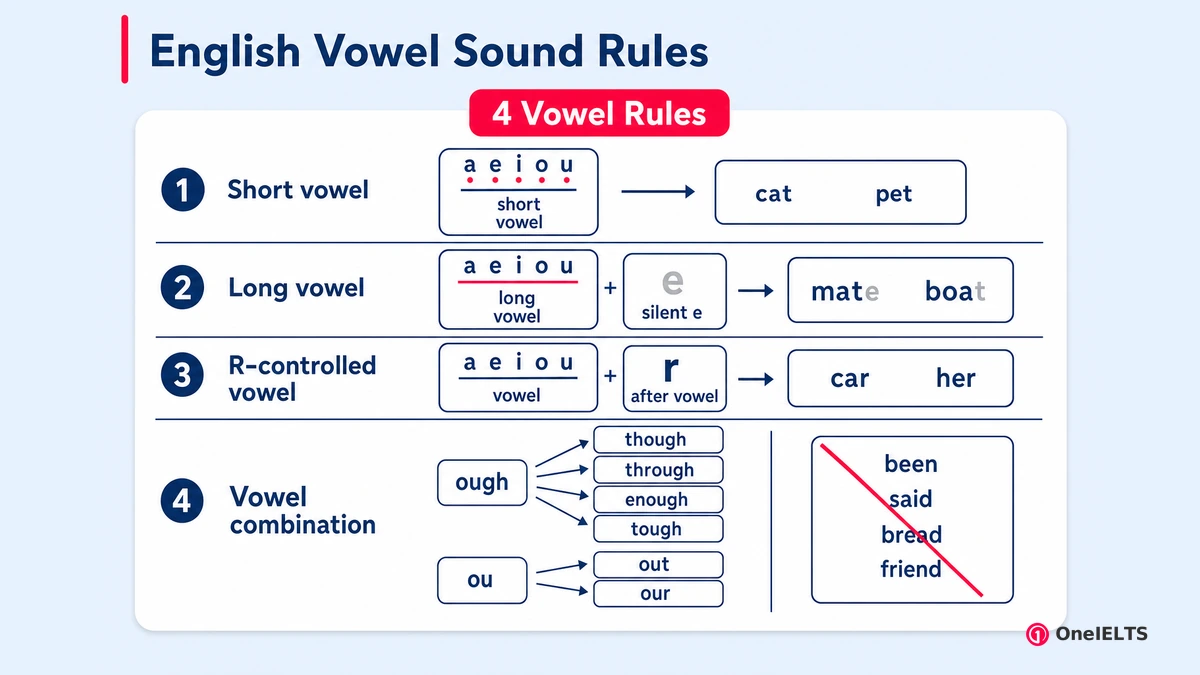
A vowel’s sound is decided by what follows it: a second vowel, a double consonant, or a silent E at the end of the word. The letter itself gives you very little. Four rules cover almost every case, and each one is set out here with its examples.
- Short vowel. Short words, and vowels followed by double consonants, usually take a short sound, as in ‘cat’ and ‘pet’.
- Long vowel. Two vowels side by side, or a final silent E, make the first vowel long, so it says its alphabet name in ‘mate’ and ‘boat’. This is the most broken rule on the page: ‘been’, ‘said’, ‘bread’ and ‘friend’ all put two vowels together and none of them is long.
- R-controlled vowel. An R after a vowel changes the sound entirely, as in ‘car’ and ‘her’, and the vowel is neither short nor long.
- Vowel combination. Some spellings carry several pronunciations, so ‘ough’ and ‘ou’ have to be learned word by word.
One competitor puts it well: ‘It signals that the vowel in the syllable before the end syllable must have a “long” pronunciation: “bite” (baɪt) versus “bit” (bɪt), for example.’
What Are the Consonant Rules in English?
Most consonants are stable. The ones worth your time are the letters that change sound depending on what comes next. Six rules cover them, and each one names its trigger first.
- Soft C. C sounds like S before I, E or Y, as in ‘city’ and ‘cycle’, and keeps its K sound elsewhere.
- Soft G. G sounds like J before I, E or Y, as in ‘gem’ and ‘giant’. Two of the most common words in English break it: ‘get’ and ‘give’ keep a hard G.
- Double consonant. A double consonant is written twice and said once, as in ‘apple’ and ‘carrot’.
- TT to D. In American speech, TT between vowels often reduces to a D sound, so ‘butter’ comes out as “budder”.
- S to Z. S sounds like Z between two vowels and at the end of many words, as in ‘rose’ and ‘dogs’.
- Voiced TH. TH buzzes in ‘this’ and ‘mother’, and it does not in ‘think’ and ‘bath’. The spelling never tells you which.
- Dark L. L darkens near the end of a syllable, as in ‘full’ and ‘milk’, where the tongue pulls back.
Which Letters Are Silent in English?
About a dozen letters go silent in English, and the letter position does the predicting rather than the letter itself. Sorting them by where they sit makes the set usable in a way an A-to-Z list never manages. Each silent letter below is grouped by its position in the word.
- K and G before N at the start. ‘Knife’ and ‘gnat’ open with an initial cluster whose first letter went quiet.
- B after M at the end. ‘Lamb’ and ‘comb’ drop the B completely.
- W before R, and in some question words. ‘Write’ and ‘who’ both lose the W.
- P before S and N. ‘Psychology’ and ‘pneumonia’ start on the second letter.
- H after W, and in a small set of words. ‘What’ and ‘hour’ both drop it.
- Final E in most words. ‘Make’ and ‘hope’ end on the consonant.
Each one is a spelling fossil: the letter is silent because it used to be pronounced.
What Is the Schwa Sound?
The schwa is the weak “uh” that unstressed vowels collapse into, and it is the most common vowel sound in spoken English. It has its own symbol, /ə/. One captured definition puts it well: ‘Unstressed vowels in multi-syllable words weaken into a lazy “uh” sound, like the “a” in about.’
Here is the point that turns it from trivia into a skill. Four different letters give you the same schwa in the weak syllable of ‘about’, ‘taken’, ‘pencil’ and ‘memory’. Say each of those vowels in full and you sound slow and effortful, because native rhythm needs some vowels thrown away.
Vowel reduction and stress are one rule seen from two sides. An unstressed vowel reduces because the syllable is unstressed, not because of the letter.
How Are Suffixes and Word Endings Pronounced?
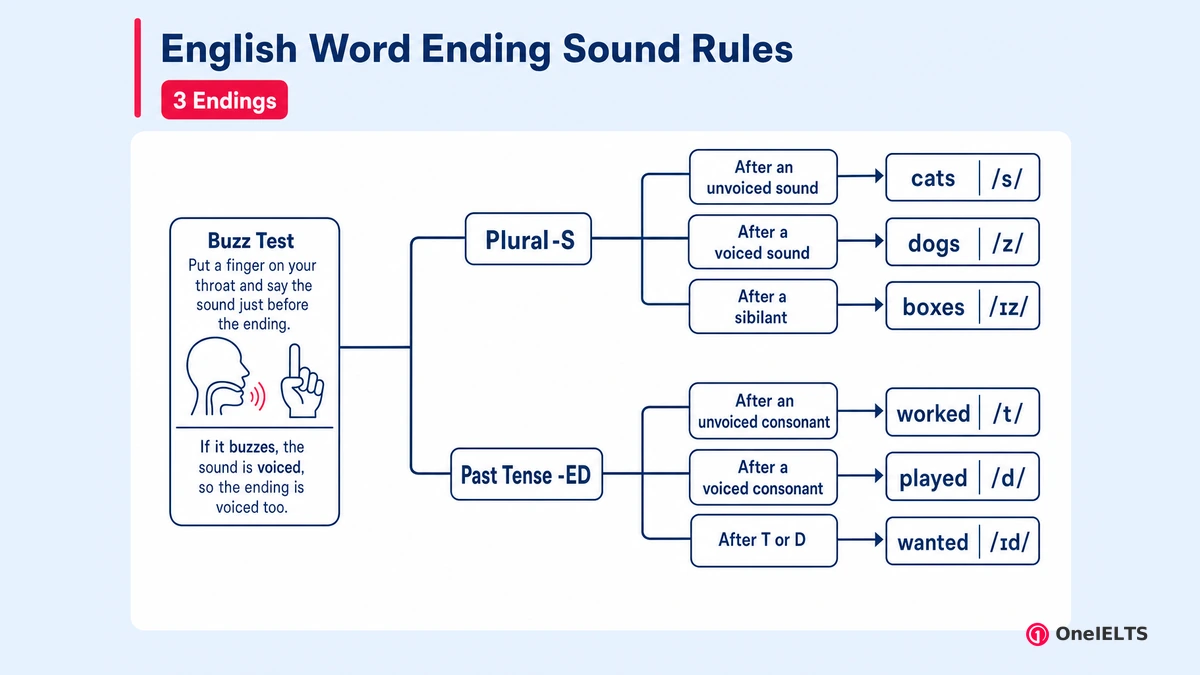
Three endings carry most of the difficulty: plural S, past tense ED, and the -tion ending. All three follow one voicing rule you can apply today. The four endings below cover almost every case a learner meets.
- Plural S and ES. Say /s/ after an unvoiced sound (‘cats’), /z/ after a voiced sound (‘dogs’), and /ɪz/ after a sibilant (‘boxes’).
- Past tense ED. Say /t/ after an unvoiced consonant (‘worked’), /d/ after a voiced consonant (‘played’), and /ɪd/ after T or D (‘wanted’).
- -TION and -SION. Both produce a SH sound, so ‘nation’ and ‘mission’ end the same way.
- The word ‘the’. Say a weak “thuh” before a consonant sound in ‘the car’, and a longer “thee” before a vowel sound in ‘the apple’.
You do not need phonetics to apply the voicing rule. Put a finger on your throat and say the sound just before the ending. If it buzzes, the sound is voiced, so the ending is voiced too.
How Does Word Stress Work in English?
Every English word of more than one syllable has exactly one strongest syllable. Putting that stressed syllable in the wrong place makes a word harder to recognise than getting a sound wrong. Three patterns cover most of it, grouped by what the word ends in.
- Two-syllable nouns. Most take the stress on the first syllable, as in ‘TA-ble’ and ‘DOC-tor’.
- Suffix-driven stress. Words ending in -tion, -sion, -ic and -ity stress the syllable immediately before that ending, as in ‘in-for-MA-tion’ and ‘e-LEC-tric’.
- Endings that pull the stress. Words ending in -ee, -eer and -ese stress the ending itself, as in ’em-plo-YEE’ and ‘Chi-NESE’.
One competitor states the stake plainly: ‘Failing to stress sounds properly while speaking can hinder your fluency and even change the way that people interpret what you’re saying.’
This section sits late on the page and matters more than the letter rules. Listeners use a stress shape for each word they know, so word recognition survives a wrong sound far better than a wrong stress.
Why Does Stress on the First Syllable Make a Word a Noun?
Yes, for a set of two-syllable words with identical spelling, first-syllable stress makes it a noun and second-syllable stress makes it a verb.
The AI Overview states it this way: ‘Two-syllable words that function as both nouns and verbs often stress the first syllable for the noun (RE-cord) and the second for the verb.’
Six common noun-verb pairs sit in the table.
| Noun (first-syllable stress) | Verb (second-syllable stress) |
|---|---|
| RE-cord | re-CORD |
| PRE-sent | pre-SENT |
| OB-ject | ob-JECT |
| CON-trast | con-TRAST |
| IN-crease | in-CREASE |
| PER-mit | per-MIT |
Capitals mark the stressed syllable, and that marked stress is the whole difference between the two words. Note the limit honestly. The source says ‘often’, not ‘always’, so the stress shift covers a set of pairs rather than every two-syllable word.
Which English Pronunciation Rules Don’t Always Apply?
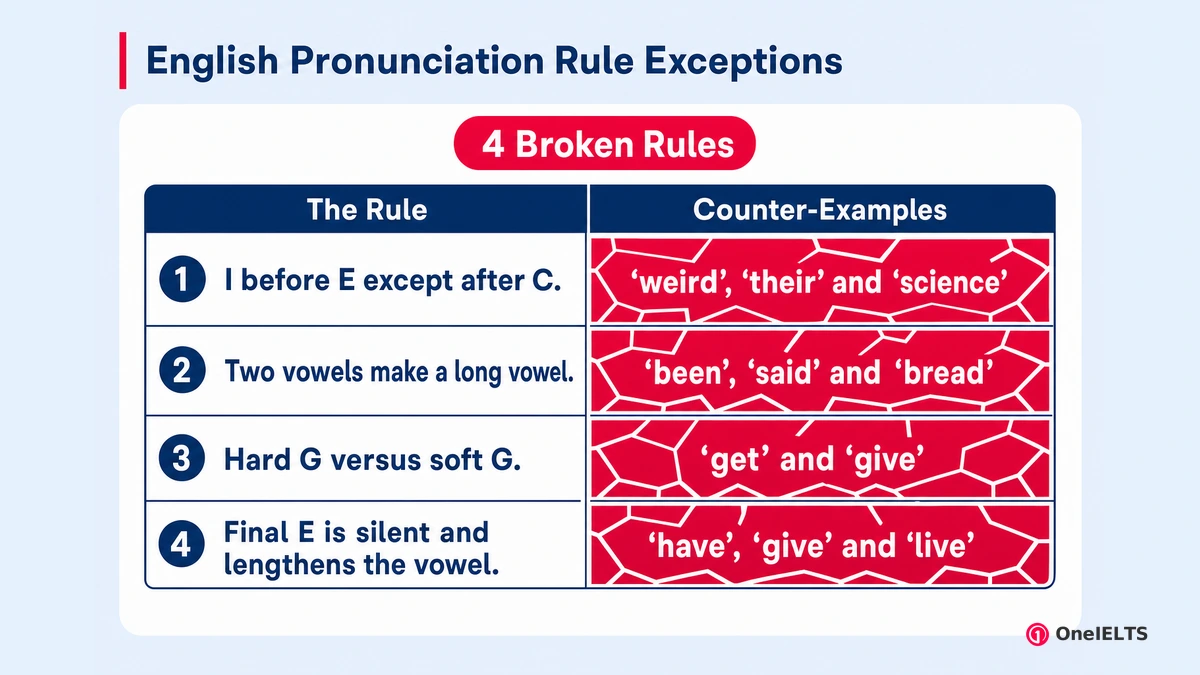
The four most-quoted rules in English are also the four that break most often. Knowing where they break is worth more than knowing a longer list. Each broken rule appears here with the words that defeat it and the reason.
- I before E except after C. ‘Weird’, ‘their’ and ‘science’ all ignore it, because the jingle was built for one narrow vowel sound and gets applied to every spelling.
- Two vowels make a long vowel. ‘Been’, ‘said’ and ‘bread’ each hold two vowels and a short sound, because these are old words whose spelling settled before the sound did.
- Hard G versus soft G. ‘Get’ and ‘give’ keep a hard G in front of E and I, because they reached English by a different route than the soft-G words.
- Final E is silent and lengthens the vowel. ‘Have’, ‘give’ and ‘live’ keep the short vowel, because English avoids ending a word in a bare V.
Checked on 5 August 2026, only one of the four guides ranking for this query admits that any rule fails, and it is the lowest-ranked of the four. So here is the conclusion, stated as a conclusion. Treat every rule on this page as a default rule that saves you time. Treat the most common words in English as the place where the default loses and a counter-example waits.
Why Is English Pronunciation So Strange?
English kept the spellings of words it borrowed, and it kept old spellings after the sounds had changed. The written word therefore records an older pronunciation than the one you hear. Three causes cover it, and no more than three are needed.
- Borrowed spelling. Words arriving from French, Latin and Greek brought their own spelling conventions with them.
- Sound change. The vowel sounds of English shifted after spelling had already begun to settle.
- Frozen spelling. Printing sets spellings in place, so later shifts in speech never reached the page.
The silent letters above are the evidence. The K in ‘knife’ and the B in ‘lamb’ were once pronounced, which is exactly why they are still written, and each is a spelling fossil left behind by speech. That history is the cause of exceptions across this whole page, and it adds no rules of its own.
What Are Homonyms in English – Same Sound, Different Spelling?
Homonyms come in two directions. Homophones share the same sound and differ in spelling, while homographs share the same spelling and differ in sound. The two sets below use words a learner meets in ordinary reading.
- Homophone. ‘Their’, ‘there’ and ‘they’re’; ‘to’, ‘too’ and ‘two’; ‘write’ and ‘right’; ‘flour’ and ‘flower’.
- Homograph. ‘Lead’ the metal and ‘lead’ the verb; ‘tear’ the drop and ‘tear’ the rip; ‘wind’ the air and ‘wind’ the action; ‘live’ the adjective and ‘live’ the verb.
Context decides which word you are reading, and nothing else does. The noun-verb pairs in the stress table are homographs too, and stress alone carries the difference between them.
What Are the Most Mispronounced English Words?
The words learners get wrong most are not rare words. They are common words whose spelling contradicts the rules above. Twelve examples cover the main traps, each labelled with the rule it breaks rather than with a respelling.
- Comfortable. A lost syllable: it is said in three beats, “KUMF-ter-bul”.
- Vegetable. Another lost syllable, so three beats again, not four.
- Wednesday. The middle syllable disappears completely, leaving “WENZ-day”.
- February. The first R is dropped by most speakers, giving “FEB-yoo-ary”.
- Colonel. A foreign spelling that kept its French look and took an R sound, “KER-nul”.
- Choir. Also a foreign spelling, said “KWIRE” with no CH sound at all.
- Yacht. A borrowed spelling from Dutch, reduced to “YOT”.
- Clothes. A consonant cluster that collapses, so it sounds close to ‘close’.
- Months. Another consonant cluster, with the TH and the S fighting for room.
- Sixths. The hardest cluster in ordinary English, four consonant sounds in a row.
- Iron. A hidden silent letter effect: it is “EYE-urn”, not “EYE-ron”.
- Salmon. The L is a hidden silent letter, so it is “SAM-un”.
These are common word examples rather than a measured top twenty. No source ranks them or counts the speakers who get each one wrong.
How Do You Learn These Pronunciation Rules?
You do not learn these rules by memorising the list. You learn them by hearing a contrast, copying it, and recording yourself to check whether the copy worked. One instruction comes before all the others, and the five methods follow it.
Pick one rule per week. A learner who tries to apply thirty-five rules at once applies none of them, and a single rule practised for seven days needs no conscious effort by day eight.
- Minimal pair drilling. Take the one contrast you get wrong, such as ‘ship’ and ‘sheep’, and say both until they differ.
- Shadowing. Repeat a recording a half-second behind the speaker, so you copy rhythm and stress rather than single sounds.
- Self-recording. Record your own voice, listen back, and mark the words a stranger would have to guess at.
- Reading aloud. Read with the text in front of you, so the spelling and the sound arrive together and the rule sticks.
- Singing. Sing along with lyrics, because a melody forces the stress pattern onto the right syllables for you.
Why Is Correct Pronunciation in English Important?
Pronunciation decides whether you are understood, and being understood is the whole point. The standard is clarity not accent. Three things change once your sounds are predictable.
You understand other people better, because knowing what a reduced vowel or a silent letter does tells you what to listen for. You are understood more easily, so intelligibility rises and listener effort drops. And your confidence changes, since speakers who expect to be understood stop hedging and slowing down.
Draw the line here. The goal is not to sound like a native speaker. It is for a listener not to have to work, and that two-way understanding is what pronunciation buys you.
How Do You Improve English Pronunciation?
Improving English pronunciation comes down to three moves you repeat. Learn the four families rather than a numbered inventory. Expect the most common words in English to break whatever rule you just learned, and practise one contrast at a time with your recorded voice as the judge.
What Are the Pronunciation Rules for IELTS Speaking?
The pronunciation rules for IELTS Speaking are the same rules, judged against a published criterion. IELTS Speaking scores the Pronunciation criterion as one of four, and that criterion measures intelligibility rather than accent. Word stress and sentence stress carry the most weight there. The IELTS Speaking band descriptors page sets out how it is applied.
What Are the 7 Rules for Excellent English Speaking?
The 7 rules for excellent English speaking are a fluency question rather than a pronunciation question, and that question has its own page. The split is fluency not pronunciation: pronunciation is how a word sounds, and fluency is how speech flows. This related question needs pace, linking and hesitation control, so read how to speak English fluently for the speech flow side.
Written by Rifah Binte Faruk, reviewed 14 August 2026.
Last verified: 14 August 2026
Practice for the Real IELTS Exam
Apply what you’ve learned with free, exam-style practice:
- Take a free IELTS mock test — all four skills, real exam timing, AI band scoring
- Sit a Speaking section mock — timed Parts 1–3 with voice recording and band feedback
- Practise all three parts — sample questions with feedback