The honest answer is that IELTS difficulty is relative, not absolute: the test feels as hard as the gap between your current English and your band target. A 6.0 is within reach for most candidates after a few weeks of practice. Each half-band above 7.0, though, takes disproportionately more work, and the Writing section is where that extra effort bites hardest. Speaking trips people up for a different reason, since it is scored live by an examiner.
This guide covers whether the exam is genuinely difficult and which section is the hardest. It then explains why students struggle, how it feels for Indian candidates, how IELTS compares with TOEFL or PTE, and the highest-impact ways to make your preparation easier.
Last verified: 30 June 2026
Is the IELTS Exam Difficult?
IELTS is not inherently difficult; how hard it feels depends on your English level, your target band, and your preparation. The test measures everyday and academic language, not obscure vocabulary, so the question is rarely whether you know enough English. A band of 6.0 to 6.5 is widely achievable for candidates who already study or work in English and put in a few weeks of practice.
The jump to 7.5 and above is genuinely demanding, because the band descriptors reward precision that casual fluency does not guarantee. In short, IELTS difficulty scales with the distance between where your English sits today and the target band an institution asks for.
Which IELTS Section Is the Hardest?
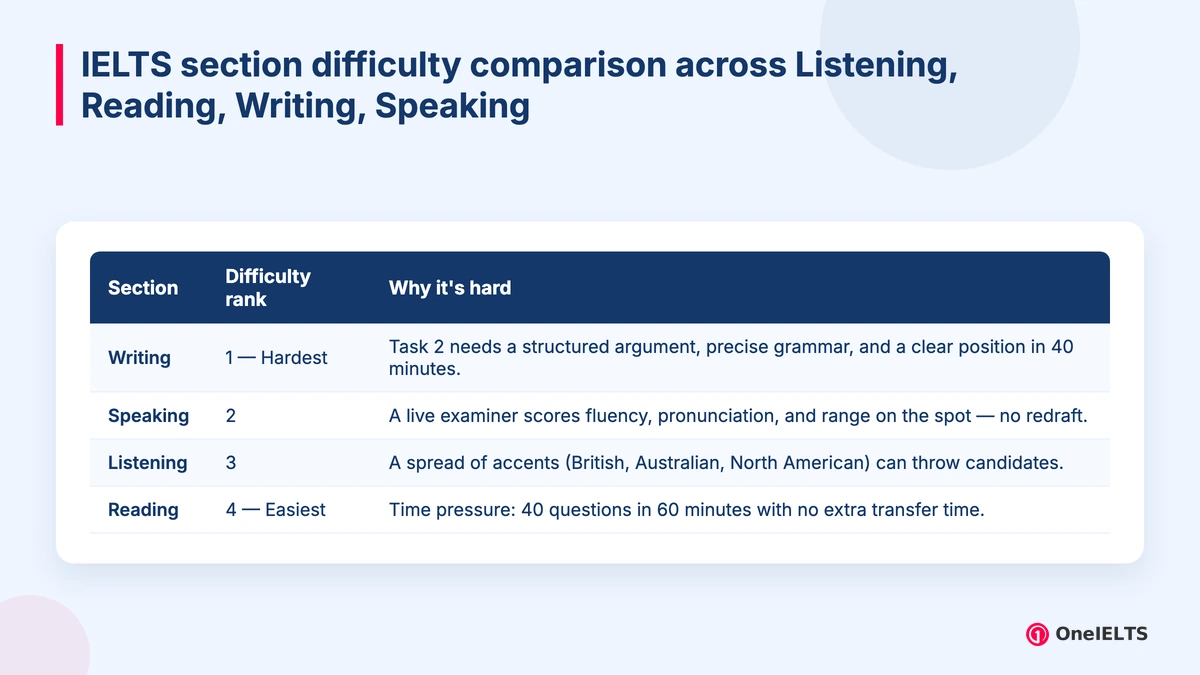
Most candidates rank the four sections in a fairly consistent order, and the reasons say a lot about where to spend study time. The sections, hardest first, appear here with what makes each one tough.
- Writing. Most test-takers name this the hardest section, because Writing Task 2 demands a structured argument, precise grammar, and a clear position inside 40 minutes.
- Speaking. A live examiner assesses your Speaking fluency, pronunciation, and range on the spot, so there is no chance to redraft an answer.
- Listening. A spread of Listening accents, from British to Australian and North American, can throw candidates who have only trained on one variety.
- Reading. The texts are manageable, but Reading time pressure is real, since you answer 40 questions in 60 minutes with no extra transfer time.
Why Do Students Find IELTS Challenging?
The struggle usually comes down to test mechanics rather than weak English, and a handful of recurring hurdles explain most lost marks. These are the challenges candidates report most often.
- Time pressure. Each section runs to a strict clock, and many candidates lose marks by not finishing rather than by answering wrongly.
- Band descriptors. Few test-takers read the band descriptors, so they never learn what a 7 actually requires versus a 6.
- Unfamiliar accents. The Listening audio mixes accents, and a single misheard name or number can cost a whole answer.
- Essay structure. A weak essay structure, not weak grammar, is the most common reason Writing scores stall below target.
- Exam nerves. Exam nerves hit hardest in Speaking, where hesitation and self-correction drag the fluency score down.
Is IELTS Difficult for Indian Students?
For most Indian students IELTS is challenging but very achievable, because English is already a medium of study. The real hurdles are accent familiarity in Listening, Writing Task 2 structure, and strict timing, not the language itself. Candidates from CBSE or ICSE English-medium backgrounds start with a clear advantage, since the medium of instruction in their schooling matches the test’s register.
The work that remains is targeted: training your ear on the range of Listening accents, drilling a repeatable Writing Task 2 template, and rehearsing under the clock. With that focused practice, a strong band is well within reach for most Indian students.
Is IELTS More Difficult Than TOEFL or PTE?
IELTS is not harder than TOEFL or PTE; it is differently structured, with a human Speaking interview and handwritten or typed Writing rather than fully computer-scored tasks. TOEFL records your spoken answers into a microphone, and PTE scores everything by algorithm, while IELTS sits you across from a real examiner.
Which test feels easier depends on your strengths, not on absolute difficulty. If you freeze in front of a person, a computer-scored format such as PTE may suit you. If you speak more naturally to a human than a machine, the IELTS Speaking interview plays to that. The content overlaps heavily, so the choice is about format fit, not which exam is objectively tougher.
How Can You Make IELTS Easier?
You make IELTS easier the same way you make any skill easier: deliberate practice aimed squarely at your weakest skill, backed by honest feedback and a clock. Generic study spreads effort thin; targeted study moves the band that is holding your overall score down. The highest-impact habits are set out below.
- Diagnose your weakest skill. Sit one full test first, then pour most of your hours into the lowest-scoring section instead of revising what you already do well.
- Get expert feedback. Self-marked Writing and Speaking plateau fast, so have a teacher or rater score your work against the band descriptors.
- Drill time management. Practise every section against the real clock, because exam-day timing is a skill you build, not a thing you hope for.
- Take regular mock tests. Full-length mock tests rebuild stamina and surface the careless errors that only appear under pressure.
How Long Does It Take to Prepare for IELTS?
Most candidates need 4-8 weeks of focused practice, though your preparation time depends on your starting level and your target band. A candidate already near their target may need only light revision. A wide gap between current and required scores stretches the timeline well beyond eight weeks, especially for half-bands above 7.0. For a structured study plan that fits your schedule, see our IELTS preparation tips.
Is a Band 7 Hard to Achieve in IELTS?
A Band 7 is achievable but demanding, requiring consistent accuracy across all four skills rather than a strong showing in just one or two. The band rewards control: precise grammar, a clear lexical range, and answers that stay on task under time pressure. Writing is usually the skill that holds candidates back at this level, because consistency in Task 2 argumentation is harder to sustain than conversational fluency. Reaching 7 means closing the small, repeated errors that a 6.5 tolerates. To see how each skill maps to the scale, read our IELTS band score guide.
Practice for the Real IELTS Exam
Apply what you’ve learned with free, exam-style practice:
- Take a full IELTS mock test
- Practice by section: Listening, Reading, Writing, Speaking
- Structure your essays with IELTS Writing templates