After your long turn, the IELTS examiner closes Speaking Part 2 with one or two short questions on the same cue card topic. These rounding off questions aren’t printed on the cue card, and a short, direct answer is all they need. This page covers only those closing questions; the cue card, preparation minute and two-minute talk have their own Part 2 guide.
You’ll see what they are, why they’re asked, how many come, whether the card shows them, how Part 2 ends, what a short talk changes, scoring and how to answer. Six cue cards follow with 20-40-word model answers and the Speaking Part 3 question each opens into.
What Are Rounding Off Questions in IELTS Speaking Part 2?
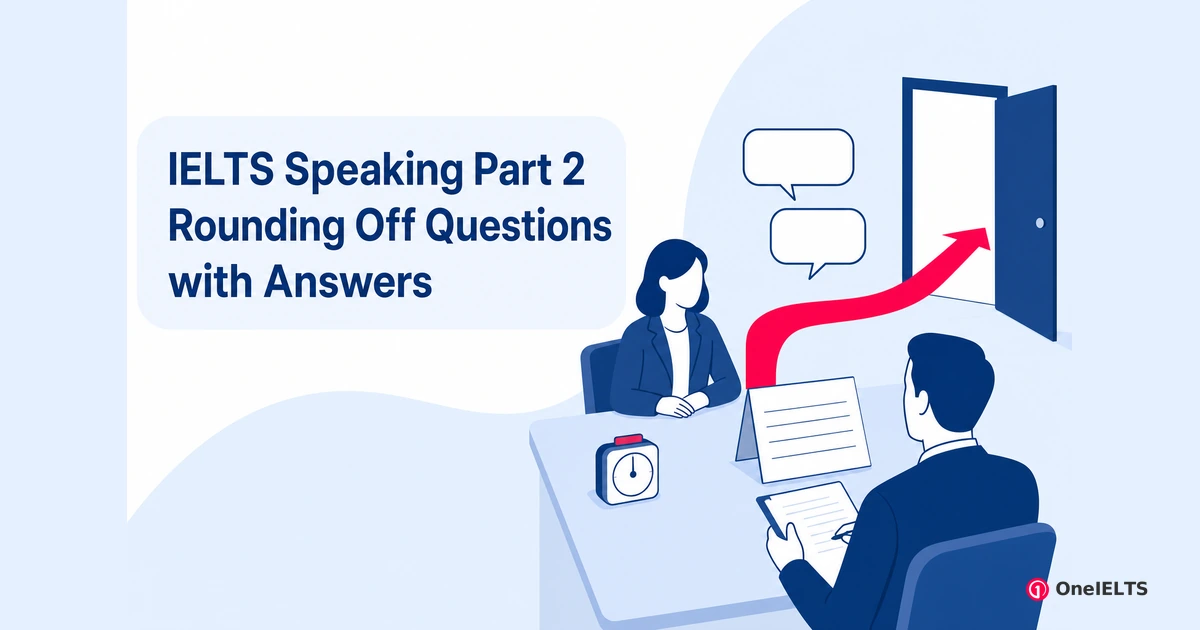
Rounding off questions are the one or two short questions an IELTS examiner asks on the same topic straight after your Part 2 talk, to close the long turn. The official Part 2 format on ielts.org (checked on 7 October 2026) says the examiner stops you when the time is up and “may then ask you one or two questions on the same topic.”
ieltspodcast calls them follow-up questions. They still belong to Part 2, even though Part 3 starts right after them. The IELTS Speaking test format page shows all three parts.
Why Does the Examiner Ask Rounding Off Questions?
The examiner asks them to close Part 2 smoothly and give you one final, short chance to show natural speaking on the topic after your prepared talk. They move the test from your long, prepared turn back to a two-way conversation.
You didn’t plan the answer in the preparation minute, so the examiner hears spontaneous speech instead of a rehearsed talk. The questions also come from the examiner script. Being asked one says nothing about how well or badly your talk went.
Are There Always Two Rounding Off Questions?
No, the examiner asks one or two rounding off questions, and the number varies from test to test. The official wording says the IELTS examiner “may” ask one or two questions, so a single question is normal, not a sign of a weak talk.
Part 2 therefore holds one cue card with three or four cue card prompts, then one or two questions. When Part 2 timing runs tight, an examiner can move straight to Part 3. That’s possible, not typical.
Are Rounding Off Questions Written on the Cue Card?
No, rounding off questions are not printed on the cue card; the examiner asks them aloud after your talk. The card carries a topic line and three or four bullet prompts, usually ending with “explain why” or “explain how you felt”.
You can’t prepare a rounding off answer in the one-minute preparation, because you haven’t heard the question yet. It stays on the same topic, though, so the notes and ideas you built for the talk still help.
How Does IELTS Speaking Part 2 End?
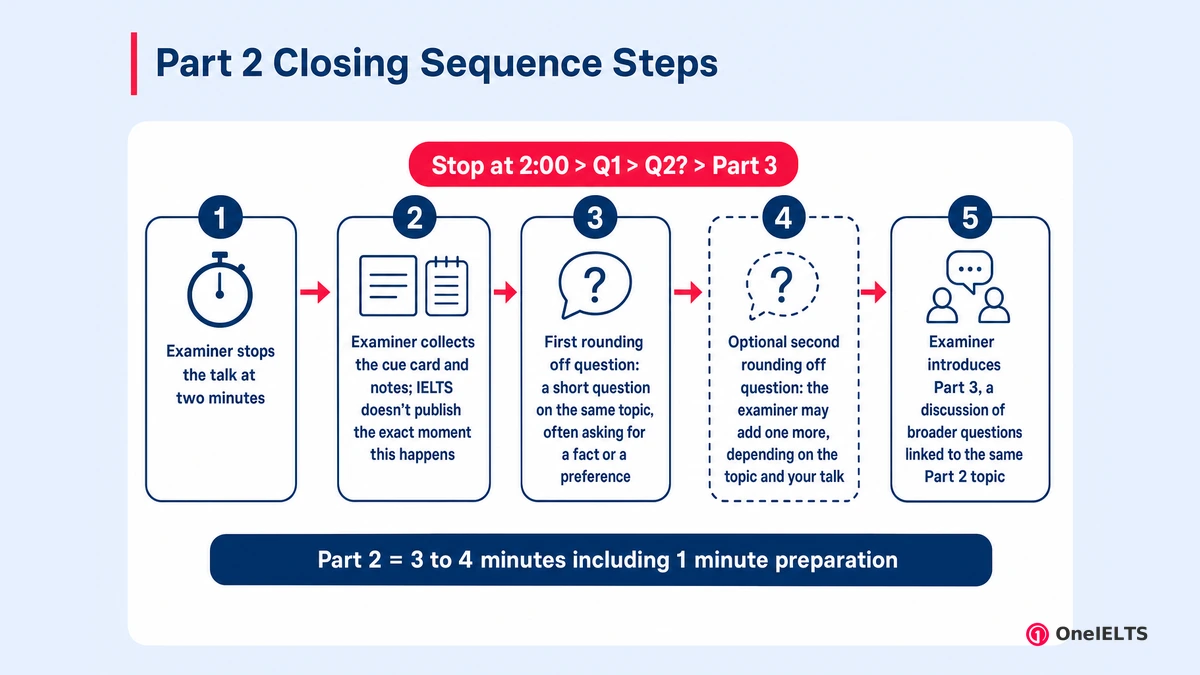
The examiner stops you at two minutes, asks one or two rounding off questions on the same topic, then moves you on to Part 3. Per ielts.org, the whole of Part 2 takes three to four minutes, including the one-minute preparation.
Five moments close Part 2, and they run in this order.
- Examiner stops the talk at two minutes; being cut off mid-sentence is normal and costs you no marks.
- Examiner collects the cue card and notes; IELTS doesn’t publish the exact moment this happens.
- First rounding off question: a short question on the same topic, often asking for a fact or a preference.
- Optional second rounding off question: the examiner may add one more, depending on the topic and your talk.
- Examiner introduces Part 3, a discussion of broader questions linked to the same Part 2 topic.
Don’t save a rehearsed conclusion for the end of your two-minute talk. The IELTS examiner stops you when the time is up, so a planned closing line often goes unsaid. Your rounding off answer becomes the last thing the examiner hears before Speaking Part 3.
What Happens If You Finish Your Part 2 Talk Before Two Minutes?
The examiner may prompt you to keep going, and the rounding off questions then come sooner. Finishing early breaks no rule, but it gives the examiner less to assess. ieltsliz.com reports the examiner prompt as “Anything else you’d like to add?”
Speaking for at least one minute is expected, and a full two-minute talk is the target. A short talk shifts more weight onto your rounding off answers, which feed the same criteria, Fluency and Coherence included.
To recover, return to bullet prompts you skipped, or add a specific example or feeling. The two-minute speech page covers the full technique.
Are Rounding Off Questions Difficult?
No, rounding off questions are usually easy, because they stay on the topic you have just spoken about and need only a short answer. They carry no separate score.
The examiner awards one Speaking band for your whole performance on four criteria: Fluency and Coherence, Lexical Resource, Grammatical Range and Accuracy, and Pronunciation. A careless one-word reply still counts as evidence. Two things make these questions feel hard. You haven’t seen them in advance, and some ask for an opinion or a comparison instead of a personal fact.
How Should You Answer Rounding Off Questions?
Answer with a direct reply, one reason or detail, and then stop, roughly one to three sentences in total. A short answer is the goal, and memorized phrases only add length without content. A yes/no question still needs a reason: “Yes, I would, because the café near my office is quieter than home.”
Six habits keep a rounding off answer brief and on target.
- Answer the question directly first, so the examiner hears your reply in the opening words.
- Add one reason or example that supports your reply, then stop before it turns into a story.
- Keep it short; this is not a second long turn, so one to three sentences is enough.
- Stay on the cue-card topic, even when the question asks about other people or a different time.
- Use a natural opener, not a memorized phrase like “That’s an interesting question,” which adds nothing.
- Ask the examiner to repeat if you missed it; asking for repetition is a normal part of conversation.
What Are Examples of Cue Cards and Rounding Off Questions?
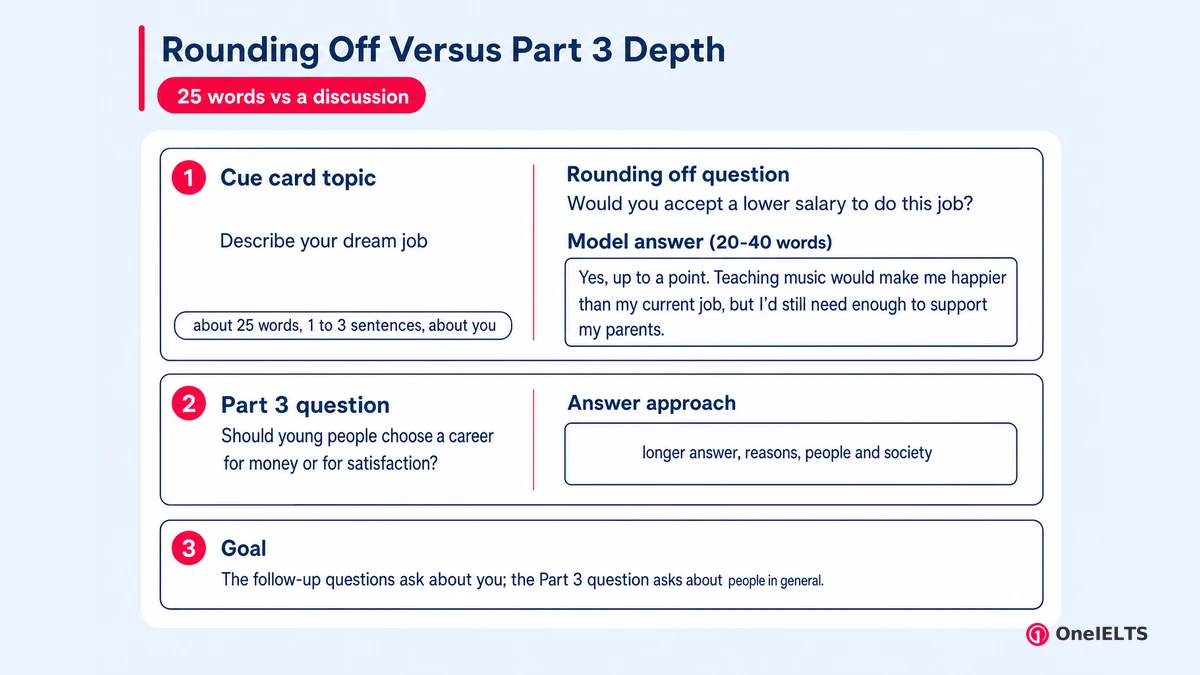
Six cue cards pair each cue card topic with a rounding off question, a model answer and the Speaking Part 3 question it opens into.
| Cue card topic | Rounding off question | Model answer (20-40 words) | Part 3 question it leads into |
|---|---|---|---|
| Describe your favorite hobby | Do you think you’ll still do this hobby in ten years? | Yes, I think so. I took up cycling to get fit, but now it’s how I switch off after work, and that need won’t disappear. | Why do some hobbies become more popular than others over time? |
| Describe a quiet place you like to visit | Do you prefer to go there alone or with other people? | Alone, mostly. It’s a small reading room in our local library, and the whole point is the silence, which disappears the moment I bring a friend. | Is it harder to find quiet places in cities today than in the past? |
| Describe a childhood friend | Are you still in touch with this friend? | Only now and then. We message on birthdays, but he moved to Dubai for work, and the time difference makes long calls hard to arrange. | Do people keep friendships longer now that social media exists? |
| Describe your dream job | Would you accept a lower salary to do this job? | Yes, up to a point. Teaching music would make me happier than my current job, but I’d still need enough to support my parents. | Should young people choose a career for money or for satisfaction? |
| Describe a book that had an effect on you | Would you recommend this book to a teenager? | Probably not yet. The story deals with grief in a slow, quiet way, and I think a reader needs a few losses of their own before it lands. | Do people read less than they did a generation ago? |
| Describe how you use technology in everyday life | Could you manage a week without your phone? | I could, but it would be awkward. I pay for almost everything through my phone, so I’d need to carry cash again for the first time in years. | Has technology made people’s lives easier or simply busier? |
Each model answer aims at a band 9 answer in style: a direct reply, one reason, natural vocabulary. The follow-up questions ask about you; the Part 3 question asks about people in general.
The most common slip in practice is a second talk of 60 or 70 words where 25 would do. More topics sit in the IELTS Speaking cue cards bank.
How Do Rounding Off Questions Lead Into IELTS Speaking Part 3?
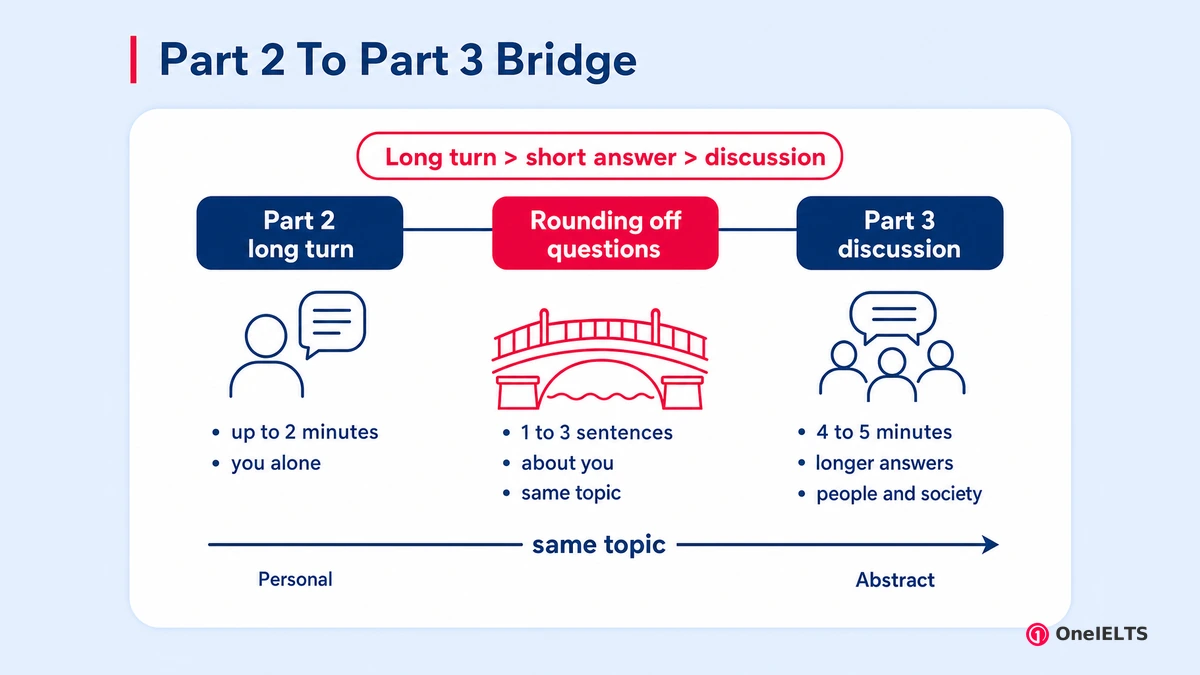
Rounding off questions are the bridge between your long turn and the Part 3 discussion. They keep the Part 2 topic but switch to short conversation, and Speaking Part 3 then takes that topic into broader, abstract questions.
The difference is depth. A rounding off answer is one to three sentences about you. Part 3 expects longer answers that give reasons about people and society. ielts.org describes Part 3 as a two-way discussion of issues linked to the Part 2 topic “in a more general and abstract way”. Your rounding off answer warms up those ideas.
What Happens in IELTS Speaking Part 2 Before the Rounding Off Questions?
The steps before the rounding off questions are the cue card, one minute of preparation with paper and pencil, and a talk of up to two minutes. IELTS provides a pencil and paper for the one-minute preparation, and the examiner stops your long turn at two minutes. Topics and sample answers for Speaking Part 2 sit in the IELTS Speaking Part 2 guide.
What Questions Come in IELTS Speaking Part 3?
The questions in Part 3 are broader discussion questions linked to the Part 2 topic, asking for opinions, comparisons and reasons. Part 3 lasts four to five minutes and expects longer answers than a rounding off question does. The IELTS Speaking Part 3 guide covers its question types.
How Long Does the Whole IELTS Speaking Test Take?
The whole IELTS Speaking test takes 11 to 14 minutes: Part 1 four to five minutes, Part 2 three to four minutes, and Part 3 four to five minutes. Rounding off questions fill the last minute or so of Speaking Part 2, after Speaking Part 1 and before Speaking Part 3. The IELTS Speaking test duration page gives the full split.
Where Can You Practice IELTS Speaking Part 2 and 3 Questions With Answers?
The best place to practice is a timed mock test that runs Part 2, its rounding off questions and Part 3 in sequence, so you get used to the switch from a long turn to short answers. For speaking practice, keep recorded answers and check each rounding off reply stays short. IELTS Speaking practice covers Part 2 and Part 3.
Written by Rifah Binte Faruk, reviewed 7 October 2026.
Last verified: 7 October 2026
Practice for the Real IELTS Exam
Apply what you’ve learned with free, exam-style practice:
- Take a free IELTS mock test — all four skills, real exam timing, AI band scoring
- Sit a Speaking section mock — timed Parts 1–3 with voice recording and band feedback
- Practice all three parts — sample questions with feedback