To hit your target band you don’t need more study hours — you need the right order. IELTS preparation is the structured work of learning the four modules, drilling each against the band descriptors, and proving progress with the mock test. It runs on a study plan, the right official resources, and steady daily practice.
The fastest gains come from diagnosing your weakest skill with one timed mock, then drilling that first, because the overall band averages all four. This guide covers what preparation involves, how to build a strategy, and how long it takes. It then walks through per-module work, the study material you need, your online, course or self-study options, daily immersion, mock tests, common mistakes, and the best resources.
Last verified: 30 June 2026
What Does IELTS Preparation Involve?
IELTS preparation means learning the four-module test format, then drilling targeted strategies for Listening, Reading, Writing and Speaking against the public band descriptors. The exam structure runs about 2 hours 45 minutes in one sitting: Listening takes 30 minutes, Reading 60 minutes, Writing 60 minutes, and the Speaking interview runs 11 to 14 minutes.
Each module has a fixed shape. Listening has 4 sections and 40 questions, Reading has 3 passages and 40 questions, and Writing splits into two tasks — a Task 1 report or letter and a Task 2 essay. Knowing those numbers before you study means nothing on test day catches you off guard.
Your overall band averages the four modules, so a single weak skill drags the whole score down. That is why a targeted strategy beats spreading effort evenly across the four skills averaged. Strong preparation pairs exam-technique drills with everyday English proficiency, because the test samples real language, not rehearsed lines. The work has two halves: knowing how each section is built, and practising the strategy that earns marks under that section’s clock.
How Do You Build an IELTS Preparation Strategy?
A working IELTS preparation strategy is diagnostic-first: you measure the test format before you study, then drill the skill that costs the most band points. Instead of opening a textbook at page one, you find your weakest module from a diagnostic mock and pour your time there, closing with a timed retest. These five steps turn that principle into a weekly routine.
- Learn the test format and timing. Study the structure, question types and clock for each module so nothing on test day surprises you and you can pace every section confidently.
- Take one full timed mock to diagnose your weakest module. Sit a complete test under exam conditions; the lowest band exposes where your overall score leaks the most and deserves attention first.
- Drill that module against its band descriptors. Read the public criteria for your weakest skill, then practise specifically to satisfy each descriptor rather than guessing what examiners reward.
- Rotate the other three modules. Keep the stronger skills sharp with shorter weekly sessions so they hold steady while your weakest module climbs toward your target band.
- Retest with timed mocks to track gains. Run a fresh timed retest roughly weekly, compare bands, and confirm the work is moving the number you actually care about.
Which IELTS Module Should You Prepare First?
Prepare your weakest module first, because the overall band is the average of four skills and lifting the lowest score raises that average fastest. Writing and Speaking usually need the most work for most candidates, since both are productive skills graded by an examiner.
Confirm your own weakest skill with a mock before you commit, then check what each level demands in our IELTS band score guide.
Can You Prepare for IELTS at Home Without Coaching?
Yes, you can prepare at home without coaching if you use official materials and timed mocks with disciplined self-review. Self-study at home suits motivated candidates who mark their own work honestly and stick to a schedule.
Coaching mainly helps with Writing Speaking feedback, where a second pair of eyes catches errors you can’t see yourself. Blend free official materials with the occasional evaluated mock, and use our IELTS preparation tips to structure that self-review.
How Many Hours a Day Should You Study for IELTS?
Study one to three hours a day, because steady daily practice beats long, irregular sessions for IELTS preparation. That one to three hours splits by gap: near-target candidates need about one hour daily, while wider gaps call for two to three hours of mixed module work.
Splitting each session into a drill and immersion pairing keeps focus, so you sharpen exam technique and widen your everyday English in the same day. Lock the daily slots into our IELTS study plan so the routine survives a busy week.
How Do You Make an IELTS Preparation Timetable?
Make a preparation timetable by counting back from your test date, giving your weakest module the most weekly slots, and fixing one timed mock each week. The test date countdown sets your deadline, the slot weighting forces effort onto the skill holding your score back, and the weekly mock checks whether the plan is working.
Split each day into drill and immersion blocks, so technique and exposure both advance without either crowding the other out. Keep the drill and immersion blocks at a fixed hour, because a slot the same time every day survives a busy week far better than a floating one.
Front-load Writing and Speaking practice in the early weeks, since these productive skills take longest to move. Build the weekly grid with our IELTS study plan template.
How Much Daily English Immersion Does IELTS Prep Need?
Beyond exam drills, daily immersion in real English builds the vocabulary range and listening range the test rewards, because the exam samples authentic academic and everyday language rather than textbook drills.
Read English newspapers and novels to widen your written vocabulary, and listen to podcasts and lectures, including TED talks, to tune your ear to natural speech. Don’t let it stay passive: shadow speakers aloud and note new collocations so input becomes active vocabulary you can deploy in Writing and Speaking.
Aim for 30 to 60 minutes of immersion daily alongside your structured practice. Steady exposure tunes your ear to connected speech and varied accents, which lifts Listening and Speaking indirectly, long before test day arrives.
Pick material slightly above your comfort level, since easy input teaches little. A news analysis podcast or a current-affairs column stretches your vocabulary range far more than light entertainment, and it mirrors the academic register the test favours.
How Do Mock Tests Fit Into IELTS Preparation?
Timed mock tests are the backbone of preparation. One timed mock test will diagnose and measure your progress: it finds your weakest module, builds the exam stamina four straight sections demand, and tracks gains in band terms.
Take a full mock at the start to set your baseline, then one per week, and review by cause — not just whether an answer was wrong, but why. Mocks also rehearse exam pacing, so you stop running out of time on Reading or Writing Task 2 on the real day.
Keep a band score log of each mock’s four results, so you can see which module’s trend is flat and redirect your drilling there. That band score log turns a pile of practice tests into a clear line you can act on, and the trend tells you whether to stay on a module or move on.
Computer-based mocks with AI evaluation, such as the ones OneIELTS runs, give realistic Writing and Speaking feedback that a self-marked paper test cannot. In practice, candidates who review mocks by error type rather than by score improve a half-band faster, because they stop repeating the same mistake.
How Long Does IELTS Preparation Take?
Most candidates need between two weeks to three months, depending on the gap between your current level vs target band. A half-band gap can close in two to four weeks, while a one-to-two-band gap usually needs two to three months.
Consistency matters more than total hours, so an hour a day beats a single weekend cram. A diagnostic mock gives the fastest diagnostic estimate: it shows your current bands against the target and tells you how far you have to travel. Expect the productive skills to lag, because Writing and Speaking move slower than Reading and Listening, so a low Writing band stretches the whole timeline.
Can You Prepare for IELTS in One Month?
Yes, one month is enough if your English is already near target band and you study with a focused daily plan. A one-month plan prioritises mock tests and your weakest module over broad revision, because there isn’t time to relearn everything.
That focused daily study drills the skill holding your score back and rehearses exam conditions repeatedly. Map it out with our IELTS study plan template.
How Do You Create a Daily IELTS Study Plan?
Build a study plan by fixing your test date, mapping weekly module targets, and scheduling a timed mock every week. The test date anchor sets your countdown, the weekly module targets break work into manageable blocks, and the weekly mock measures whether you’re on pace.
After each mock, adjust by results based on which module lags, so your effort always follows the data. Our IELTS study plan guide shows the weekly layout in detail.
How Do You Prepare for IELTS in 1 Month vs 3 Months?
How long you have changes what you focus on, not just how much you study. A one-month sprint defends a band that is already near target band, while a three-month build closes a real gap with balanced module rotation. The trade is risk against breadth, and the table below sets the two timelines side by side.
| Timeline | Best for | Daily focus | Main risk |
|---|---|---|---|
| 1 month | Candidates already near the target band | Mocks plus the single weakest module | Burnout, with no time to fix a low base |
| 3 months | Candidates one to two bands below target | Balanced module rotation plus steady immersion | Losing consistency over the longer stretch |
Pick the timeline your diagnostic mock supports, not the one your test date forces. If a one-month sprint can’t realistically close your gap, move the booking rather than gamble a band.
How Should You Prepare for Each IELTS Module?
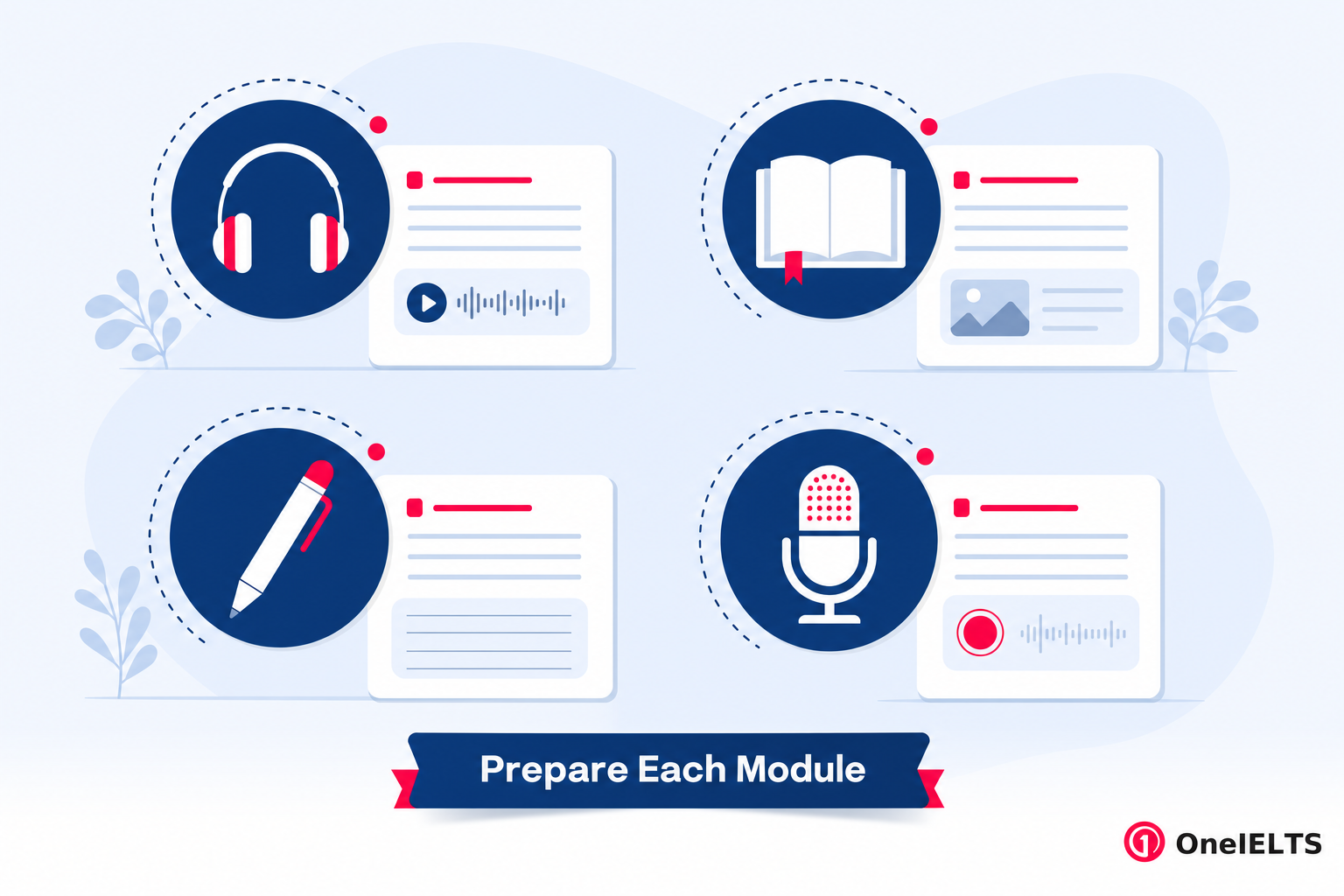
Preparation differs by module because each skill is tested and graded differently, so one study habit won’t serve all four. Listening and Reading reward speed and accuracy under the clock, while Writing and Speaking reward how you produce language against marking criteria. Each module below carries its own drill.
- Listening — use timed Listening practice with varied accents. Train on British, Australian and North American voices, sit each section to the clock, and review every wrong answer to learn whether you misheard, misspelled, or missed the cue entirely.
- Reading — build skimming and scanning Reading speed. Practise locating answers fast across long passages, since you cannot read every word in the time given, and watch the word limit on each gap-fill so a correct idea is not marked wrong.
- Writing — learn the four Writing criteria. Study task achievement, coherence, lexical resource and grammar, then practise Task 1 and Task 2 strictly to time so your planning, writing and checking all fit the real exam window.
- Speaking — practise Speaking fluency and pronunciation aloud. Speak answers out loud daily to build natural fluency and clear pronunciation, and avoid memorised answers, which examiners spot quickly and which usually drift off the actual question asked.
How Do You Prepare for IELTS Listening?
Prepare for IELTS Listening by practising with varied accents under timed conditions and reviewing every wrong answer by question type. The recording plays only once, so you train under the same one-shot pressure you’ll meet on test day.
Build note-taking and prediction so you anticipate the answer before it arrives and catch it while the audio runs. Drill each format with our IELTS listening practice tests until the question types feel routine.
How Do You Improve Grammar for IELTS Writing?
Improve grammar for IELTS Writing by fixing the recurring error types that cost band points, not by memorising every rule. The examiner scores grammatical range and accuracy, so the goal is fewer errors plus a wider mix of structures.
Drill tenses, articles and complex sentences, then check each practice essay against that grammatical range and accuracy criterion to see which mistakes repeat. Target the patterns that keep surfacing with our IELTS grammar guide.
How Do You Prepare for IELTS Reading?
Prepare for IELTS Reading by building skimming and scanning speed across all three passages and tracking the spelling and word limit on every gap-fill answer. Speed matters because you cannot read every word and still finish 40 questions in the hour.
Practise under the strict 60-minute limit, and remember Reading gives no extra transfer time, unlike Listening. Learn each question type — matching headings, True False Not Given, and sentence completion — so you read for the exact target the question asks. Sharpen that technique with our IELTS preparation tips guide.
How Do You Prepare for IELTS Speaking and Writing?
Prepare for IELTS Speaking and Writing by practising every task to time and checking your output against the four marking criteria, because these productive skills carry the most room to gain. Both are graded by an examiner, so technique against the descriptors moves the band faster than vocabulary alone. The examiner scores fluency, lexical resource, grammatical range and pronunciation, so each rehearsal targets one of those four marking criteria.
Rehearse the Speaking Part 2 long-turn answer for the full two minutes and record yourself, so you hear fillers and pronunciation slips you would otherwise miss. Plan each Writing Task 2 essay for five minutes before writing, then check it for coherence and cohesion and lexical resource against the descriptors. Tighten the language side with our IELTS grammar guide.
What Study Material Do You Need for IELTS Preparation?
The study material you need moves you from learning the format to getting graded against the criteria, and almost all of it is official or free. You gather real past papers, the band descriptors, mocks with answer keys, a language reference, and one immersion source. These five types cover what a serious candidate actually uses.
- Official Cambridge IELTS practice books with real past papers. These contain genuine retired tests, so the question types and difficulty match the real exam instead of an author’s imitation.
- A grammar and vocabulary reference. Keep one book or app on hand to fix the recurring language gaps your mocks expose, especially the structures that cap your Writing band.
- The public band descriptors for each module. These free criteria tell you exactly what examiners reward, turning vague practice into work aimed at the next half-band.
- Timed mock tests with answer keys. Full mocks with worked answers let you sit the test under pressure and then review every error by cause, not just by score.
- An immersion source such as English podcasts or newspapers. One steady stream of real English widens your vocabulary range and tunes your ear far beyond what drill questions alone can.
What Are the Best IELTS Preparation Tips?
The best IELTS preparation tip is to practise to time and review by cause, not just by score. Practising to time builds the pacing the four-module test demands, and review by cause stops you repeating the same mistake.
Read the question instructions carefully and watch the word limits on Writing and gap-fills. Keep a no memorised answers rule for Speaking and Writing, since examiners spot rehearsed lines and penalise them. Turn these habits into a routine with our IELTS preparation tips guide.
Should You Prepare for IELTS Online, in a Course, or Self-Study?
The right route depends on how much feedback you need and how much discipline you bring, since the three options trade cost against correction. The self-study route is cheapest but leaves Writing and Speaking unmarked; an online course adds graded tasks remotely; a coaching course gives the most tutor feedback at the highest cost. The table below sets the three routes side by side.
| Route | Best for | Feedback | Cost |
|---|---|---|---|
| Self-study | Motivated candidates near their target band | Low — self-review only | Free or low |
| Online course | Candidates wanting structure they can follow remotely | Medium to high — graded tasks | Paid subscription |
| In-person / coaching course | Candidates needing Writing and Speaking correction | High — tutor feedback | Highest |
Most candidates blend routes: self-study for format and drilling, then a course or evaluated mocks where the Writing and Speaking feedback actually changes the band.
Can You Prepare for IELTS Online?
Yes, you can prepare entirely online using official online prep hubs, video lessons, apps and computer-based mocks. Online prep mirrors the computer-delivered test interface, which helps directly if you book the computer format, since you rehearse the same screen, timer and answer fields.
The free vs paid split matters: free online resources cover the basics of format and practice, while paid courses add structure and feedback that self-study alone can miss. Trusted online options include British Council LearnEnglish, IDP preparation tools, reputable YouTube channels and AI-evaluated mock platforms.
Online study also removes travel time, and that remote access means a candidate in a smaller town reaches the same materials as one living next to a test centre. Remote access is the real advantage: the syllabus, the mocks and the feedback all arrive on a screen, wherever you sit, so location no longer caps the quality of your preparation.
How Long Is a Typical IELTS Preparation Course?
A typical IELTS preparation course runs four to eight weeks, though a self-paced course online lets you finish faster or stretch the work over longer. The fixed-length classes suit candidates who want a deadline and a tutor pacing them.
Choose course length by the gap between your diagnostic mock score and your target band: a half-band gap needs weeks, a two-band gap needs months. Match the syllabus to that gap with our IELTS syllabus guide.
What Are Common IELTS Preparation Mistakes to Avoid?
The mistakes below are the ones that most often cost candidates a half-band, and almost all of them come from studying without a plan or a clock. Each one is easy to fix once you name it. These five are the traps worth catching early.
- Studying every module equally instead of the weakest first. Spreading effort evenly wastes your strongest hours; the overall band is an average, so the lowest skill is where extra work pays back the most.
- Practising with no timer, so test-day pacing collapses. Working with no timer hides the real pressure, and candidates then run out of time on Reading or Writing Task 2 when the actual exam clock starts.
- Review by score only, never by error cause. A review by score only tells you where you are, not why; without diagnosing each error’s cause, you carry the same mistakes into the real test.
- Using memorised answers that examiners penalise. Memorised answers for Speaking and Writing drift off the question and trip the examiner’s radar, lowering rather than raising your band on both productive skills.
- Ignoring the public band descriptors and guessing what examiners reward. The free criteria spell out exactly what each band needs, so guessing wastes effort that targeted descriptor-led practice would convert into points.
Catch these early, and steer clear of the wider traps in our IELTS mistakes guide.
What Are the Best Resources for IELTS Preparation?
The best IELTS preparation resources fall into five categories that move you from learning the format to getting graded feedback. You start with real past papers, add official hubs and free explainers, drill in short bursts on mobile, then close the loop with evaluated mocks. The five categories that cover almost every candidate’s needs are set out here.
- Official Cambridge IELTS books (1–19). The Cambridge IELTS books contain genuine past papers, making them the most reliable source for authentic question types and realistic difficulty across all four modules.
- British Council and IDP prep hubs. The official British Council IDP hubs publish free practice tests, sample answers and exam-day guidance straight from the organisations that run the test worldwide.
- Reputable websites and YouTube channels. Trusted teaching sites and video channels explain strategies and band descriptors clearly, which suits visual learners who want a tactic demonstrated rather than only described.
- Mobile IELTS apps. Quality IELTS apps deliver short, structured practice questions and band-score tools you can use in spare minutes, keeping daily momentum between longer study sessions.
- Computer-based mock tests with AI evaluation. AI evaluation mocks, such as those from OneIELTS, score full timed tests and return Writing and Speaking feedback, closing the gap self-study usually leaves open.
Which Books Are Best for IELTS Preparation?
The official Cambridge IELTS practice book series is the best starting point, because it uses real past papers rather than imitations, so the difficulty and question types match what you’ll actually face. Add a grammar and vocabulary book alongside the Cambridge IELTS series to fix the recurring language gaps your mocks reveal. Pair it with focused language work using our IELTS grammar guide.
What Is the Best App for IELTS Preparation?
The official IELTS by IDP app is a strong free choice, with practice questions, study plans and band-score tools built in by one of the test’s own owners. The IELTS by IDP app suits short daily practice that keeps your routine alive. It should sit alongside full mocks rather than replace them, since a phone screen can’t rehearse three hours of exam stamina. See what the IDP version offers in our IELTS IDP overview.
Are Free IELTS Preparation Resources Enough?
Free resources are enough to learn the format and practise, but most candidates also need Writing Speaking feedback, because you cannot reliably grade your own productive skills against the criteria. Combine free official materials with at least a few evaluated mocks so an examiner or AI scorer can flag the errors you keep missing. Our IELTS syllabus guide shows exactly what those free materials need to cover.
Where Can You Find Free IELTS Practice Material Online?
Find free practice material on the official IELTS, British Council and IDP sites, plus reputable platforms and OneIELTS computer-based mocks. Prioritise sources that use real or realistic test material over random question dumps, because practising on inaccurate questions builds the wrong habits. Stick with the official IELTS sites and the British Council IDP hubs first, then supplement with trusted platforms and OneIELTS mocks.
Practice for the Real IELTS Exam
Apply what you’ve learned with free, exam-style practice:
- Take a full IELTS mock test
- Practice by section: Listening, Reading, Writing, Speaking
- Structure your essays with IELTS Writing templates