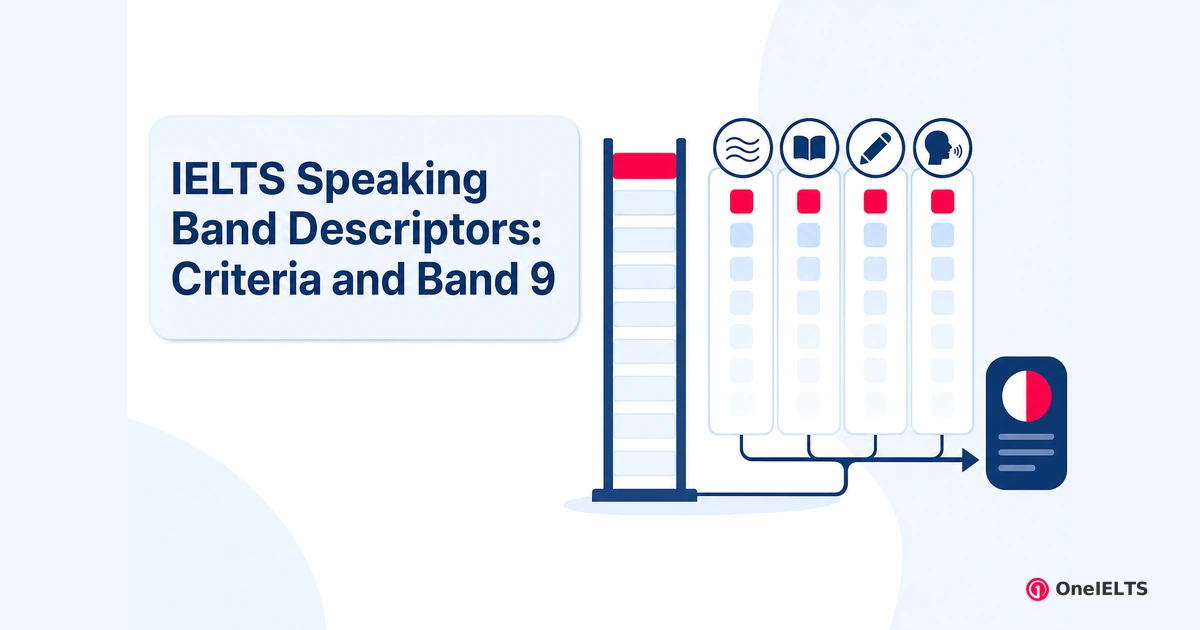
Four criteria, nine bands, one published document. The IELTS Speaking band descriptors are the statements an examiner matches your speech against to award a band from 0 to 9 on each of four assessment criteria. That band descriptor wording is released as a public version PDF, so you can read the same text the examiner works from.
Count four criteria, not five or six. One page in this niche adds a Cambridge criterion; another splits two compound names apart.
This page covers how examiners use the descriptors, who marks the test, the four criteria, and each criterion in turn. It then covers the final band calculation, which averages four bands to the nearest half band. After that come the move from band 6 to 8, what band 9 requires, whether band 7 or 6.5 is enough, which descriptor version is published, and what to study next.
What Are the IELTS Speaking Band Descriptors?
The IELTS Speaking band descriptors are the official published statement of performance at each band from 0 to 9 on four criteria. They are the text an examiner matches your speech against, and they describe performance rather than prescribing technique.
IELTS uses a nine bands scale, so every criterion carries its own band. The test owners release that descriptor wording as a public version PDF instead of keeping it internal, which means the standard is readable by any candidate.
One line shows the register. At band 9, the Fluency and Coherence wording reads: “speaks fluently with only rare repetition or self-correction; any hesitation is content-related rather than to find words or grammar.”
What each criterion measures, and how four bands become one, come further down this page.
How Are the Speaking Band Descriptors Used?
The examiner listens once, in real time, and awards a whole band per criterion by finding the description that best matches what you actually said. No error tally is kept during the test.
That makes the marking a real-time judgement rather than a scoring sheet. Four steps run from your first answer to the four figures on the examiner’s form.
- The examiner hears your performance live across the three test parts, with no replay.
- The examiner holds the four criteria separately, tracking each one on its own.
- The examiner matches each criterion to the closest matching description in the published wording.
- The examiner records four band figures, one for every criterion.
The four are independent criteria. You can be band 8 on Lexical Resource and band 6 on Fluency and Coherence in the same test, because the wording is written to allow exactly that split.
Two things the descriptors never do. They are not a checklist you tick off while speaking, and they are not applied to your ideas or opinions.
Who Marks the IELTS Speaking Test?
A trained, certified examiner marks the Speaking test, and it is the same examiner who conducts the interview. The person asking the questions awards the bands.
Live marking carries one consequence candidates miss. The marking happens once, in the room, so no line-by-line replay backs it up and no second marker sits alongside. One long silence therefore costs more here than one wrong answer would in Reading.
Examiners are certified and monitored, and the published descriptors exist to make a comparable judgement possible when two examiners hear two similar candidates. No harvested source states a re-certification interval or a monitoring frequency.
What Are the Four IELTS Speaking Assessment Criteria?
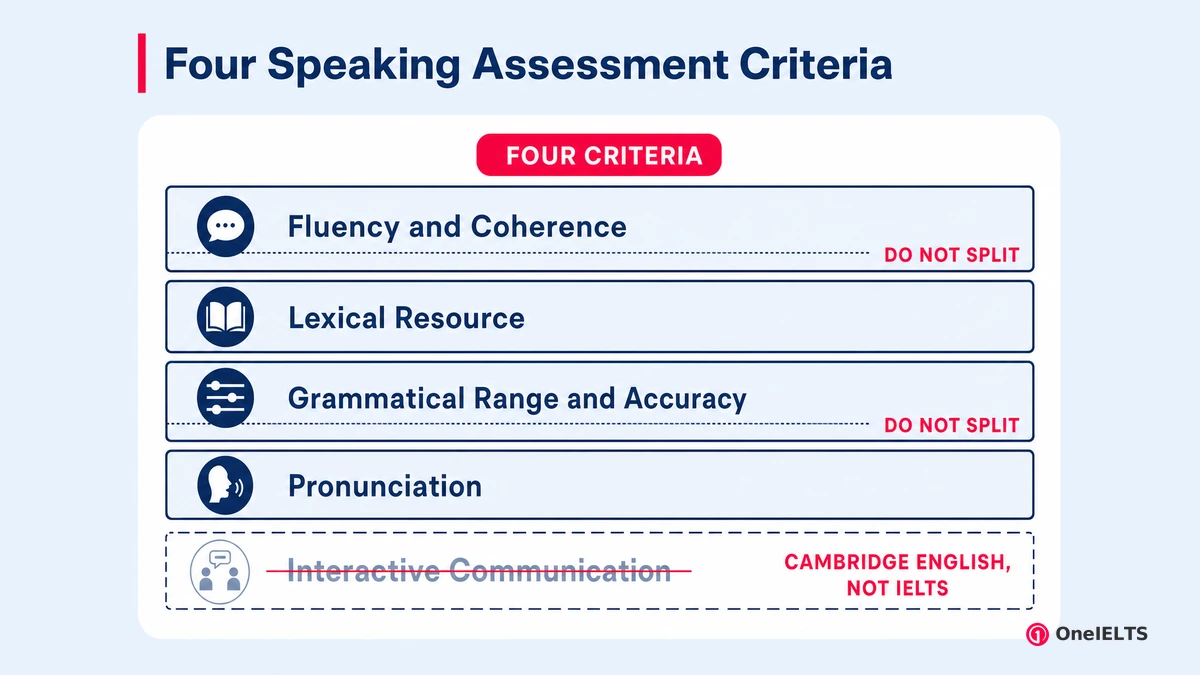
Four: Fluency and Coherence, Lexical Resource, Grammatical Range and Accuracy, and Pronunciation, each worth the same as the others. One prep provider words this as four equally weighted criteria, and the official documents print the four side by side with no weighting attached.
Four criteria not five is the count worth holding onto. Some pages add a fifth, Interactive Communication, which is a Cambridge English criterion that IELTS does not mark in Speaking.
Others state four and then print six items, because a compound criterion name gets split in the list. Fluency and Coherence becomes two entries, Grammatical Range and Accuracy becomes two more, and the count silently changes.
Four criteria, two of them with compound names. Each one gets its own section immediately after this, in the order the official document uses.
What Does Fluency and Coherence Measure?
Fluency and Coherence measures whether you can keep talking at a normal speech rate, and whether what you say hangs together. The two halves fail differently.
Fluency covers rate and hesitation. Coherence covers whether a listener can follow your answer thread from one idea to the next without doing the joining themselves.
The top of the scale turns on hesitation cause rather than hesitation count. The band 9 wording permits only the pause spent preparing what to say next, and rules out the pause spent finding words or grammar. Thinking time is not a fault; word-hunting is.
A mid-sentence pause therefore reads worse than a pause between sentences, because it signals a language search rather than a thought. Repeated self-correction sends the examiner the same signal.
What Does Lexical Resource Measure?
Lexical Resource measures your vocabulary range and how accurately and appropriately you use it. The trade runs in both directions.
Reaching for a less common item and getting the collocation wrong is visible in this criterion. So is never reaching at all, because collocation awareness only shows when you attempt something beyond the safe word.
The band 7 wording prices errors in. It credits the candidate who “uses some less common and idiomatic vocabulary and shows some awareness of style and collocation, with some inappropriate choices”, so an inappropriate choice at band 7 is priced in rather than disqualifying.
Paraphrase is the visible skill here. Not knowing a word costs you nothing if you can go round it in a clause the listener follows.
What Does Grammatical Range and Accuracy Measure?
Grammatical Range and Accuracy measures the variety of sentence structures you produce and how many of them are error-free. The two are scored together, which traps the careful candidate.
Somebody who only produces short simple sentences can be almost error-free and still be capped by structural variety. The descriptors use two measures: the proportion of error-free sentence output, and whether an error that impedes understanding appears.
A slip a listener glides past costs less than one that stops them. That is the difference the wording draws.
Two structures carry the most weight in Speaking and cost the least to practise. Build complex sentences on a subordinate clause, and hold tense consistency across a long turn, which is where a Part 2 card pushes most candidates into past narrative.
What Does Pronunciation Measure?
Pronunciation measures how easy you are to understand, and how much listener effort your speech costs. A natural accent is not penalised, and the test owners publish that position plainly.
What the criterion targets is intelligibility plus the features that carry meaning: word stress, sentence stress, and the sounds that separate one word from another.
Two habits cost marks. Mis-stressed multi-syllable words send a listener back to reconstruct what you meant, and flat sentence stress removes the signal showing which part of your answer is the point.
Neither is an accent problem. Both are stress problems, and stress is trainable on a short list of words you already use. The sound-by-sound work belongs on the pronunciation page, not here.
How Does the Examiner Arrive at Your Final Speaking Band?
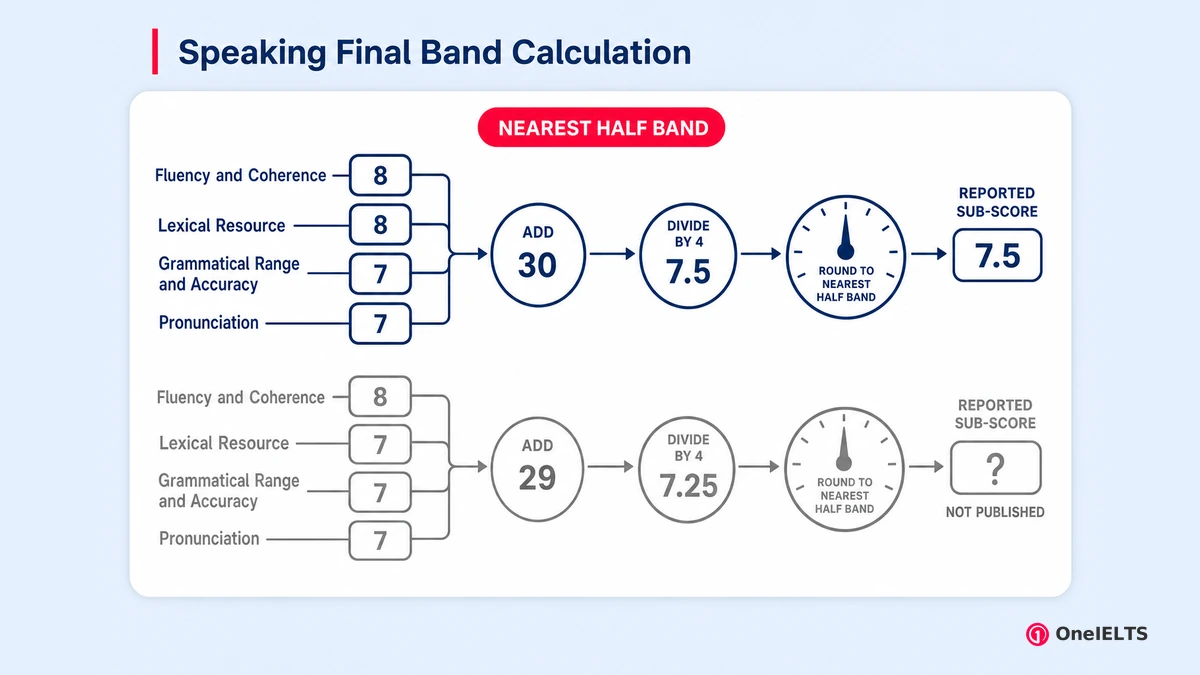
The four criterion bands are averaged, and the average is reported to the nearest half band. Add the four whole numbers, divide by four, and you have your Speaking sub-score.
That one step is the largest hole on this query. Five of the six pages harvested for this article say nothing about how four criterion bands become one, and four of those five are owned by the test owners themselves. The single page that gives any rule stops at rounding to the nearest half band, and a top-five page puts this exact question in a heading without answering it.
Five worked examples start from four whole criterion bands and run the arithmetic end to end.
| Fluency and Coherence | Lexical Resource | Grammatical Range and Accuracy | Pronunciation | Average | Reported sub-score |
|---|---|---|---|---|---|
| 7 | 7 | 7 | 7 | 7.0 | 7.0 |
| 6 | 7 | 7 | 8 | 7.0 | 7.0 |
| 8 | 8 | 7 | 7 | 7.5 | 7.5 |
| 9 | 9 | 8 | 8 | 8.5 | 8.5 |
| 8 | 7 | 7 | 7 | 7.25 | 7.5 |
Half-band rounding is the stated rule, and it is not a complete one. The published rule governs the overall band across the four skills: an average ending in.25 rounds up to the next half band, and one ending in.75 rounds up to the next whole band.
How Do You Improve from Band 6 to Band 7 or Band 8?
Change one criterion at a time. The four are judged independently, and your lowest criterion drags the average down, so lifting the weakest one moves the reported band further than polishing the strongest.
Four steps make that single-criterion focus practical.
- Find your lowest criterion from a marked mock or teacher feedback, never from a guess.
- Read only that criterion’s wording one band higher, and ignore the other three.
- Change the single behaviour that wording names, and change nothing else that week.
- Re-test on an unseen question, so the gain is not memorised content.
The 6-to-7 move is concrete in the wording rather than in generic advice. It asks for longer answers with a visible thread, and fewer mid-sentence searches for words. The commonest misread we see is a candidate drilling vocabulary lists when the criterion actually holding them at 6 is Fluency and Coherence.
Between 7 and 8, the shift is not more range. It is range that arrives without effort. If reaching for a less common word slows you down, the vocabulary is present but not yet automatic, and that automatic flexibility surfaces in Fluency and Coherence. The multi-week routine belongs on the preparation page.
How Do You Get Band 8.5 or Band 9 in IELTS Speaking?
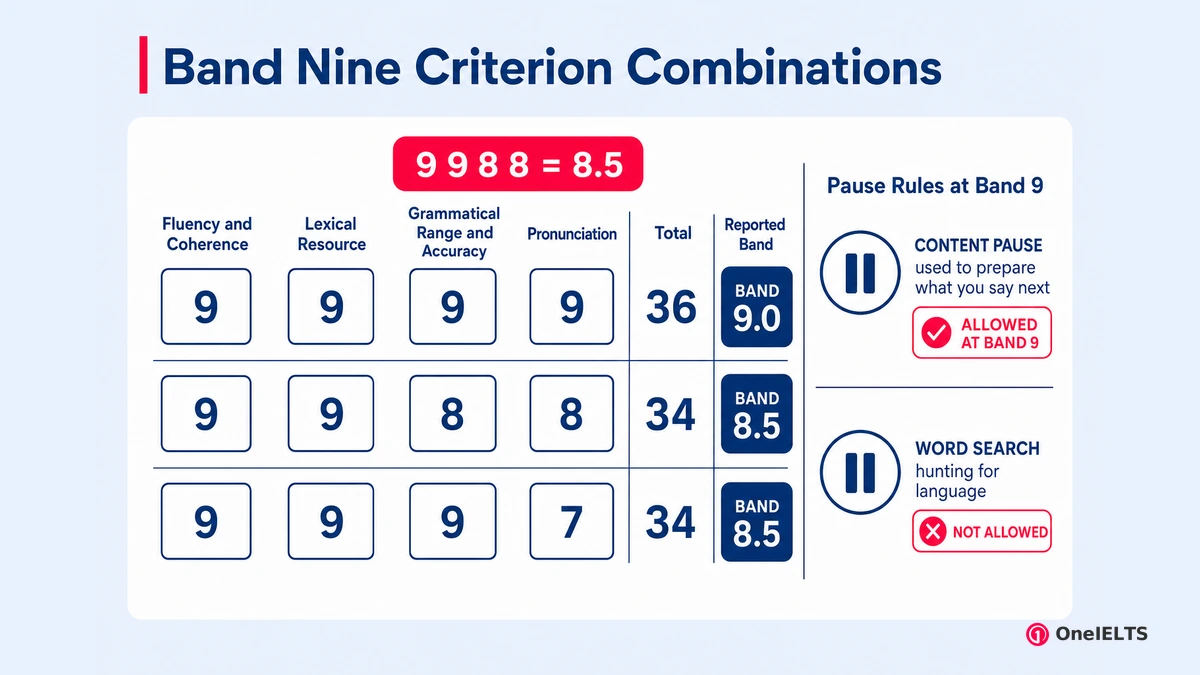
An 8.5 or 9 average needs at least three of the four criteria at the top, and the descriptors describe an absence of effort rather than a display of difficulty. Run the arithmetic and the target stops being an aspiration.
Only one criterion combination produces a reported 9.0: four nines, summing to 36. A top-band average of 8.5 has two routes, 9-9-8-8 and 9-9-9-7, both summing to 34.
Band 9 wording is where candidates misread the target. It permits hesitation used to prepare what you say next, so a content-driven pause is not a fault at all. Band 9 does not mean never pausing. It means every pause is about content rather than about hunting for language.
The live People-also-ask block on this query asks how to reach 8.5, and no harvested page answers it from the descriptor wording. The answer is arithmetic plus one behaviour, so this section stops here instead of padding out a tips list.
Test the gap under exam timing on a free IELTS Speaking mock test.
Is Band 7 in IELTS Speaking Good – and Is 6.5 Enough?
Good depends entirely on what you are applying for, so treat this as a requirement question. Band 7 clears most common Speaking requirements, and 6.5 clears many but not all.
A band is not good or bad in itself. The useful frame is sufficient not good: sufficient or insufficient against a named requirement, and that named requirement belongs to an institution or a visa route.
Check it in two moves. Find the requirement the receiving body publishes, then read both numbers in it, because a requirement is usually stated as an overall band plus a minimum in each skill.
That per-skill minimum is why a 6.5 in Speaking can block an application whose overall band is already fine. This page publishes no university, visa or professional-body Speaking figure, because requirement thresholds change and no page on this SERP sources them. Read yours from the body that sets it.
Which Speaking Band Descriptor Version Can You Actually Read?
One: the public version. The examiner version is not released to candidates.
The public version is the PDF the test owners publish for candidates and teachers, and it is the source of every descriptor phrase quoted on this page. An examiner-facing version exists for examiner training and stays an unpublished document.
Three separate searches around this query hunt for a public version PDF, an examiner version PDF and a private version, which tells you candidates believe something is being withheld. Nothing hidden would change your preparation.
The public version carries the band-by-band wording for all four criteria, and that wording is the actionable part. Download it from the test owner’s own site rather than a re-hosted copy. The public-version PDF carries no printed version date, so quote it with the date you retrieved it rather than a version number.
What Should You Study Next After the Band Descriptors?
Read one criterion’s wording, pick the behaviour it names, and practise that. A top-five competing page asks the same question and answers it with a gated download, which is a form rather than a decision. Take your lowest criterion, build a targeted routine around the single behaviour the wording describes, and rehearse it in the part of the test where that criterion shows most. The wording tells you what is measured; test-day delivery is where you show it.
What Are the IELTS Writing Band Descriptors?
The IELTS Writing band descriptors are the Writing equivalent of everything above, with a different set of four criteria. Writing is marked on Task Achievement or Task Response, Coherence and Cohesion, Lexical Resource, and Grammatical Range and Accuracy, so two of the four carry a shared criterion name with Speaking and two do not. Compare them in our IELTS Writing band descriptors guide.
What Is the Most Important Aspect of the Descriptors to Remember?
The most important aspect is that the descriptors describe your language, never your ideas. Nothing in the four criteria rewards an interesting answer, a true answer or a clever opinion. That language not content rule fixes the descriptor scope, and it makes every test-day tactic in our IELTS Speaking tips guide safe to use.
Written by Rifah Binte Faruk, reviewed 14 August 2026.
Last verified: 14 August 2026
Practice for the Real IELTS Exam
Apply what you’ve learned with free, exam-style practice:
- Take a free IELTS mock test — all four skills, real exam timing, AI band scoring
- Sit a Speaking section mock — timed Parts 1–3 with voice recording and band feedback
- Practise all three parts — sample questions with feedback