In IELTS Speaking Part 2 the examiner hands you a printed cue card, then takes it back about four minutes later. One topic line, three or four bullet points, one minute to prepare, one to two minutes to talk.
Outside the exam the same term means an actor’s prompt card, so this page settles that first. It then covers the spelling, the examiner’s reason for using a task card, and the five topic category groups.
After that come the cards reported in the current block and ten cards with sample answers. The last sections cover the follow-up questions that close the long turn, reusing one subject across a category, the PDF question, a practice routine, and the band-9 answer.
What Is a Cue Card?
A cue card is a card with words or prompts written on it that helps a speaker remember what to say. Two very different jobs hide under that one name.
On stage and on camera it is a prompt card, also called a note card. Wikipedia’s entry describes note cards that help actors and speakers remember what they have to say, and it never mentions IELTS at all. In broadcast work the card is a live prompt, swapped on the fly and read from continuously while the camera runs.
In the exam it is the printed task card the examiner gives you in Part 2. The IELTS task card is the opposite of a script. It gives you the topic and takes nothing else away, and reading from it is not the point, because your marks come from the language you build around it.
Everything from here on is about the exam card.
What Is a Cue Card in the IELTS Speaking Test?
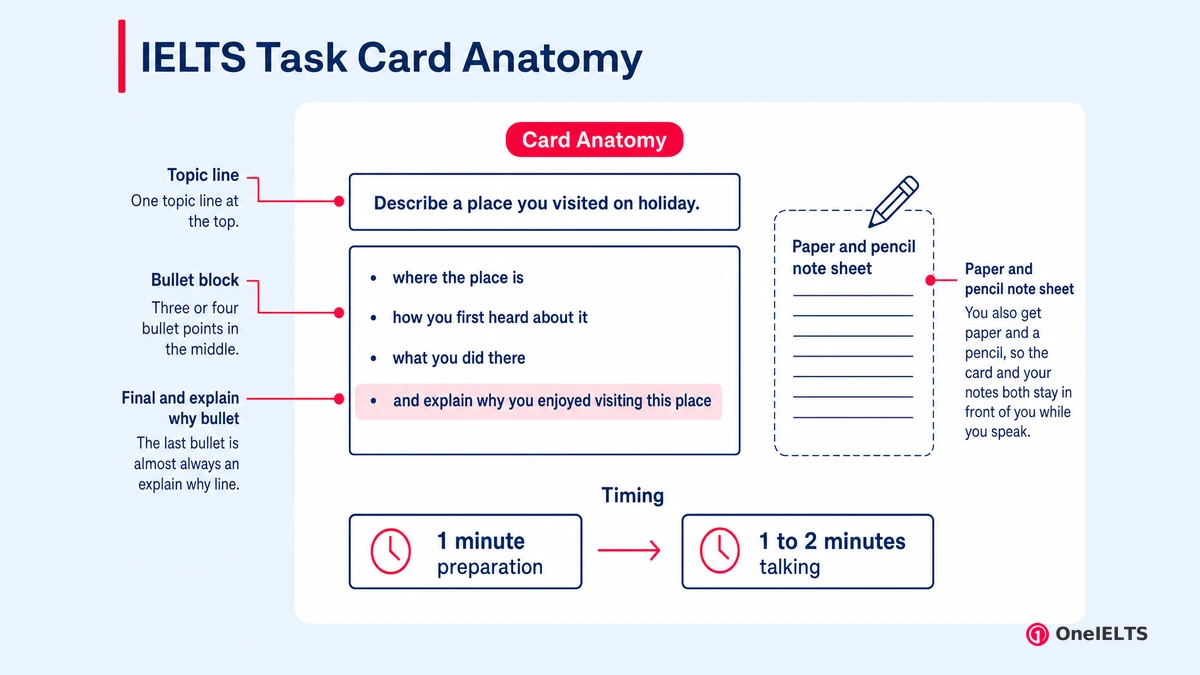
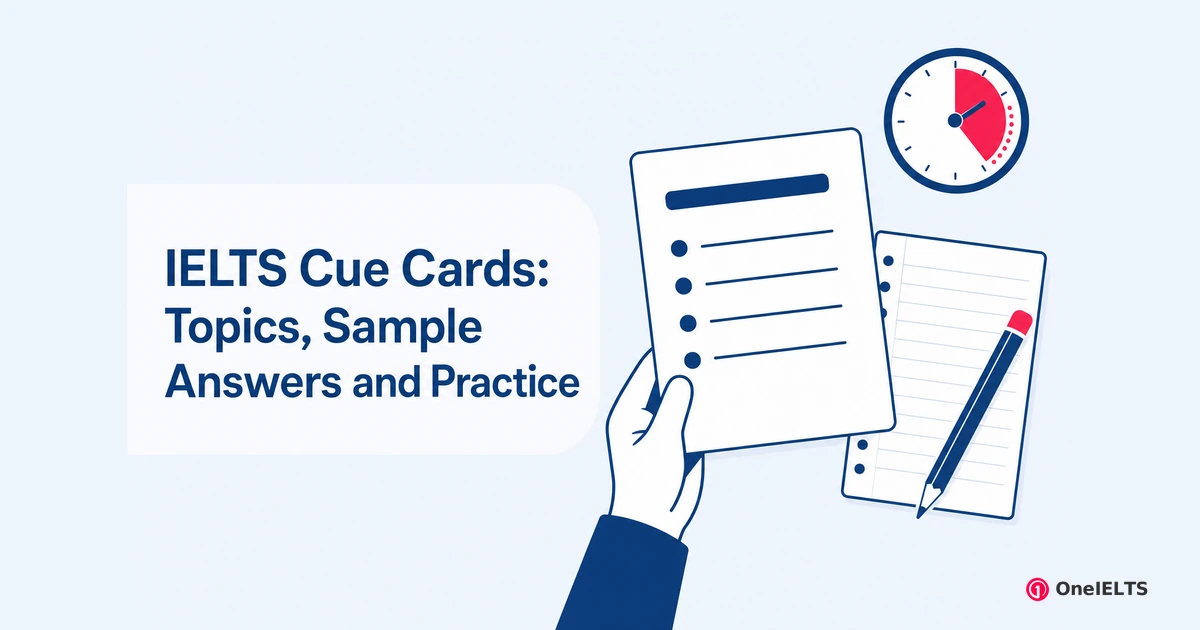
The IELTS cue card is the printed task card the examiner hands you at the start of Speaking Part 2, carrying one topic line and three or four bullet points. You keep it in front of you and talk for one to two minutes after one minute of preparation.
Google’s own summary of this query also says three or four bullet points. The count genuinely varies between cards, so treat it as a range rather than a fixed number.
Three practical details decide how the two minutes feel. The card is the only written material in the whole Speaking test. The examiner chooses it, and you cannot ask for a different one. You also get paper and a pencil, so the card and your notes both stay in front of you while you speak.
The last bullet is almost always an explain why line, and that is the bullet the examiner most wants answered. This page owns the cards themselves. The long turn as a method, meaning the note format and the shape of the answer, belongs to the Part 2 guide linked further down.
Is It Que Card or Cue Card?
Cue card. Que is not a word in English, and queue means a line of people, so the exam term is always cue.
Three misspellings turn up in search boxes. Que card borrows a real Spanish and French word that does not exist in English. Queue card borrows the British word for a line of people waiting. Q card is a broadcast label for a hand-held prompt, and no test owner uses it.
The origin explains the exam use. A theatre cue is a signal to speak, the moment an actor’s line begins, and the card does the same job for you. Search or ask a teacher using the cue card spelling and you get IELTS material; use the other three and you land in language forums.
Why Does the IELTS Examiner Give You a Cue Card?
To make you produce two minutes of unbroken speech on a subject you did not choose. IDP publishes the purpose plainly, stating that cue card questions evaluate your fluency, coherence, vocabulary, pronunciation, and ability to organise ideas.
Fluency and coherence is one of the four criteria your Speaking band is built from, and the long turn is where an examiner hears it without interrupting. The assessment purpose also explains the topics. Every card sets a personal, descriptive topic, so no outside knowledge is required, and an honest answer about a dull object scores better than an invented one about a fascinating object.
The bullet points exist so that nobody runs out of material, and so that every candidate is measured on the same four or five moves. For two minutes the examiner asks nothing at all, which leaves your skill at organising ideas fully exposed. This is the one part of the test where hesitation has nowhere to hide.
What Are the Main Categories of IELTS Cue Card Topics?
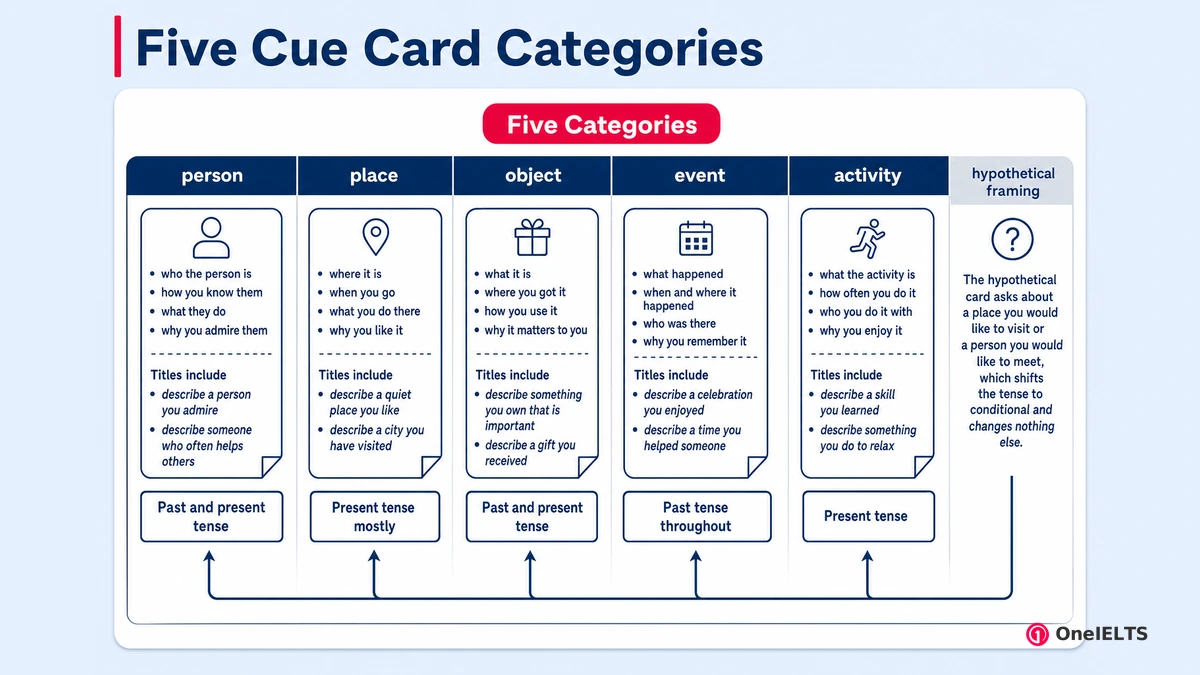
Five. A person, a place, an object, an event and an activity cover almost every card ever set.
The topic category matters more than the individual card, because categories stay stable while cards rotate. Three unrelated sites reach the same five on their own.
Keith Speaking Academy heads its cards Describe a Person, an Event, an Object, a Place and an Activity. IELTS Liz writes “an object (thing), a person, a place, an event (occasion) or an activity”, and IELTS Advantage groups its cards into person, object, experience, place and future-hypothetical. A taxonomy three competitors reach independently is a specification, not an opinion.
Each category carries its own bullet pattern, its own tense and two sample titles.
- Person card. Bullets ask who the person is, how you know them, what they do, and why you admire them. Past and present tense. Titles include describe a person you admire and describe someone who often helps others.
- Place card. Bullets ask where it is, when you go, what you do there, and why you like it. Present tense mostly. Titles include describe a quiet place you like and describe a city you have visited.
- Object card. Bullets ask what it is, where you got it, how you use it, and why it matters to you. Past and present tense. Titles include describe something you own that is important and describe a gift you received.
- Event card. Bullets ask what happened, when and where it happened, who was there, and why you remember it. Past tense throughout. Titles include describe a celebration you enjoyed and describe a time you helped someone.
- Activity card. Bullets ask what the activity is, how often you do it, who you do it with, and why you enjoy it. Present tense. Titles include describe a skill you learned and describe something you do to relax.
A sixth framing is not quite a category of its own. The hypothetical card asks about a place you would like to visit or a person you would like to meet, which shifts the tense to conditional and changes nothing else.
Which IELTS Cue Cards Are Current in 2026?
Cue cards rotate in roughly four-month blocks, so a current list is one stamped with a date, and the cards reported from the most recent block are the ones worth rehearsing.
Card rotation works in blocks of about four months. Each four-month block brings a partly new set and keeps a large share of the old one, which is why cards repeat across blocks and across years. A dated list of forty cards beats an undated list of three hundred, because you can tell what you are actually rehearsing. That repetition is also the argument for preparing by category instead of card by card.
Every list of this kind, including this one, is built from candidate reports rather than published exam material. A recently reported card is a strong bet, not a guarantee. The block label and refresh schedule sit at the top of the list so you can check its age before you trust it.
Ten reported cards from the current block sit under the five categories, each printed with its own bullets.
Person
- Describe a person you admire for their patience. You should say who the person is, how you know them, what they do, and explain why their patience impresses you.
- Describe an older person you enjoy talking to. You should say who the person is, how you know them, what you talk about, and explain why you enjoy talking to them.
Place
- Describe a quiet place you like to go. You should say where it is, how often you go there, what you do there, and explain why you find it quiet.
- Describe a city you would like to live in. You should say which city it is, how you heard about it, what you know about it, and explain why you would live there.
Object
- Describe something you own that you would never sell. You should say what it is, where you got it, how often you use it, and explain why you would never sell it.
- Describe an app on your phone that you use a lot. You should say what the app is, when you started using it, what you use it for, and explain why you use it so often.
Event
- Describe a celebration you remember well. You should say what the celebration was, where it happened, who was there, and explain why you remember it.
- Describe a time you helped someone. You should say who you helped, what the problem was, what you did, and explain why it mattered to that person.
Activity
- Describe a skill you learned outside school. You should say what the skill is, when you learned it, how you learned it, and explain why you wanted to learn it.
- Describe something you do to stay healthy. You should say what you do, how often you do it, when you started, and explain why you chose it.
What Are the Most Common IELTS Cue Cards with Sample Answers?
About ten cards recur often enough to be worth a full rehearsed answer, and each one needs the card verbatim, a set of prep notes and one spoken model.
Read every model here for its shape, never for its content. A memorised answer bent onto a different card is audible inside ten seconds, and an examiner who believes an answer was memorised is entitled to disregard the language in it. What you are copying is the order of the moves, the level of detail, and the way the explain-why line gets its own ending.
Each model runs about two minutes at a normal spoken pace. Time it rather than estimate it, and record the first three, because a fifth of the top ten results on this query is video of somebody speaking a cue-card answer. Length that only works on paper is no use in the room.
Ten cards follow, each with its bullets, the notes a candidate would really write, a model and the category it belongs to.
Card 1. Describe an older person you enjoy talking to. You should say who the person is, how you know them, what you talk about, and explain why you enjoy talking to them.
Prep notes. Nani, 78, Nagpur / Sunday calls / old stories, cooking / no rush, real listener
Model answer. The older person I most enjoy talking to is my grandmother, my Nani, who is seventy-eight and lives in Nagpur. I have known her all my life, obviously, but we only started talking properly about six years ago, when I moved away for college and began calling her every Sunday evening.
We talk about very ordinary things. She tells me what she cooked, who visited, which neighbour is annoying her that week. Then she drifts into older stories, about moving cities as a young married woman with two suitcases and no Hindi. I ask a lot of questions at that point, because those stories are not written down anywhere.
What I enjoy is the pace. She never checks the time and she never rushes to give advice. If I say something stupid she just laughs and moves on, which almost nobody else in my family does. She also listens in a way my friends do not, without waiting for her turn to speak.
So I would say it is the calm more than the content. Twenty minutes with her resets my week, and I usually put the phone down feeling lighter than when I picked it up.
Category. Person card, mixed past and present tense.
Card 2. Describe someone who taught you something useful. You should say who the person is, what they taught you, how they taught you, and explain why it was useful.
Prep notes. Ravi, cycle stall, class 8 / chain slipping / gave me the spanner / still fix my own
Model answer. The person who taught me something genuinely useful is Ravi, a neighbour who ran a small cycle repair stall at the end of our lane. I was in class eight and my bicycle chain kept slipping, so I pushed it down to him about twice a week.
The third time, he refused to fix it. He put the spanner in my hand and told me to do it while he watched. It took me forty minutes and I got grease on my school shirt, but I have never paid anyone to fix a chain since.
He taught by making me do the thing, which is very different from being told how. He only stepped in when I was about to break something. He also explained why the chain slipped in the first place, so I understood the fault instead of just the repair.
It is useful in a practical sense, because I still service my own bike. It is more useful as a habit, though. When something breaks now, my first instinct is to open it and look, rather than to find someone to hand it to.
Category. Person card, past tense with a present-tense ending.
Card 3. Describe a quiet place you like to go. You should say where it is, how often you go there, what you do there, and explain why you find it quiet.
Prep notes. Terrace, Pune flat / 6 am, 4 times a week / chai and a book / city sounds like weather
Model answer. The quiet place I go to most is the terrace of our apartment building in Pune. It is nothing special to look at, just a concrete floor, a water tank and some washing lines, but at six in the morning it is completely empty.
I go up about four times a week, usually with tea and whatever I am reading. I stay maybe forty minutes, until the first scooters start in the lane and somebody comes to collect their clothes.
What I do there is not much. I read, I drink the tea slowly, and sometimes I just watch the crows fight over the water tank. In exam weeks I take my notes up and revise, because nothing interrupts me.
It is quiet in a strange way, because the city is right there underneath. You can hear it, but it is far enough down to sound like weather rather than traffic. My room is quieter in decibels, and yet the terrace is where my head actually goes quiet. Forty minutes up there is worth two hours anywhere else.
Category. Place card, present tense.
Card 4. Describe a city you would like to live in. You should say which city it is, how you know about it, what you would do there, and explain why you would like to live there.
Prep notes. Lisbon / cousin worked there 2 years / small, walkable, sea / cheaper than London / slower
Model answer. The city I would most like to live in is Lisbon. I have never been, which probably makes this a fantasy, but my cousin worked there for two years and her photographs and stories have stayed with me.
It appeals to me for practical reasons first. It is small enough to cross on foot or by tram, and it sits on the sea, so you are never far from open water. The cost of living is also far lower than London or Dublin, which matters if you are moving for work rather than for money.
The other reason is the pace. My cousin said people eat dinner late, work stops properly at the end of the day, and nobody treats being busy as an achievement. That sounds like the opposite of my last three years.
I would want a year there rather than forever. I would miss my family and I would definitely miss the food here. But I would like to find out whether a slower city changes the way I work, or whether I would just carry the same rush with me.
Category. Place card, hypothetical framing in the conditional.
Card 5. Describe something you own that you would never sell. You should say what it is, where you got it, how often you use it, and explain why you would never sell it.
Prep notes. Dad’s HMT watch, 1986 first salary / mechanical, wind it daily / wore it to my viva / worth 2,000
Model answer. The thing I would never sell is my father’s watch, an HMT mechanical he bought in 1986 with his first salary. It is steel, slightly scratched, with a cream face that has gone a little yellow.
He gave it to me when I finished my degree. It is mechanical, so there is no battery, and if you forget to wind it for a day it simply stops. I wind it most mornings, and those thirty seconds have quietly become part of getting ready.
I wear it for anything that matters. I wore it to my viva and to both of my job interviews, not because I think it is lucky, but because it makes me feel like an adult in a room full of adults.
In money terms it is worth very little. A jeweller in Camp offered me around two thousand rupees for it, which tells you everything. It is the only object I own that my father used every single day for thirty years, and nothing on sale anywhere replaces that.
Category. Object card, past and present tense.
Card 6. Describe an app on your phone that you use a lot. You should say what the app is, when you started using it, what you use it for, and explain why you use it so often.
Prep notes. Splitwise / flat of four / gas cylinder argument / rent, groceries, autos / settle on the 1st
Model answer. The app I open most, after the obvious ones, is Splitwise. I share a flat with three other people, and it is the only reason we are still on speaking terms.
I downloaded it in my first month here, after an argument about a gas cylinder that nobody wanted to pay for. Now everything goes in, the rent, the groceries, the internet bill, even small things like a shared auto fare.
It works very simply. You add what you paid and who it was for, and the app keeps a running total of who owes whom. On the first of every month we settle up, and that takes about two minutes instead of a whole evening of arguing.
I use it five or six times a week. What I like is that it removes the awkwardness, because nobody has to ask a friend for two hundred rupees when the app has already asked for them. It also keeps a history, so an old disagreement can be checked instead of remembered.
Category. Object card, present tense.
Card 7. Describe a celebration you remember well. You should say what the celebration was, where it happened, who was there, and explain why you remember it.
Prep notes. Diwali 2021, Nashik, uncle’s house / first one after lockdown / 30 people / cousins cooked / power cut at 9
Model answer. The celebration I remember best is Diwali in 2021, the first one after the lockdowns. It was at my uncle’s house in Nashik, and about thirty of us came, which had not happened for two years.
Everyone arrived by the afternoon. The cousins were put in charge of the food for the first time, so we made far too much of it, and the diyas were lit late because we were still arguing about the chakli.
The part everybody talks about now is the power cut. The lights went at around nine, right in the middle of dinner, and instead of complaining we carried the food up and ate by the diyas on the terrace. Somebody found a speaker with a charged battery, and it turned into the best two hours of the night.
I remember it because of what came before it. The two Diwalis before that were phone calls and photographs, so a house that full felt like something had been handed back to us.
Category. Event card, past tense.
Card 8. Describe a time you helped someone. You should say who you helped, what the problem was, what you did, and explain why it mattered to that person.
Prep notes. Neighbour aunty, about 70 / hospital booking online, QR code letter / no smartphone / 2 hours / called back after
Model answer. A time I helped someone that I still think about is when I filled in a hospital form for our neighbour. She is about seventy, lives alone, and her appointment had to be booked through a website.
She rang our doorbell holding a printed letter with a QR code on it, which tells you how badly designed the process was. She does not use a smartphone, and the helpline had put her on hold twice that morning.
It took us nearly two hours at my laptop. Half of that was hunting for her old records, and the rest was the site logging us out. I booked the slot, printed the confirmation and wrote the date in large letters across the top of the page.
What made it worth doing was the follow-up. She called a week later to say she had been seen and the report was fine. Ninety minutes of typing for me was the difference between getting treated and giving up for her.
Category. Event card, past tense.
Card 9. Describe a skill you learned outside school. You should say what the skill is, when you learned it, how you learned it, and explain why you wanted to learn it.
Prep notes. Swimming at 19 / municipal pool near station / coach Sunil, 6 am group / 4 months / deep end fear
Model answer. The skill I learned outside school is swimming, and I learned it late, at nineteen. I grew up in a town with no pool, so I simply never got round to it until my second year of college.
I joined the municipal pool near the station, because a month there cost less than two coffees. A coach called Sunil taught the six o’clock group, mostly children and three embarrassed adults, including me.
It took about four months to be comfortable. The first six weeks were entirely about breathing, and I hated them. The hard part was never the technique, it was the deep end, because I had built up a real fear of it over nineteen years.
The day I crossed the deep end without stopping is one of the few things I can still picture clearly. I swim twice a week now, and it is the only exercise I have ever kept up. Learning something physical as an adult also taught me that being bad at it in public is survivable.
Category. Activity card, past tense with a present-tense ending.
Card 10. Describe something you do to stay healthy. You should say what you do, how often you do it, when you started, and explain why you chose it.
Prep notes. Evening walk, 45 min / university ground / since January / podcast or nothing / back pain gone
Model answer. The main thing I do to stay healthy is walk in the evenings. It is not impressive, but it is the only routine I have kept for more than a few months.
I go out at about half past seven, once work is finished, and I walk for forty-five minutes around the university ground near my flat. I have done it most days since January, so it is nearly a year now.
I do not take calls. I either listen to a podcast or to nothing at all, and that part is what actually helps. Sitting for nine hours a day had given me a sore lower back and a stiff knee, and both of those faded within two months of starting.
I chose walking because it needs no equipment, no membership and no partner. Gyms have defeated me twice. Walking asks almost nothing of me except that I put my shoes on, and that low bar is exactly why it survived when everything else stopped.
Category. Activity card, present tense.
How Do You Use the Follow-Up Questions on a Cue Card?
After your two minutes the examiner asks one or two short questions on the same card. These are officially rounding-off questions, and the expected answer is a sentence or two, not a second long turn.
They are predictable, because they do one of two things. A narrowing follow-up picks one detail you mentioned and asks about that, so an answer about your grandmother turns into a question about how often you call her. A valuing follow-up asks whether the thing is worth something. The British Council publishes exactly that pair for its own card about an important object, asking “is it valuable in terms of money?” and “would it be easy to replace?”.
The error candidates make is length. A follow-up answered for ninety seconds forces the examiner to interrupt you, because they are closing the part, not opening Part 3. A short answer with one reason attached hits the target.
Almost no prep page prints these next to its cards, and Google’s AI Overview mentions follow-up questions without naming or explaining them, so most candidates meet one for the first time in the exam.
Each card above carries two likely follow-ups, one narrowing and one valuing.
| Card | Narrowing follow-up | Valuing follow-up |
|---|---|---|
| An older person you enjoy talking to | Do you talk to her about work as well? | Is time with older relatives valued in your family? |
| Someone who taught you something useful | Did you stay in touch with him? | Is a practical skill worth more than a course? |
| A quiet place you like to go | Do you ever go there with anyone? | Is quiet easy to find in your city? |
| A city you would like to live in | What would you do there in your first week? | Is moving abroad worth the cost? |
| Something you own that you would never sell | How often do you actually wear it? | Would it be easy to replace? |
| An app on your phone that you use a lot | Who else in the flat uses it? | Is an app like that worth paying for? |
| A celebration you remember well | Who did most of the cooking? | Are large family gatherings still important? |
| A time you helped someone | Did she ask you directly for help? | Is helping neighbours common where you live? |
| A skill you learned outside school | How often do you swim now? | Is a skill harder to learn as an adult? |
| Something you do to stay healthy | Do you walk alone or with someone? | Is walking enough exercise on its own? |
How Do You Reuse One Answer Across Several IELTS Cue Cards?
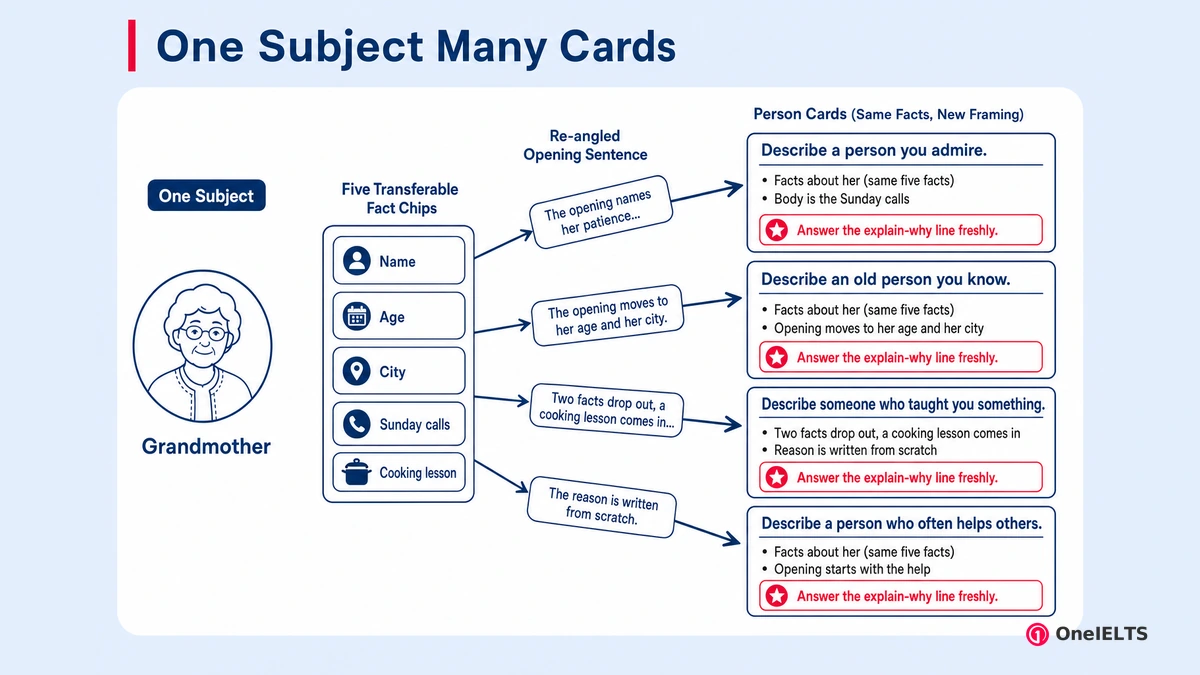
Prepare one real subject per category, then re-angle it to whatever the card asks. The same grandmother answers a person you admire, an old person you know, someone who taught you something and a person who often helps others.
This works because three independent sources reduce every card to the same five categories, so five prepared subjects cover the whole field. The facts about a subject travel between cards untouched. Only the framing has to move.
Five steps turn one prepared subject into an answer for any card in its category.
- Pick one subject per category. Choose one person, one place, one object, one event and one activity you genuinely know well, then stop changing your mind and keep those five for good.
- List the transferable facts. Write the four or five facts about each subject you can always say, such as names, dates, numbers, and one small story that carries real detail.
- Match the bullets to your facts. Spend thirty seconds pairing each printed bullet with a fact you already hold, and mark the bullet that has nothing attached to it yet.
- Re-angle the opening sentence. Rewrite your first line in the card’s own wording, so a re-angled opening for a helpful person starts with the help rather than with your admiration.
- Answer the explain-why line freshly. Build a fresh reason out of the card’s own question, because that bullet is the one part where an examiner can hear you reusing an answer.
Take the grandmother through three cards from the same category. On describe a person you admire, the opening names her patience and the body is the Sunday calls. On describe an old person you know, every fact stays and the opening moves to her age and her city. On describe someone who taught you something, two facts drop out, a cooking lesson comes in, and the reason is written from scratch.
The line between reuse and cheating is exact. Reusing the subject is preparation, while reciting memorised sentences is memorising, and the second one is audible. An examiner who believes your answer was memorised is entitled to disregard the language in it, which turns a strong answer into no answer at all.
Is There an IELTS Cue Card PDF You Can Download?
Yes. A dated download is the only kind worth having, because a cue-card PDF goes stale the moment the cards rotate.
Two related searches on this query ask for a PDF and a third asks for a Part 2 PDF, so the demand is real. What sits behind it is offline rehearsal on a phone during a commute, not a wish for a document. A download built for that puts the cards and bullets on the first pages, the model answers after them, and stays a printable list on A4.
The warning is the important half. Undated cue-card PDFs circulate for years, and a stale card list is worse than no list, because you cannot tell which block it came from. Check anything you download, including anything you take from this page, against a dated list.
How Should You Practise with IELTS Cue Cards?
One unseen card a day. One minute on a timer to prepare, two minutes recorded, then two listens, one for the clock and one for whether every bullet got answered.
Unseen cards are the whole point of the drill. Rehearsing the ten cards on this page until they are perfect, then meeting an eleventh in the exam, is the exact failure this routine prevents. Rehearse five prepared subjects and practise on cards you have never read, which is the reverse of what most candidates do.
Listen back to ten of your own recordings and the pattern repeats. The answer dies at about ninety seconds with one bullet unanswered, and the last thirty seconds turn into repetition. That is a preparation fault rather than a grammar fault, and only a recording shows it to you.
This is also the one part of the Speaking test that needs no partner, because the long turn is a monologue against a clock. The recording replaces the partner, since the failures here are audible rather than visible.
The daily routine takes eight minutes and runs in five steps.
- Draw an unseen card. Pick a card you have not read, from a dated list or a random generator, and start it without skimming first, because the surprise is the point.
- Set a one minute timer. Take one minute with paper and a pencil, write prompt words only, and stop the moment the one minute timer sounds, even mid-word.
- Record two minutes on your phone. Talk into a phone recording for the full two minutes without stopping, and keep going even when a sentence collapses on you halfway through.
- Run a bullet check. Play the recording once against the printed bullets, then mark any bullet you missed, since a skipped bullet costs you more than a stumble does.
- Answer the follow-ups in one sentence. Finish with the card’s likely rounding-off questions, one sentence for each, so that stopping short becomes a habit.
The sixty-second preparation protocol itself, the note format and the answer structure all belong to the Part 2 guide, and the multi-week study plan belongs to the preparation page.
The IELTS Speaking cue card practice filter holds unseen cards. Draw the daily one from there, on a free account.
How Do You Get a Band 9 Answer from an IELTS Cue Card?
A band-9 answer is not a better card. It is a real subject answered in the card’s own terms for the full two minutes. The card is only a prompt, and the language that scores is language you already own about something you actually know.
Three implications fall out of the page above. A long card list buys you card exposure rather than memorisation, so the value of this page is the number of cards you have seen, not the number you have rehearsed. Five prepared subjects beat fifty prepared answers, because the categories hold while the cards rotate. The card that looks impossible is nearly always one re-angled answer away from a subject you already hold.
Google’s own summary of this query ends by offering to write you a sample answer if you tell it the card. That is exactly the wrong instinct. The skill being marked is producing the answer under a clock, and produced language is what the band descriptors measure, so an answer you did not build yourself is worth nothing in the room.
The four questions below are the ones candidates ask with a card already in their hand.
How Big Is a Cue Card?
In IELTS the card is a sheet about postcard size, printed one side only, and it is the examiner copy rather than yours to keep. Neither test owner publishes its dimensions. Outside the exam a cue card is a large off-camera board, a production prop read at distance, which is why the size question gets asked. The long turn sits on our IELTS Speaking Part 2 guide.
Does a Cue Card Come Up in IELTS Speaking Part 1?
No, it does not. Part 1 is a spoken exchange with no printed material at all, and the cue card appears in Part 2 only. Cue card IELTS Speaking Part 1 is a real related search on this query, and what those searchers want is the Part 1 question list. Our IELTS Speaking questions bank covers that question list by topic, for the Part 1 exchange.
Can You Write on the IELTS Cue Card Itself?
No. You write on the paper you are given, not on the card, and you keep both in front of you while you speak. The paper and pencil hold prompt words only, one or two per bullet, in a vertical list in the card’s order. Full sentences get read aloud, and read speech sounds flat and unpaced, so keep the card in view and use the IELTS Speaking Part 2 note format.
How Long Do You Talk About an IELTS Cue Card?
One to two minutes, and the two-minute ceiling is real, because an examiner timer runs through the long turn. The published range is the accurate answer, and a flat two minutes is not. The British Council publishes “1 to 2 minutes”, and Google’s AI Overview here agrees. Aim for the full two minutes, because stopping early brings the follow-up sooner. Timing for all three parts sits in our IELTS Speaking test format guide.
Written by Rifah Binte Faruk, reviewed 14 August 2026.
Last verified: 14 August 2026
Practice for the Real IELTS Exam
Apply what you’ve learned with free, exam-style practice:
- Take a free IELTS mock test — all four skills, real exam timing, AI band scoring
- Sit a Speaking section mock — timed Parts 1–3 with voice recording and band feedback
- Practise all three parts — sample questions with feedback