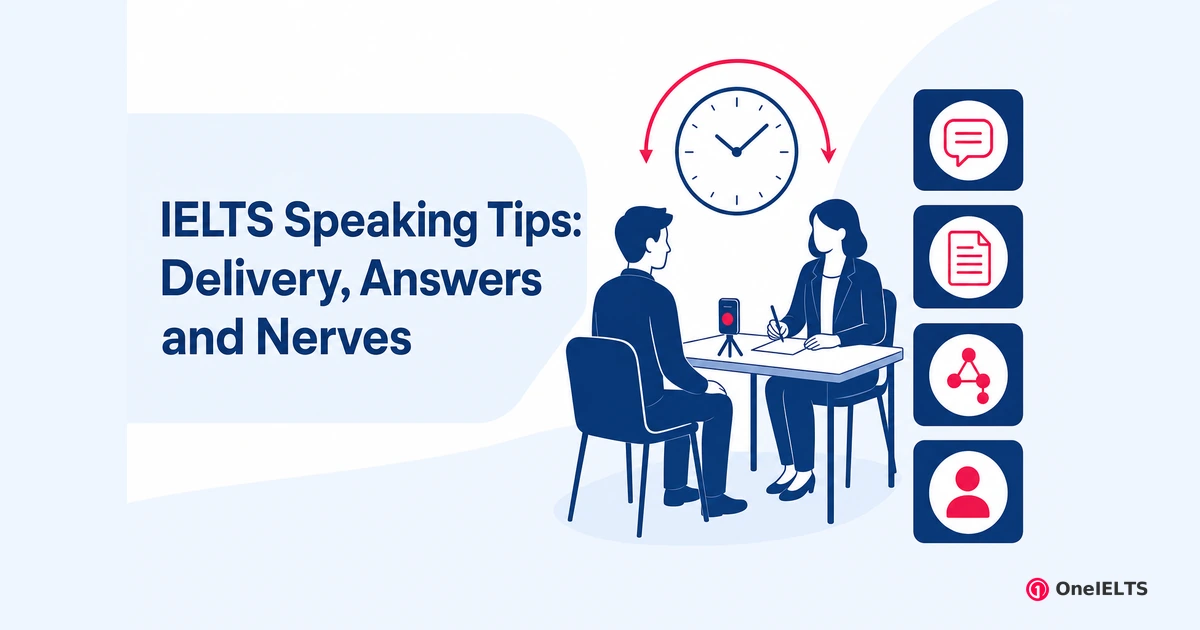
You sit in a room with one examiner for eleven to fourteen minutes, and every word is recorded and marked against four marking criteria. The IELTS Speaking tips that matter in that room are test-day tactics, not study plans.
This page runs in the order the day does. It covers delivery, answer length, and what changes in each part. Then the examiner, the common mistakes, what to say when you don’t know an answer, nerves, and timing. After that come the recovery phrases that rescue a stalled answer, whether you may invent, last-minute advice, what test-takers share on Reddit, and how any of it turns into a band.
What Are the Most Important IELTS Speaking Tips?
Extend every answer beyond one sentence, speak at a natural pace, never recite a memorised script, and keep going when you slip. Those four habits cover most of the marks candidates lose.
The test measures your English, not your ideas. Examiners score you on Fluency and coherence, Lexical resource, Grammatical range and accuracy, and Pronunciation, the four criteria published in the IELTS Speaking Band Descriptors. A tip is only worth following if it moves one of those four criteria. Anything that doesn’t is superstition, and this query attracts plenty of it.
What each band actually requires belongs on our band page rather than here. Four tips carry the most weight, each paired with the criterion it protects.
- Give an extended answer, not a single sentence. Fluency and coherence rewards a willingness to speak at length, so answer directly and then add one reason or one example you can picture.
- Hold a natural pace. Pronunciation is scored on how clearly you are understood, not on speed, so a rushed delivery works against you. Steady speech with real pauses reads as control.
- Never recite a memorised script. Examiners spot rehearsed speeches instantly and deduct points, and a memorised chunk collapses the moment the examiner asks a follow-up you did not rehearse for.
- Repair a slip once and keep going. One self-correction costs almost nothing under Grammatical range and accuracy. Repeating the same repair three times is what the descriptors penalise, so fix it and move.
What Are the General Delivery Tips for IELTS Speaking?
Five delivery habits carry across all three parts, and none of them is about what you say. Don’t memorise, don’t reach for big words, keep a normal pace, repair a slip and move on, and don’t speak in a monotone.
Delivery is marked apart from content because two of the four criteria describe how you speak rather than what you cover. A delivery habit therefore earns more marks than a clever idea. Each habit below names the criterion it protects.
- Don’t memorise answers. A memorised answer gets scored down under Lexical resource and Grammatical range, because it stops matching the question. Prepare topics and opinions instead, never whole sentences you can recite.
- Don’t reach for big words. Lexical resource rewards words you control, so a wrong long word costs more than a right short one earns. Use the vocabulary you already own, and say it accurately.
- Keep a normal pace and pause where the meaning pauses. A content-related pause is permitted at band 8, where the descriptor allows hesitation that is “mostly content related”. Rushing only blurs your pronunciation.
- Repair once, then move on. A slip you fix in three words barely registers in the mark. Hunting for the word out loud produces filler noise, and that is what actually costs you fluency.
- Don’t speak in a monotone. Pronunciation covers stress and intonation, so a flat delivery caps that criterion even when your grammar is clean. Let your voice move with the meaning.
IDP publishes “Tip 5: Pause to think” immediately beside “Tip 6: Avoid using fillers”, and the pairing settles something candidates get wrong. Pausing is endorsed; filler noise is not. The official band-9 Fluency descriptor draws the same line: “Any hesitation that occurs is used only to prepare the content of the next utterance and not to find words or grammar.”
Accent worries most candidates and matters least. The descriptors measure intelligibility, not nationality, and IDP’s own tip is “Don’t worry about your accent”. IDP also states that “Smiling can help calm your nerves which in turn helps your pronunciation”, and the mechanism is physical: a relaxed jaw shapes clearer sounds.
How Long Should Your IELTS Speaking Answers Be?
Aim for two to three sentences in Part 1, the full two minutes in Part 2, and thirty to forty-five seconds in Part 3. Short answers cost you directly on fluency.
Part 1 runs four to five minutes and contains about twelve questions, per ieltsliz, which is what makes two or three sentences the right size. Part of your score for Fluency is showing you are willing to speak at length, and very short answers are not good for your Fluency score. The working rule is direct answer then more detail.
Candidates most often lose the band in Part 1 rather than Part 3, by treating twelve easy questions as small talk and answering each in four words. The target is also band-dependent, and that is worth saying plainly. If your English is weaker your answers will naturally be shorter, and if you are aiming for band 7 or above they need to be longer. A band-dependent target beats one number handed to everybody.
Each part sets its own length for a different reason, shown here with the reason attached.
| Part | Target answer length | Why that length |
|---|---|---|
| Part 1 | Two to three sentences | About twelve questions run inside four to five minutes, so brief context on who, what, where or why fits the pace. |
| Part 2 | The full two minutes | The long turn is the one stretch you control, and stopping early leaves fluency evidence the examiner has no way to mark. |
| Part 3 | Thirty to forty-five seconds | Answers here need a position plus support, and a longer stretch shows the range that Part 1 never asks you to produce. |
What Are the Part-Specific Strategies for IELTS Speaking?
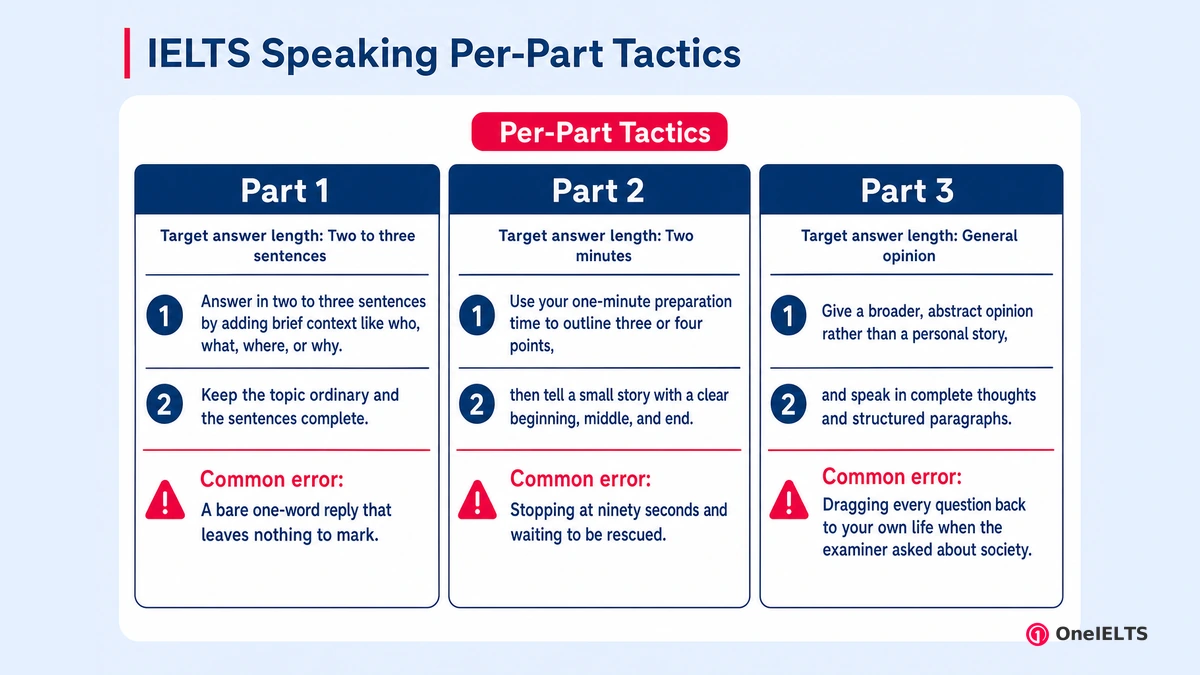
Part 1 wants brief context, Part 2 wants a story that fills two minutes, and Part 3 wants a general opinion rather than a personal one.
One strategy can’t cover all three parts, because each part asks for a different kind of talk. Part 1 samples your everyday English, Part 2 tests sustained speech, and Part 3 tests discussion. Each part gets two tactics here plus the error that costs candidates most.
- Part 1. Answer in two to three sentences by adding brief context like who, what, where, or why. Keep the topic ordinary and the sentences complete. The common error is a bare one-word reply that leaves nothing to mark.
- Part 2. Use your one-minute preparation time to outline three or four points, then tell a small story with a clear beginning, middle, and end. The common error is stopping at ninety seconds and waiting to be rescued.
- Part 3. Give a broader, abstract opinion rather than a personal story, and speak in complete thoughts and structured paragraphs. The common error is dragging every question back to your own life when the examiner asked about society.
Each per-part tactic stops at two moves on purpose. The Part 1, Part 2 and Part 3 pages own the method in full, and this section deliberately doesn’t restate them.
What Should You Expect from the Examiner in IELTS Speaking?
Expect a neutral professional who won’t react, won’t coach you, and will interrupt you when the clock says so. You are also allowed to ask for a question again.
A neutral examiner keeps the same face for a band 5 and a band 9. Fateheducation puts it plainly: “The examiner stays neutral throughout. They won’t react visibly or coach you during the test.” Don’t read their silence as a sign signalling that you’re doing badly.
Two permissions are worth knowing before you walk in. A repeat request is allowed, and ieltsadvantage sets the limit. You may ask the examiner to repeat a question, and you may ask what a single word means. What you may not ask for is an explanation of a whole sentence.
Ieltsliz confirms that asking for a repeat “doesn’t affect your score”. Ieltspodcast goes further with “You won’t lose points”, and suggests learning the phrase “I’m sorry, could you please repeat the question”.
A clock interruption carries no judgement. The examiner stops you mid-sentence because the schedule says so, and being stopped often means you were producing plenty of language. The whole thing is a recorded test, which is what makes a later remark on your result possible.
What Are the Common Mistakes to Avoid in IELTS Speaking?
Six mistakes recur, and every one shrinks the amount of language the examiner can mark. They are a memorised answer, one-word replies, rushing, filler noise, reaching for words you cannot control, and going silent on an unfamiliar question.
None of the six is a matter of taste. Each shows up in a named criterion, which is why the replacement behaviour matters more than the warning. Every mistake here carries the criterion it costs and the behaviour that replaces it.
- A memorised answer. Google states the consequence bluntly: examiners spot rehearsed speeches instantly and will deduct points. Replace the script with two or three opinions per topic that you can rephrase on the spot.
- A one-word reply. Never give one-word “yes” or “no” answers; always add reasons and real examples. It costs fluency for the same reason short answers do, so extend to the length that part expects.
- Rushing. Speed doesn’t read as fluency. It blurs pronunciation and hides the stress patterns the criterion measures, so drop to the pace you use with a colleague and hold the volume steady.
- Filler noise. Strings of “um” and “you know” fill time without producing language. Pause silently instead, because a short quiet pause is permitted while a hum is only noise.
- Reaching for words you cannot control. A misused long word costs Lexical resource more than a plain accurate one earns. Say the simple version, then extend it with an example rather than a synonym.
- Going silent on an unfamiliar question. Silence is the one thing here that can’t be marked at all. Say you haven’t met that situation, then pivot to something close, which the next section scripts in full.
Self-correction needs care in the other direction too. If you slip up, correct yourself quickly and move on without panic. It is repeated repair, not a single clean fix, that the descriptors penalise.
What Should You Do If You Don’t Know the Answer?
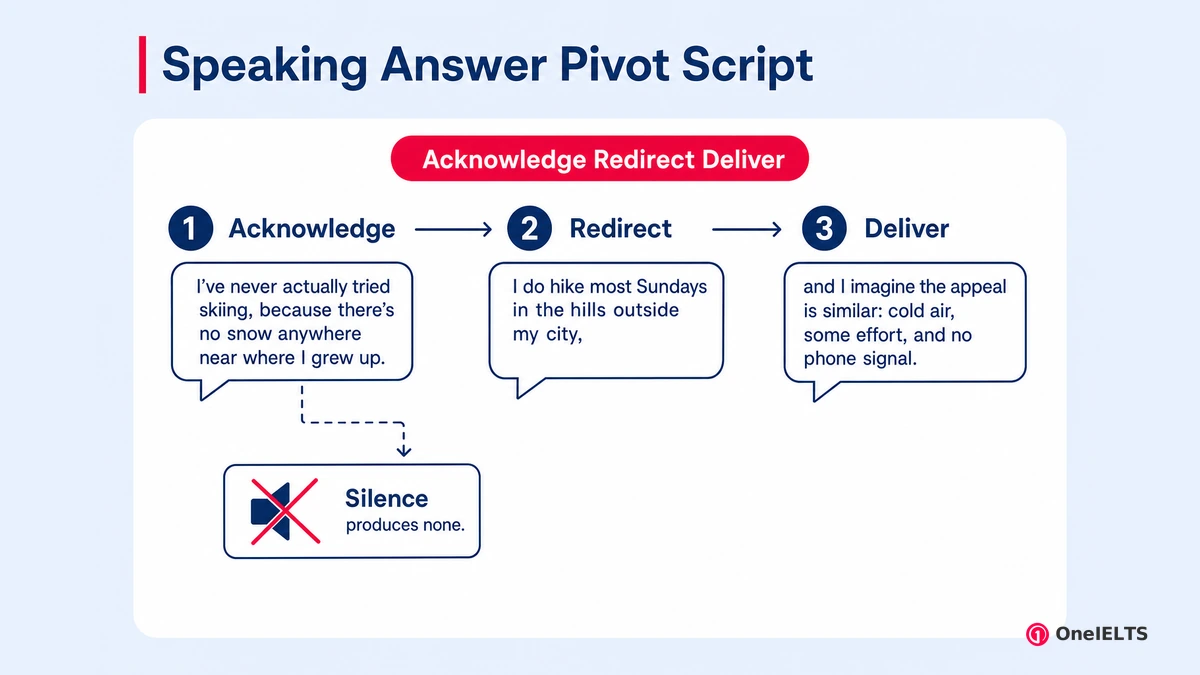
Say so briefly, then pivot to something adjacent that you do know. The examiner is marking your English, not your experience.
Fateheducation is the one ranking page that answers this, and its wording is worth learning: “Stay composed if a question catches you off guard. You can restate the question, admit you haven’t experienced that exact situation, and then pivot to something similar that you do know.”
Its own example is skiing. If you’ve never tried it, don’t freeze; simply say so and then describe another outdoor activity you’re familiar with.
The script has three moves you can rehearse tonight. Acknowledge and pivot happen in one breath, and then you deliver the detail on the adjacent experience you chose.
“I’ve never actually tried skiing, because there’s no snow anywhere near where I grew up. I do hike most Sundays in the hills outside my city, and I imagine the appeal is similar: cold air, some effort, and no phone signal.”
That answer can’t cost you marks, because there is no content criterion in Speaking. An honest pivot produces language, silence produces none, and silence is the only thing here that gets marked down. Part 3 works differently: an abstract question you have no view on still needs a defensible position, so take one you can argue instead of admitting you have none. The Part 3 page covers that case in full.
How Do You Handle Nervousness and Anxiety in IELTS Speaking?
The first minute is the worst, so warm up before you walk in and use the unmarked opening exchange as free practice.
Ieltsadvantage reports that it takes most IELTS students 10-15 minutes to “warm-up” and perform to the best of their ability on test day. Arriving cold therefore has a real cost, and the waiting room is where you pay it or avoid it. Five moves shorten that warm-up period, and each one is physical or procedural.
- Talk to someone in English before you go in. The queue, the receptionist, or a friend on the phone all count, and any real exchange starts the clock on your warm-up early.
- Treat the unmarked opening as practice. The identity check and your name and hometown questions aren’t scored, so use them as your first thirty seconds of speaking rather than admin.
- Feed yourself English for a full day. Ieltsadvantage’s instruction is blunt: you should speak, write, read and listen to English for 24 hours before your IELTS Speaking test.
- Take two seconds before answering. Collecting thoughts before you speak often makes a bigger difference than you’d think, and a short pause is permitted where filler noise is not.
- Smile on the way in. IDP notes that smiling can help calm your nerves, which in turn helps your pronunciation, because a relaxed jaw produces clearer consonants.
Expectation setting does the rest of the work. The first minute always feels worse than it sounds on the recording, and English input the day before is the cheapest way to make the room feel familiar.
How Do You Manage Time in the IELTS Speaking Test?
You don’t manage the time. The examiner owns the clock in every part, so your only timing jobs are the one minute in Part 2 and the length of each answer.
The test runs eleven to fourteen minutes, and the examiner clock moves on when their schedule says so. Rationing your material makes no sense against a fixed schedule, and neither does trying to finish a part early.
Two pieces of timing genuinely belong to you. The preparation minute in Part 2 is yours, and so is the stopping point of each answer, once you have made a point and supported it. The Part 2 and Part 3 pages cover both in depth, and this page won’t restate them.
A neutral interruption is the outcome you want. Being cut off usually means you were producing enough language, while finishing early hands the examiner spare time to fill with another question.
Which Phrases Help You Get Back on Topic?
A small recovery set turns a lost thread into visible control rather than a breakdown: anyway, what I was trying to say is, and to come back to your question.
A recovery phrase is scored language, not a stumble. Band 8 tolerates “very occasional repetition or self-correction”, so an occasional self-correction delivered inside a clean phrase is cheaper than trailing off into nothing. Four recovery jobs cover almost every wobble, with two phrases each.
- Getting back on topic after drifting off topic. Use “anyway, coming back to your question” or “but the main thing is”.
- Restating something that came out wrong. Use “what I mean is” or “let me put that another way”, then say it once.
- Expanding when you stalled early. Use “a good example of that would be” or “the reason I say that is”.
- Generalising when your own detail runs out. Use “people my age tend to” or “in most places I know of”.
Two phrases per job is the limit here on purpose. The linking-word page owns the full set, including the thinking-time phrases, so build the bank there rather than on a tips page.
Is It Okay to Invent Answers in IELTS Speaking?
Yes in principle, because nothing you say is fact-checked. Inventing while you speak still costs the fluency that is marked, so borrow a real memory instead of building one.
The permission isn’t the interesting part, since candidates already assume it. There is no content criterion, and no examiner verifies your job, your hometown or your grandmother. What exists is a fluency and coherence criterion, and fabricating under pressure eats exactly the attention that criterion measures.
The workable middle is a borrowed memory. If a cue card doesn’t fit your life, describe someone else’s experience in the first person: your cousin’s flat becomes your flat, your colleague’s trip becomes your trip. A borrowed memory still supplies the specific detail that extension needs, and you aren’t assembling it in real time.
One version does cost marks. A rehearsed story reused across three different topics reads as memorised, and it gets penalised as memorised, whichever cue card you bend it onto.
What Are the Best Last-Minute IELTS Speaking Tips?
In the last day, do three things only: speak English aloud, re-read the four criteria, and rehearse the two or three phrases you want to be automatic.
Nothing about your English changes in twenty-four hours. What changes is how warm you are and how automatic your opening sentences feel. Two of the moves below belong to the night before and two to the morning itself.
- Night before: take 24 hours of English input. Ieltsadvantage’s rule is that you should speak, write, read and listen to English for 24 hours before your IELTS Speaking test.
- Night before: rehearse two or three phrases until each is automatic. An automatic phrase survives the room, while one you learned that evening still needs thinking about.
- Test day: arrive early and speak to someone in English. Most candidates need ten to fifteen minutes to reach their real level, so spend those minutes outside the room.
- Test day: re-read the four criteria, then stop preparing. Knowing what gets scored changes how you answer more than any last-minute topic list you could memorise.
One thing deserves saying honestly. New material is what to avoid: new vocabulary, new idioms and new structures learned this late never become automatic enough to survive the room, and reaching for them is precisely what produces hesitation.
Which IELTS Speaking Tips Do Test-Takers Share on Reddit?
Test-takers share the same four tips the publishers give, plus two the publishers rarely mention: the examiner’s manner tells you nothing, and the first question is always easier than you fear.
Peer advice earns its place on this query, and the evidence runs three ways. A related search asks for it by name, a Reddit thread ranks sixth organically, and Google’s own AI Overview cites Reddit for its Part 1 advice. Readers want what candidates say, not only what schools say.
In aggregate, what candidates post tracks publisher guidance closely: extend your answers, don’t memorise, expect Part 3 to be harder, and don’t panic when you get interrupted. Threads add the two reassurances above, which schools rarely put in writing.
One divergence deserves adjudicating. Candidates commonly report that speaking fast sounds fluent. Google’s guidance says the opposite: “Do not rush. Speak slowly and clearly so your pronunciation remains accurate.” The publishers are right, and the descriptor explains why, since a natural pace protects the pronunciation that speed damages first. Treat any single post as an anecdote rather than a rule.
How Do You Turn IELTS Speaking Tips into a Higher Band?
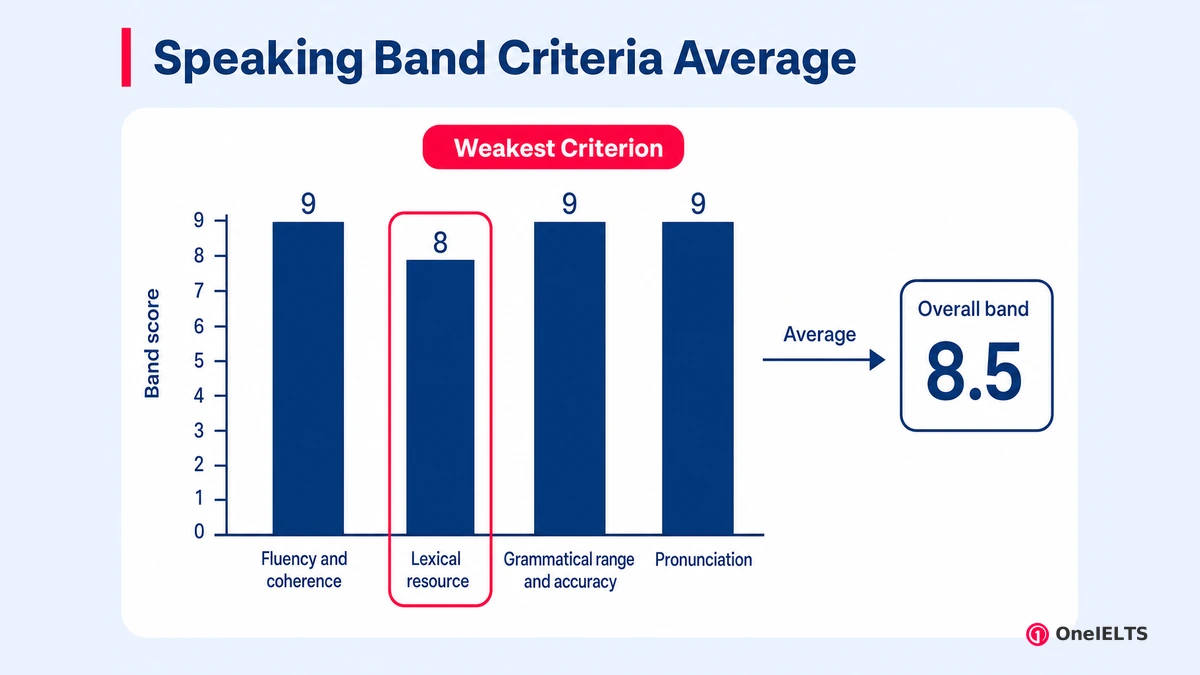
Tips don’t raise a band on their own. They stop you losing marks you had already earned, and the band moves when the weakest of your four criteria moves.
Three implications follow from everything above. Every tip on this page is protecting marks rather than adding new ones, so your English sets the ceiling while your habits set the floor. Averaged criteria are what you are scored on, which makes the weakest criterion the highest-value place to work. And the tips with the biggest effect are the ones that stop you producing less language than you can.
A tips page can’t settle band arithmetic properly, so this is the handover point. What each descriptor says, and how the overall score gets worked out, belongs to the band page. The four questions below are the ones Google actually surfaces on this query, and three of them are band questions.
How Can You Get 8.5 in IELTS Speaking?
Band 8.5 is the rounded average of your four criteria, so it usually means three nines and an eight, and the work belongs on the single criterion holding you down.
That weakest criterion is most often Lexical resource, because range is the last to move. Fluency and pronunciation respond to habit within weeks, while vocabulary you can use accurately takes months. Check what an 8 and a 9 each require in the IELTS Speaking band descriptors.
How Can You Get 9.0 in IELTS Speaking?
A 9.0 needs a 9 or near-9 on all four criteria at once, which for fluency means speech with only very occasional self-correction or repetition.
The descriptor is more generous than candidates expect. At band 9 there is permitted hesitation: pausing is fine when it serves content preparation rather than word-hunting. Fluency is not the absence of pauses. The IELTS Speaking band descriptors give the exact wording for each criterion.
Is 6.75 Converted to 7 in IELTS?
Yes, an overall average ending in.75 rounds up to the next whole band, and an average ending in.25 rounds up to the next half band.
The rounding up applies to your overall average, not to one criterion. This question keeps being asked because almost no page states any rule, and none of the test owners’ own Speaking band pages does either. Read the published rule on the official scoring page, and see our IELTS Speaking band descriptors page for the citation.
How Do You Improve Your IELTS Speaking?
You improve by practising the thing the test measures: speaking aloud, recorded, on unseen questions, then reviewing the recording against one criterion at a time.
Recorded practice is what makes single-criterion review possible, because you can’t hear your own hesitation live. An unseen question stops you rehearsing. Room versus routine is the split this page rests on, so take the multi-week routine from our IELTS Speaking preparation guide.
Written by Rifah Binte Faruk, reviewed 14 August 2026.
Last verified: 14 August 2026
Practice for the Real IELTS Exam
Apply what you’ve learned with free, exam-style practice:
- Take a free IELTS mock test — all four skills, real exam timing, AI band scoring
- Sit a Speaking section mock — timed Parts 1–3 with voice recording and band feedback
- Practise all three parts — sample questions with feedback