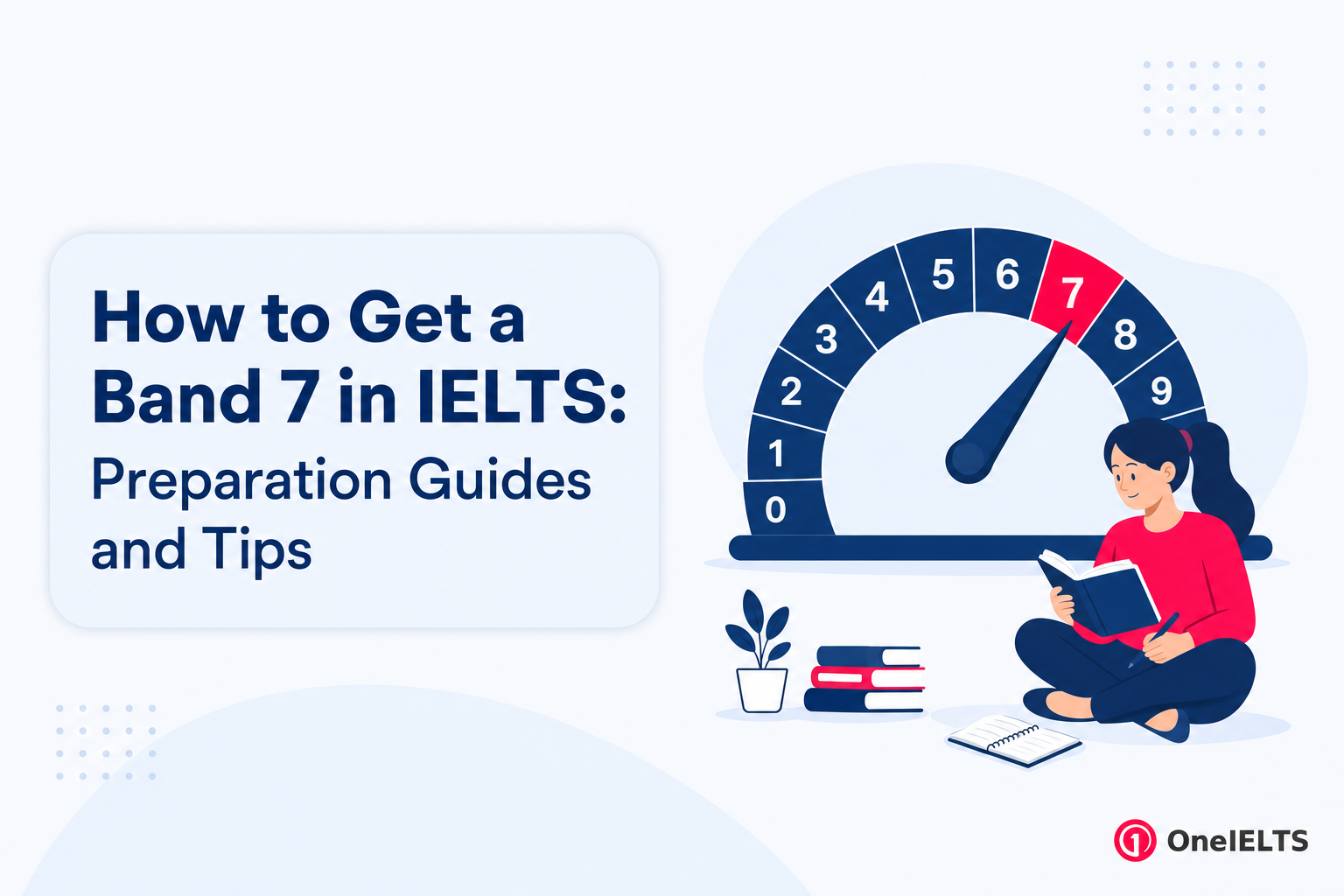
A band 7 in IELTS marks you as a Good User — roughly CEFR C1, operationally fluent with only occasional errors. The catch most candidates miss: a 7 is often a per-section minimum, not just an overall average. A 7.5 overall with a 6.5 in Writing still fails a stream that wants 7 in every band.
This guide walks six preparation guides in order, then closes with section-wise tips, how hard a 7 really is, what an IELTS band 7 means, and which countries and visas accept it. The six guides ahead: understand the test format, strengthen all four sections equally, study the band descriptors, build topic-based vocabulary, sharpen grammar range and accuracy, and take timed mock tests.
1. Understand the IELTS Test Format
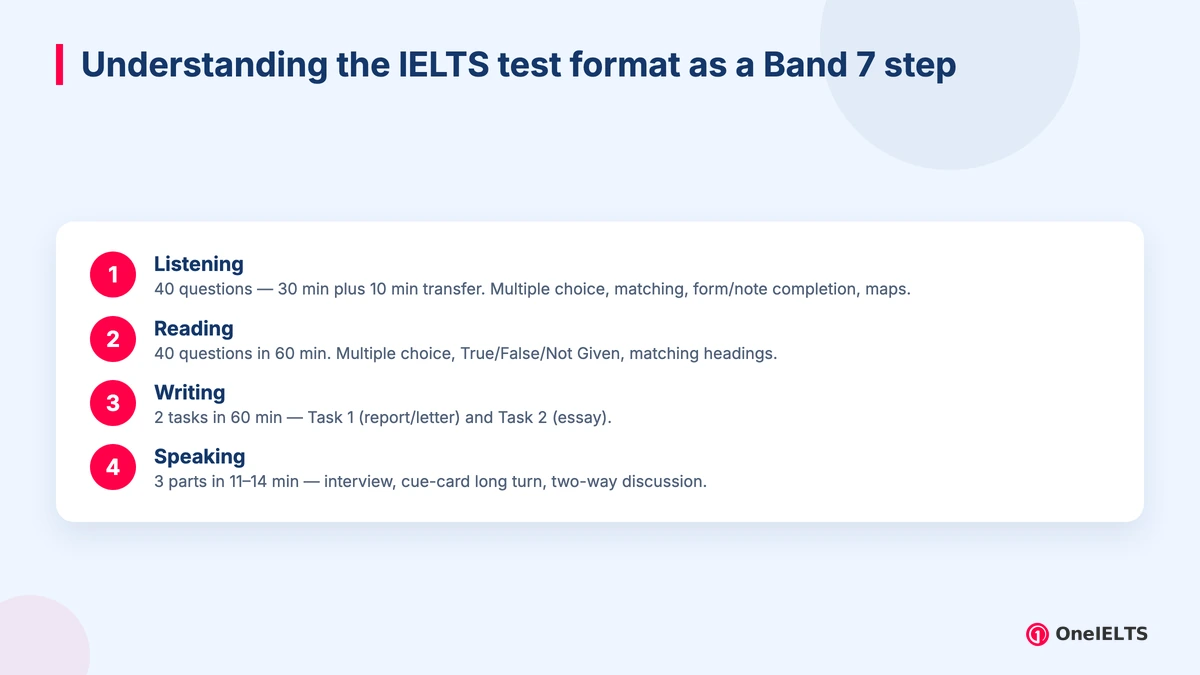
Knowing the shape of each paper before you train removes guesswork, so the four sections and their timing per section are mapped below.
| Section | Task/question types | Questions or tasks | Time |
|---|---|---|---|
| Listening | Multiple choice, matching, form/note completion, maps | 40 questions | 30 min + 10 min transfer |
| Reading | Multiple choice, True/False/Not Given, matching headings | 40 questions | 60 min |
| Writing | Task 1 (report/letter) and Task 2 (essay) | 2 tasks | 60 min |
| Speaking | Interview, cue-card long turn, two-way discussion | 3 parts | 11–14 min |
The four sections — Listening Reading Writing Speaking — always run in that fixed order, and the band 7 you carry forward is built from all four. Train each against its real clock, not an open-ended one.
2. Strengthen All Four Sections Equally
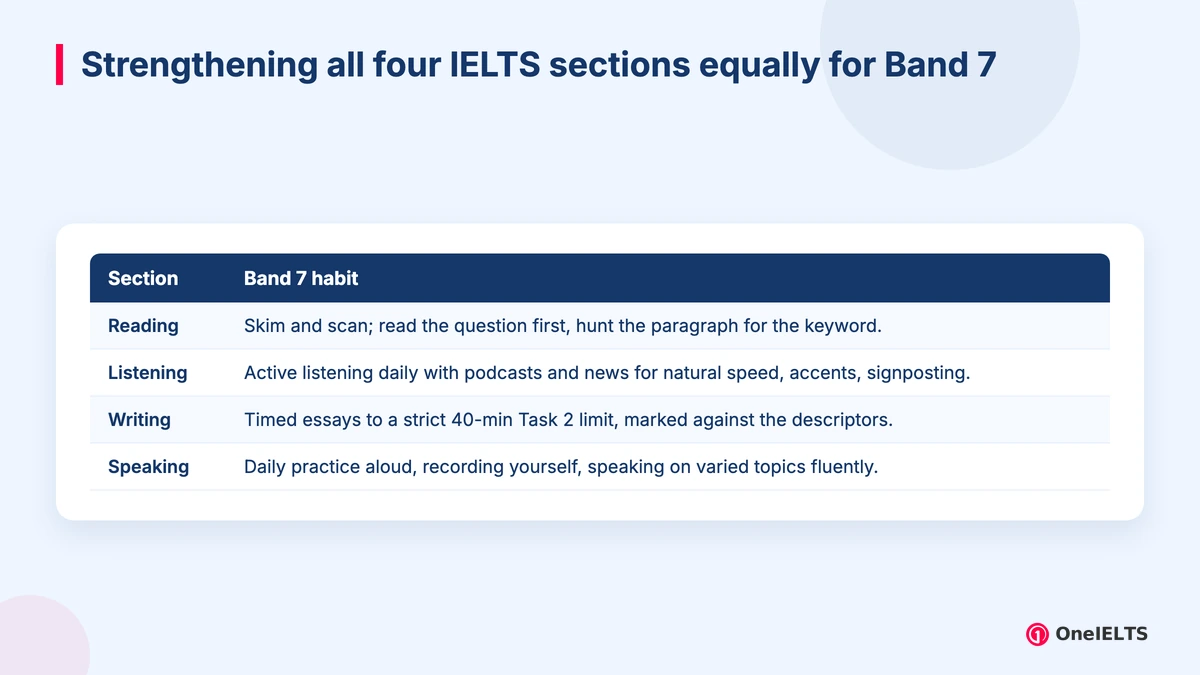
A band 7 needs balanced skills because many visa streams demand a 7 in each band, so one weak paper sinks the whole result no matter how strong the other three are. The fastest gains come from drilling each section against the exact sub-skill examiners reward. Four section-by-section habits that move a 7 within reach follow here.
- Reading. Practise skimming and scanning so you locate answers fast, reading the question first and hunting the paragraph for the keyword rather than reading every line.
- Listening. Train active listening daily with podcasts and news so you follow natural speed, accents and signposting words that flag the answer before it arrives.
- Writing. Write timed essays to a strict 40-minute Task 2 limit, then mark each against the descriptors so structure and argument tighten under real pressure.
- Speaking. Do daily practice aloud, recording yourself, so you can speak on varied topics fluently without long pauses or one-word answers.
3. Study the Band Descriptors
At band 7 an examiner looks for clear ideas developed with reasons and a flexible vocabulary used with some less common items. On grammar, occasional errors allowed at this level rarely block meaning, so a small slip costs nothing. In Writing that means a position held across every paragraph; in Speaking it means extended turns that stay on topic. Band-7 wording reads like “this trend is likely to intensify as urban populations expand,” not a memorised phrase dropped in. The raw score for band 7 sits around 30 of 40 in Listening and roughly 30 of 40 in Academic Reading, so a few wrong answers still clear the bar.
4. Build Topic-Based Vocabulary
Lexical resource gates a band 7 because the descriptor rewards flexible use of vocabulary and penalises the same plain words repeated across an essay. Learn vocabulary by theme — education, environment, technology — so that a prompt finds you already holding ten precise nouns and verbs for it. The 7 comes from using less common lexical items and collocations accurately. Think “carbon footprint,” “widening inequality,” and “lifelong learning.” Build your banks around recurring topic themes, and learn each word inside a phrase, because a wrong collocation costs more than a missing one.
5. Sharpen Grammar Range and Accuracy
Grammatical range and accuracy gates band 7 because the descriptor asks for a mix of structures produced with frequent error-free sentences. Mixing simple, compound and complex sentences shows range — a short sentence for emphasis, a complex one to qualify a claim. Control your tenses, modals and conditionals so meaning stays exact. A conditional clause such as “had the policy passed, emissions would have fallen” outscores a flat “if the policy passed.” That control of form is what lifts the score. Drill complex sentences until they come out clean, because a 7 forgives the occasional slip but not a pattern of grammar accuracy breaking down.
6. Take Timed Mock Tests
A full timed mock replicates exam pressure, so it builds the stamina to stay sharp through a back-to-back Listening, Reading and Writing morning. Each mock also identifies weaknesses you would never spot in untimed drills. Sitting several mocks builds stamina week on week and surfaces the half-band that leaks away under the clock. Review every mock against the band descriptors, scoring your own Writing and Speaking honestly. Mock practice also reduces test-day anxiety, because the room, the clock and the format stop being unknowns.
What Are the Section-Wise Tips to Score Band 7?
Each paper rewards a different exam-day habit, and the four that most often lift a candidate to a 7 are timing discipline in Reading, anticipation in Listening, structure in Writing, and extension in Speaking. Across hundreds of scripts, candidates lose half a band in Writing Task 2 by drifting off the prompt far more often than by weak grammar. The four section-wise band-7 tips worth drilling before test day are set out here.
- Reading. Spend about one minute per question and move on if stuck, marking it to revisit, so a single hard item never eats the time three easy ones need.
- Listening. Read questions ahead during every pause so you know exactly what to listen for, predicting the answer type — name, number, date — before the speaker reaches it.
- Writing. Plan a clear five-paragraph essay — intro, three bodies, conclusion — and respect the word count with no word-limit breach, since over-writing rarely helps.
- Speaking. Extend speaking answers with reasons and examples rather than stopping at a sentence, because Part 3 rewards developed opinions and a one-line reply caps your fluency.
Is It Hard to Get a Band 7 in IELTS?
A band 7 is achievable but demanding — it marks a Good User with only occasional errors, which most candidates reach through structured practice rather than raw talent. The productive papers cause most failures, with Writing often the blocker because Task 2 punishes weak structure and drift off the prompt. Speaking lags too when answers stay short. Consistent practice on those two papers, scored against the descriptors, closes the gap fastest.
What Does an IELTS Band 7 Mean?
A band 7 means a Good User — operationally fluent with occasional inaccuracies, roughly CEFR C1, who handles complex language well despite the odd slip. Examiners describe band 7 in the descriptors as handling detailed reasoning, using a flexible vocabulary range, and producing mostly error-free sentences. You can see exactly how each criterion is scored in the IELTS band descriptors.
Which Countries and Visas Accept a Band 7?
Several countries’ universities and visa streams accept and often require a 7, frequently in each band rather than just overall. A 7 is a common postgraduate cut-off, and a per-band 7 unlocks competitive routes. UK and Australia visas show this clearly: UK Tier visa categories and Australia skilled streams both award their strongest English points at 7 in every section. Check the exact thresholds for one major destination in our IELTS for UK guide before you book.
Last verified: 30 June 2026
Practice for the Real IELTS Exam
Apply what you’ve learned with free, exam-style practice:
- Take a full IELTS mock test
- Practice by section: Listening, Reading, Writing, Speaking
- Structure your essays with IELTS Writing templates