A band-9 cohort at IELTS Advantage averaged 1.2 idioms across the whole test, and many of those students used none at all. What the examiner hears is a fixed phrase whose meaning is not the sum of its words, and it either lands naturally or announces itself as a memorised phrase. Lexical Resource rewards idiomatic language broadly, which is a wider target than the proverb-style idiom most candidates chase.
This page covers the definition, the score effect, the descriptor wording, the safe quantity, the topic sets, and the ones to avoid. It then works through the cost of an error, idioms you don’t understand, the phrasal verb, safer alternatives, the PDF question, and the band 8 to band 9 gap.
What Is an Idiom in IELTS Speaking?
An idiom is a fixed multi-word phrase whose meaning cannot be worked out from its individual words, such as over the moon, in hot water, and a blessing in disguise. Examiners score it under Lexical Resource, alongside every other word choice you make.
No separate idiom category exists on the mark sheet, and there is no quota. A correct, natural idiom helps your range. A wrong or forced one hurts, exactly as any other phrase would.
IDP puts “What’s an idiom?” and “What’s a phrasal verb?” back to back on its own guidance page, and that pairing is deliberate. A fixed expression and a phrasal verb sit in the same family of non-literal meaning, and the sections below take that up.
Register matters as much as accuracy does. A folksy proverb dropped into an abstract Part 3 answer about government policy is a precision error, even when the phrase itself is perfectly correct.
Do Idioms Improve Your IELTS Speaking Score?
Only when they are accurate and natural, and far less often than the internet implies. IELTS Advantage measured its own band-9 students and published a measured average of 1.2 idioms across the whole test, with many of them using no idioms at all.
The sources you have already met disagree with each other. The British Council’s blog calls idioms “essential to scoring a Band 7 or above in the Speaking test”, then warns in the same piece that “Randomly memorising English idioms can easily backfire”.
IDP says band 7 and higher requires you to “show the examiner that you can use idiomatic language”. IELTS Advantage tells its own readers that “trying to include as many of these words and phrases in your speaking test answers is not a good strategy”.
Here is the resolution, and it settles the rest of this page. The descriptors reward idiomatic language, meaning natural, native-like phrasing. That is a far wider thing than a proverb-style idiom.
Collocations and phrasal verbs are idiomatic. “Raining cats and dogs” is an idiom and a liability. Candidates chase the second kind because it is listable, and 1.2 is what you measure when someone has been building the first.
One practical consequence follows. Nobody has ever missed band 7 for a shortage of idioms, and plenty of candidates have lost a precision mark reaching for one. Accuracy is what the mark sheet rewards, and a large inventory of phrases is not.
Do the IELTS Band Descriptors Require Idioms?
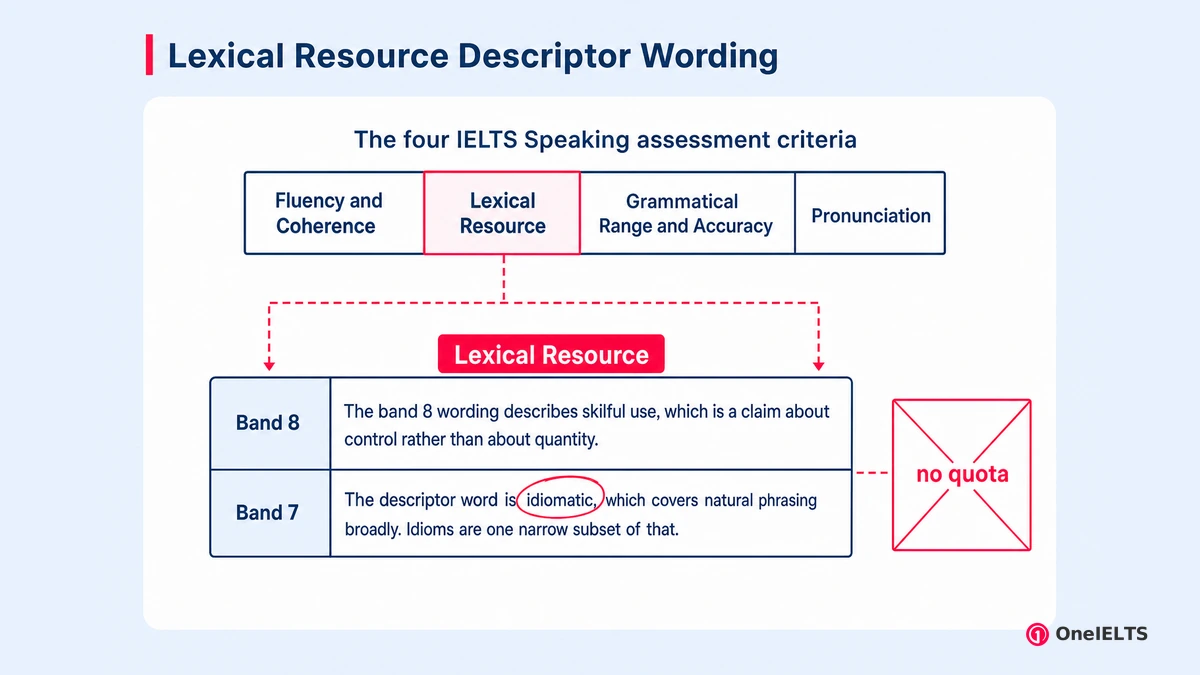
The Speaking descriptors name idiomatic vocabulary at the upper bands without requiring idioms as such, and they set no number at all. There is no quota anywhere in the document.
Here is the official wording for Lexical Resource at the upper bands, quoted from the four-page IELTS Speaking band descriptors PDF published on ielts.org.
Quoting it matters more here than on almost any other IELTS question. The scoring page on ielts.org links the Speaking band descriptors as a downloadable PDF and never displays the text, so not one page ranking on this query quotes it. That absence is why “essential for band 7” has circulated unchallenged for years.
The distinction the official wording turns on is tiny, and it decides everything else on this page. The descriptor word is idiomatic, which covers natural phrasing broadly. Idioms are one narrow subset of that.
Two further facts come from the document itself. The same band descriptor set applies to every Speaking candidate, so nothing here is module-specific. And the band 8 wording describes skilful use, which is a claim about control rather than about quantity.
Are You Overusing Idioms in the IELTS Speaking Test?
Probably, if you are planning them. Google’s AI Overview on this query puts the ceiling at one or two per part, and going past that is the single most common way idioms cost marks instead of earning them.
Three sources that rarely line up agree here. The AI Overview says to “use idioms sparingly (1 or 2 per part is enough) so they sound natural”. Keith Speaking Academy, the page Google cites for that judgement, says to use them “naturally and sparingly” because “Forcing idioms into every answer can sound rehearsed”. IDP warns candidates to “be very careful not to overuse them”.
Overuse has a sound, and it is the one thing candidates cannot hear in themselves. It is a rehearsed cadence, idioms arriving on subjects with no topic fit, and the same register repeated whatever the question. Once an examiner decides an answer is an assembled answer built from memorised parts, the language inside it stops counting towards range.
So use this counting rule instead. Aim for zero idioms and let one or two arrive on their own. Planning to insert them is what produces the overuse, and restraint is the whole skill.
Which Common Idioms Come Up by Topic in IELTS Speaking?
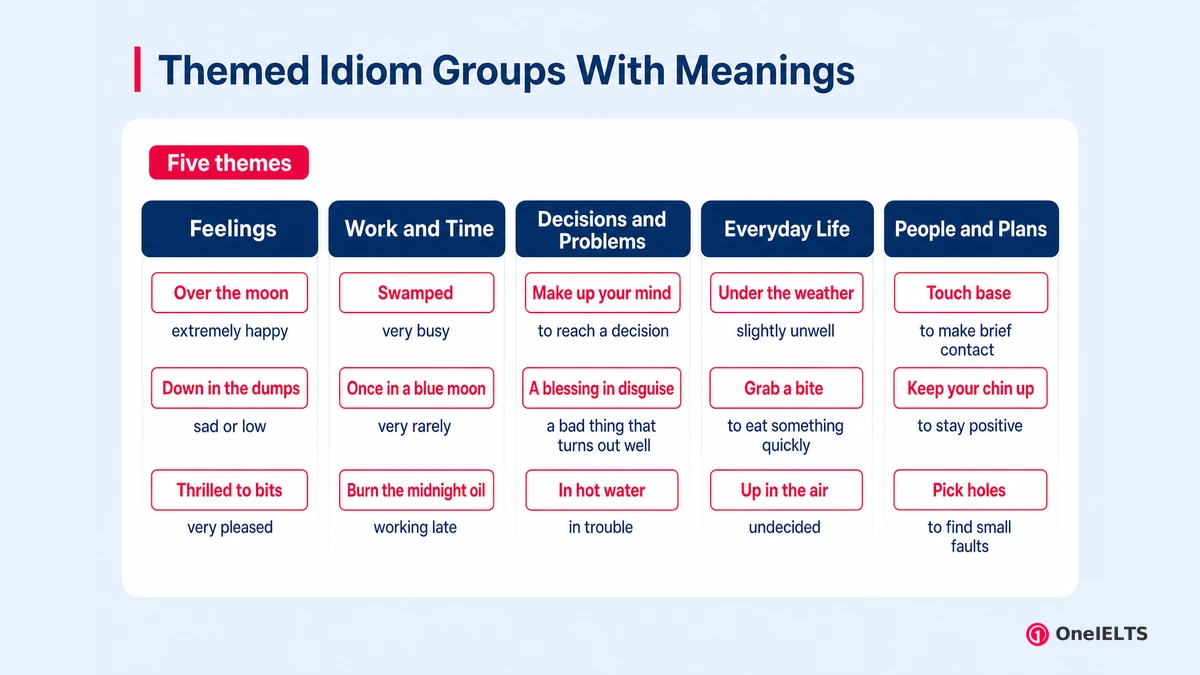
A short set grouped by the themes the test actually asks about is all anyone needs, covering feelings, work and time, decisions and problems, everyday life, and people and plans.
Grouping by theme beats an alphabetical or numbered list because the examiner asks by theme. A phrase filed under “feelings” surfaces when the question is about your family news, whereas item 47 on an A-to-Z list surfaces never.
Every phrase here comes from either Google’s AI Overview on this query or Keith Speaking Academy’s curated ten, and four of them appear in both, which is the strongest overlap in the set. Five theme groups follow, each with three phrases, a plain-English meaning, and one natural sentence you could say about your own life.
- Feelings. The phrases Part 1 keeps asking for when it wants your reaction to news, weather, work or family.
- Over the moon means extremely happy. My sister was over the moon when her nursing licence finally came through, because she had spent three years studying for it.
- Down in the dumps means sad or low. I get a bit down in the dumps in the last week of monsoon, when it rains every single day and nobody goes out.
- Thrilled to bits means very pleased and excited. My parents were thrilled to bits about the new flat, mostly because it is ten minutes from my grandmother’s house.
- Work and time. Part 1 and Part 2 both ask how busy you are, so these three carry a lot of weight.
- Swamped means very busy with too much work. I have been swamped since March, because two people left my team and nobody has replaced them yet.
- Once in a blue moon means very rarely. I cook properly once in a blue moon, usually when my flatmate is away and I have the whole kitchen to myself.
- Burn the midnight oil means working late into the night. I burned the midnight oil for a week before my final exams, and my sleep still has not recovered.
- Decisions and problems. Part 3 turns abstract fast, and these three survive that shift without sounding folksy.
- Make up your mind means to reach a decision. It took me four months to make up my mind about the course, because both universities offered roughly the same thing.
- A blessing in disguise means a bad thing that turns out well. Losing that internship was a blessing in disguise, since the job I found afterwards paid nearly twice as much.
- In hot water means in trouble. My brother got into hot water at school for missing three weeks of classes, and my mother still brings it up.
- Everyday life. Ordinary, low-risk phrases about food, health and unsettled plans, all from Keith Speaking Academy’s curated ten.
- Under the weather means slightly unwell. I was under the weather for most of last week, so I worked from home and cancelled everything that was not urgent.
- Grab a bite means to eat something quickly. We usually grab a bite near the office rather than cook, because nobody wants to start cooking at ten at night.
- Up in the air means undecided. My holiday plans are still up in the air, since my sister has not told me which week she can take off.
- People and plans. Useful in Part 3, where the questions turn to colleagues, friendships and how people keep in contact.
- Touch base means to make brief contact. I touch base with my old classmates every couple of months, usually on a group call that nobody organises properly.
- Keep your chin up means to stay positive. My father told me to keep my chin up after the first rejection, and that turned out to be reasonable advice.
- Pick holes means to find small faults. My editor picks holes in everything I write, which is annoying on the day and useful a week later.
Which Idioms Should You Avoid in IELTS Speaking?
Avoid the ones that come from textbooks and free idiom lists, starting with “it’s raining cats and dogs”, which Google’s own AI Overview names as a phrase that “can sound fake”.
An idiom becomes risky when the examiner has heard it more often from candidates than from English speakers. That single test of risk explains all four categories below.
Keith Speaking Academy, the source Google cites here, gives the same verdict on the same phrase, saying outdated idioms “sound memorised and unnatural”. IDP warns against ones that “are overused, and sound forced”. Four risky categories account for nearly every idiom that costs marks, each with two phrases examiners hear far too often.
- Dated textbook phrase. “It’s raining cats and dogs” and “as fit as a fiddle” appear on every free list, so an examiner has heard them thousands of times.
- Regional idiom. “Bob’s your uncle” and “the bee’s knees” belong to specific places and generations, and a candidate who has never heard one used will misplace it.
- Register mismatch. “Money doesn’t grow on trees” and “a penny for your thoughts” turn an abstract Part 3 answer folksy, which reads as a precision error rather than range.
- Too slow to say. “You can’t judge a book by its cover” and “the ball is in your court” break your rhythm if you cannot deliver them at natural speed.
The dated ones keep circulating for an uncomfortable reason. They sit on every free idiom list, which is exactly why they are the strongest memorisation signal a candidate can send.
Apply one test before you keep any phrase. Keep only the ones you have actually heard in conversation, spoken by a real person, within the last year. Anything else stays off your list.
Why Does Saying an Idiom Incorrectly Cost You Marks?
A fixed phrase allows no flexibility at all, so changing one word stops it being English, and the examiner hears an error rather than an attempt at range.
Ordinary vocabulary tolerates approximation. An idiom does not. “Very happy” with a slightly odd adverb still communicates, while “over the sky” communicates nothing and costs a precision mark. That is why one word substitution inside an idiom carries a risk profile unlike any other word in your answer.
| What candidates actually say | The fixed phrase |
|---|---|
| “I was over the sky about the result.” | “I was over the moon about the result.” |
| “It was a blessing in the sky.” | “It was a blessing in disguise.” |
| “I am in the hot water with my boss.” | “I am in hot water with my boss.” |
There is a second, less obvious cost. A mangled idiom breaks fluency too, because candidates hear themselves get it wrong and stop to repair it. That self-repair is audible, and one three-word phrase can therefore lose you marks under two criteria at once.
Why Is Using Idioms You Don’t Understand a Mistake in IELTS Speaking?
The examiner can follow up on anything you say, so an idiom you cannot unpack turns into a question you cannot answer. An examiner follow-up exposes a half-known phrase in a single exchange.
Idioms carry connotation as well as meaning, and that is the trap nobody spells out. Several common ones are mildly negative, informal or sarcastic. A candidate working from a dictionary gloss can say something that reads as rude about their own family.
“My grandfather kicked the bucket last year” is accurate by the gloss and flippant to anyone listening, because the phrase belongs to an informal register nobody uses about a bereavement.
Apply a three-part test before you learn any idiom. Can you say what it means, when it would be inappropriate, and one situation you would use it in? Two out of three is not enough to say it under exam pressure.
This is the failure mode behind the “100 idioms” and “500 idioms” searches. A memorised list that size cannot be understood, only stored, and stored phrases are the ones that come out wrong.
What Is a Phrasal Verb and Does It Count as Idiomatic Language?
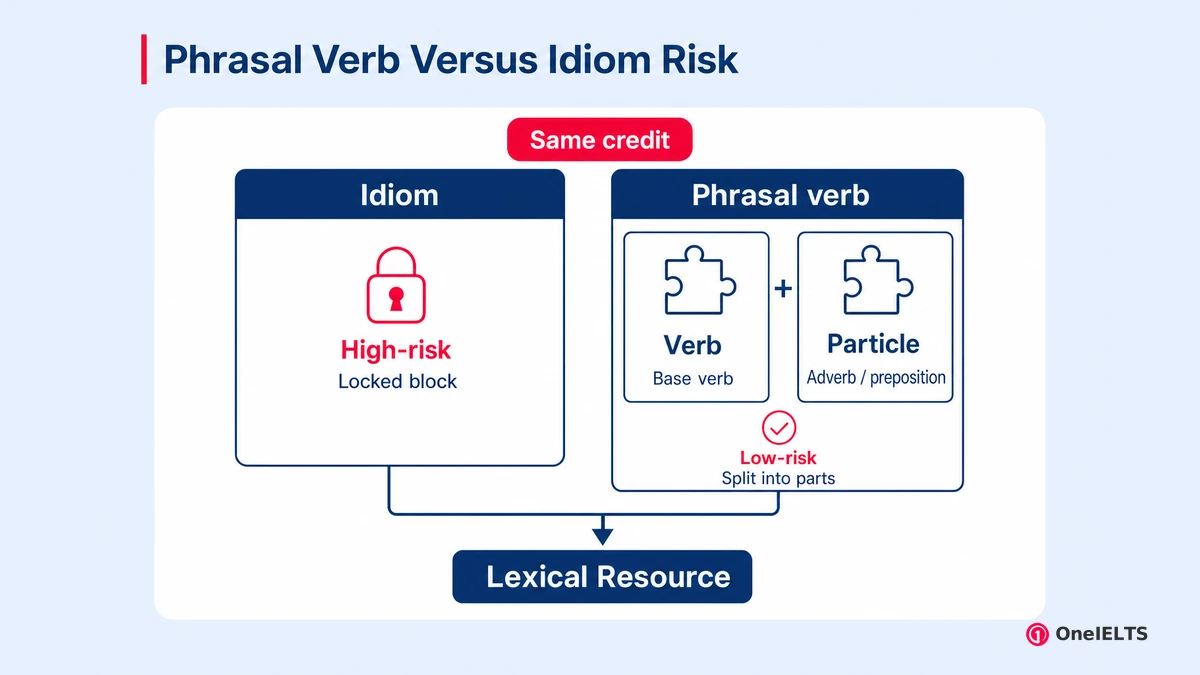
Yes. A phrasal verb is a verb plus a particle with a non-literal meaning, such as take up a hobby, put off a decision, and get on with someone. It counts as idiomatic language, and it brings almost none of the risk that proverb-style idioms carry.
This is the most useful redirection on the page. Phrasal verbs do everything candidates hope idioms will do, because they signal natural, native-like phrasing under Lexical Resource. They are also high frequency, which means you have genuinely absorbed them rather than read them.
They flex across registers. And you cannot over-deploy them, since fluent speech is already full of them. Swap an idiom-hunting habit for a phrasal-verb habit and you get the credit without the exposure.
One piece of evidence says this reading is right rather than merely convenient. IDP, a test owner, puts “What’s a phrasal verb?” directly after “What’s an idiom?” on its own idioms page. Google’s AI Overview does the same thing without noticing, offering “take up” and “disconnect from” as examples, and both are phrasal verbs rather than idioms. Nine high frequency phrasal verbs follow, sorted by the themes the test keeps returning to.
- Free time. I took up swimming last year. I have really got into Korean films recently.
- Work and study. I keep putting off the paperwork. I finally got through my reading list.
- People. I get on with my flatmate. I fell out with a friend over something small.
- Plans. We came up with a cheaper route. I looked into a night course.
One caution applies. Separable phrasal verbs have word-order rules, and getting those wrong is a grammar error rather than a lexical one, so a separable verb costs you under a different criterion.
Which Phrases Should You Use Instead of Idioms in IELTS Speaking?
Use collocations, phrasal verbs and functional phrases, because all three are idiomatic, all three are safer, and all three turn up in band-9 speech far more often than idioms do.
The swap is simple. You keep the criterion you were aiming at and drop the failure mode that comes with proverbs. Each replacement below sends the examiner a specific signal, and each carries lower risk than a memorised idiom does. Three replacements are worth your preparation hours, with two examples each and the signal each one sends.
- Collocation. “Heavy traffic” and “make a decision” show natural pairing, which tells the examiner your word choices come from real English rather than from a thesaurus.
- Phrasal verb. “Put off” and “get on with” show native-like verb choice, the same signal an idiom sends, without the register risk that a proverb brings with it.
- Functional phrase. “That depends on” and “to be honest” show you can manage a conversation, buying thinking time while sounding like a speaker rather than a reciter.
Two examples each is deliberate, because the full sets live elsewhere. Collocations belong on the speaking vocabulary page and functional phrases on the linking-words page, and this section exists to redirect your effort rather than to duplicate them. Here is the honest summary. If your preparation time is limited, spend none of it on idioms.
Where Can You Get an IELTS Speaking Idioms PDF?
This page offers one, and it carries the fifteen themed idioms with their sample sentences rather than the 100- or 500-idiom lists the related searches keep asking for.
The demand is loud, and matching it would be wrong. Three of the eight related searches on this query ask for a PDF, and two ask for a hundred or five hundred idioms. An S3-hosted PDF ranks fourth, which Google cites in its AI Overview as “Amazon Web Services”. A big downloadable list is what the market wants and what the only measured evidence says does not work.
So here is the position, stated plainly. A 500-idiom PDF is the most downloaded and least useful artifact in IELTS preparation. The failure mode is never having too few idioms. It is using ones you have not absorbed.
The themed download therefore holds the same fifteen idioms as the topic section plus the phrasal-verb set, each with its sample sentence. Page one repeats the one or two per part rule, so nobody treats the file as a memorisation sheet. One absorbed phrase you can produce under pressure beats forty you can only recognise on paper.
Which Idioms Get You Band 9 in IELTS Speaking?
None in particular. The measured answer is that band-9 speakers average about one idiom in the whole test, so no idiom gets you there and no absence keeps you out.
Three implications fall out of everything above. First, the band ceiling is set by control over inventory, which means a longer list cannot raise it. Second, the phrases that actually separate a band-8 speaker from a band-7 one are collocations and phrasal verbs, both idiomatic without being idioms. Third, the only idiom worth using is one you would have said anyway.
The related searches asking for band-9 idiom lists are asking a question that has no list answer. IELTS Advantage publishes band-9 sample answers built around each idiom, then reports a measured average of 1.2 for the same cohort. Those samples show what is possible rather than what is required.
The real answer is four words long. One or two, accurate, on topic, and unplanned. An unplanned idiom is the only kind that has ever helped anyone.
How Can You Get 8.5 in IELTS Speaking?
IELTS Speaking reports one band from four averaged criteria, so a band 8.5 usually means three 9s and an 8, and the work belongs on your single weakest criterion. Idioms sit inside one part of one criterion, which makes them a small contribution and almost never the constraint.
In the answers I mark, the missing half band usually sits in Fluency and Coherence, where hesitation and self-repair show. Check the wording yourself in the ielts speaking band descriptors.
Do Idioms Help in IELTS Writing?
No, and in two tasks they actively cost you marks. Academic Task 1 describes data, and a formal letter needs a formal register, so a figurative phrase in either is a register error.
The one tolerable place is an informal General Training letter to a friend, where a light idiom fits. Everywhere else the phrase you want is precise wording. Build the habit on the speaking side first with our IELTS Speaking vocabulary guide.
Which Simple Idioms Are Safest for IELTS Speaking?
The safest ones are short, high frequency phrases you already understand, such as swamped, make up your mind, in hot water, and under the weather. Simple phrases are safe for three reasons.
You have heard each one used, so you know the neutral register it carries. Each is a short phrase you can deliver at natural speed. And all four cover almost any topic and sit in both Google’s AI Overview and Keith Speaking Academy’s curated ten, the strongest source overlap on this query. Fold them into a routine with our ielts speaking tips.
Do You Need 100 Idioms for IELTS Speaking?
No. Fifteen understood idioms beat a hundred you have only read, because the measured average for band-9 speakers is about one idiom per test. A hundred read but unlearned phrases sit in a notebook and never reach your mouth.
Spend the freed hours on collocations and phrasal verbs across the same themes, which move the same criterion and cannot backfire the way a mangled proverb does. Build a themed routine, one topic a week, using our ielts speaking preparation guide.
Written by Rifah Binte Faruk, reviewed 14 August 2026.
Last verified: 14 August 2026
Practice for the Real IELTS Exam
Apply what you’ve learned with free, exam-style practice:
- Take a free IELTS mock test — all four skills, real exam timing, AI band scoring
- Sit a Speaking section mock — timed Parts 1–3 with voice recording and band feedback
- Practise all three parts — sample questions with feedback