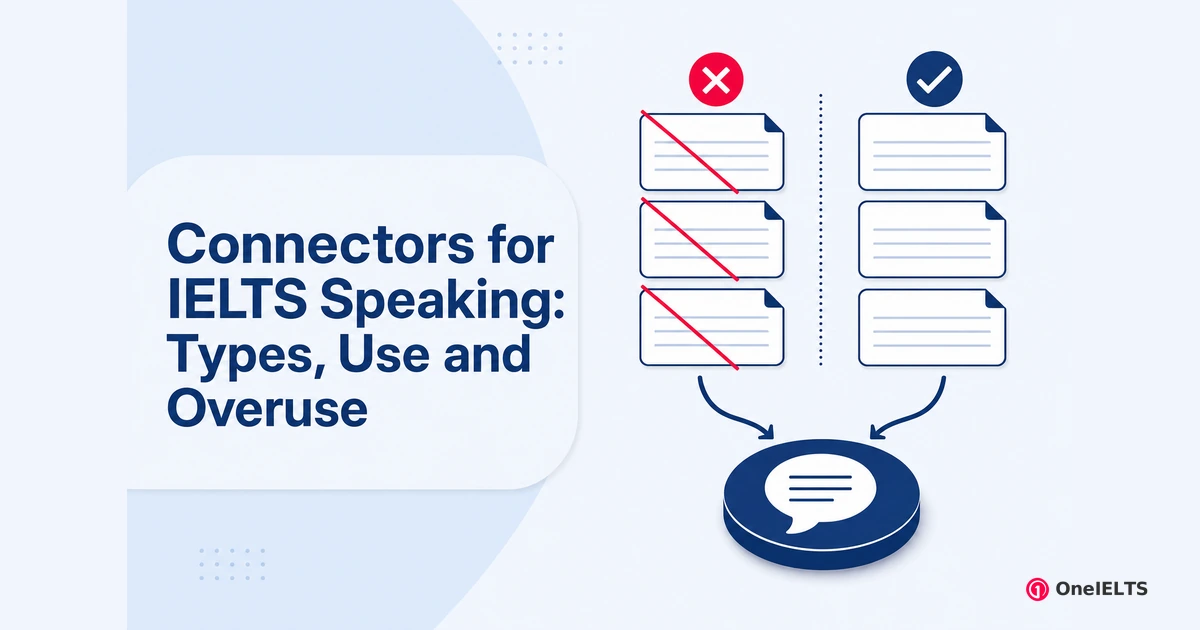
Google’s own AI Overview on connectors for IELTS Speaking tells you to avoid moreover and furthermore, then says you can use and, but and because as often as you like. The official band descriptor settles which rule is right. A connector is marked under Fluency and Coherence, not under vocabulary, so the only thing that counts is whether a listener can follow you.
This page defines the linking word set, names the criterion, and separates spoken register from written. It then sets out eight jobs, the thinking-time phrase group and the openers, before covering use by part, overuse, the Writing boundary, the download, and what changes at band 9.
What Are Connectors in IELTS Speaking?
Connectors are the words and short phrases that signal how one idea relates to the next, so a listener follows your answer without effort. A linking word and a transition word are the same thing under a different name. Most pages on this query use at least two of the three labels, which is why you have probably searched more than one of them.
They work at the level of the whole answer rather than the sentence. Each one marks a relationship between ideas, whether that is a reason, a contrast, an example or a result, and the listener uses that mark to keep track of where you are going.
The plain ones count too. And, but and because are connectors, and that fact carries most of the argument further down this page. None of it is vocabulary in the scoring sense. The next section names the criterion that actually measures them.
Which IELTS Criterion Marks Your Use of Connectors?
Connectors are marked under Fluency and Coherence, not under Lexical Resource. The IELTS Speaking Band Descriptors list exactly four criteria, which are Fluency and coherence, Lexical resource, Grammatical range and accuracy, and Pronunciation. Connectors sit inside the first one.
That placement changes what is worth practising. If connectors were scored as vocabulary, collecting more of them would raise your band. They are scored as coherence, so the question that matters is whether the listener can follow you. A candidate who uses and, but and because coherently outscores one who deploys furthermore.
Notice the second half of the name. It is Fluency AND Coherence, one criterion covering two things. A connector you have to hunt for buys you the coherence half and costs you the fluency half, because retrieval hesitation is audible to the examiner.
Not one page ranking on this query quotes the descriptors, which is why the topic gets taught as a vocabulary-range exercise. The long turn and the Part 3 discussion are judged on the same criterion, so cohesion is the thread running through all three parts.
Why Should You Avoid Written Linkers Like Moreover and Furthermore?
Avoid them because they belong to written English, and in speech they make you sound like you are reading an essay aloud. Google’s AI Overview on this query names moreover, furthermore and thus as the ones to drop. It tells readers to “avoid heavy academic linkers like moreover, furthermore, or thus to keep your tone conversational and fluent”. Its opening line treats natural spoken connectors, rather than rigid writing words, as the basis of IELTS speaking success.
The damage is real rather than stylistic. A register mismatch is audible, and it costs you on the criteria that reward natural speech. An examiner who hears furthermore in a Part 1 answer about your hometown hears a rehearsed insert, which is the same signal a memorised idiom sends.
Six written forms recur in candidate answers, and each has a spoken equivalent that covers the identical job.
| Written linker | Spoken equivalent |
|---|---|
| Moreover | What’s more / on top of that |
| Furthermore | And another thing |
| However | But / that said |
| Therefore | So |
| In conclusion | So overall |
| Nevertheless | Even so |
One caveat is worth stating plainly. These written forms are correct English and they are right in Writing Task 2. The problem is the module difference, not the word, and that is why two of the eight related searches on this query ask about Writing.
What Are the Types of Connectors for IELTS Speaking?
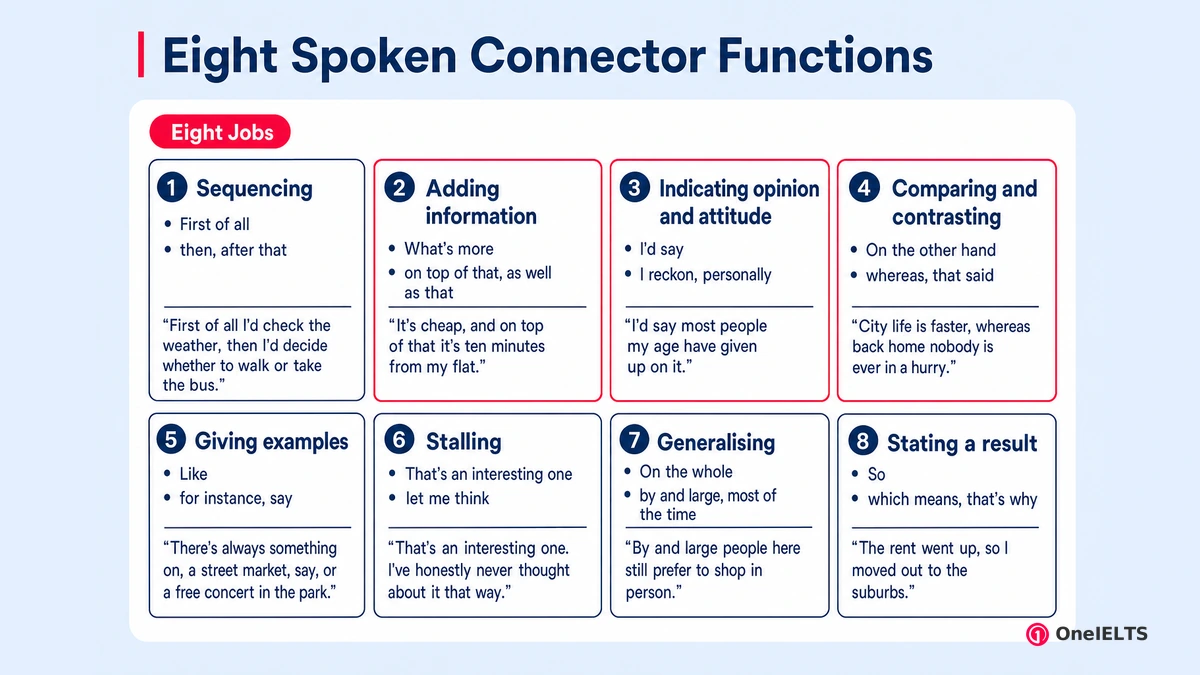
Eight jobs cover everything a spoken answer needs to signal, from sequencing and adding information through to stating a result. Each one is a language function rather than a word class, which is why the grouping holds up under pressure. In the test you never think “I need a conjunction”. You think “I need to add something”.
IDP publishes these eight linking functions in its own connector guidance, and Google’s AI Overview groups three of the same jobs under Adding Information, Contrasting Ideas and Giving Opinions. Each function below carries two or three spoken phrases and one line you could say out loud.
- Sequencing. First of all, then, after that. Use it when an answer has an order. “First of all I’d check the weather, then I’d decide whether to walk or take the bus.”
- Adding information. What’s more, on top of that, as well as that. It stacks a second point onto the first. “It’s cheap, and on top of that it’s ten minutes from my flat.”
- Indicating opinion and attitude. I’d say, I reckon, personally. It marks the next clause as yours rather than as fact. “I’d say most people my age have given up on it.”
- Comparing and contrasting. On the other hand, whereas, that said. It sets two things against each other. “City life is faster, whereas back home nobody is ever in a hurry.”
- Giving examples. Like, for instance, say. This is the quickest repair for a vague answer. “There’s always something on, a street market, say, or a free concert in the park.”
- Stalling. That’s an interesting one, let me think. It buys a second while you choose content. “That’s an interesting one. I’ve honestly never thought about it that way.”
- Generalising. On the whole, by and large, most of the time. It softens a sweeping claim so Part 3 answers stay honest. “By and large people here still prefer to shop in person.”
- Stating a result. So, which means, that’s why. It closes the loop between a reason and its outcome. “The rent went up, so I moved out to the suburbs.”
Two or three phrases per job is the limit worth carrying. Range is not what gets marked here, so a hundred-connector list would argue against the rest of this page.
Which Phrases Work for Giving Opinions, Explaining and Buying Time?
Candidates cut these phrases because someone told them any pause costs marks. The descriptor says otherwise. Band 9 Fluency and Coherence reads, “Any hesitation that occurs is used only to prepare the content of the next utterance and not to find words or grammar”. Band 8 allows hesitation that “may occasionally be used to find words or grammar, but most will be content related”.
So the criterion does not punish pausing. It punishes word hunting. That distinction makes content-related hesitation legal at the top of the scale. Google’s AI Overview arrives at the same place from the other direction, advising you to replace “I think” with phrases that “buy you time to think”.
One rule falls out of that. Automatic retrieval is the whole point. If you have to search for the thinking-time phrase, the search costs you exactly what the phrase was meant to buy. Eight of them follow, sorted by the moment they fit.
- Before an opinion, “I’d say”. Two syllables, no wind-up, and it hands the listener your position immediately rather than after a preamble.
- Before an opinion, “Personally, I reckon”. Slightly informal, and the informality is the point in a spoken test rather than a written one.
- Before a Part 3 question, “That’s an interesting one”. Buys about a second, and one use across the whole test still reads as human.
- Before a Part 3 question, “Let me think for a second”. Says plainly that you are choosing content, which is the hesitation the descriptor permits.
- Before a Part 3 question, “I’ve never really thought about that”. Honest, and it buys a full clause of thinking without sounding evasive.
- Mid-answer, “As far as I know”. Hedges a fact you are unsure of while keeping the sentence moving forward.
- Mid-answer, “What I mean is”. Repairs a clause that came out wrong, and self-repair is marked as control rather than as error.
- Mid-answer, “One possible explanation is”. Opens an explanation in Part 3 and gives you a whole phrase to plan the rest.
The failure mode is repetition. Two or three rotated are invisible, while the same one before four answers is a verbal tic.
Hesitation noise is a separate matter. Um, ah and a dragged “like” buy nothing, because they are not language and nothing gets marked. A real phrase does the same job and is scored.
Which Starting Phrases Work Best in IELTS Speaking?
The best opening phrase answers the question in the same breath, as “Well, I’d say” and “For me it’s definitely” both do. Your first three words set the examiner’s expectation for the whole answer, and the front of an answer is the most audible place to stall.
Openers split by part, because the three parts ask for different first moves. Here are the ones worth making automatic, with an example each.
- Part 1, the direct opener. Answer, then reason. “Yes, quite often, mainly because my office is a twenty-minute walk away.” Two or three sentences is the whole answer.
- Part 1, the plain restatement. “I don’t, actually.” A negative answer opens just as well as a positive one, and it usually produces a more specific reason.
- Part 2, the naming opener. “The place I want to talk about is a bookshop near my old school.” Name the thing first, describe it second.
- Part 2, the time anchor. “This happened about three years ago, when I was still at university.” A date or a place sets the long turn before you start building it.
- Part 3, the position-taking opener. “I’d say it cuts both ways, though on balance.” State a position at once, because the discussion rewards a claim you can then defend.
- Part 3, the qualified opener. “It depends on the country, but generally.” Useful when a question generalises about people and a flat answer would simply be false.
One opener costs marks, and candidates love it. “Well, that’s a very interesting question” says nothing. In practice it is the phrase test-takers repeat most, and by its third appearance the examiner hears a stall rather than language. One use is human. Three is a verbal tic, and an empty preamble in front of every answer is the clearest version of one.
Keep the two phrase sets apart. A thinking-time phrase buys you a second before you commit, while a starting phrase is the commitment itself. A few do both, “Well, I’d say” among them, which is why those are the ones to drill. The Part 2 long turn has its own rules for a first sentence, and the long-turn page covers them in depth.
Which Connectors Should You Use in IELTS Speaking Part 1?
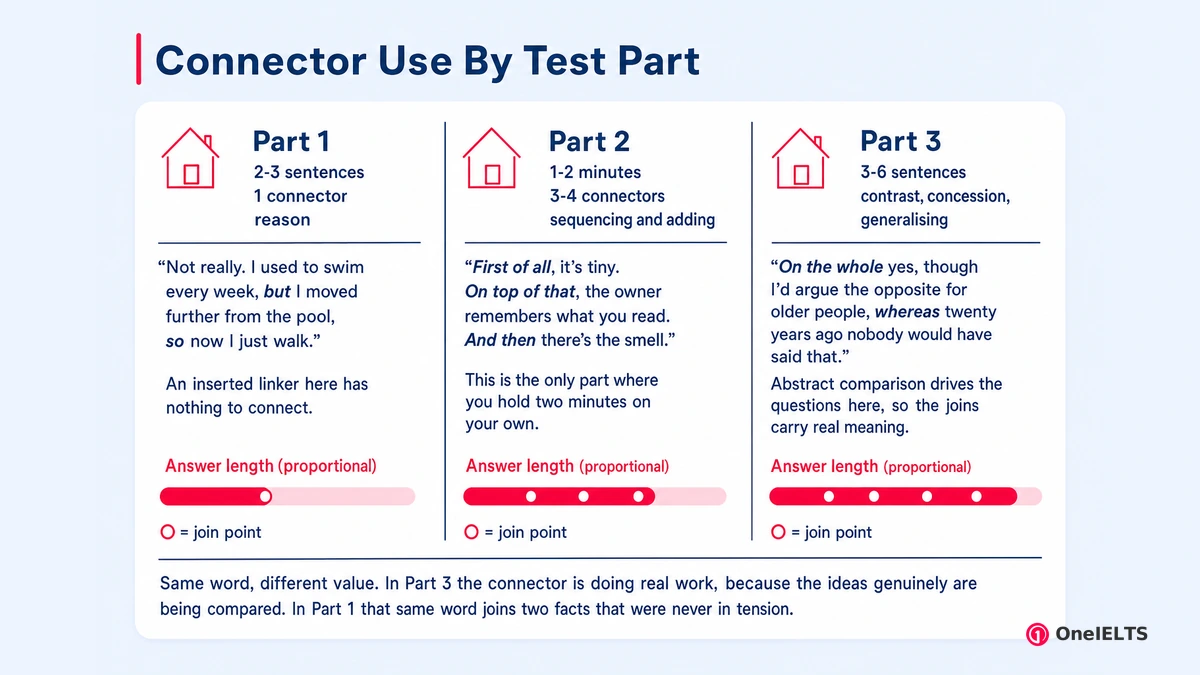
Part 1 needs the fewest connectors of the three parts, usually one. Answer length decides the number, since two or three sentences leave room for a single join, and because carries most of that load.
Connector need scales with how long you have to hold the floor alone. Each part gets its own line, with a worked answer and the joins marked in italics.
- Part 1, two or three sentences. One connector, sometimes none. The reason connector does the work. “Not really. I used to swim every week, but I moved further from the pool, so now I just walk.” An inserted linker here has nothing to connect.
- Part 2, one to two minutes. Three or four, mostly sequencing and adding. “First of all, it’s tiny. On top of that, the owner remembers what you read. And then there’s the smell.” This is the only part where you hold two minutes on your own.
- Part 3, three to six sentences per answer. Contrast, concession and generalising. “On the whole yes, though I’d argue the opposite for older people, whereas twenty years ago nobody would have said that.” Abstract comparison drives the questions here, so the joins carry real meaning.
Same word, different value. In Part 3 the connector is doing real work, because the ideas genuinely are being compared. In Part 1 that same word joins two facts that were never in tension.
Can You Use Too Many Connectors in IELTS Speaking?
Yes for the academic ones and no for the basic ones. Google’s AI Overview on this query says to use “and”, “but” and “because” as many times as you want. An academic linker in every sentence, by contrast, is heard as rehearsed.
The disagreement sits inside a single Google answer. The same overview that tells you to drop moreover also names the basic linker set, “but, and, because, like, also”, as the most common linking words for speaking. IELTS Liz, at rank two on this query, holds the same position, and Google quotes her for it. The list pages, meanwhile, all sell range.
The criterion settles it. Coherence asks whether the listener can follow, so a repeated because is invisible and a repeated furthermore is a signature. Frequency turns into a problem only when a connector is doing display work rather than joining work.
Two habits are worth watching. A sentence-initial habit, where a connector opens every single sentence, turns an answer into a list. A doubled connector such as “so therefore” or “but however” is a grammar error stacked on top of a register one.
Do IELTS Writing Connectors Work in the Speaking Test?
Mostly no. The Writing set belongs to the written register, and the two modules reward opposite things, which is why one word helps in Task 2 and hurts in Part 1.
Cross-module confusion is built into this query. Two of the eight related searches ask about connectors for IELTS Writing Task 1 and Task 2. The traffic leader is a test-owner page titled “Connectors for IELTS Writing and Speaking”, and it handles both modules together. Searchers land here with the wrong module in mind, through no fault of their own.
The overlap is real but small. A register-neutral connector such as “first of all” or “for example” covers both modules, because neither one carries a register signal. A formal contrast word does not travel, and neither does a formal conclusion word. That module difference is the whole of the answer.
Where Can You Get a Connectors for IELTS Speaking PDF?
A one-page download covers this topic, and it holds the eight jobs with two phrases each, plus the thinking-time set. Two of the eight related searches on this query ask for a PDF, so the demand is real enough to answer properly.
One page rather than ten follows from the argument above. Coherence sets your score, not range, so you need a small set automatic rather than a phrase table to browse at leisure.
The build rule is short. Side one prints the same eight jobs and the same phrases as this page, so the two never drift apart, with each automatic phrase on its own line. Side two repeats them under a per-part grouping, so you can revise for whichever part you are weakest on.
Which Connectors Get You Band 9 in IELTS Speaking?
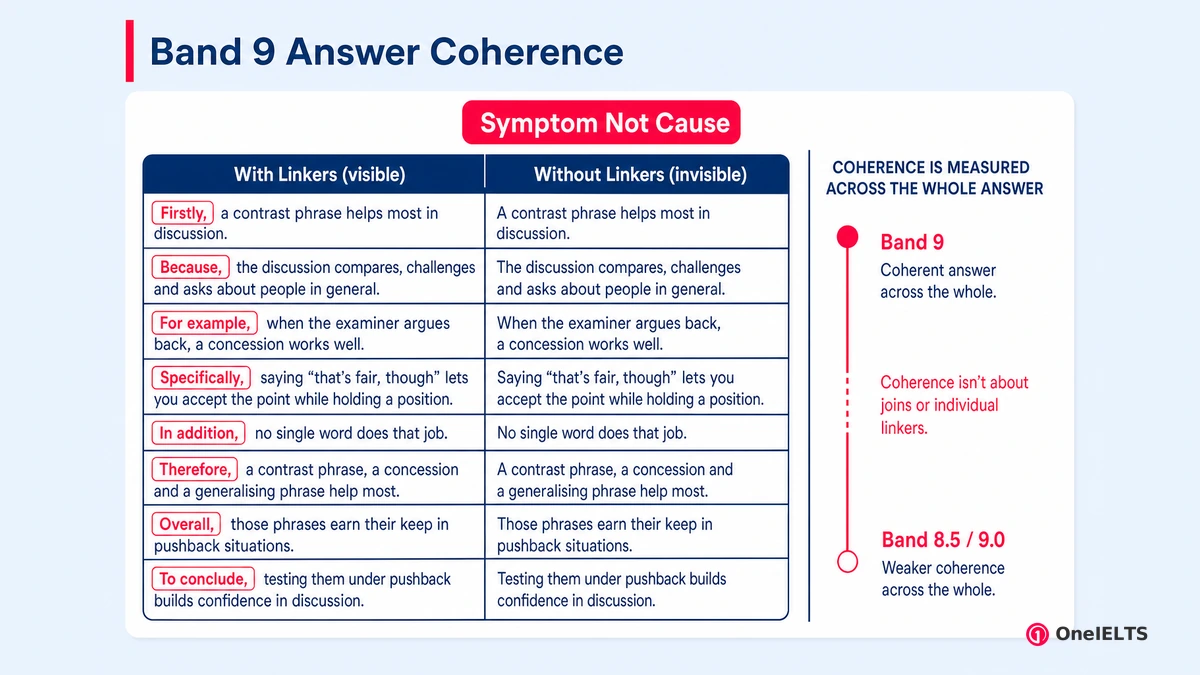
No particular ones. At band 9 the connectors stop being noticeable, because the answer holds together whether or not a linking word is present.
Three consequences follow from everything above. Coherence is a property of the whole answer rather than of its joins, so treat a connector as symptom not cause of good structure. The descriptor allows content-related hesitation, so a small automatic set is worth more than a long list. And whole-answer coherence drops the moment you add an unnecessary connector to an answer that had no relationship to signal.
The related search asking for band 9 connectors has no list answer. Pretending otherwise would sell you the wrong thing. The real answer is eight jobs, two phrases each, automatic. The band and part questions that follow from it are taken up below.
How Can You Get 8.5 in IELTS Speaking?
Band 8.5 comes out of averaged criteria, usually three 9s and an 8, so the work belongs on your weakest criterion rather than on adding connectors. Connectors sit inside one half of one criterion, which makes them almost never the constraint. Grammatical range and pronunciation usually set the ceiling instead. Check the wording in the IELTS Speaking band descriptors before you pick what to practise.
How Can You Get 9.0 in IELTS Speaking?
A 9.0 needs all four criteria at 9 or close to it at once, and for Fluency and Coherence that means speech with only occasional self-correction or repetition. The descriptor is more generous than candidates assume. Permitted hesitation exists at band 9 when it goes to content preparation rather than to word-finding, so fluency is not absence of pauses. The IELTS Speaking band descriptors set out that wording exactly.
Which Connectors Help Most in the IELTS Speaking Discussion?
The ones that help most are a contrast phrase, a concession and a generalising phrase, because the discussion compares, challenges and asks about people in general. Pushback is where they earn their keep. When the examiner argues back, a concession such as “that’s fair, though” lets you accept the point while holding a position, and no single word does that job. Our IELTS Speaking Part 3 guide covers the question types.
Test them under pushback on the IELTS Speaking discussion practice filter, free once you register.
Do Connectors Count as Vocabulary in IELTS Speaking?
No, not mainly. They are marked under Fluency and Coherence, though an unusual or precise phrase can also register as lexical range.
Comma replacement is the test that decides it. “And” replaces a comma cleanly, so it does coherence work only. “To be fair, though” shifts your stance, and that meaning change shows range as well. Word choice is handled on our IELTS Speaking vocabulary page.
Written by Rifah Binte Faruk, reviewed 14 August 2026.
Last verified: 14 August 2026
Practice for the Real IELTS Exam
Apply what you’ve learned with free, exam-style practice:
- Take a free IELTS mock test — all four skills, real exam timing, AI band scoring
- Sit a Speaking section mock — timed Parts 1–3 with voice recording and band feedback
- Practise all three parts — sample questions with feedback