An examiner never counts your words. What gets marked is whether each word fits the thing you are describing, and that judgement carries the name Lexical Resource. IELTS Speaking vocabulary runs on two axes, not one. There is topic lexis for the themes that keep coming back, and there is the functional phrase set that lets you state an opinion or buy a second to think.
This page covers the meaning, the marking, which words you need, the twelve topics, collocation pairs and idioms. It then takes on opinion and clarification phrases, paraphrasing, how to learn words, how many are enough, where the PDF is, and what band 9 sounds like. A bigger list is not the goal, and it is the easy half.
What Is IELTS Speaking Vocabulary?
IELTS Speaking vocabulary is the range and precision of the words and set phrases you can use while you talk. It is scored as Lexical Resource, one of the four criteria, and it reaches wider than single words. It covers topic lexis, collocations, fixed expressions, and the functional phrase set that carries opinion, comparison and hesitation.
Fit beats difficulty. A common word used exactly outscores a rare word used loosely, so word choice is judged against the thing in front of you. Part 3 exposes this most, because abstract questions leave nowhere to hide. The mark covers the whole test rather than one part.
Google’s AI Overview on this query answers with three headings. Two are topics, ‘Home and Daily Routine’ and ‘Work and Hobbies’. The third is a function, ‘Opinions and Clarification’, and its published items are ‘To some extent’, ‘What I mean is’ and ‘Off the top of my head’. Two axes, then, not one.
How Is Vocabulary Marked in IELTS Speaking?
Vocabulary is marked as Lexical Resource, one of the four marking criteria, all weighted the same. The examiner listens for three qualities, and a word used wrongly earns nothing, however advanced it is.
Precision comes first: the word fits the thing. Range comes second: not the same two adjectives in every answer. Flexibility comes third, and almost nobody practises it. It means going round a word you have lost instead of stopping on it, and it is what saves an answer.
The penalty that surprises people is the memorised phrase. Candidates lose more ground here than they lose through a small word stock. Drop ‘a double-edged sword’ into a Part 1 answer about breakfast and it is heard as memorised. It costs twice, once for precision and once for naturalness.
All four scores are averaged, so strong fluency cannot buy back a weak lexical mark. The band descriptors describe vocabulary in words rather than counts, which is why no honest page hands you a number to learn.
Which Vocabulary Do You Actually Need for IELTS Speaking?
You need everyday, natural vocabulary for familiar topics, plus a small set of functional phrases. The advanced and academic word lists that candidates chase are not what earns the marks.
The test is a conversation about your life, your opinions and general issues. The words that score are the ones a fluent speaker would reach for without thinking. Everyday vocabulary placed with natural word choice sounds fluent. A bought word list sounds bought.
Part 3 is the exception. There the questions turn abstract and the plain word genuinely is the precise one: inequality, infrastructure, incentive. An abstract noun of that kind earns its place, because nothing shorter says the same thing.
Before you learn any word, run the ten-second test on it. Could you use it in an unscripted sentence about your own life within ten seconds? If not, it is passive vocabulary, and passive vocabulary does not turn up under pressure.
Which Topics Should Your IELTS Speaking Vocabulary Cover?
About a dozen recurring themes cover nearly every question in all three parts. The efficient move is ten to fifteen usable words per theme, not a thousand words overall.
The themes repeat because the test asks about your life, your habits and the general issues around them, and those do not change from year to year. Ten to fifteen items per theme is roughly what a two-minute answer needs. Twelve themes are set out here, each with a few real words and the part where the theme usually turns up.
- Home and daily routine (Part 1). Spacious, on the outskirts, a creature of habit, stuck in a rut. Enough to describe where you live and what your mornings look like.
- Work and study (Parts 1 and 3). A rewarding job, a demanding workload, work-life balance, meet a deadline. These carry the personal question and the abstract follow-up equally well.
- Hobbies and free time (Parts 1 and 2). Take up a hobby, an avid hiker, unwind, get hooked on. The verb pairs matter more here than the nouns do.
- Food (Parts 1 and 2). Home-cooked, a quick bite, eat out, a sweet tooth. Four items cover most food questions without a single rare adjective in sight.
- Travel and holidays (Part 2). Off the beaten track, a short break, breathtaking scenery, book in advance. Part 2 cards ask for a place far more often than a person.
- Technology (Parts 1 and 3). Disconnect from my phone, screen time, come in handy, a steep learning curve. Part 3 turns each of these into a question about society.
- Friends and family (Part 1). A close friend, get on well with, take after someone, keep in touch. All four are pairs of words rather than single words.
- Health (Parts 1 and 3). Keep fit, a balanced diet, cut down on sugar, feel run-down. Plain verbs beat medical nouns in every part of the test.
- Environment (Part 3). Cut emissions, single-use plastic, renewable energy, raise awareness. Part 3 asks what governments ought to do, so keep the nouns concrete.
- Education (Part 3). Hands-on learning, a heavy syllabus, drop out, tuition fees. This theme overlaps with work, so learn the two in the same week.
- Media and books (Parts 2 and 3). A page-turner, catch up on the news, biased coverage, get into a series. Part 2 cards ask for a book you liked.
- The city you live in (Parts 1 and 2). The hustle and bustle, proximity to the centre, well connected, a green space. Useful for the place cards too.
What Are Collocations in IELTS Speaking Vocabulary?
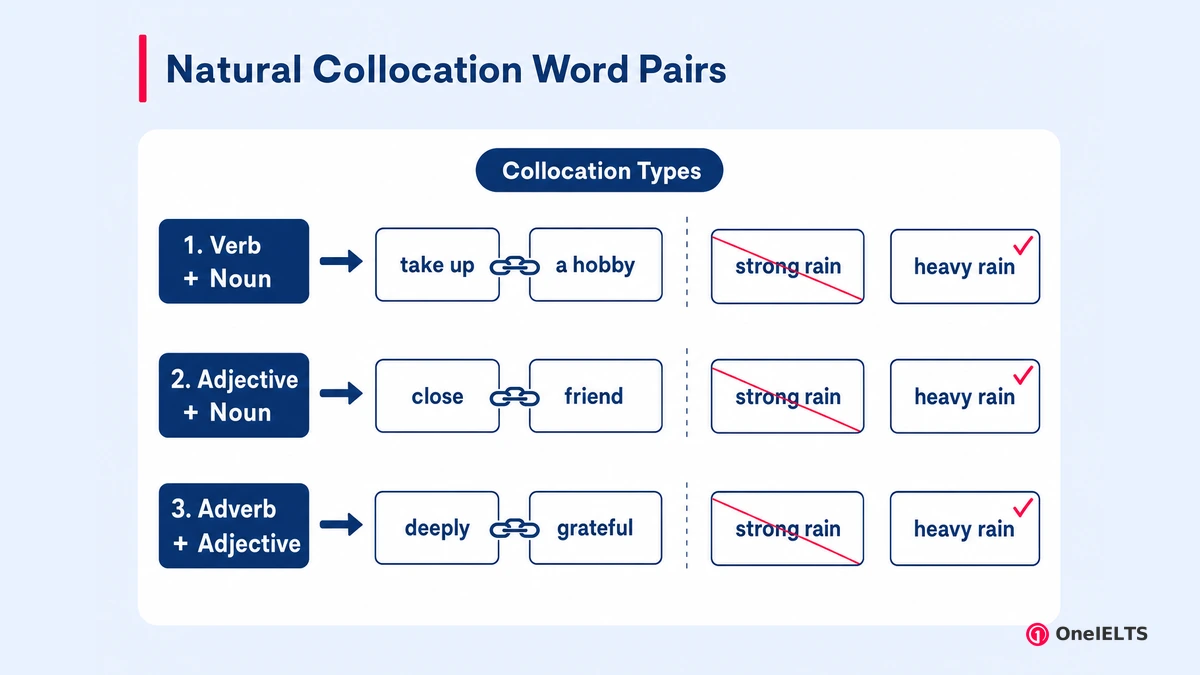
Collocations are word pairs that natural speakers always put together, such as heavy rain, take up a hobby and close friend. Learn the pair as one item and your speech sounds native rather than assembled.
Test it on yourself. ‘Strong rain’ and ‘heavy rain’ sit at the same level of English, yet only one of them is right, and the examiner hears the gap at once. A candidate with 200 collocations sounds more fluent than one with 800 single words, because the natural pairing is what fluency is made of.
Three types repay deliberate work. Verb and noun pairs carry most of Part 1: take up a hobby, do the housework. Adjective and noun pairs carry description: close friend, heavy traffic. Adverb and adjective pairs carry emphasis: deeply grateful, highly unlikely.
Record the pair, never the single word. Treat each one as a single lexical unit in your notes, and the acquisition routine further down does the rest.
How Do Idioms Fit Into IELTS Speaking Vocabulary?
Idioms count as lexical range only when they land naturally. A handful used correctly helps, and a list forced in hurts, and the band descriptors never require one.
The search results push the opposite belief. A live related search pairs vocabulary with idioms, and both IDP pages publish idiom lists, so candidates arrive certain that idioms are a scoring requirement. They are not. An idiom is one way to show range and the riskiest one, because a misused idiom counts as a precision error rather than a neutral gap.
One rule keeps you safe. Use only idioms you have heard in real speech and could explain, and no more than two or three across a whole test. Natural delivery decides whether an idiom belongs: ‘stuck in a rut’ passes that check, a fetched proverb does not. The full set, and the ones that backfire, sit on the idioms page.
Which Phrases Help You Give Opinions and Clarification?
A small fixed set covers every functional need in the test: four or five to state an opinion, two to qualify it, two to clarify, and one to buy a moment.
These count as vocabulary rather than grammar because each functional phrase is stored and produced whole, exactly like a collocation. Buying a moment is not cheating either. IDP names ‘Stalling’ as a linking function in its own right, and a real phrase always beats a filler noise. Six functions matter, with two phrases apiece.
- Stating an opinion. ‘The way I see it’ and ‘I’d say’. Both open a view without the flat ‘I think’ every candidate reaches for.
- Qualifying it. ‘To some extent’ and ‘more often than not’. A qualifying phrase softens a claim you cannot fully defend, and it sounds honest.
- Comparing. ‘Compared with ten years ago’ and ‘nothing like as common’. Part 3 asks about change over time, so these two earn their place.
- Exemplifying. ‘Take my own family’ and ‘a good case in point’. One example turns a thin opinion into an answer with real content.
- Clarifying what you just said. ‘What I mean is’ and ‘to put it another way’. A clarifying phrase rescues a botched sentence.
- Buying thinking time. ‘Off the top of my head’ and ‘that’s an interesting one’. Real language wins you thinking time without an empty noise.
Two phrases per function is the whole quota here. The full discourse-marker set belongs on the linking-word page.
What Does Paraphrasing Successfully Require in IELTS Speaking?
Paraphrasing requires a second way of saying the same thing, ready before you need it. It is the part of Lexical Resource that rescues an answer when the exact word will not come.
It sits on a vocabulary page, not a grammar one, because it is scored as lexical flexibility. The examiner listens for whether you can move around a word you have lost rather than stopping dead on it.
Two moves do the work. Go one level more general: a spaniel becomes a dog, a dog becomes a pet. Or switch to describing the function instead of naming the thing, as in ‘the thing you open bottles with’. Both keep speech running and both are marked as range.
Part 3 is where this pays most. The question usually contains the exact word you would reach for, so repeated wording throws away the easiest range point on the page. Say it back in your own words instead.
How Do You Improve Your Vocabulary for IELTS Speaking?
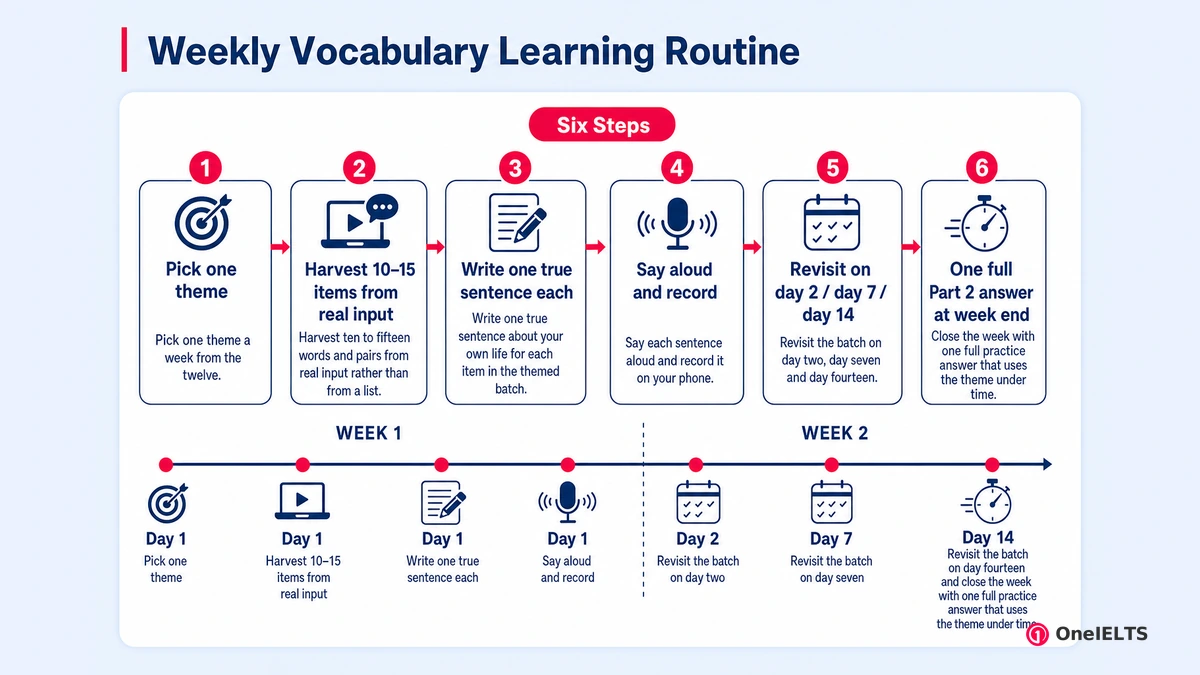
Learn each word inside the sentence you would actually say it in, out loud, in themed batches, and revisit each batch three times across two weeks. Collecting words fails for a plain reason: a word stored on its own has no sentence to live in, so it never arrives when you speak.
Three inputs feed different parts of the score. Reading feeds range, because it puts words in front of you that no conversation would. Imitation feeds pronunciation and rhythm alongside the words. Writing forces precision, because you can see your word choice sitting on the page and correct it.
Pick imitation if you only have time for one, since it is the only input that produces speech. Six steps turn a single theme into language you can say.
- Pick one theme a week from the twelve. A single theme is small enough to finish and wide enough to reuse, and it stops you jumping between words you will never need together.
- Harvest ten to fifteen words and pairs from real input rather than from a list. A podcast, a vlog or a conversation hands you the word with its collocation and its context already attached.
- Write one true sentence about your own life for each item in the themed batch. True sentences stick because the memory is already there, while invented examples fade inside a week.
- Say each sentence aloud and record it on your phone. Words that are said aloud become speech, and words that stay on the page stay silent, while the exam tests only the spoken half.
- Revisit the batch on day two, day seven and day fourteen. A spaced revisit costs about four minutes each time and moves an item from recognition into production, which is the half that scores.
- Close the week with one full practice answer that uses the theme under time. Two minutes on a Part 2 card is the only proof that the batch has actually landed.
How Much Vocabulary Is Enough for IELTS Speaking?
No source publishes a number. The band descriptors are written in words, not counts, so there is no published figure for how many words a band needs.
A few hundred well-used words and pairs across a dozen themes is the honest estimate for band 7. Treat it as an estimate, never as a rule. The criterion measures use, not size.
The question comes from the products, not the exam. Two keyword rows ask how much is enough, one asks whether vocabulary matters, and the related searches offer ‘1000 vocabulary words for IELTS’. A passive list of a thousand words mostly stays passive.
Run a coverage test instead. Can you talk for two minutes on each of the twelve themes without stalling for a word? That two-minute check tells you more than any total. Fifteen usable items across twelve themes is 180 items, a fortnight of work, and enough to stop the stalling.
Where Can You Get an IELTS Speaking Vocabulary PDF?
This page offers one, and it is the themed set from the topics section with an example sentence for every item, rather than a thousand-word dump.
The demand is loud for a reason. Four of the eight live related searches ask for a PDF, and a PDF file ranks fifth on this query with more traffic than most real pages. People revise on a phone.
A long, undated word-list dump is the most popular way to study vocabulary and the least effective one. A themed download beats it because you can finish it, and phone revision works when every item arrives with a sentence you can say aloud.
Our download carries the same themes and items as the topics section, so the two never drift apart, and it includes the functional phrase set that no competitor PDF carries.
Which Vocabulary Gets You Band 9 in IELTS Speaking?
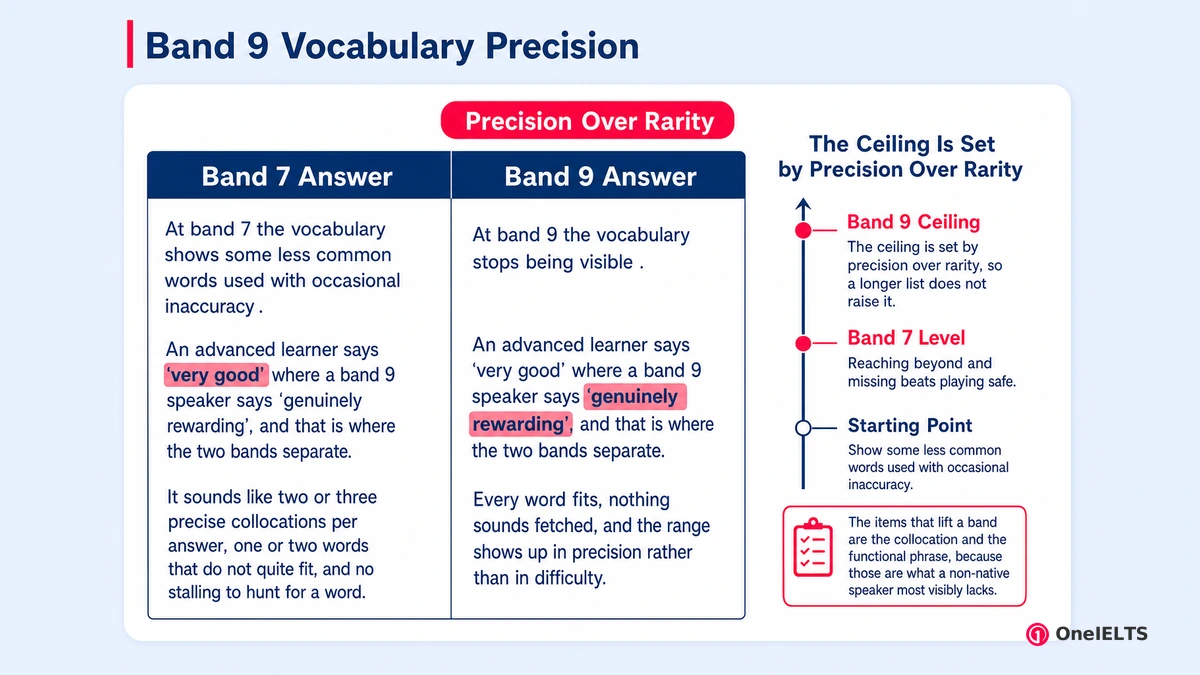
At band 9 the vocabulary stops being visible. Every word fits, nothing sounds fetched, and the range shows up in precision rather than in difficulty.
Three things follow from everything above. The ceiling is set by precision over rarity, so a longer list does not raise it. The items that lift a band are the collocation and the functional phrase, because those are what a non-native speaker most visibly lacks.
Then there are the short words. An advanced learner says ‘very good’ where a band 9 speaker says ‘genuinely rewarding’, and that is where the two bands separate.
The related searches asking for band 7 and band 9 word lists want an answer that no list can give. There is no band 9 vocabulary set. There is only band 9 use, and the four questions here take it apart.
Which IELTS Speaking Vocabulary Marks Band 7?
Band 7 shows some less common vocabulary used with occasional inaccuracy, which means a candidate who reaches beyond the obvious word and sometimes misses. It sounds like two or three precise collocations per answer, one or two words that do not quite fit, and no stalling to hunt for a word. Reaching beyond and missing beats playing safe. The wording of each band sits in our ielts speaking band descriptors guide.
How Do IELTS Speaking Vocabulary and Idioms Work Together?
Idioms are a subset of your lexical range, so they are counted like any other phrase: right if they fit, wrong if they do not. Build the topic and collocation base first, then add two or three idioms you have genuinely heard someone use. Reversing that order is the most common way to lose a precision mark. The set that scores is in our idioms for IELTS Speaking guide.
Which Linking Phrases Count as Vocabulary?
The linking phrases that carry meaning count, while a clause joiner does not. These signal opinion, concession, comparison or a moment of thought. One line decides it: a discourse marker you could swap for a comma is grammar, as with ‘and’ and ‘also’. A meaning-carrying phrase moves the stance, as with ‘to be fair’ and ‘mind you’. Build the set from our connectors for ielts speaking guide.
How Do You Learn Vocabulary by Mimicking Native Speakers?
Copy whole phrases out loud at the speaker’s own speed, rather than noting words down for later. Imitation is the highest-yield method for this test, because it is the only practice that produces speech: it trains words, stress and rhythm together. Shadow thirty seconds of a real speaker daily and say it back without reading. That shadowing is spoken practice, and it costs five minutes. Fold it into your ielts speaking preparation routine.
Written by Rifah Binte Faruk, reviewed 14 August 2026.
Last verified: 14 August 2026
Practice for the Real IELTS Exam
Apply what you’ve learned with free, exam-style practice:
- Take a free IELTS mock test — all four skills, real exam timing, AI band scoring
- Sit a Speaking section mock — timed Parts 1–3 with voice recording and band feedback
- Practise all three parts — sample questions with feedback