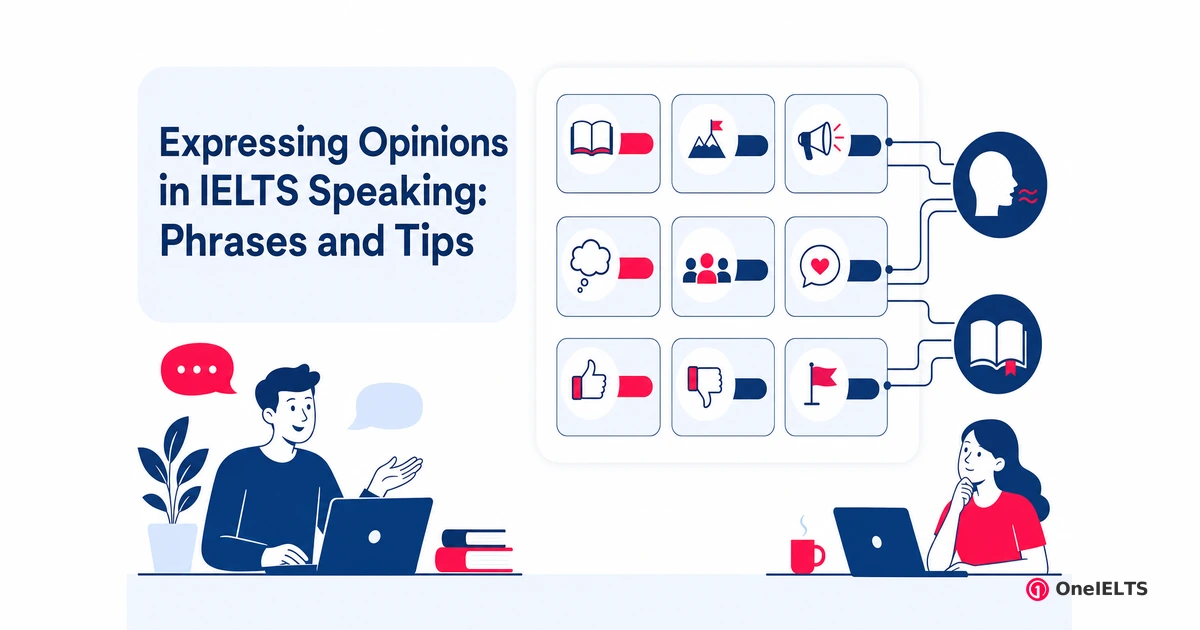
Opinion phrases tell the examiner where your view starts, how sure you are and why you hold it. You’ll use them in every part of the test, but IELTS Speaking Part 3 is where the examiner pushes for views on society, so most examples here come from Part 3. Each phrase family is matched to its natural test part and to the Fluency and Coherence or Lexical Resource line it serves.
After a definition come question frames, basic and advanced phrases, strong and tentative views, the general point of view, reasons, agreeing, disagreeing and concluding, then a model answer and tips. Linking words have their own page; this one covers phrases that give, qualify, defend or close a personal opinion.
What Does Expressing an Opinion Mean in IELTS Speaking?
Expressing an opinion means stating your own view on a question, showing how certain you are and giving at least one reason for it, rather than only describing facts. Fact and opinion sound different: “Most Delhi students commute by metro” is a fact, while “Buses deserve their own lanes” is a view to defend.
IELTS scores how you express a view, not which view you hold, so no stance is right or wrong. Other words for an opinion are view, stance, standpoint, point of view and perspective.
Opinions appear occasionally in Part 1 (“Do you like…?”) and sometimes after your Part 2 talk. In the Part 3 discussion they’re constant, because the examiner moves you onto abstract topics.
Which Questions Do Examiners Use When Asking for Your Opinion?
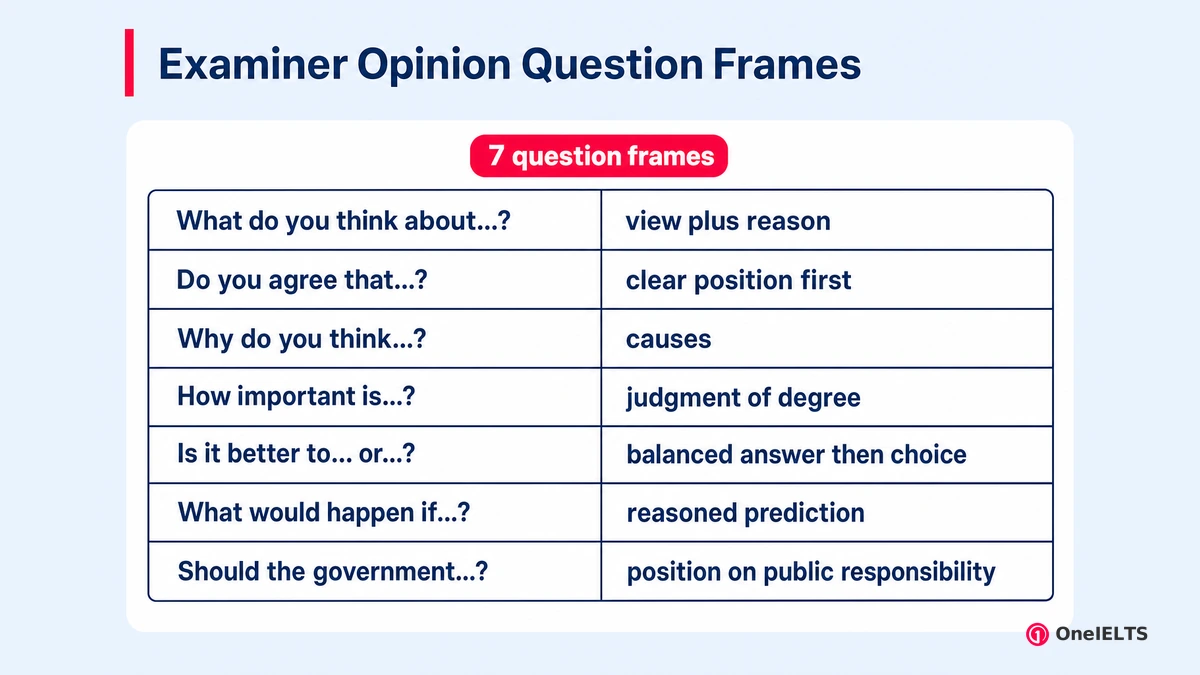
Examiners rarely say “What is your opinion?” Instead, opinion questions usually arrive as “What do you think about…”, “Do you agree that…”, “Why do you think…”, “How important is…” or “Is it better to… or…”. Each question frame hints at the answer it wants. “Do you agree that…?” needs a clear position (yes, no or partly) before the reason, while “Is it better to… or…?” invites a balanced answer that weighs both sides.
Treat each of these seven examiner prompts as a request for your view, even when the word opinion never appears in the Part 3 question.
- What do you think about…? “What do you think about online shopping?” expects your view plus one reason.
- Do you agree that…? “Do you agree that cities are too crowded?” expects a clear position first, then support.
- Why do you think…? “Why do you think young people move abroad?” expects causes, explained with your own reasoning.
- How important is…? “How important is learning history?” expects a judgment of degree, from vital to minor.
- Is it better to… or…? “Is it better to rent or buy?” expects a balanced answer, then your choice.
- What would happen if…? “What would happen if cars were banned downtown?” expects a reasoned prediction about likely results.
- Should the government…? “Should the government fund sports facilities?” expects a position on public responsibility, with a reason.
What Are the Basic Phrases for Expressing Your Opinion?
Basic phrases are short, safe openers that suit Part 1 answers and quick Part 3 replies. They’re fine at any band, as long as phrase variety stops you leaning on one opener all test. Each opinion opener carries a slightly different meaning: “I think” gives an everyday view, “I feel” signals a personal reaction, and “In my opinion” states a clear view.
These seven openers sit in an everyday register, and each comes with a line you could say in the test.
- I think… “I think weekends are for resting, so I rarely make plans on Saturdays.”
- I feel… “I feel a bit stressed in crowded markets, so I shop online instead.”
- In my opinion,… “In my opinion, my hometown needs more parks for children and older people.”
- I believe… “I believe reading every day is the easiest way to build your vocabulary.”
- Personally, I’d say… “Personally, I’d say mornings are my best time for studying and serious work.”
- If you ask me,… “If you ask me, street food is the best part of living in Kolkata.”
- I reckon… “I reckon most of my friends would choose a beach trip over the mountains.”
Which Advanced Phrases Can You Use to Give Your Opinion?
Advanced phrases add precision to Part 3 answers and can show the less common vocabulary and style awareness that Lexical Resource rewards. At band 7, the public descriptor asks for “some ability to use less common and idiomatic items and an awareness of style and collocation”. So an advanced phrase earns credit only when it fits the question and forms a natural collocation with the words around it.
Eight of them work well on Part 3 society questions, each shown in a sample sentence.
- From my point of view,… “From my point of view, public transport should be free for students.”
- From my perspective,… “From my perspective, remote work suits parents better than graduates who are just starting out.”
- As far as I can tell,… “As far as I can tell, fewer teenagers read printed books these days.”
- As I see it,… “As I see it, tourism brings money but also pushes up local rents.”
- It seems to me that… “It seems to me that advertising shapes what children want more than parents do.”
- The way I see it,… “The way I see it, cities should plant trees before building more car parks.”
- My view is that… “My view is that exams measure memory more accurately than real ability.”
- I’m of the opinion that… “I’m of the opinion that every school should teach basic first aid.”
Stacking memorized phrases backfires. “In my humble opinion, I dare say…” sounds rehearsed, and examiners notice a polished opener that doesn’t match the grammar of the sentence after it.
How Do You Express a Strong Opinion?
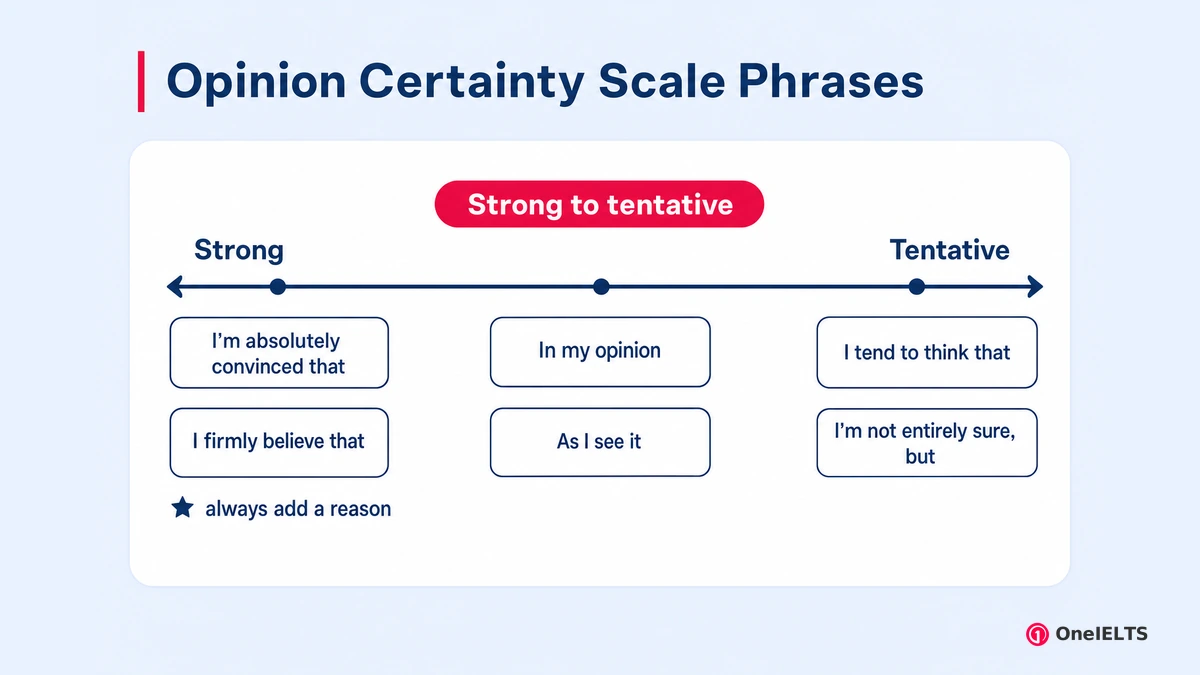
Strong phrases show conviction, and they suit questions where you’re clearly taking a side, such as “Do you agree that…?”. Intensifying adverbs like definitely, certainly and clearly push a plain statement further, as in “This is definitely the wrong approach”. The risk is sounding absolute on a complex Part 3 issue, so a strong opinion needs a reason straight after it.
Five firm openers mark a view you’re ready to defend, each with a short example.
- I’m absolutely convinced that… “I’m absolutely convinced that children pick up languages faster than adults.”
- I strongly believe that… “I strongly believe that healthcare should be free for everyone over seventy.”
- There’s no doubt in my mind that… “There’s no doubt in my mind that smartphones distract students in class.”
- I’m completely sure that… “I’m completely sure that my city will need a metro within ten years.”
- I firmly believe that… “I firmly believe that every worker deserves at least one full day off weekly.”
How Do You Express a Neutral or Tentative Opinion?
Hedging language lets you give a tentative opinion while admitting you’re unsure, which sounds mature when Part 3 lands on an unfamiliar topic like space travel or cryptocurrency. “I tend to think” marks a soft, subjective opinion rather than a definitive one. “I don’t know” on its own ends your answer, whereas a hedge plus a reason keeps you talking while buying time to think.
When you’re unsure, reach for one of these seven hedges, each shown in a short example.
- I tend to think that… “I tend to think that people were happier before social media, though I’m unsure.”
- I’m not entirely sure, but… “I’m not entirely sure, but I’d guess most farmers now use mobile apps.”
- It could be argued that… “It could be argued that space research wastes money needed on Earth.”
- I suppose… “I suppose older people find online banking harder, mainly because of passwords and small screens.”
- I’d probably say… “I’d probably say teachers matter more than buildings in a good school.”
- It depends on… “It depends on the job, but most office work could happen from home.”
- I haven’t really thought about it, but… “I haven’t really thought about it, but robots could help nurses in hospitals.”
How Do You Express a General Point of View?
A general point of view reports what people or society think rather than what you think. The Part 3 discussion often asks society questions, such as attitudes to marriage or work, and impersonal structures let you sketch the common view before adding your own. Switching to a personal point of view takes one clause: “Many people think tutoring is essential, but personally I think good schools make it unnecessary.”
The five impersonal openers that follow report what others believe, each tied to a Part 3 example.
- It’s widely believed that… “It’s widely believed that university degrees guarantee good jobs, though that’s changing.”
- Many people would argue that… “Many people would argue that cars make family life far easier in suburbs.”
- It’s generally accepted that… “It’s generally accepted that exercise improves mental health as well as fitness.”
- Some people say that…, while others… “Some people say that tourism helps villages, while others say it damages them.”
- Most people in my country think… “Most people in my country think owning a house matters more than renting.”
How Do You Explain Your Opinion With Reasons and Examples?
An opinion with no support is a one-line answer. Part 3 rewards the pattern of opinion, reason, example, then a short result or contrast. That answer extension matches the band 7 Fluency and Coherence line, “Able to keep going and readily produce long turns without noticeable effort”.
Supporting reasons and a personal example also give your discourse markers something real to connect. The general set of linking words has its own page, so only opinion-support phrases appear here.
Six support phrases move a bare view toward a developed answer.
- The main reason is that… “The main reason is that rents keep rising, so young people can’t save much.”
- This is because… “This is because children copy what they see adults doing every day.”
- For example, in my city… “For example, in my city, most offices now allow two days at home.”
- Take… for instance. “Take my cousin, for instance; she learned coding entirely from free videos.”
- I say this because… “I say this because my own grades improved once I stopped studying late.”
- What I mean is… “What I mean is that online friends rarely replace the people you see.”
Which Phrases Can You Use to Agree With an Opinion?
Agreement phrases answer “Do you agree that…?” questions and any examiner statement such as “Some people say…”. Show the degree of agreement, not just a yes, because a bare “Yes” gives the examiner nothing to assess.
The replies below run from full agreement down to partial agreement.
- I completely agree… “I completely agree that children need outdoor play, because screens keep them indoors.”
- That’s exactly how I feel. “That’s exactly how I feel; noisy open offices make concentrating very hard.”
- I couldn’t agree more. “I couldn’t agree more; public libraries deserve much bigger budgets than they get.”
- I agree up to a point, but… “I agree up to a point, but online courses lack classroom discipline.”
- That’s true to some extent. “That’s true to some extent, although rural areas still lack fast internet.”
How Do You Disagree With Someone’s Opinion Politely?
You can disagree with the statement in the question, and polite disagreement backed by a reason counts in your favor. You disagree with the idea in the examiner statement, never with the examiner personally. Softening language such as “I see what you mean” keeps the tone friendly while your counter-argument does the work. A flat “No” with no reason scores poorly on coherence, because it leaves no topic development to judge.
Five disagreement phrases follow, ordered from soft to firm.
- I’m not sure I agree with that. “I’m not sure I agree; many older people use smartphones confidently.”
- I see what you mean, but… “I see what you mean, but cheap flights also harm the environment.”
- That’s not always the case. “That’s not always the case; some top companies hire people without degrees.”
- I’d have to disagree, because… “I’d have to disagree, because homework teaches children to manage their own time.”
- I see it differently. “I see it differently: fame on social media rarely brings lasting happiness.”
Which Phrases Help You Conclude Your Opinion in Part 3?
A short closing line rounds off a long answer and shows turn control, so the examiner knows you’ve finished and can move on. A natural concluding phrase uses a spoken register. “In conclusion” belongs in a Task 2 essay and sounds stiff when you say it aloud.
Four spoken closers wrap up an answer without sounding scripted.
- So, all in all,… “So, all in all, I’d keep phones out of classrooms until secondary school.”
- That’s why I believe… “That’s why I believe cycle lanes would make our city healthier and calmer.”
- On balance, I’d say… “On balance, I’d say the benefits of tourism outweigh the problems it causes.”
- So overall, I think… “So overall, I think working from home suits most people better than commuting.”
What Are Examples of Expressing Opinions in an IELTS Speaking Answer?
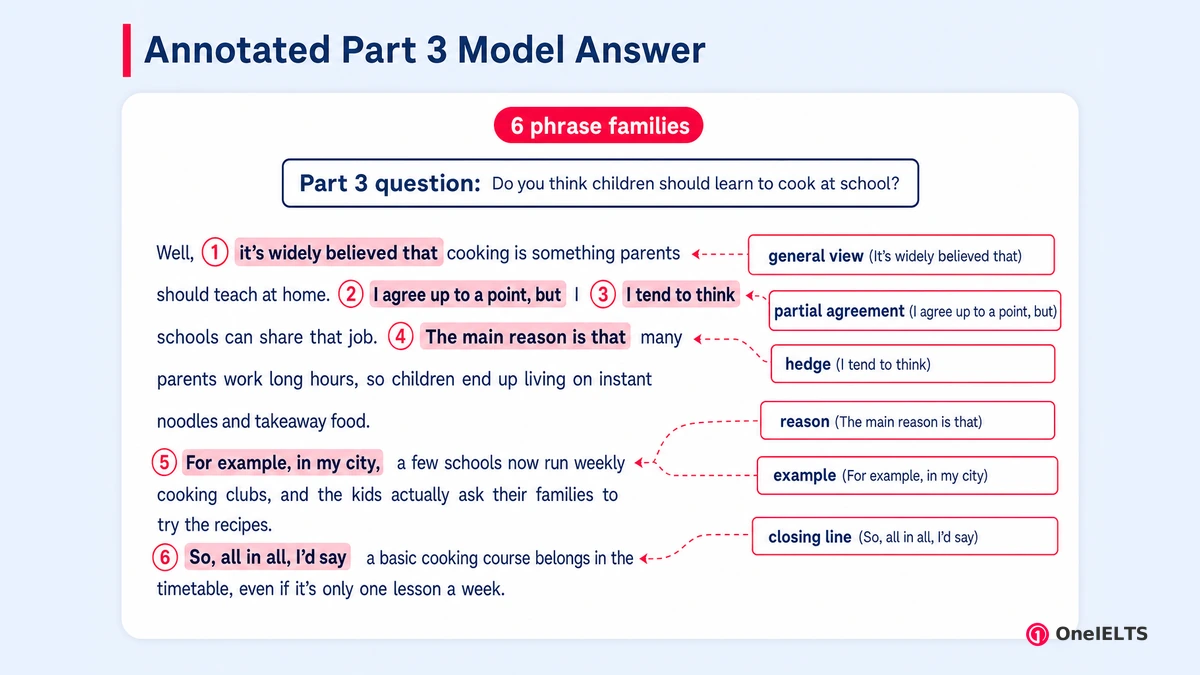
This model answer responds to the Part 3 question “Do you think children should learn to cook at school?” and uses one phrase from each phrase family.
Well, it’s widely believed that cooking is something parents should teach at home. I agree up to a point, but I tend to think schools can share that job. The main reason is that many parents work long hours, so children end up living on instant noodles and takeaway food.
For example, in my city, a few schools now run weekly cooking clubs, and the kids actually ask their families to try the recipes. So, all in all, I’d say a basic cooking course belongs in the timetable, even if it’s only one lesson a week.
The table maps each phrase in that answer to its family, the part it suits and the band descriptor line it supports. Every quote comes from the public ielts.org Speaking band descriptors, checked on 7 October 2026.
| Phrase used | Phrase family | Speaking part it suits | Band descriptor line it serves |
|---|---|---|---|
| “It’s widely believed that…” opens the answer with society’s view | General point of view, reporting what most people believe | Part 3, where society questions invite an impersonal opening | Lexical Resource 7: “an awareness of style and collocation is evident” |
| “I agree up to a point, but…” qualifies the common view | Partial agreement, accepting one side before turning the other way | Part 3, after a statement the examiner quotes | Fluency and Coherence 7: “Flexible use of spoken discourse markers, connectives and cohesive features” |
| “I tend to think…” gives a personal view with a hedge | Tentative opinion, a soft personal view rather than a definitive one | Part 3 mainly, and relaxed Part 1 answers too | Lexical Resource 7: “Some ability to use less common and idiomatic items” |
| “The main reason is that…” supplies the cause behind the view | Reason, the support that turns a claim into an argument | Parts 1 and 3, whenever a view needs defending | Fluency and Coherence 7: “readily produce long turns without noticeable effort” |
| “For example, in my city…” grounds the claim in real life | Example, a concrete local case that backs the reason | All three parts, including the Part 2 long turn | Fluency and Coherence 8: “Topic development is coherent, appropriate and relevant” |
| “So, all in all, I’d say…” closes the turn cleanly | Closing line, a spoken summary that signals you have finished | Part 3, at the end of a long answer | Fluency and Coherence 9: “Topic development is fully coherent and appropriately extended” |
One descriptor line works as a warning. At band 5, Fluency and Coherence reads “Overuse of certain discourse markers, connectives and other cohesive features”, so a phrase repeated in every answer counts against you.
What Are the Best Tips for Expressing Your Opinion in IELTS Speaking?
The phrases lift your Speaking band score only when they’re varied, followed by a reason and matched to the part of the test. Phrase variety and answer extension are what the examiner hears, and memorized language that ignores the question undoes both. In recorded practice answers, the pattern you’ll hear most often is “I think” opening four answers in a row with the reason left out.
Six habits turn the phrase lists above into marks on test day.
- Answer the question first, then add the phrase. Say “Yes, mostly” before any opener so your answer comes first.
- Rotate three or four openers instead of repeating ‘I think’. Mix “I’d say” and “As I see it” across parts.
- Always add a reason and an example. A view plus one reason and one real case fills thirty seconds.
- Match the register to the part. Casual “I reckon” suits Part 1; impersonal “It’s widely believed” suits Part 3.
- Hedge on topics you know little about. A hedge plus a guess beats a flat “I don’t know.”
- Avoid long memorized chunks. Examiners spot rehearsed lines, and the lowest descriptor bands describe “memorised utterances”.
How Do Linking Words Help in Expressing and Supporting Opinions?
The linking words that matter most for opinions are cause, contrast and example markers, because they join your view to its support. Cause markers like “because” provide the reason, contrast markers like “however” or “on the other hand” add the other side, and example markers like “for instance” ground it. They hold a long answer’s coherence, and our IELTS Speaking linking words guide has the full list.
How Should You Answer Questions Asking for Your Opinion in Part 3?
The steps for a Part 3 opinion answer are to state your view, give a reason, add an example, and close or contrast. That Part 3 structure fits an answer length of about 30 to 60 seconds, a practical target rather than an official rule. IELTS Speaking Part 3 is an abstract discussion, so expect a follow-up question challenging your view.
Can Expressing Opinions Well Help You Reach Band 7 in Speaking?
Yes, varied opinion language with clear support feeds two criteria at band 7, Fluency and Coherence and Lexical Resource. Phrases alone don’t lift the band, because Pronunciation and Grammatical Range and Accuracy are marked separately. Frequent grammar errors can still leave you short of 7, which our IELTS Speaking band 7 guide tackles criterion by criterion.
Is It Okay to Give an Opinion You Do Not Really Hold?
Yes, the examiner assesses your English rather than your beliefs, so you can choose the view that is easiest to explain. In a language assessment, the easier argument is a fair choice. An invented view still needs a believable reason and a believable example. Our guide to lying in IELTS Speaking shows where that line sits.
Where Can You Practice Expressing Opinions for IELTS Speaking?
The best place to practice is a timed Part 3 mock where your answers are recorded and scored. Drill each phrase family with written exercises, then move to IELTS Speaking practice under a mock test timer. Play back your recorded answers and count every “I think” for quick feedback on variety.
Written by Rifah Binte Faruk, reviewed 7 October 2026.
Last verified: 7 October 2026
Practice for the Real IELTS Exam
Apply what you’ve learned with free, exam-style practice:
- Take a free IELTS mock test — all four skills, real exam timing, AI band scoring
- Sit a Speaking section mock — timed Parts 1–3 with voice recording and band feedback
- Practice all three parts — sample questions with feedback