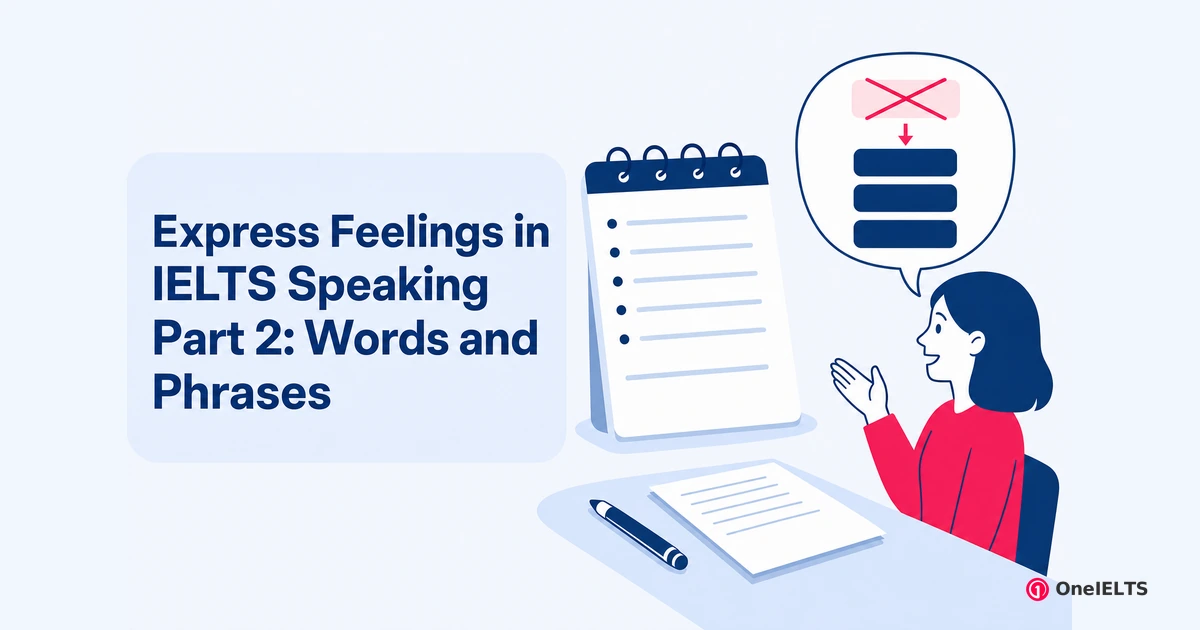
Many Part 2 cue cards end with a prompt such as “and explain how you felt about it”, which asks you to name, grade and justify an emotion during your long turn. Happy, sad and good keep that answer at a lower Lexical Resource band. The fix is precise, graded feeling vocabulary plus a reason, not memorized quotes. Part 2 format, cue card topics and general Speaking vocabulary have their own OneIELTS pages.
We cover what the prompt means and where feelings go after one minute of preparation. Then come “I feel” frames, positive, negative and mixed emotion words, intensity, idioms and physical signs. It closes on extending, common struggles, examples, practice, and the effect on your Speaking band.
What Does Expressing Your Feelings Mean in IELTS Speaking Part 2?
In Part 2, expressing your feelings means naming the emotion you felt, showing how strong it was and giving the reason for it. It usually answers the final prompt on your cue card, such as “and explain how you felt about it” or “why it was memorable”.
The task card gives you a topic and three or four prompts. The British Council gives you one minute to prepare, then 1 to 2 minutes to talk, and ielts.org advises keeping going for the full 2 minutes. Checked on 7 October 2026.
A certified examiner doesn’t score the emotion, or whether the story is true. They score how precisely and fluently you put it into words. One feeling sentence shows Lexical Resource, Grammatical Range through past tense narration and “made me feel” structures, and Pronunciation through intonation. So “I felt happy” wastes the best moment of your Part 2 long turn.
How Do You Start Expressing Your Feelings in a Part 2 Answer?
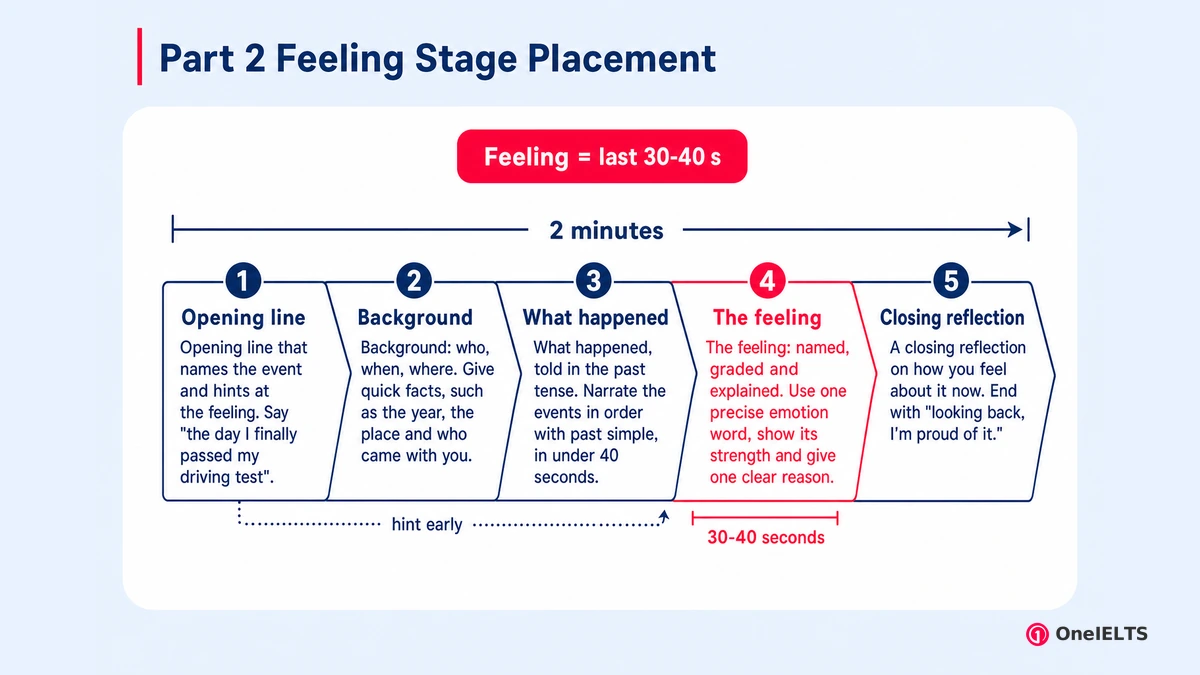
Put the feeling where the cue card asks for it, normally the last prompt, but signal it early with one short line in your opening. Then give the full feeling paragraph in the final 30 to 40 seconds.
A two-minute answer has a four-part body (background, events, feeling, closing reflection) with a one-line opener in front. The feeling sits near the end because that’s where the card puts it, and the early hint makes it sound planned. Five stages carry a typical answer from the first line to the last.
- Opening line that names the event and hints at the feeling. Say “the day I finally passed my driving test”.
- Background: who, when, where. Give quick facts, such as the year, the place and who came with you.
- What happened, told in the past tense. Narrate the events in order with past simple, in under 40 seconds.
- The feeling: named, graded and explained. Use one precise emotion word, show its strength and give one clear reason.
- A closing reflection on how you feel about it now. End with “looking back, I’m proud of it.”
In your one-minute notes, mark the feeling stage with one emotion word and one reason, such as “relieved, weeks of worry”. Open that stage with signposting like “What I remember most is how…” so the examiner hears a new stage begin. That clear shift supports Fluency and Coherence. Take one breath before it, and the pause sounds deliberate.
How Do You Use “I Feel” Statements in a Cue Card Answer?
Use “I feel” for the present or “I felt” in the past simple, followed by a precise emotion word and a reason. Then vary the frame, so you don’t say “I felt” five times in two minutes.
Everyday advice on self-expression says to follow “I feel” with a clear emotion word. That transfers well to IELTS, because it forces you to name the emotion instead of retelling events. A bare “I feel” isn’t enough, though, since the reason does the scoring work. Six sentence frames, each with a model line, keep the answer varied.
- I felt + adjective + because… “I felt nervous because I hadn’t spoken to my grandfather in years.”
- It made me feel + adjective. “Her message made me feel genuinely valued after a terrible week at work.”
- I was absolutely + strong adjective. “I was absolutely thrilled when the acceptance email finally arrived in my inbox.”
- What struck me most was… “What struck me most was how calm I felt once the race started.”
- I couldn’t help feeling + adjective. “I couldn’t help feeling a little jealous when my cousin got the job.”
- Looking back, I feel… “Looking back, I feel grateful that my teacher refused to let me quit.”
Tentative language shows range too. “I think I was more relieved than happy” or “maybe it was a mix of pride and nerves” tells the examiner you can grade a feeling, not just label it. Watch the causative make: you say “it made me feel”, never “it made me to feel”.
Which Positive Feelings in English Can You Use in Part 2?
Delighted, grateful, relieved, thrilled, content and proud replace “happy” and tell the examiner exactly which kind of good feeling the event caused. Ten positive emotions fill this table, each matched to the cue card type it suits best.
| Word | What it means | Cue card it fits | Model line |
|---|---|---|---|
| Delighted | Very pleased, usually about news or a result you hoped for. | Describe a time you received good news from a friend or relative. | I was delighted when my sister called to say she’d been accepted. |
| Grateful | Thankful to someone because they helped you or gave you something valuable. | Describe a person who helped you when you were facing a difficulty. | I’m still deeply grateful to Mr. Rahman for staying late to coach me. |
| Relieved | Free from worry after something bad didn’t happen or finally ended. | Describe a time you solved a problem that had worried you for weeks. | I was hugely relieved when the mechanic said the repair would be cheap. |
| Thrilled | Extremely excited and pleased, often about something new or long awaited. | Describe an exciting event or trip you had been looking forward to. | I was thrilled to finally see the northern lights after two cold nights. |
| Proud | Pleased about something you or someone close to you achieved through effort. | Describe an achievement you worked hard for, such as an exam or race. | I felt really proud crossing the finish line of my first 10 km run. |
| Content | Quietly satisfied and calm, with no need for anything more at all. | Describe a place where you like to relax or spend your free time. | Sitting by the lake with a book, I felt completely content and calm. |
| Optimistic | Hopeful and confident that things will turn out well in the future. | Describe a plan or goal you have for the next few years. | After the interview, I felt optimistic that the job offer would come soon. |
| Fulfilled | Satisfied because you used your abilities to do something truly meaningful. | Describe a time you helped someone or did voluntary work in your community. | Teaching those children to read left me feeling more fulfilled than any paid job. |
| Nostalgic (warm sense) | Fondly remembering a happy time from the past, with a little longing. | Describe a childhood memory, an old photo or a place you once lived. | Seeing my old school made me feel nostalgic for those long summer afternoons. |
| Over the moon (idiom) | Extremely happy; an informal idiom covered with others in the idioms section. | Describe a happy family event such as a wedding, birth or big win. | When my brother’s son was born, the whole family was over the moon. |
Match the adjective of feeling to the cue card type: relieved for a problem you solved, grateful for a person who helped you, proud for an achievement. Collocation carries these words further, so “deeply grateful” and “hugely relieved” sound natural where “very grateful” sounds flat. That’s the less common vocabulary an examiner listens for. Topic words for travel, work or technology belong on the Speaking vocabulary page, while this table covers feeling words only.
Which Negative Feelings in English Can You Use in Part 2?
Swap “sad” or “bad” for disappointed, frustrated, anxious, embarrassed, guilty or heartbroken, and you can describe a difficult experience without sounding flat. Nine negative emotions appear here, each paired with a common cue card type and a model line.
| Word | What it means | Cue card it fits | Model line |
|---|---|---|---|
| Disappointed | Sad because something was worse than expected or didn’t happen at all. | Describe a time a plan was canceled or an event let you down. | I was bitterly disappointed when the concert was canceled an hour before it started. |
| Frustrated | Annoyed because you couldn’t do or change something despite trying hard. | Describe a time you waited a long time or something kept going wrong. | I got increasingly frustrated as the website crashed every time I tried to pay. |
| Anxious | Worried and uneasy about something important that is about to happen. | Describe an important exam, interview or performance you once prepared for. | I felt so anxious the night before my interview that I barely slept. |
| Embarrassed | Uncomfortable and self-conscious because other people saw you make a mistake. | Describe a time you made a mistake in front of other people. | I was deeply embarrassed when I called my new manager by the wrong name. |
| Guilty | Feeling bad because you did something wrong or hurt someone you care about. | Describe a time you broke a promise or forgot something important. | I felt terribly guilty for missing my best friend’s birthday dinner last year. |
| Lonely | Sad because you are alone or have nobody to talk to. | Describe a time you moved to a new city or lived abroad. | During my first month in Toronto I felt completely lonely, especially on weekends. |
| Annoyed | Slightly angry about something irritating, usually a small problem that passes quickly. | Describe a time you were late or someone kept you waiting. | I was really annoyed when the bus drove straight past me in the rain. |
| Stressed | Under pressure because you have too much to do or decide. | Describe a busy period, such as exam season or moving to a new home. | I was so stressed during exam season that I stopped seeing my friends. |
| Heartbroken | Extremely sad, usually after losing someone or something you deeply loved. | Describe a time you lost something or someone that mattered to you. | I was heartbroken when our old dog died the summer I turned fifteen. |
Negative cue cards are common: a time you were late, a time you lost something, a difficult decision. A negative answer scores just as well as a positive one, because the examiner rates precise word choice, not how cheerful the story is. Keep the tone measured. “I was really disappointed” sounds controlled, while “it was the worst day of my life” sounds dramatic and vague.
Which Other English Words for Feelings Describe Mixed Emotions?
Words such as overwhelmed, nostalgic, bittersweet, torn, confused and stunned describe feelings that are neither simply good nor bad. Real cue-card memories, like leaving home, a farewell or a surprise, are usually mixed. Eight words for mixed emotions cover most of them, each with a cue card where it fits naturally.
- Overwhelmed. Too many strong feelings at once, perfect for a surprise party or a graduation ceremony.
- Nostalgic. Warm but slightly sad about the past, ideal for describing an old photo or childhood home.
- Bittersweet. Happy and sad together, the natural word for a farewell, a move abroad or leaving school.
- Torn. Pulled between two choices, useful for a difficult decision such as which university offer to accept.
- Stunned. So surprised you can’t react, good for unexpected news, whether that news is good or bad.
- Puzzled. Confused because something doesn’t make sense, useful for a strange event or a misunderstanding with someone.
- Intrigued. Curious about something unusual, fitting a cue card about a new place or an interesting person.
- Insecure. Unsure of yourself and your ability, an honest word for a first day at work or school.
Contrast structures show a mixed feeling clearly: “I was excited but also a little nervous”, or “part of me felt proud, while another part felt sad to leave”. These are complex sentences, so they count toward Grammatical Range and Accuracy as well as vocabulary. A bittersweet memory gives you both in one line.
How Do Categories of Emotions Help You Choose Stronger Words?
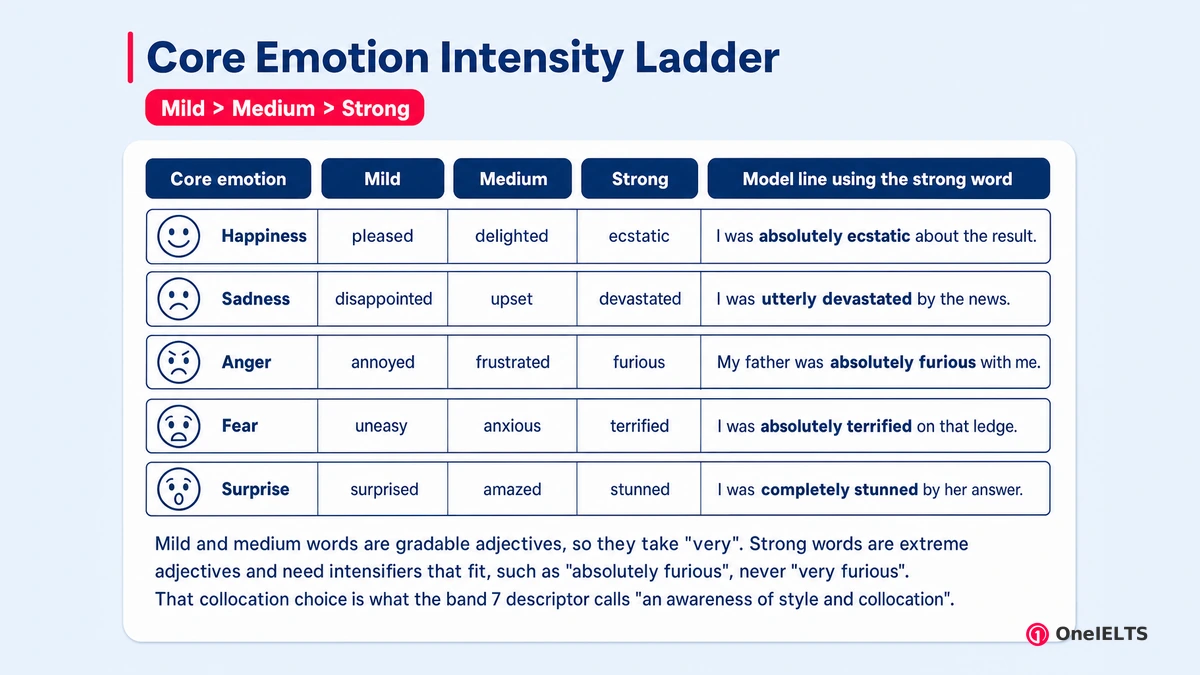
Ranking words by core emotion lets you match the word to how intense the experience really was. Pleased and ecstatic are both happiness, but they tell different stories. This intensity ladder runs five emotions from mild to strong.
| Core emotion | Mild | Medium | Strong | Model line using the strong word |
|---|---|---|---|---|
| Happiness | pleased | delighted | ecstatic | I was absolutely ecstatic about the result. |
| Sadness | disappointed | upset | devastated | I was utterly devastated by the news. |
| Anger | annoyed | frustrated | furious | My father was absolutely furious with me. |
| Fear | uneasy | anxious | terrified | I was absolutely terrified on that ledge. |
| Surprise | surprised | amazed | stunned | I was completely stunned by her answer. |
Mild and medium words are gradable adjectives, so they take “very”. Strong words are extreme adjectives and need intensifiers that fit, such as “absolutely furious”, never “very furious”. That collocation choice is what the band 7 descriptor calls “an awareness of style and collocation”.
Which Idioms for Expressing Feelings Sound Natural in IELTS Speaking?
Over the moon, on cloud nine, feeling down, butterflies in my stomach, a lump in my throat and see red are common idioms. They sound natural when you use one, once, in the right context and tense. Seven idioms work well in a past-tense story, shown here with a meaning and a cue-card line.
- Over the moon. Extremely happy: “I was over the moon when my scholarship letter finally arrived.”
- On cloud nine. Blissfully happy: “I was on cloud nine for days after my sister’s wedding.”
- Feel down / feel blue. Sad or low: “I felt a bit down after my best friend moved abroad.”
- Butterflies in my stomach. Nervous excitement: “I had butterflies in my stomach before going on stage.”
- A lump in my throat. Close to tears: “I had a lump in my throat during my grandfather’s speech.”
- See red. Suddenly very angry: “I saw red when someone scratched my new car and drove off.”
- Heavy-hearted. Sad and burdened: “I left my hometown heavy-hearted, knowing I wouldn’t return for years.”
The risk is forcing them. Stacked idioms (“I was over the moon and on cloud nine”) read as memorized language and can hold your band down. One well-placed idiom per answer is enough, because idiomatic vocabulary earns credit through natural usage, not volume. The IELTS Speaking idioms page holds the wider list.
How Can You Describe the Physical Signs of a Feeling?
Describe what your body did, such as “my heart was pounding”, “my hands were shaking” or “my face went red”. A physical detail reveals the emotion and creates a more vivid picture than the word alone.
Everyday advice on emotions says to notice the physical sensation first, like a tight chest or a warm face, and then give it a name. Part 2 turns that advice into one technique, which uses an emotion word plus one body detail in the same sentence. Six emotions and their physical signs make good starting points.
- Nervous. “My heart was pounding and my palms were sweaty as I waited outside the exam hall.”
- Embarrassed. “My face went bright red when everyone in the meeting turned to look at me.”
- Moved. “I had a lump in my throat, and my eyes filled with tears as she spoke.”
- Shocked. “I froze and couldn’t say a word when I saw who was at the door.”
- Relieved. “I let out a huge sigh the moment the doctor said everything was fine.”
- Angry. “My jaw tightened, and I had to count to ten before I replied to him.”
Keep it to one physical detail per feeling, or the vivid description turns into a list of symptoms. Hold one tense pattern: past continuous for the scene (“my hands were shaking”) and past simple for the event. Body language verbs like “I froze” or “I shrugged” work the same way.
How Can You Talk More About Your Feelings for Two Minutes?
Extend a feeling by explaining why you felt it, how it changed, and how you feel about it now. Those moves turn one sentence into 30 to 40 seconds of speech. Five techniques for extending the answer each add a sentence or two of speaking time.
- Give the reason. Use cause and effect: “I was nervous because I’d never spoken to 200 people.”
- Show the change. “At first I was terrified, but by the end I was actually enjoying it.”
- Compare then and now. “Looking back, I realize the failure taught me more than any success did.”
- Add a consequence. “It made me much more confident about speaking up in seminars and meetings.”
- Contrast with expectations. “I expected to feel homesick, but actually I felt free for the first time.”
After the long turn, the examiner may ask one or two rounding-off questions on the same topic. If you’ve already built a reflection into your answer, “Would you do it again?” takes seconds to answer. The Part 2 rounding-off questions page covers that stage.
Why Can’t Many Candidates Express Their Feelings Clearly in English?
Most candidates struggle because of a small, overused word set (happy, sad, good, very), translation from their first language and a few grammar traps. They don’t lack feelings to describe. Six common errors cause most of the trouble, and each one has a quick fix.
- Overusing happy, sad and very. Swap each for a graded word, such as delighted, devastated or absolutely.
- Confusing -ed and -ing adjectives. “I was boring” means you bored others; say “I was bored” instead.
- Translating feeling expressions word for word. First-language transfer produces odd lines, so learn English chunks like “felt at home”.
- Wrong tense when narrating the past feeling. Keep narrative tenses consistent: “I was nervous”, never “I am nervous”.
- Naming the feeling without a reason. Add “because” plus one fact every time you name an emotion.
- Freezing when the right word does not come. The cause is usually panic over one missing word, not weak vocabulary.
Play back almost any first practice recording and the feeling stage is the shortest part, often one line: “It was a very good experience.” Those overused words are the first thing to replace. The in-the-moment fixes for freezing are paraphrase strategies, covered in the section on having no words.
What Are Examples of Expressing Your Feelings in a Part 2 Answer?
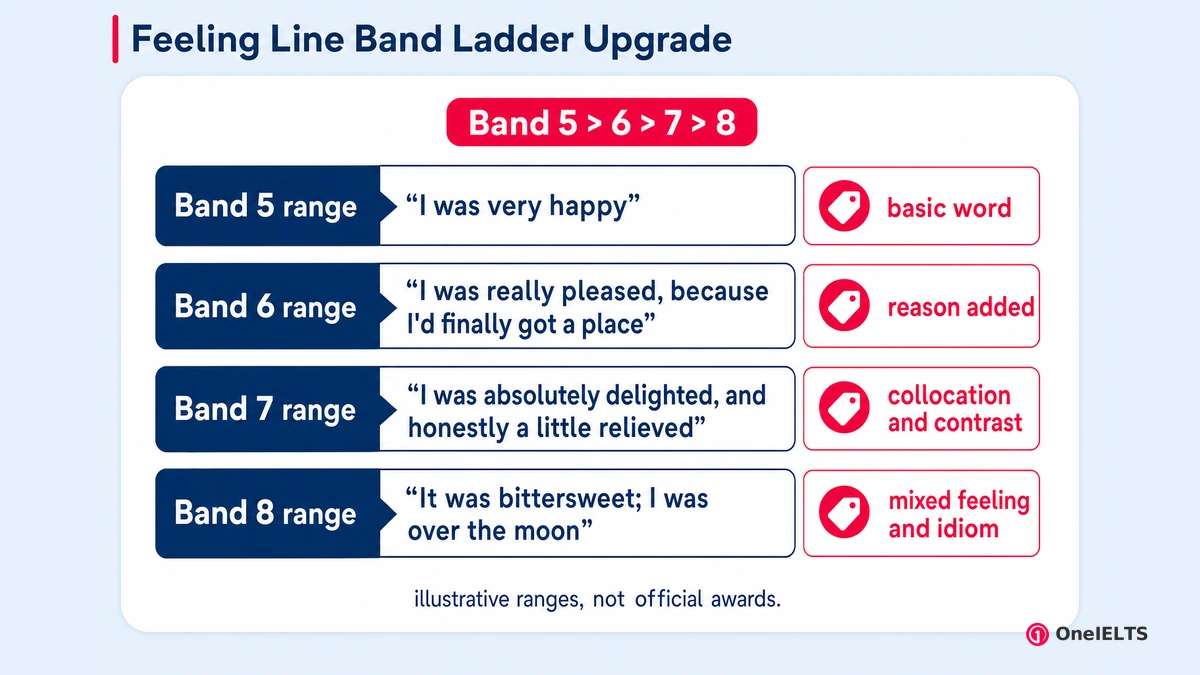
The clearest example is one feeling line upgraded step by step. “I was very happy” (band 5 range) becomes “I was absolutely delighted, and honestly a little relieved, because I had been worried for weeks” (band 7+ range).
This band ladder uses one good news cue card, “Describe a time you received good news”, and ties each step to a public Lexical Resource descriptor phrase. The band labels are illustrative ranges, not official awards. Descriptor wording was checked against the IELTS Speaking band descriptors on ielts.org on 7 October 2026.
| Band range | Feeling line | What changed | Descriptor phrase it reflects |
|---|---|---|---|
| Band 5 range | “When I read the email, I was very happy. It was very good news.” | A basic word repeated with very, and no reason given for the feeling. | “Limited flexibility”: the resource covers the topic, but the same few words keep returning. |
| Band 6 range | “When I read the email, I was really pleased, because I’d finally got a place.” | A wider word plus a reason, though the word choice is still fairly safe. | “Resource sufficient to discuss topics at length”, with meaning that stays clear throughout the answer. |
| Band 7 range | “I was absolutely delighted, and honestly a little relieved, because I had been worried for weeks.” | A less common word, a collocating intensifier and a contrast between two feelings. | “Some ability to use less common and idiomatic items” and “an awareness of style and collocation”. |
| Band 8 range | “It was bittersweet; I was over the moon about the offer but already dreading leaving home.” | A precise mixed feeling, one natural idiom and a reflection on what came next. | “Skilful use of less common and idiomatic items” used to “convey precise meaning”. |
Every step adds less common vocabulary or a reason, and none adds a memorized phrase. The same language in flow sounds like this model answer to “Describe a person who helped you”.
When Ms. Karim offered to coach me for my university interview, I was honestly a bit embarrassed, because I’d never asked anyone for help before. By the third session, that embarrassment had turned into real gratitude. What struck me most was how patient she was. Looking back, I’m deeply grateful, and I think that’s why I now tutor younger students myself.
How Can You Write It Down to Build Your Feelings Vocabulary?
Write two or three short sentences a day about how something made you feel, using a new feeling word each time. Then use the same note style in the one-minute preparation on test day. A five-step routine turns that habit into exam-ready emotional vocabulary.
- Keep a feelings notebook, one entry a day. Two or three sentences are enough; consistency beats length.
- Write the event, the feeling word and the reason. For example: “Missed the bus, frustrated, late for my exam.”
- Upgrade one basic word per entry. Cross out “happy” and write the precise word, such as “relieved” or “thrilled”.
- Practice one-minute notes on a past cue card. Note just one emotion word and one reason for the feeling stage.
- Record a two-minute answer and listen for repeated words. Use self-recording to practice Speaking and count each repeat.
Done daily, this speaking practice moves new words from your notebook into the answers you give under time pressure.
How Does Expressing Feelings Affect Your IELTS Speaking Band Score?
Expressing feelings well mainly lifts Lexical Resource, through precise, less common words and collocation, and Pronunciation, through intonation that carries the emotion. It also supports Fluency and Coherence when the feeling is signposted and extended. It earns nothing on its own if the language is basic or memorized.
Per ielts.org, the four criteria carry equal weighting, and their average gives your Speaking band score. A feelings answer shows each one.
Fluency and Coherence shows in how smoothly you move through the feeling stage. Lexical Resource shows in word choice, and Grammatical Range and Accuracy in “made me feel” and contrast clauses. Pronunciation shows in the stress on the key feeling word. The full Speaking band descriptors set out each band.
How Do We Express Our Feelings Through Intonation in IELTS Speaking?
The main ways we express our feelings through the voice are intonation, stress and pace. A rise-fall tone on the key word (“I was abSOlutely delighted”) and sentence stress on the intensifier make the emotion audible. A flat delivery undercuts even a strong word. The Pronunciation criterion rewards this, and band 8 describes “flexible use of stress and intonation across long utterances”. Our IELTS Speaking pronunciation guide has drills for it.
Should You Use Quotes to Express Your Feelings in IELTS Speaking?
No, memorized quotes rarely help, because examiners are trained to spot rehearsed language. A quote dropped into a feelings answer shows someone else’s vocabulary, not your range, so it can’t lift Lexical Resource toward band 7. Use a short, natural idiom or a reflection in your own words instead, such as “looking back, I’d do it again”. The IELTS Speaking band 7 guide shows what that level sounds like.
What Can You Say When You Have No Words to Express Your Feelings?
The strategies that keep you talking when the exact feeling word does not come are paraphrase, comparison and honest description. These communication strategies protect Fluency and Coherence, and the band 7 and 8 Lexical Resource lines both credit “effective use of paraphrase”. Four rescue lines cover most blank moments.
- Paraphrase. “It’s hard to describe, but it was a strange mix of pride and fear.”
- Compare. “It felt like my first day at a new school, exciting and scary at once.”
- Describe the body. “I just stood there, smiling, and couldn’t think of anything to say.”
- Buy time naturally. “How can I put it… it was more relief than joy, really.”
Short fillers like “how can I put it” are fine once, but a string of “umm” is not. Our guide to communicating effectively has more ways to keep talking.
Written by Rifah Binte Faruk, reviewed 7 October 2026.
Last verified: 7 October 2026
Practice for the Real IELTS Exam
Apply what you’ve learned with free, exam-style practice:
- Take a free IELTS mock test — all four skills, real exam timing, AI band scoring
- Sit a Speaking section mock — timed Parts 1–3 with voice recording and band feedback
- Practice all three parts — sample questions with feedback