The examiner hands you a printed task card and gives you one minute of preparation with paper and a pencil. Then you talk alone for one to two minutes, and the examiner closes with one or two rounding-off questions.
That shape is IELTS Speaking Part 2, the individual long turn: three or four printed points on the card, and about three to four minutes in total. This page works through the card, the timing, the topic categories, the preparation minute, the notes, the structure, the opening, the expansion, the ending, the marking, the mistakes and the band.
What Is IELTS Speaking Part 2?
IELTS Speaking Part 2 is the middle section of the Speaking test, officially called the individual long turn. The examiner hands you a printed task card, gives you one minute with paper and a pencil, then listens while you speak alone on that topic for up to two minutes. One or two short closing questions end the part.
This is the only place in the test that requires uninterrupted speech from you, which is why it exposes fluency. The examiner won’t help you, prompt you or talk with you while the clock runs. You also can’t swap the card, because the examiner chooses it and you answer the one you are handed.
Every card sets a descriptive topic drawn from your own life, such as a thing you own, a person you admire, a place you go back to or an event you remember. No outside knowledge is tested. The cue-cards page holds the topic inventory; this page teaches the method.
What Is on the IELTS Speaking Part 2 Task Card?
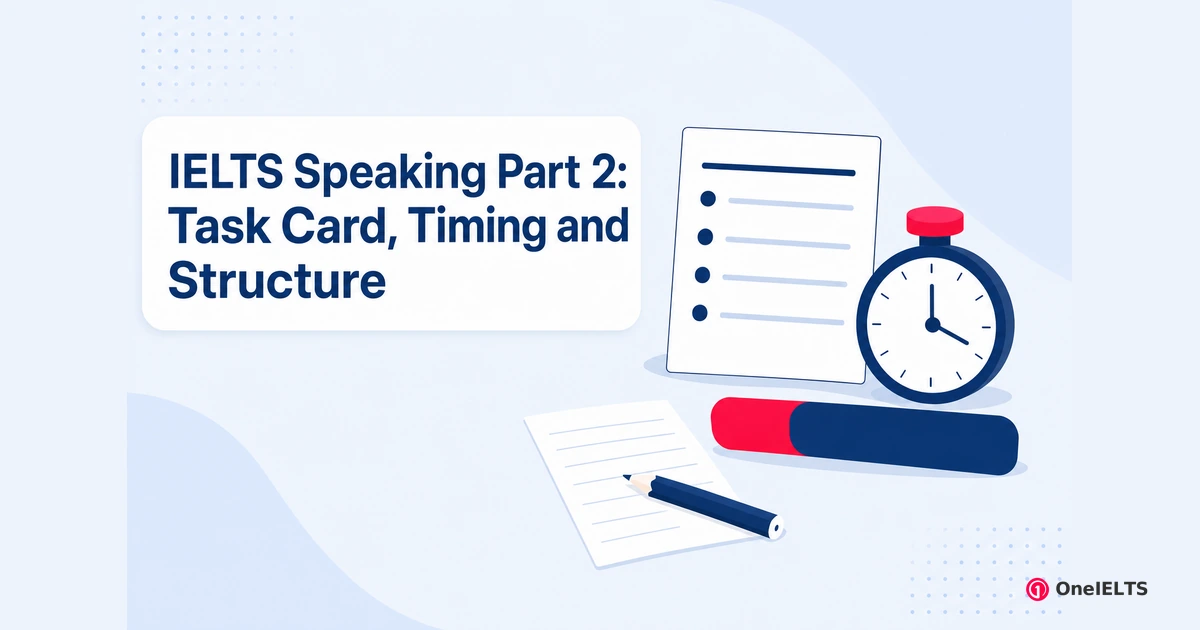
A Part 2 task card prints one topic sentence, three or four points to cover, and a final line that almost always begins with “and explain why”. The topic sentence starts with a verb such as Describe or Talk about.
The card isn’t a question waiting for an answer. It’s a plan somebody has already written for you, so reading it as an outline saves most of the preparation minute. Four elements make up that plan, and each one does a different job.
- Topic line. The opening sentence names your subject and starts with a verb such as Describe or Talk about, so the task is set before you read further.
- Prompt points. Two or three bullets phrased with question words such as where, how long, what and who, each one a stretch of your talk.
- Explanation point. The closing line, printed as “and explain why”, asks for your reason rather than another fact, which makes it the hardest line to answer in one sentence.
- Instruction block. A printed note tells you that you have one minute to prepare, that notes are allowed, and that paper and a pencil are provided.
The two test owners count the parts differently. IDP describes three bullet points and a final question, while the British Council’s own published card carries four points. Both descriptions fit the same card, because the fourth point is the and-explain-why line, printed as a bullet but working as the question the examiner most wants answered. Treat that line as the one you must not run out of time for.
Most teaching sites call the sheet a cue card, and the test owners print it as a task card. Here is the British Council’s own published task, from its practice Speaking test.
Describe something you own which is very important to you. You should say:
- where you got it from
- how long you have had it
- what you use it for
- and explain why it is important to you
Two more facts about the card matter in the room. You keep it in your hand for the whole talk and may look at it whenever you like, and the printed points are a suggested order rather than a compulsory one.
How Long Is IELTS Speaking Part 2?
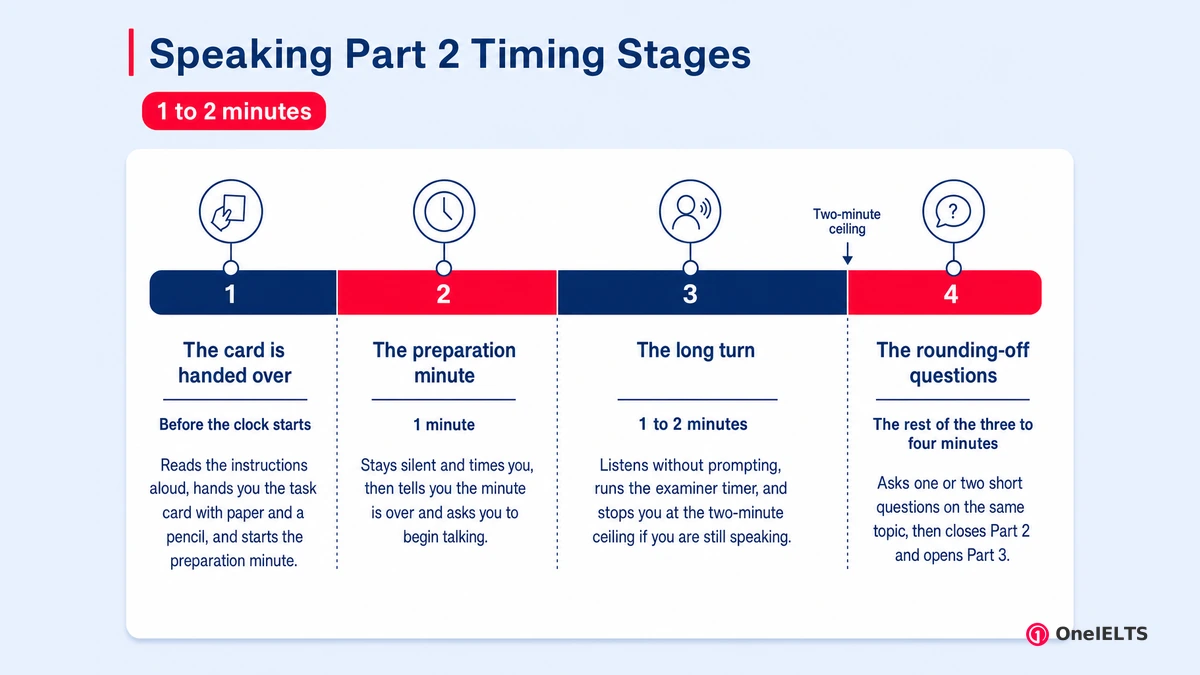
Part 2 runs about three to four minutes end to end: one minute to prepare, then one to two minutes of talking, then one or two short rounding-off questions.
The examiner runs that clock rather than you, and the part moves on when the timing says so. Four stages fill those minutes, and each one asks something different of you.
| Stage | Length | What the examiner does |
|---|---|---|
| The card is handed over | Before the clock starts | Reads the instructions aloud, hands you the task card with paper and a pencil, and starts the preparation minute. |
| The preparation minute | 1 minute | Stays silent and times you, then tells you the minute is over and asks you to begin talking. |
| The long turn | 1 to 2 minutes | Listens without prompting, runs the examiner timer, and stops you at the two-minute ceiling if you are still speaking. |
| The rounding-off questions | The rest of the three to four minutes | Asks one or two short questions on the same topic, then closes Part 2 and opens Part 3. |
Two test owners publish two different numbers, and both are right. The British Council tells candidates to “talk about the topic for 1 to 2 minutes”. IDP says the examiner uses a timer and interrupts you at the two-minute mark. They describe two edges of the same turn: two minutes is the ceiling the examiner enforces, and one minute is the floor below which the talk counts as a short turn.
So what happens at ninety seconds? Nothing stops. You keep going until the ceiling, and being cut off mid-sentence there costs you nothing. That is the practical reason to aim for the full two minutes rather than the minimum. Finishing early adds no time back.
Which Topic Categories Come Up in IELTS Speaking Part 2?
Five categories cover almost every card: an object, a person, a place, an event and an activity. Which one you have been handed decides how you plan the minute.
The topic itself barely matters. The category does, because it tells you what kind of material the examiner expects, and that is what you write your prompt words against. Each category demands one planning move.
- Object card. Describe the thing physically before you reach the reason: size, material, age and where it sits. A topic category built on detail rewards you for naming what you can actually see.
- Person card. Establish the relationship first, then spend your longest stretch on one anecdote about them, because a single remembered episode fills more time than a list of adjectives.
- Place card. Give a sense of scale and atmosphere: how big it is, how busy, how it sounds and smells, and who else is usually there with you.
- Event card. Put the story in sequence, from what happened first to what happened last, so the tenses and the time markers carry a good stretch of the talk.
- Activity card. Treat it as a habit: how often you do it, when it started and why you kept going. The reason it began is usually the richest part of the answer.
Cards often sit in two categories at once, so forcing a choice wastes time. A card about a festival you attended is an event and a place, and either planning move works.
The hypothetical framing on some cards, a place you would like to visit or a person you would like to meet, changes nothing about the method except the tense. For the inventory of cards themselves, the cue-cards page carries the list; this section stops at the planning move.
Sets across these categories sit behind the IELTS Speaking long turn practice filter, which a free account opens.
How Should You Use the One Minute of Preparation Time in IELTS Speaking Part 2?
Spend the first fifteen seconds choosing a real example, the next thirty writing prompt words against each printed point, and the last fifteen fixing your opening sentence in your head.
That minute is the only planning you get, and it isn’t long enough for two attempts. A sixty-second protocol with a time budget on each move stops you spending the whole thing on the first decision. These four steps fill it in order.
- Read the card once and pick a real thing or person you actually know (0-15 seconds). Take the first real example that fits, not the best one. A real example you can see in your head supplies detail for free.
- Write prompt words beside each printed point (15-45 seconds). One or two words per point, in the card’s own order. Writing sentences here is the mistake that eats the minute and leaves you reading later.
- Decide the one detail that gets your longest stretch (45-50 seconds). That is nearly always the and-explain-why line. Mark it with a star, and treat the earlier points as the route to it rather than the destination.
- Rehearse the first sentence silently (50-60 seconds). Fix the exact opening sentence in your head and say it once without moving your lips. A first sentence that arrives ready makes the start sound fluent.
The minute requires one decision before all the others, and the pattern is consistent in practice classes: candidates hunt for an impressive topic instead of an available one. A dull card answered with a real example beats an interesting card answered with invented detail. The fluency you lose while inventing is marked, and the topic is not.
Two practical points close the minute out. Starting before it ends doesn’t give the time back, and the minute is silent, so thinking aloud isn’t assessed but does eat the clock.
On the British Council card above, the minute goes like this. Seconds 0-15: my grandfather’s watch, real, still in a drawer at home. Seconds 15-45: four prompt words, one per printed point. Seconds 45-50: a star against the reason, which is that he wore it every day for forty years. Seconds 50-60: “The thing I’d like to describe is an old wristwatch that belonged to my grandfather.”
How Do You Take Notes for IELTS Speaking Part 2?
Write a vertical list of one or two prompt words per printed point, under twenty words in total, using nouns, adjectives and adverbs rather than sentences.
Your notes are a route your eye follows while your mouth keeps talking. They exist so you can find the next point in half a second without stopping. Five rules keep them usable under pressure.
- One or two words per point. Anything longer stops being a prompt, because a phrase you have to read is a phrase you stop speaking to read.
- Nouns, adjectives and adverbs only. Content words carry the idea, and verbs are the part of a sentence you can improvise fluently while speaking.
- A vertical list in the card’s point order. Stacking the prompt words down the page lets your eye find the next point without searching sideways through a paragraph.
- Nothing you would be tempted to read aloud. A memorised script written down gets recited, and recitation is audible immediately in the pacing.
- A total under twenty words. Count them if you like: four points, four short lines, and enough white space that one glance finds the line you want.
A full sentence in your notes is worse than no notes at all. A written sentence gets read rather than spoken, and read speech is flat, unpaced and instantly recognisable to an examiner. It costs you under pronunciation and fluency even when the language itself is correct.
The practical facts are in your favour. The examiner provides paper and pencil with the card, and you keep the card and the notes in front of you throughout the talk, so glancing down is allowed and expected.
Here are the notes for the same British Council card, written the way they look on the paper.
watch - grandad, 1970s
had it - 12 yrs, since he died
use - special days only
WHY - he wore it daily, 40 yrs
That is eighteen words. Every line is a prompt, none of it is a sentence, and the order matches the card.
How Do You Structure a Two-Minute IELTS Speaking Part 2 Answer?
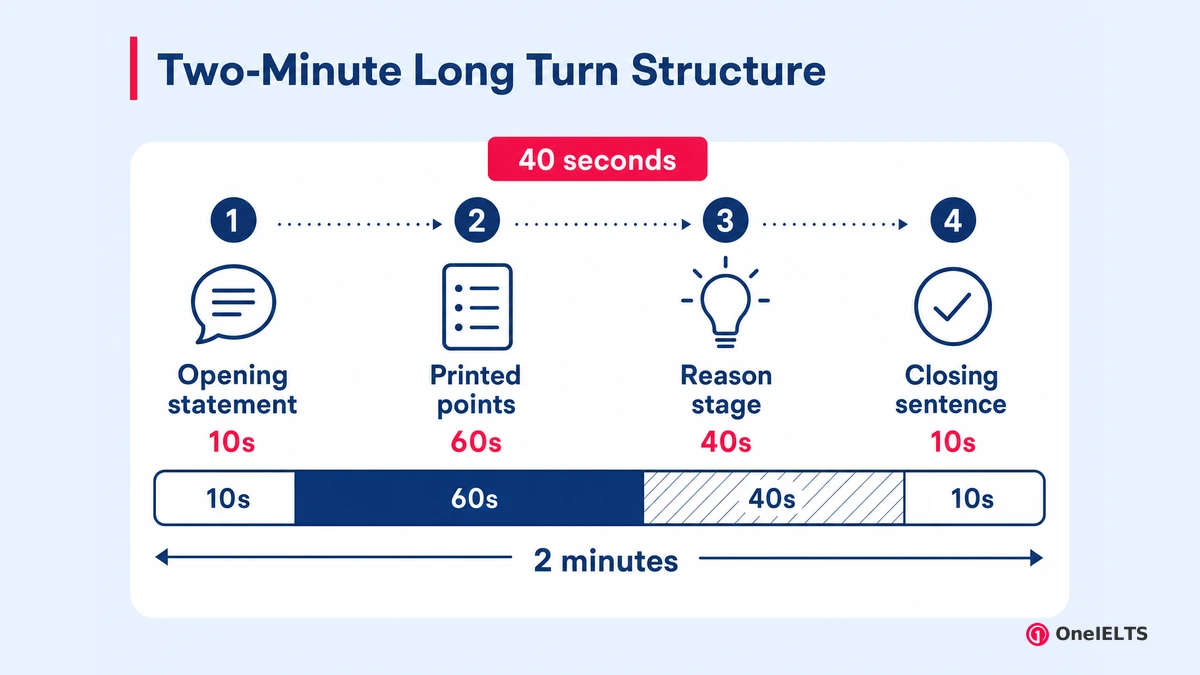
Open by naming the thing in one sentence, then walk the printed points in their printed order with two or three details each. Give the last third to the and-explain-why line, and close with one summarising sentence.
The card already provides the outline, so a structure question is really a clock question. Each stage owns a share of the two minutes.
- The opening statement, roughly ten seconds. One sentence names the thing, borrowing the card’s own wording, so the examiner hears a fluent start rather than a hesitation. You rehearsed this one in the minute, so it arrives ready.
- The printed points, roughly sixty seconds shared between them. Give each point two or three details and then move on, even when there is more to say, because coherence covers every point on the card.
- The reason stage, roughly forty seconds. The and-explain-why line gets your longest stretch, and a reason extends by one more layer of because whenever the clock is still running.
- The closing sentence, roughly ten seconds. One summarising line lands the talk, such as “so that’s why an ordinary old watch matters more to me than anything else I own”.
This shape prevents one specific failure: ninety seconds spent on the first printed point, and the examiner stopping you before you reach the reason. Move on when a point is answered.
The printed order is a suggestion, so combining two points in one stretch is fine as long as neither is dropped. A signposted transition between points, something as small as “as for how long I’ve had it”, makes the talk sound organised rather than listed.
How Do You Start Your IELTS Speaking Part 2 Talk?
Name the thing in your first sentence, borrowing the card’s own words, so the sentence is ready before the minute ends and the examiner hears a fluent start rather than a hesitation.
The first sentence is the one worth rehearsing, because it’s the only sentence you can fix in advance. Everything after it is improvised against your prompt words. A naming sentence does the whole job in about ten seconds, and it commits you to the example you chose.
Openings fail in four predictable ways. A filler run-in such as “well, I would like to talk about” wastes seconds. So does a preamble about how difficult the topic is, a definition of the topic word, or a recital of the whole card. None of them says anything, and the examiner has already started listening for fluency.
Borrowed wording is sensible, because the card offers a first clause you can use. Repeating the entire card costs ten seconds and shows no language of your own. One short piece of context after the naming sentence, when or where or who with, buys you a running start into the first printed point.
Three openings, one for each of three categories:
- Object card: “The thing I’d like to describe is an old wristwatch that belonged to my grandfather.”
- Person card: “The person I want to talk about is my old neighbour Farida, who taught me to cook.”
- Place card: “The place I’ve chosen is a rooftop cafe in Dhaka where I spent most of my final year.”
How Do You Expand an IELTS Speaking Part 2 Answer to Fill Two Minutes?
Attach two or three details to every printed point using a fixed set of expanders, such as a comparison, a specific instance, a sensory detail, a feeling and a consequence. Each point then runs twenty seconds instead of five.
Most candidates don’t run out of time. They run out of things to say at about fifty seconds, and the rest of the turn turns into repetition. Six expanders solve that, and each one is shown here on the watch card from earlier.
- A specific instance rather than a general claim. Swap “I wear it often” for “I wore it to my sister’s wedding last March”, because a dated instance invites the next sentence.
- A comparison with something else. “It’s heavier than any watch you’d buy now, and the strap is leather rather than the metal ones my friends wear.”
- A sensory detail. “The glass is scratched in one corner, and it ticks loudly enough that I can hear it from the next room when the house is quiet.”
- How it makes you feel. “Putting it on still makes me feel more serious than I actually am, which is probably why I only wear it on important days.”
- What would change without it. “If I lost it tomorrow I’d have nothing of his left in the house, and that is the part I’d mind.”
- When it last mattered. “I took it to be repaired in January, and I was more anxious in that shop than about anything else this year.”
The highest-yield expander is the and-explain-why line. A reason always takes one more layer of because, and it is the only point on the card with no natural end. When the clock is still running and you have nothing left, go back to the reason instead of inventing a new fact.
Two habits don’t work. Dropping your speech rate to fill time is heard as hesitation, and a repeated point you already made is heard as running out, which sounds worse than being stopped at the ceiling.
What Are the Rounding-Off Questions in IELTS Speaking Part 2?
Rounding-off questions are the one or two short questions the examiner asks immediately after your talk, and each one wants a short answer of a sentence or two rather than another long turn.
The name belongs to the test owner. The British Council heads this stage “Rounding off questions” and publishes two of them for its sample card: “is it valuable in terms of money?” and “would it be easy to replace?”. IDP describes the same stage as a final question at the end of the card. No other page in the ranking set names it, which is why candidates are surprised when it arrives.
The questions always come back to the same topic you just spoke on, so no fresh preparation is possible or needed. They are still Part 2 and still marked. Answering one with a full minute of speech is the standard error, because the examiner is closing the part rather than opening a discussion. That discussion is what Part 3 is for, and it starts seconds later with abstract questions on the same theme.
Two model answers at the expected length:
- “Is it valuable in terms of money?” “Not really, no. It’s an old watch, and I doubt anyone would pay much for it.”
- “Would it be easy to replace?” “Impossible, I’d say, because the whole value is who it belonged to.”
How Is IELTS Speaking Part 2 Marked?
There is no separate Part 2 band. The examiner marks the whole Speaking test on four marking criteria, and the long turn is the stretch where two of them, fluency and coherence, are most exposed.
Those four marking criteria carry equal weight: fluency and coherence, lexical resource, grammatical range and accuracy, and pronunciation. Each one is applied to everything you say across the three parts.
Candidates plan for Part 2 as though it were scored on its own. It isn’t. This part feeds an averaged band with Parts 1 and 3, so a strong long turn can’t rescue a weak Part 3, and a stumbled one doesn’t sink the test.
It still matters more than its share of the clock. This is the test’s only stretch of uninterrupted speech, so hesitation, self-correction and repetition are audible with no examiner question to hide behind. It is also where the examiner hears whether you can organise extended language, which is the coherence half of that criterion.
Content isn’t marked. A dull but fluent talk outscores an interesting but halting one, so the work belongs on your weakest criterion.
What Are the Common Mistakes to Avoid in IELTS Speaking Part 2?
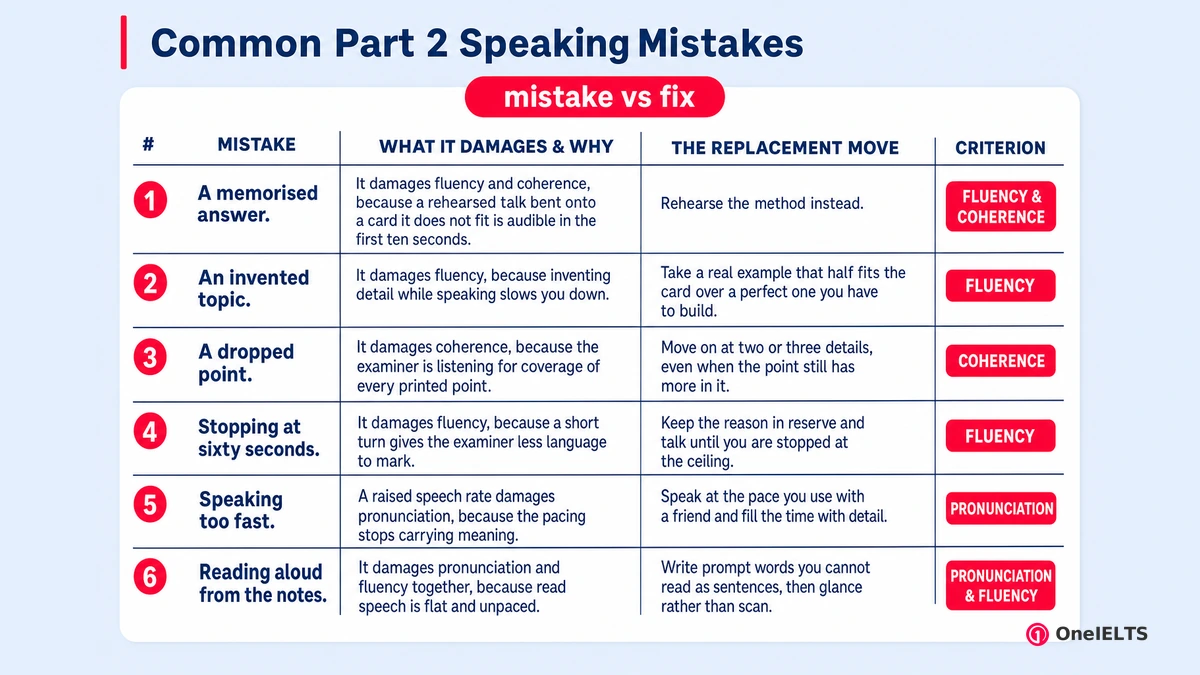
The six that cost the most are a memorised answer, an invented topic, one printed point eating the whole talk, stopping at sixty seconds, speaking too fast, and reading the notes aloud.
Each one trades a small comfort for a marked criterion. Here is what each mistake damages, and the move that replaces it.
- A memorised answer. It damages fluency and coherence, because a rehearsed talk bent onto a card it does not fit is audible in the first ten seconds. Rehearse the method instead.
- An invented topic. It damages fluency, because inventing detail while speaking slows you down. Take a real example that half fits the card over a perfect one you have to build.
- A dropped point. It damages coherence, because the examiner is listening for coverage of every printed point. Move on at two or three details, even when the point still has more in it.
- Stopping at sixty seconds. It damages fluency, because a short turn gives the examiner less language to mark. Keep the reason in reserve and talk until you are stopped at the ceiling.
- Speaking too fast. A raised speech rate damages pronunciation, because the pacing stops carrying meaning. Speak at the pace you use with a friend and fill the time with detail.
- Reading aloud from the notes. It damages pronunciation and fluency together, because read speech is flat and unpaced. Write prompt words you cannot read as sentences, then glance rather than scan.
The memorised answer deserves its own warning, because it carries the harshest penalty and the strongest temptation. An examiner who believes an answer is memorised is entitled to disregard the language in it, so a rehearsed paragraph can earn you almost nothing.
Speaking quickly is the mistake candidates believe helps them, since it fills the time and feels fluent. It costs marks for the same reason a read sentence does, because the pacing stops doing any work.
How Do You Get a High Score in IELTS Speaking Part 2?
At the top bands the material decides the score: a real example carried by developed detail, delivered at a normal speaking pace for the full two minutes with no rehearsed line in it.
Three things follow from the method above. The structure is a structural floor rather than a ceiling, so a correct shape with thin content stalls around band six. The criteria are averaged, so your practice belongs on your weakest criterion rather than the one you already enjoy.
The third one matters most. The only rehearsal that raises a band is rehearsing the method on an unseen card, rather than rehearsing answers to cards you have already met. No amount of topic preparation beats the ability to talk for two minutes about a card you have never seen, because the examiner chooses the card and you don’t.
What Makes a Band 9 IELTS Speaking Part 2 Answer?
A band nine long turn fills the full two minutes, covers every printed point, spends its longest stretch on the reason, and sounds like someone describing something they actually know. An examiner also hears four things a transcript never shows. There is no rehearsed cadence, no repair of the same phrase twice, natural stress on the meaning-carrying words, and a landed close. The published ielts speaking band descriptors set out what each criterion expects.
Should You Always Use Genuine Stories in IELTS Speaking Part 2?
Yes, wherever you can: a genuine story costs nothing to retrieve, and inventing while you speak costs the fluency that is actually marked. Invention breaks no rule. It is simply expensive.
If no real example fits the card, borrow a real one from someone you know and tell it in the first person. A borrowed memory still supplies the specific detail that expansion needs. Our speaking lie in ielts guide covers the fluency cost of invented detail.
How Is IELTS Speaking Part 2 Different from Parts 1 and 3?
Part 1 is a short exchange on familiar topics, and Part 2 is a timed monologue you prepare for one minute. Part 3 asks for abstract discussion on the same theme, with every answer an unprepared answer. For practice that means Part 2 is the only part you can rehearse whole, and the only one where the examiner role is to stop you rather than help you. Read the ielts speaking part 3 guide next.
Which Useful Phrases Help in IELTS Speaking Part 2?
Three kinds, and only three: a naming phrase to open, a transition signpost between the printed points, and a closing phrase to land the end. “The thing I’d like to describe is” and “as for how long I’ve had it” cover the first two jobs. A time-buying filler is heard as hesitation, so learn the signposts and skip the fillers. The full discourse marker set sits in our connectors for ielts speaking guide.
Can You Practise the Individual Long Turn Without a Partner?
Yes, you can, and the long turn needs no partner at all, because it is a monologue against a clock. The routine that works is one unseen card a day, one minute on a timer, and two minutes of phone recording. Listen once for the clock and once for repeated words.
Recording replaces the partner, since long-turn mistakes are audible rather than visible. Build solo practice into an ielts speaking preparation plan, then sit a free ielts speaking mock test.
Written by Rifah Binte Faruk, reviewed 14 August 2026.
Last verified: 14 August 2026
Practice for the Real IELTS Exam
Apply what you’ve learned with free, exam-style practice:
- Take a free IELTS mock test — all four skills, real exam timing, AI band scoring
- Sit a Speaking section mock — timed Parts 1–3 with voice recording and band feedback
- Practise all three parts — sample questions with feedback