OneIELTS

Test prep byAcadion
RB

Rifah Binte Faruk

Professional Title

IELTS Instructor & Content Contributor at OneIELTS

Location

Sylhet, Bangladesh

Education Qualification

  • Bachelor's Honours in progress, Dakshin Surma Government College, Sylhet
  • Teacher Training Programme, British Council
  • IELTS Band 7.5 (Listening 8.5, Speaking 8.0, Reading 6.5, Writing 6.0), British Council, April 2022

Expertise

  • IELTS Speaking instruction and live mock-test delivery
  • Listening strategy at the 8.5 band level
  • Mock-exam administration and exam-day procedure
  • Educational and promotional content for IELTS programmes
  • Bilingual delivery in English (C1–C2) and Bangla

Summary

Rifah Binte Faruk has been teaching IELTS in Sylhet for three years and now writes for OneIELTS. She holds a personal IELTS band of 7.5, with Listening 8.5 and Speaking 8.0, and has completed the British Council's Teacher Training Programme. Her day-to-day work has been built around live Speaking instruction and mock-test administration, and she has run dozens of timed speaking assessments. Her writing draws on that classroom and exam-day experience rather than on textbook theory.

Professional Experience

IELTS Instructor & Content Contributor at OneIELTS (2026–Present): Writes IELTS preparation material with a focus on Speaking and Listening, translating live classroom and mock-test experience into structured study guides.

Faculty Member, Hexa's Uposhohor, Sylhet (2022–Present): Delivers IELTS classes, supervises mock tests, and conducts timed speaking assessments.

English Teacher, Syed Jahan (Rh.) Academy, Sylhet (2022): Delivered English instruction and prepared students for examinations.

Skills

  • IELTS Speaking-test delivery and assessment
  • Mock-exam coordination and materials management
  • Classroom delivery for mixed-level learners
  • Educational video and content production

Awards and Recognitions

  • IELTS Band 7.5, British Council (2022)
  • British Council Teacher Training Programme
Articles by Rifah Binte Faruk(23)

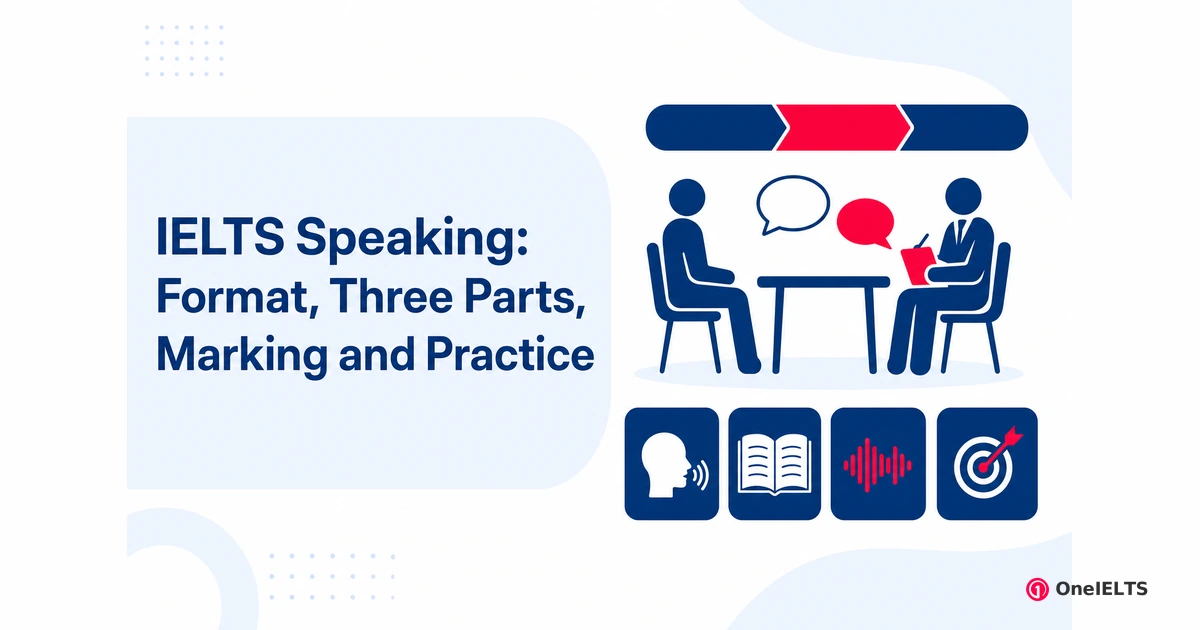
IELTS Speaking: Format, Three Parts, Marking and Practice

IELTS Speaking: Format, Three Parts, Marking and Practice

Eleven to fourteen minutes, three parts, one examiner. The IELTS Speaking test is a recorded conversation in three parts, and four marking criteria turn it into a band score from 1 to 9. The marking section here crosses the two lists that every other page keeps apart: which criterion each part decides. This page covers […]

09 Sept, 2026
IELTS Speaking
IELTS Cue Cards: Topics, Sample Answers and Practice

IELTS Cue Cards: Topics, Sample Answers and Practice

In IELTS Speaking Part 2 the examiner hands you a printed cue card, then takes it back about four minutes later. One topic line, three or four bullet points, one minute to prepare, one to two minutes to talk. Outside the exam the same term means an actor’s prompt card, so this page settles that […]

09 Sept, 2026
IELTS Speaking
IELTS Speaking Topics: Part 1, 2 and 3 Questions

IELTS Speaking Topics: Part 1, 2 and 3 Questions

IELTS Speaking questions follow one shape: the same subject at three depths. Part 1 asks “Do you like music?”, Part 2 hands you a cue card reading “Describe a concert you attended”, and Part 3 asks why musical taste changes. This page counts the questions, covers the unmarked introduction, and lists the Part 1 topics […]

09 Sept, 2026
IELTS Speaking
IELTS Speaking Part 2: Task Card, Timing and Structure

IELTS Speaking Part 2: Task Card, Timing and Structure

The examiner hands you a printed task card and gives you one minute of preparation with paper and a pencil. Then you talk alone for one to two minutes, and the examiner closes with one or two rounding-off questions. That shape is IELTS Speaking Part 2, the individual long turn: three or four printed points […]

07 Sept, 2026
IELTS Speaking
Connectors for IELTS Speaking: Types, Use and Overuse

Connectors for IELTS Speaking: Types, Use and Overuse

Google’s own AI Overview on connectors for IELTS Speaking tells you to avoid moreover and furthermore, then says you can use and, but and because as often as you like. The official band descriptor settles which rule is right. A connector is marked under Fluency and Coherence, not under vocabulary, so the only thing that […]

07 Sept, 2026
IELTS Speaking