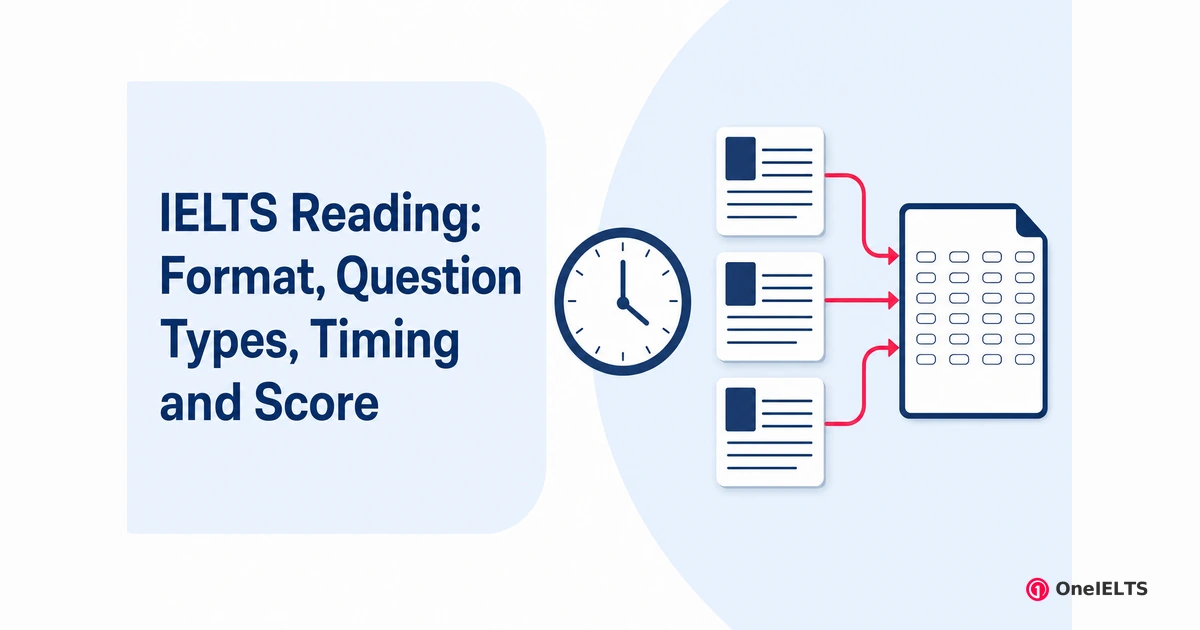
IELTS Reading gives you three passages and forty questions in sixty minutes. Those sixty minutes also cover copying every answer onto the answer sheet, so pacing decides as many marks as comprehension does.
This guide covers the reading test format, the Academic and General Training passages, the assessed skills, and the eleven question types. It then works through a six-step approach, the reading modes, speed habits, and the fifteen twenty twenty-five clock split. The closing sections handle raw-score conversion, band-level mistakes, where to practise, and the tips that lift a Reading band.
What Is the IELTS Reading Test Format?
The reading test format sets three passages, forty questions and sixty minutes, and that hour includes copying answers onto the answer sheet. Reading is the second of the four parts on test day, sitting between Listening and Writing with no break in between.
Academic and General Training candidates sit different passages under identical conditions. Both versions run three passages, forty questions and sixty minutes, so the material changes while the mechanics stay fixed. The exam board’s Academic Reading format page and IDP India’s Reading test page publish the same three numbers.
Nothing in the hour is optional. There is no reading time before the clock starts, no gap between passages, and no extra minutes at the end.
Reading is taken on computer. The passage sits on the left of the screen and the answers on the right, with a countdown clock in the corner. Paper-based IELTS, with its question and answer booklets, has been discontinued.
How Many Passages and Questions Are in the Reading Test?
Three passages carry forty questions between them. The exam board does not fix the questions per passage, so one paper might split them thirteen, thirteen and fourteen while another splits them differently.
Each passage mixes several question types, and a single passage often carries a matching set, a completion set and a True/False/Not Given set. Plan on roughly thirteen or fourteen items per passage, then check the real split in the first thirty seconds of each section.
Numbering runs straight through from 1 to 40 rather than restarting at each passage. That matters when you copy answers across, because one slipped line shifts every answer after it. Check the number against the question before you write, especially after you skip an item and come back to it.
How Long Is the IELTS Reading Test?
Sixty minutes, with no transfer time at the end. That one fact separates Reading from Listening, which ends with its own short review window.
In Reading the clock stops at sixty minutes and anything not entered in its box scores nothing. Build the copying into your plan and the time pressure drops sharply. Our IELTS Listening guide explains how that extra window works in the other section.
How Do Academic and General Training Reading Differ?
Academic reading and general training reading use different source material under identical timing. Both versions run three passages and forty questions in sixty minutes, and both are marked out of 40.
Academic reading draws long texts from journals, books and quality newspapers, written for a general readership rather than for specialists. General training reading uses notices, advertisements, staff handbooks and one longer text of general interest.
The raw score difference is the part candidates miss. Because General Training texts are easier, that version needs more correct answers than Academic for the same band. A raw total that reaches a given band on an Academic paper lands lower on a General Training paper. A General Training candidate targeting band 7 therefore has less room to lose marks than the band number alone suggests.
Take the version your destination asks for rather than the one that sounds easier. Universities and professional bodies almost always specify Academic. Migration routes and secondary schooling usually accept General Training. Reading is where the two versions diverge most, so practice material from the wrong version wastes preparation time.
What Do the Academic Reading Passages Look Like?
Three long academic passages, taken from journals, books and newspapers and written for a non-specialist reader. Topics range from archaeology to materials science, and no subject knowledge is assumed.
Expect a diagram, a graph or a short glossary when a passage turns technical. Difficulty climbs from Passage 1 to Passage 3. Our IELTS Academic guide covers the rest of that version.
What Do the General Training Reading Sections Look Like?
Everyday and workplace texts across three sections, with the shortest pieces first. Section 1 sets two or three short everyday texts such as timetables, notices and advertisements.
Section 2 moves to workplace texts, including job descriptions, contracts and staff training material. Section 3 gives one longer text of general interest, closest in length to an Academic passage. See our IELTS General Training guide for the rest of that version.
What Skills Does the IELTS Reading Test Assess?
Reading tests seven distinct skills, and each one belongs to a different question family. IDP India’s breakdown of what the Reading test assesses names them all. Knowing which skill a question targets tells you how to read for it, which is why the six-step approach starts with the question rather than the text. The seven assessed skills, with the question types that lean on each, are set out here.
- Identifying the main idea. Matching headings and summary tasks ask what a paragraph is mainly about, not which detail it happens to mention.
- Locating specific information. Scanning finds a name, a date or a figure fast, so you spend your reading time on the sentence that matters.
- Understanding detail. Completion questions test whether you read the exact wording, because one adjective often separates the right answer from the trap.
- Recognising opinions and attitudes. Yes, No, Not Given items ask whose view a sentence carries, so you separate the writer’s claim from a quoted source.
- Understanding implied meaning. Some answers are never stated outright, and you infer them from the way two sentences sit next to each other.
- Following the development of an argument. Long passages move from claim to evidence to qualification, and matching tasks reward readers who track that movement.
- Understanding vocabulary in context. The passage rarely repeats the question’s words, so you decode paraphrase and work out unfamiliar terms from their surroundings.
Notice how few of the seven involve reading for pleasure. Six of them are search skills applied under a clock. That gap explains a pattern seen again and again in marked papers, where candidates who read widely in English still score below the band they expected. Wide reading builds the vocabulary; only timed practice builds the search.
What Are the IELTS Reading Question Types?
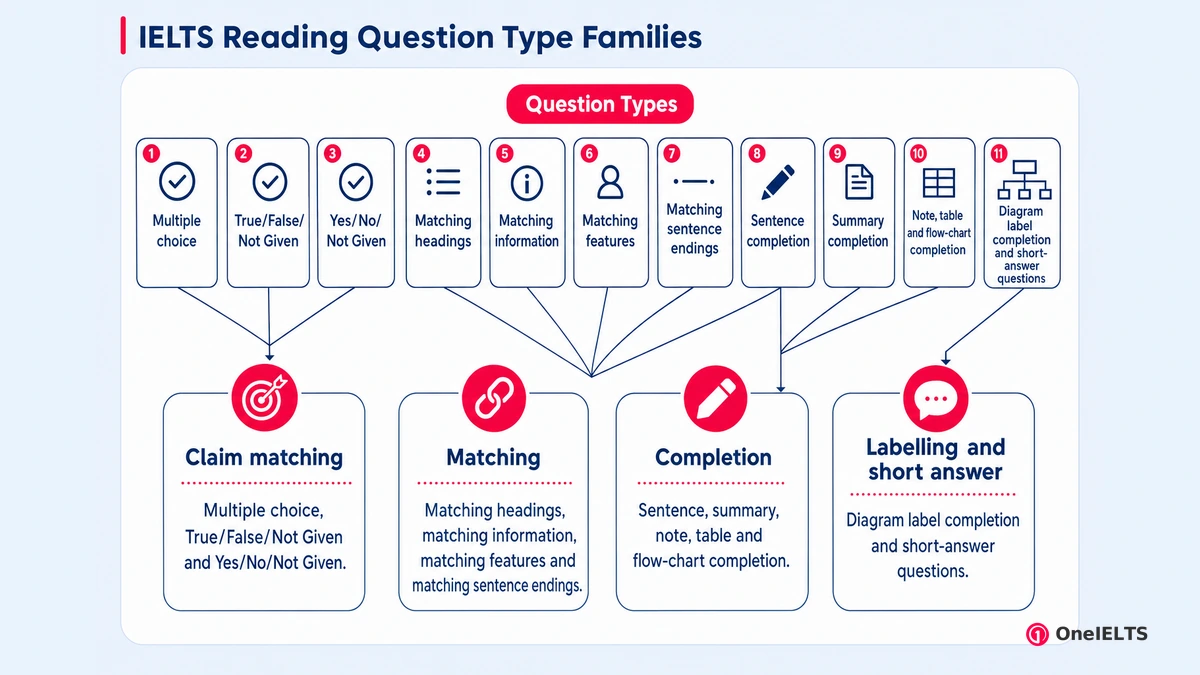
The exam board lists eleven question types for academic reading, and General Training draws on the same set. Eleven separate techniques is more than anyone holds in mind under a clock, so group the question types into four families instead.
Each family behaves the same way on the page and rewards the same tactic, which turns eleven decisions into four. The four families, and the sections that unpack each one, are named here.
- Claim matching. Multiple choice, True/False/Not Given and Yes/No/Not Given.
- Matching. Matching headings, matching information, matching features and matching sentence endings.
- Completion. Sentence, summary, note, table and flow-chart completion.
- Labelling and short answer. Diagram label completion and short-answer questions.
No rule fixes how many of each type a paper uses. A single Academic paper typically draws on five or six of the eleven, and the mix changes between versions. Drilling every family therefore beats betting on the ones you like.
Families also travel together. A matching set and a completion set often share the same passage, so you switch mode inside one text rather than between passages.
How Do Multiple Choice and True/False/Not Given Questions Work?
Both test precise claim-matching, and the distractors are statements the passage nearly makes. Multiple choice rewards the option the text supports exactly, while the others overstate, understate or swap one detail.
True false not given judges facts against the passage. Yes no not given judges the writer’s views. Name the pair before you answer, because Not Given means the passage is silent, not that the statement is false. Our IELTS Reading multiple choice guide drills the option patterns.
How Do Matching Headings and Matching Information Questions Work?
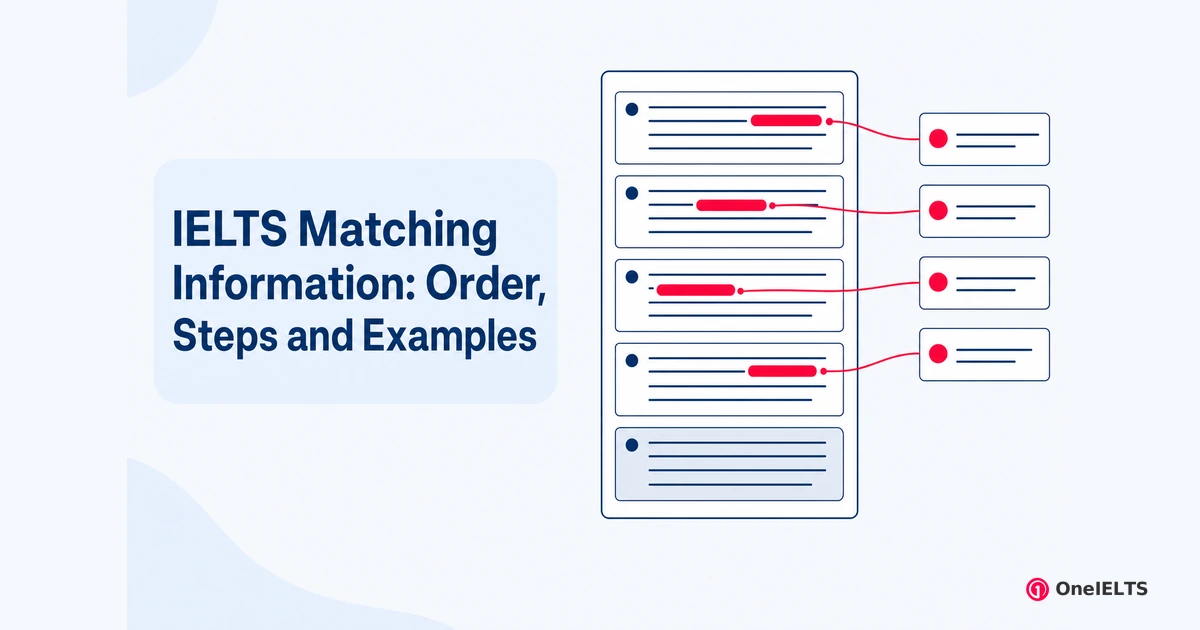
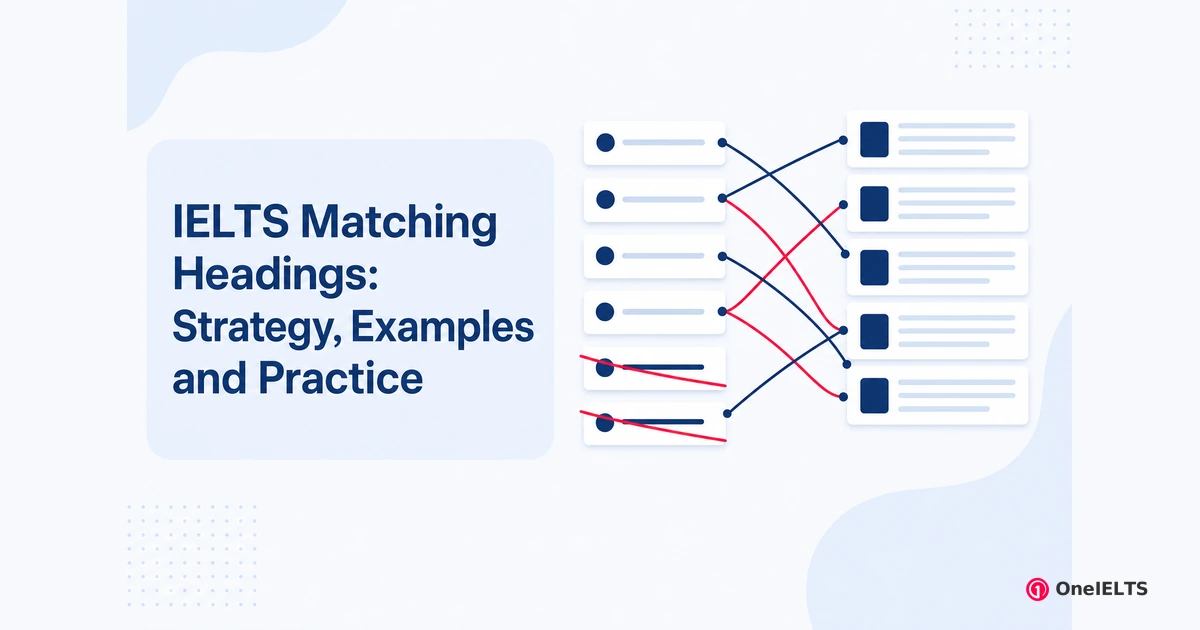
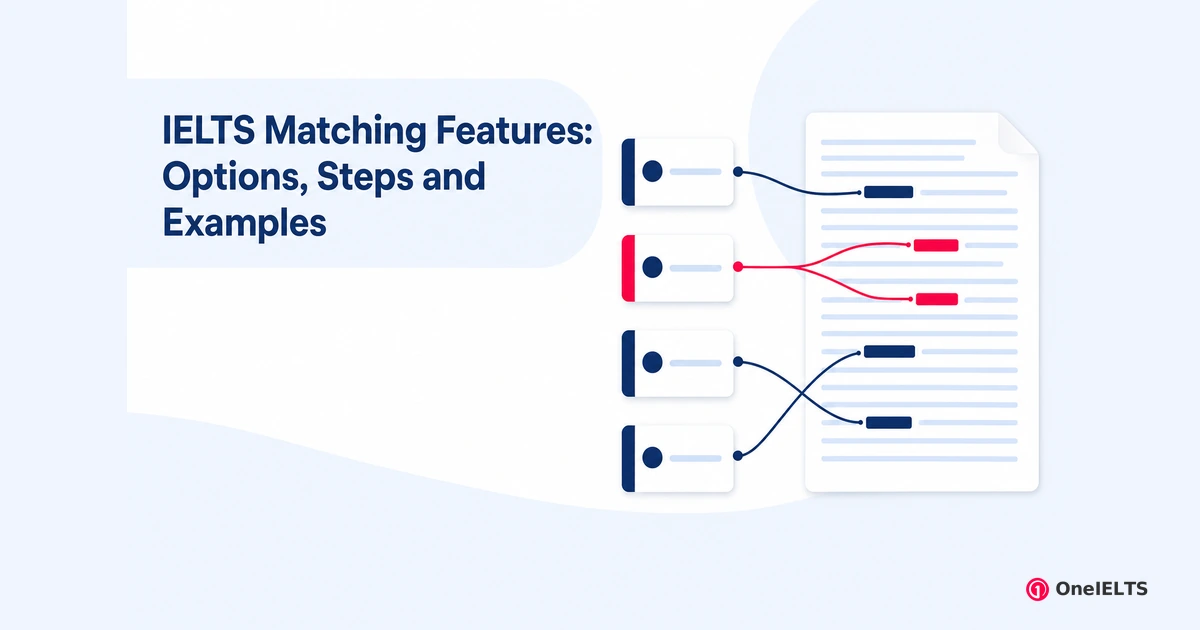
Matching tasks pair a list against the passage. Matching headings assigns a heading to each paragraph, matching information finds the paragraph holding a given fact, matching features links statements to named people or studies, and matching sentence endings completes a stem.
The list offers more options than questions, and the options never run in passage order. Cross off each option as you spend it. Our IELTS Reading matching headings guide works through the elimination method.
How Do Sentence, Summary and Note Completion Questions Work?
Completion tasks hand you a gapped sentence, summary, note, table or flow chart plus a strict word limit. Sentence completion fills a single stem, while summary completion, note completion and table completion rebuild a condensed version of part of the passage.
Every word must come from the passage and must fit the grammar of the gap, so a missing plural loses the mark. Our IELTS Reading sentence completion guide covers the grammar checks.
How Do Diagram Labelling and Short-Answer Questions Work?
Diagram labelling asks you to name parts of a picture, plan or process using words lifted from the passage. Short answer questions ask a direct question and accept a few words of answer, again taken from the text.
Both carry a word limit, and both concentrate their answers in one dense stretch of the passage. Finding that stretch is most of the work. Our IELTS Reading diagram labelling guide shows how to read a labelled figure.
How Should You Approach an IELTS Reading Passage?
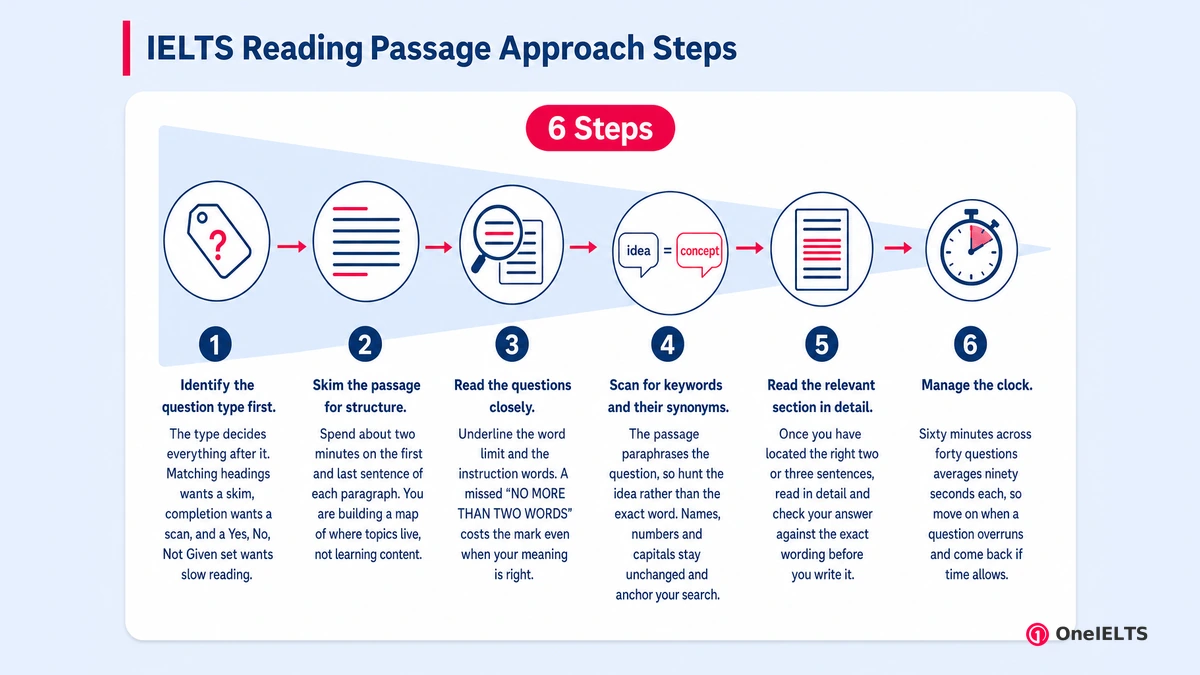
A repeatable six-step sequence beats reading the passage cover to cover. IDP India teaches the same order, and it works because each step narrows the search space for the next one. Reading the whole passage first spends the scarcest resource, time, before you know what you are looking for. These six steps run in order, and the first one, identify question type, controls the five that follow.
- Identify the question type first. The type decides everything after it. Matching headings wants a skim, completion wants a scan, and a Yes, No, Not Given set wants slow reading.
- Skim the passage for structure. Spend about two minutes on the first and last sentence of each paragraph. You are building a map of where topics live, not learning content.
- Read the questions closely. Underline the word limit and the instruction words. A missed “NO MORE THAN TWO WORDS” costs the mark even when your meaning is right.
- Scan for keywords and their synonyms. The passage paraphrases the question, so hunt the idea rather than the exact word. Names, numbers and capitals stay unchanged and anchor your search.
- Read the relevant section in detail. Once you have located the right two or three sentences, read in detail and check your answer against the exact wording before you write it.
- Manage the clock. Sixty minutes across forty questions averages ninety seconds each, so move on when a question overruns and come back if time allows.
Which Reading Modes Should You Use and When?
Three reading modes share the hour: scanning to locate, skimming for gist, and careful reading only where a question demands it.
Skimming builds the paragraph map that matching headings needs. Scanning hunts the keyword that completion and short-answer items sit beside. Careful reading is reserved for the two or three sentences that decide a Yes, No, Not Given call.
Those percentages come from a coaching video rather than the exam board, so treat them as a working ratio. The ranking is the useful part. Most of the hour goes on finding, and only a small slice on reading closely.
Switching modes costs nothing on paper and a great deal in practice. Candidates who read everything at one speed lose marks at both ends, skimming what needed care and labouring over what needed a glance. Decide the mode when you read the question, not when you reach the text.
How Do You Build Reading Speed for the IELTS Test?
Reading speed grows from habits practised outside the exam, not from a trick applied inside it. IDP’s guidance on raising Reading speed points the same way. Speed built in the final week rarely survives exam pressure, while a habit practised daily for a month does. Four habits carry most of the gain, and each one has a measurable outcome.
- Read in word groups rather than word by word. Train your eyes to land on three or four words at a time. Chunking cuts the number of fixations and lifts speed without hurting accuracy.
- Stop re-reading. Re-reading the same line twice is the biggest hidden time cost in the paper. Trust the first pass, mark the question, and return only if the answer stays unclear.
- Build academic vocabulary. Passages recycle the abstract nouns of research writing, so learn academic vocabulary in families rather than as isolated words and paraphrase stops slowing you down.
- Practise against a clock. Untimed reading builds comfort, not speed. Set sixty minutes, finish all three passages, and record where the clock ran out before the questions did.
How Do You Manage Time Across the Three Reading Passages?
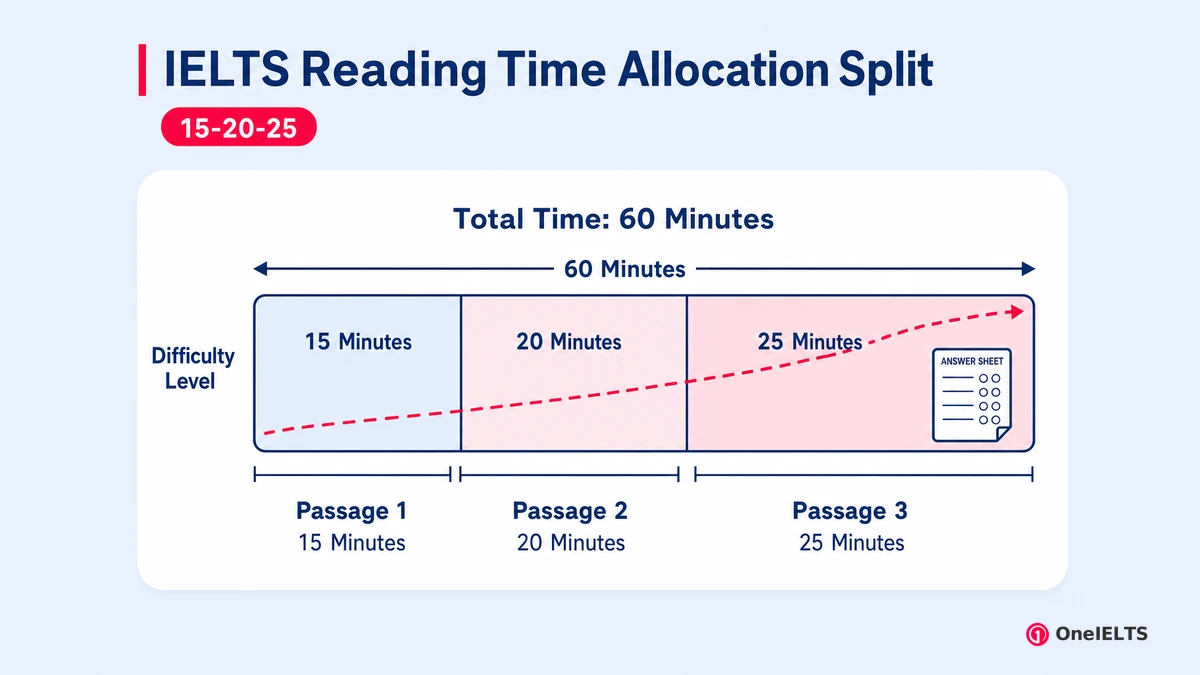
Allocate the hour unevenly, roughly fifteen minutes on Passage 1, twenty on Passage 2 and twenty-five on Passage 3, because difficulty climbs across the paper. Coaching channels call it the fifteen twenty twenty-five rule, and it is competitor-sourced rather than official.
An even twenty-twenty-twenty split feels fair and costs marks. Passage 1 holds the cheapest answers on the paper, and a full twenty minutes there steals time from the hardest passage. In marked mock papers the wrong answers cluster in the closing minutes of Passage 3, which is a pacing failure rather than a comprehension one. Good time management requires finishing Passage 1 early and banking the surplus.
There is no separate window for copying, so you transfer answers to the answer sheet as you go. Writing each passage onto the answer sheet the moment you finish it is safer than leaving a block of transfer for the last few minutes.
Pick a split and rehearse it until it runs without thought. The exact minutes matter less than owning a rule you obey when Passage 2 turns hard. Without one, the decision to move on gets made at the moment you are least able to make it.
Why Is There No Extra Transfer Time in IELTS Reading?
The sixty minutes already contains the copying, so Reading has no transfer time at the end. Listening ends with a short review window, and that comparison is what catches candidates out.
Paper based candidates write onto the answer sheet inside the hour, and computer candidates type straight into the answer box. That is why the fifteen twenty twenty-five split leaves the tail of Passage 3 free for checking. Our IELTS on computer guide covers the typed format.
How Is the IELTS Reading Score Calculated?
Each correct answer scores one mark out of forty marks, and the raw score converts to a band from 1 to 9. No half marks exist inside the raw total, and nothing is deducted for a wrong answer, so an unanswered question and a wrong guess cost the same.
The band conversion differs by version. General Training texts are easier, so that paper needs more correct answers than an Academic paper for the same band. Reading is then one of four section bands that average into the overall result, and the overall figure rounds to the nearest half band.
Reading marks are absolute rather than scaled against the other candidates in the room. Two people with the same number of correct answers on the same Academic paper receive the same Reading band. The only variable is the paper itself, which each test centre’s version equates separately before results are issued.
Raw-to-band figures on this page follow the reference marks IELTS publishes; the precise number of marks needed varies slightly from one test version to the next.
What Raw Score Do You Need for Each Reading Band?
The exam board publishes four anchor points per module, not a full chart. The raw score conversion it releases gives the average marks scored at four band levels, and the band score table below puts both modules side by side.
| Band | Academic raw score | General Training raw score |
|---|---|---|
| 8 | 35 | not published |
| 7 | 30 | 35 |
| 6 | 23 | 30 |
| 5 | 15 | 23 |
| 4 | not published | 15 |
Read across a row, not down a column. Thirty marks is a band 7 on the Academic paper and a band 6 on General Training, because a General Training test usually needs more correct answers for the same band.
Bands 9, 8.5, 7.5, 6.5 and 5.5 carry no published figure at all. The exam board also warns that these marks “will vary slightly from test version to test version”, so treat them as centres rather than cut-offs. Any chart that fills in every half band is somebody’s estimate, not the conversion. Our IELTS band score guide explains how the four section bands average into the overall result.
What Is a Good IELTS Reading Score?
No universal pass mark exists. A good reading score is whatever your university, professional body or visa route asks for, and the cut-off moves with the destination.
Undergraduate courses commonly set an overall 6.0 or 6.5 with no section under 6.0, while professional registration often sets a higher requirement. Check the figure on the institution’s own page before you fix a target. Our good IELTS score guide compares the usual thresholds.
What Are the Most Common IELTS Reading Mistakes at Each Band Level?
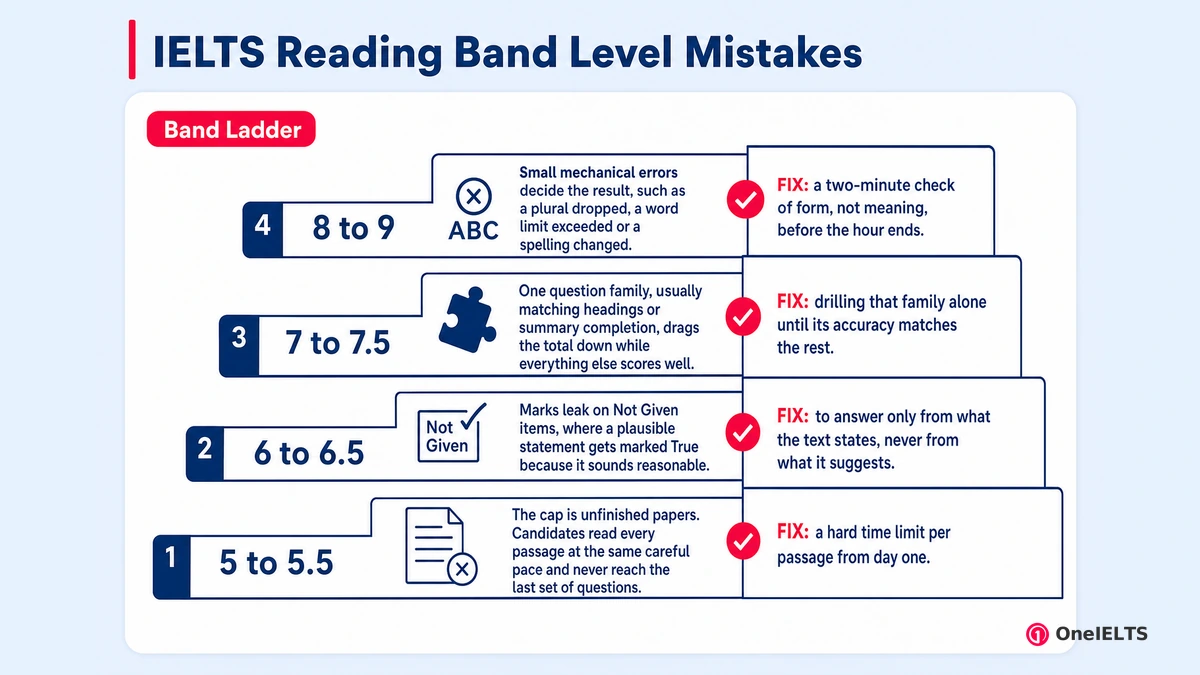
Common mistakes change shape as the band rises, and each rung of the ladder carries one dominant error. IDP India’s band-level breakdown groups them the same way. The ladder runs from band five through band seven to band nine, and score improvement comes from fixing the error that belongs to your current rung. Each band range appears here with the mistake that caps it and the fix that clears it.
- Band 5 to 5.5. The cap is unfinished papers. Candidates read every passage at the same careful pace and never reach the last set of questions. The fix is a hard time limit per passage from day one.
- Band 6 to 6.5. Marks leak on Not Given items, where a plausible statement gets marked True because it sounds reasonable. The fix is to answer only from what the text states, never from what it suggests.
- Band 7 to 7.5. One question family, usually matching headings or summary completion, drags the total down while everything else scores well. The fix is drilling that family alone until its accuracy matches the rest.
- Band 8 to 9. Small mechanical errors decide the result, such as a plural dropped, a word limit exceeded or a spelling changed. The fix is a two-minute check of form, not meaning, before the hour ends.
Work one rung at a time. Fixing the band 6 error while the band 5 error is still live changes nothing, because the paper still runs out before the last questions are reached.
Where Can You Find IELTS Reading Practice Tests?
Use OneIELTS for both kinds of Reading practice rather than hunting third-party PDFs. A full reading practice test recreates the exam, while a sectional test isolates one question type so you can drill it.
The two serve different purposes. A timed practice run of sixty minutes measures pacing, stamina and copying discipline, and a full mock test is the only way to learn where the hour actually goes. A sectional drill measures accuracy on one family with no clock hiding the cause of an error.
Alternate them. Full papers test the system, and drills repair the parts.
Quality beats volume here. Ten papers taken and never reviewed teach less than three papers taken, marked and picked apart line by line. Set the ratio at roughly one hour of practice to one hour of review, and the band moves faster than it does on volume alone.
What Should a Full IELTS Reading Practice Test Include?
Three passages, forty questions, a sixty-minute clock and an answer key that explains why each distractor fails. A full practice test without a clock trains comprehension and leaves pacing untouched. An answer key that lists only letters teaches nothing, because the value sits in the explanation. Any timed paper marked to that standard is worth repeating.
OneIELTS runs a free IELTS Reading mock test that opens once you have a free account.
How Do You Review an IELTS Reading Mock Test by Cause?
Sort every wrong answer by cause rather than by question number. Four causes cover almost everything, namely ran out of time, missed the paraphrase, misread the word limit, and misread the question itself.
Keep an error log with one line per mistake and the cause beside it. After three papers the dominant cause is obvious, and that is the one to train. Review by cause turns a score into a plan. Our IELTS Reading tips guide works through the fixes one by one.
What Are the Best Tips to Improve Your IELTS Reading Score?
The fastest gains come from fixing one weak question type and one pacing habit, not from reading more. Everything above described the test. What follows is the strategy that moves the number.
IELTS Liz and PASF arrive at the same short list of reading tips, and marked mock papers agree with them. Accuracy is lost in predictable places. The habits that improve reading score results are narrow, repeatable and mostly mechanical, and the questions people ask most are answered next.
One caution before the specifics. A strategy only counts once it survives a full sixty-minute paper, so test each tip under the clock rather than on an untimed exercise.
How Do You Get Band 7 in IELTS Reading?
A band seven reading result usually needs roughly the low 30s out of 40 on an Academic paper. The gain almost never comes from reading faster overall.
It comes from the weakest question type. A candidate stuck in the high 20s is typically strong on completion and weak on matching headings, and the whole deficit sits in that one family. Find the family that lags and drill it alone. Our IELTS band score guide shows how the raw total maps across the scale.
How Do You Get Band 9 in IELTS Reading?
A band nine reading score leaves almost no margin for error across all forty questions. At that level the remaining mistakes are mechanical rather than comprehension based, such as a dropped plural, an exceeded word limit or a mistyped answer.
Read the instruction line twice, keep the copying clean, and use the closing minutes to check form rather than meaning. Our IELTS band nine guide sets out what the top of the scale demands.
Is 6.5 or 7 Easier to Reach in Reading?
Six point five arrives sooner, and Reading is the fastest to improve of the four sections because every answer is printed on the page. Nothing has to be produced, only found.
Moving from 6.5 to band seven usually means converting three or four more items per paper, and those items sit in one or two question families. Writing and Speaking demand new language, while Reading demands a better search.
Does Spelling Matter in IELTS Reading?
Yes, a misspelled answer is marked wrong, even though the word is printed in the passage. Copy exactly what the text prints, letter for letter, because the marker expects the printed string and nothing near it. Both British and American forms are accepted where a word has two standard spellings.
How Can You Practise IELTS Reading Effectively?
Alternate full timed tests with single-question-type drills, and review every paper by cause. Effective practice has a rhythm of one timed test a week to hold pacing, two or three question type drill sessions between them, and an error log that carries forward.
Volume without review repeats the same mistake. The IELTS Reading practice hub is where OneIELTS keeps that self-paced work, and a free account opens it.
Written by Fahimur Rahman, reviewed 14 August 2026.
Last verified: 8 October 2026
Practice for the Real IELTS Exam
Apply what you’ve learned with free, exam-style practice:
- Take a free IELTS mock test — all four skills, real exam timing, AI band scoring
- Sit a Reading section mock — one full timed paper with an instant band score
- Practise by question type — self-paced passages with answer explanations