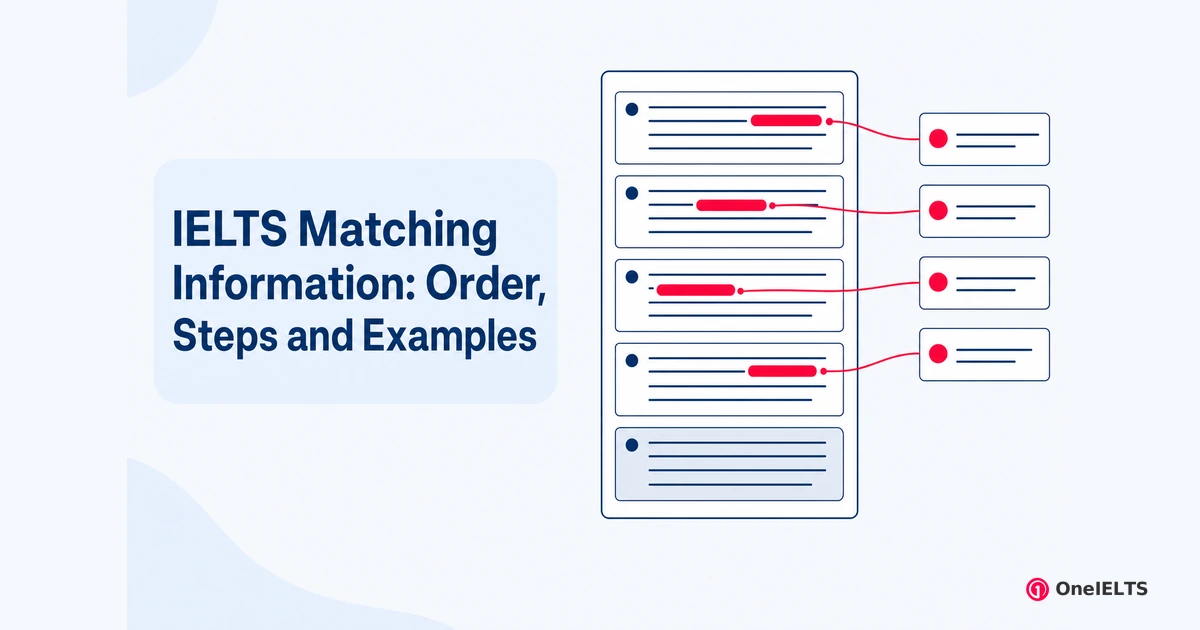
Matching paragraph information hands you a set of statements and the passage’s paragraph letters. Beside each statement you write the letter of the paragraph that contains its specific detail. The answers ignore passage order, and one paragraph can answer two statements.
That reuse is what makes the type expensive. It is the only Reading question type that can send you back through the whole passage for every statement.
This guide covers the task itself, the skills it tests, why the answers run out of order, and whether a paragraph repeats. It then works through the seven-step method, the common mistakes, an original worked example, where to practise, the tips that raise accuracy, and how the type fits the other Reading question types.
What Is Matching Paragraph Information in IELTS Reading?
You get a numbered list of statements, each describing one piece of information, and beside each one you write the letter of the paragraph that contains it. What the task asks for is paragraph location. You are finding which paragraph holds a stated fact, rather than deciding what that paragraph is about as a whole.
The information types asked for are narrow. A reason, a comparison, a description, an example or a result covers almost all of them, and each usually sits in a clause or two rather than across a whole paragraph.
The paragraph letters run from A to the final paragraph of the passage, and the paper normally prints fewer statements than there are paragraphs. Unused paragraphs are built into the design, not a sign that you have gone wrong. The instruction line above the questions is the only place that tells you whether a letter may be used more than once.
IELTS classifies this as Academic Reading Question Type 4 – Matching information, and the same task appears in General Training Reading.
What Skills Does IELTS Reading Matching Information Test?
Two skills carry this type. You scan for detail, then recognise that detail inside a paraphrase. What the task rewards is location and matching, not reading for gist and not summarising.
Skimming is the wrong first move. A skim tells you what a paragraph is about, while the information you are hunting can sit in a single clause anywhere inside it. Edubenchmark’s step list for this type drops the “Skim the Text” step it uses on every other question type, which matches what the task actually needs.
The statement will be a rewording, so shared words are a weak signal. The tiring part is holding one statement’s meaning in your head across several hundred words of text.
Why Do Matching Information Answers Not Follow the Passage Order in IELTS Reading?
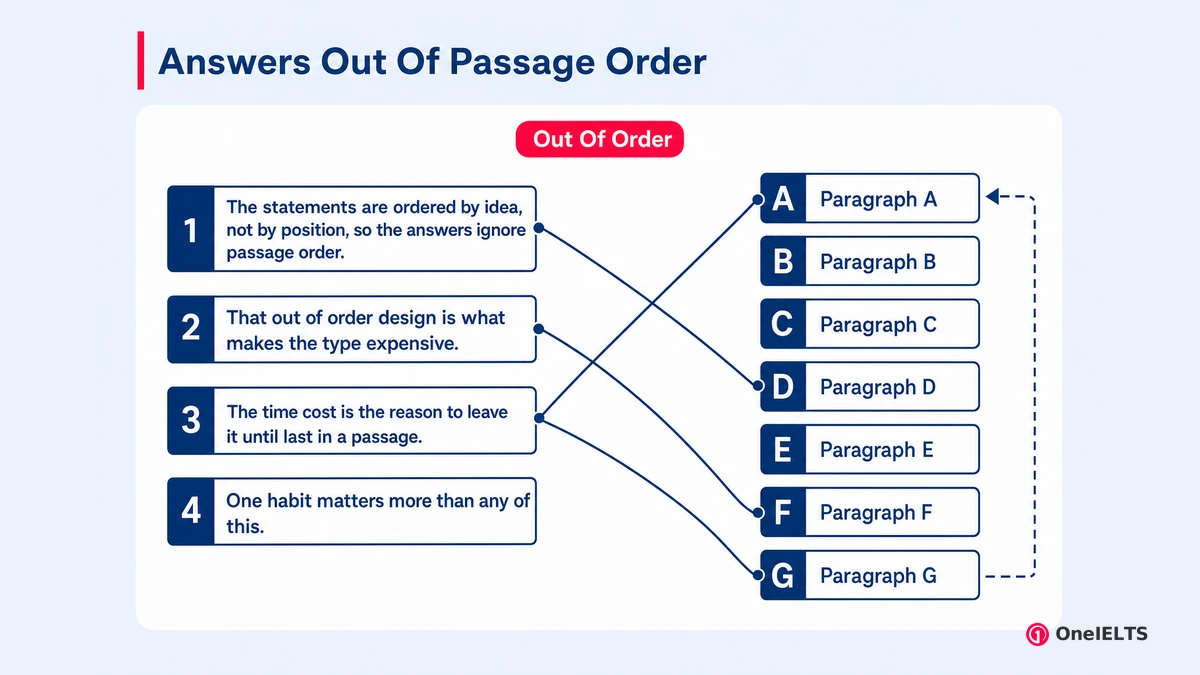
The statements are ordered by idea, not by position, so the answers ignore passage order. Statement 1’s information can sit in the last paragraph and statement 4’s in the first.
That out of order design is what makes the type expensive. Most Reading tasks let you move forward through the text; here one answer can send you back to paragraph A after you have reached paragraph G.
The time cost is the reason to leave it until last in a passage. Answer the ordered types first, because they map the text for you and leave you knowing roughly where each topic lives.
One habit matters more than any of this. Never stop scanning a paragraph once you have used it for an earlier statement. Matching features shares the out of order rule, while matching headings stays in step with the passage because it works through one paragraph at a time.
Can a Paragraph Be Used More Than Once in IELTS Reading Matching Information?
Yes, a paragraph can be used more than once, but only when the instruction line says so. That line is the only place the paper tells you.
Two shapes appear on the paper. “NB You may use any letter more than once” licenses reuse, so paragraph C can answer questions 2 and 6. “You may use each letter once only” closes that door and turns the set into a one-to-one match.
When reuse is allowed, the rule is no elimination. A paragraph you have already used stays live for every remaining statement, so keep scanning it.
Unused paragraphs are normal either way. With five statements and eight paragraphs, at least three paragraphs answer nothing, and that is the design rather than a mistake.
How Do You Answer Matching Information Questions in IELTS Reading?
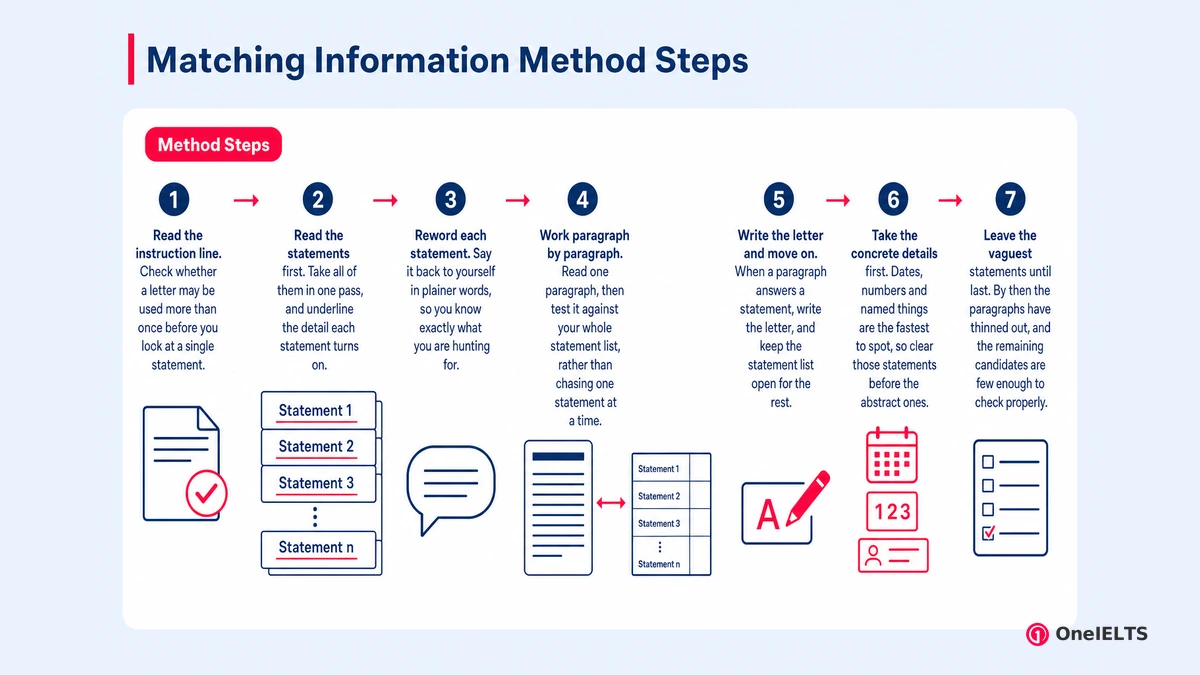
The method turns the task on its head. You read every statement before the passage, then move through the passage once, matching as you go instead of restarting the text for each question.
Seven steps make up the routine, ordered the way you would run them under exam conditions.
- Read the instruction line. Check whether a letter may be used more than once before you look at a single statement.
- Read the statements first. Take all of them in one pass, and underline the detail each statement turns on.
- Reword each statement. Say it back to yourself in plainer words, so you know exactly what you are hunting for.
- Work paragraph by paragraph. Read one paragraph, then test it against your whole statement list, rather than chasing one statement at a time.
- Write the letter and move on. When a paragraph answers a statement, write the letter, and keep the statement list open for the rest.
- Take the concrete details first. Dates, numbers and named things are the fastest to spot, so clear those statements before the abstract ones.
- Leave the vaguest statements until last. By then the paragraphs have thinned out, and the remaining candidates are few enough to check properly.
What Are the Common Mistakes in IELTS Reading Matching Information?
Marks go missing in predictable places on this type. Most wrong answers come from matching a paragraph’s topic instead of its detail, and most lost time comes from re-reading.
Seven errors account for most of the damage.
- Answering from the main idea. The main idea trap catches most candidates, because the detail asked for is often not what the paragraph is about.
- Assuming the answers run in order. The passage order assumption sends you searching the wrong half of the text and wastes the pass.
- Eliminating a paragraph the instruction lets you reuse. Crossing out paragraph D after question 2 removes the right answer to question 5.
- Matching on a shared word. A shared word between statement and paragraph proves nothing, because the real link is usually a paraphrase.
- Re-reading the whole passage once per statement. Eight statements then cost you eight passes, which is more re-reading than the clock allows.
- Doing this type first. Starting with the most expensive set drains the time management budget for the completion questions that follow.
- Leaving a statement blank. A blank scores zero, while a considered guess from the paragraphs still in play sometimes lands.
What Does a Matching Paragraph Information Question Look Like in IELTS Reading?
This worked example uses an original extract written for this page, not a Cambridge passage. Five lettered paragraphs run A to E, and the instruction line reads “NB You may use any letter more than once”.
A The county’s first seed library opened in 2019, in a disused ticket office at Aldgrove station. Members borrow seed for free and return a portion of what they harvest, which keeps the collection stocked without any purchase.
B Storage is the harder half of the work. Seed keeps longest at low humidity, so volunteers dry every donation over silica gel before it is packeted and shelved.
C Demand has grown faster than the shelving. Membership rose from 60 in the first year to more than 800 by 2024, and a waiting list now opens each spring. The tomato and bean drawers empty within a fortnight, while the flower seed rarely moves.
D Similar projects in Norway and New Zealand report the same seasonal pattern, though both charge a small annual fee that Aldgrove has resisted.
E The building itself remains a problem. The roof leaks in two places, and the trustees have applied twice for restoration funding without success.
Each statement carries its answer and the words that settled it.
- A description of the premises the library occupies. Answer: A. The phrase “a disused ticket office at Aldgrove station” settles it, even though paragraph E is the one about the building.
- A reason for drying seed before storage. Answer: B. “Seed keeps longest at low humidity” gives the reason, and the drying step follows from it.
- Figures showing how quickly membership grew. Answer: C. “Rose from 60 in the first year to more than 800 by 2024” is the only pair of numbers in the passage.
- An example of seed that members rarely take. Answer: C. “The flower seed rarely moves” sits in the same paragraph as question 3, which the instruction line permits.
Statement 1 is main idea versus detail in miniature. Paragraph E is about the building, so it reads like the answer, while the description actually sits in paragraph A. Paragraph C answers twice, and paragraph D is an unused paragraph that exists to look plausible.
Where Can You Practise IELTS Reading Matching Information?
Practise on OneIELTS rather than on the worksheet PDFs the search results push at you. Our IELTS Reading matching information practice pages filter the practice questions down to this single type. A free OneIELTS account is needed to open them.
The type has to be drilled inside a full passage to be worth much. Its whole difficulty is the cost of re-scanning a long text for statement after statement, and a tidy five-paragraph exercise hides that cost completely. A question type drill fixes the method, and a full passage tests whether the method survives the clock.
In marked practice the pattern is consistent. Candidates who lose marks here usually wrote the letter of the paragraph the statement sounds like, rather than the paragraph that contains the information.
Review your errors with three checks. Did I answer from the main idea instead of the detail? Did I assume the answers ran in order? Or did I match on a word and miss the paraphrase?
What Are the Best Tips for IELTS Reading Matching Information?
The matching information tips that move accuracy are about sequencing and discipline. Reading every statement before you touch the passage, then making one pass, is the single biggest gain available on this type.
Eight habits carry most of the improvement, ordered by when you use them.
- Read the instruction line first. It is the only place that tells you whether a letter may repeat.
- Read every statement before you touch the passage. One pass over the questions saves several passes over the text.
- Hunt the detail, not the topic. A paragraph’s subject and the information asked for are often two different things.
- Expect the answers out of order. Statement 6 can sit in paragraph A, so never search forward only.
- Work through the passage once, not once per statement. One paragraph, checked against every statement, then move on.
- Do this type after the others in the passage. The ordered question types map the text for you first.
- Write letters, never words. The answer sheet wants a paragraph letter, and a copied phrase scores nothing here.
- Leave nothing blank. A blank scores zero, and one of the remaining paragraphs is the right letter.
How Does Matching Information Fit With the Other IELTS Reading Question Types?
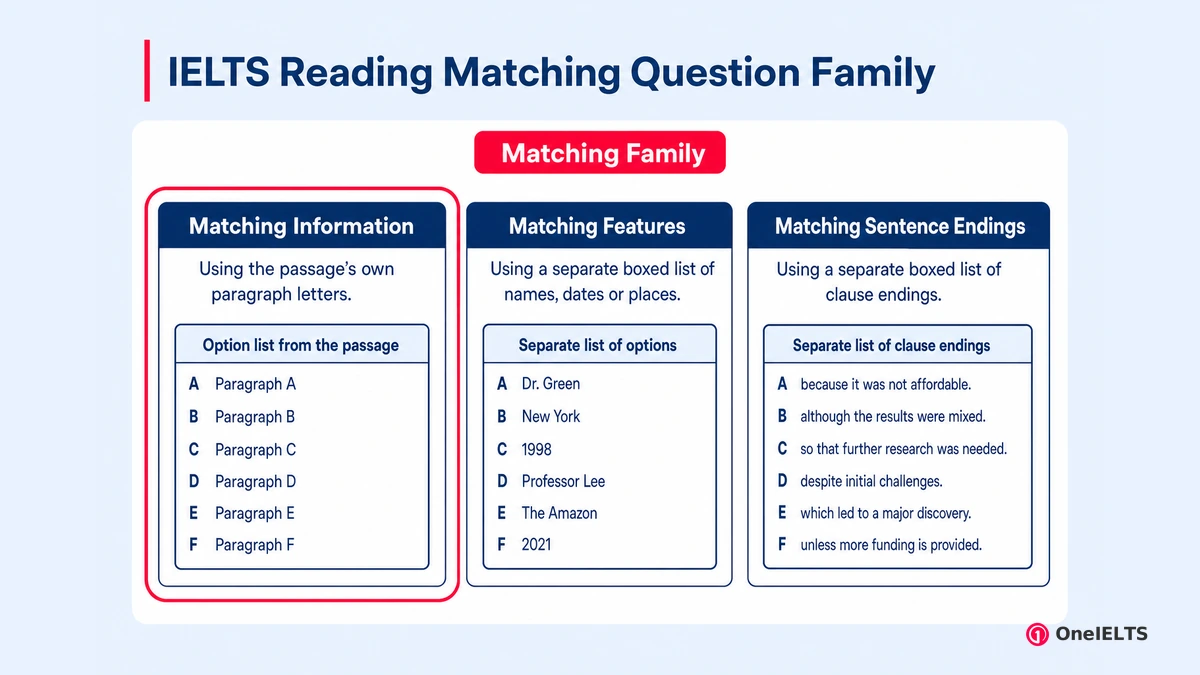
Among the official Academic Reading question types, matching paragraph information belongs to the matching family, the group whose answer is a letter taken from a supplied list rather than words copied out of the text.
Three of those types answer with a letter from a list: matching information, matching features and matching sentence endings. Only matching information draws that list from the passage’s own paragraph letters. The other two hand you a separate box of options, and matching headings uses roman numerals instead.
Everything above this line treats the type on its own. What follows sets it against its two nearest neighbours and against the General Training paper.
Is Matching Paragraph Information the Same as Matching Headings in IELTS Reading?
No, and confusing them is the commonest error on this type. Matching headings asks what a paragraph is ABOUT, while matching information asks which paragraph CONTAINS one specific detail.
A paragraph’s main idea is often not the detail a statement wants, so the same paragraph can be the right answer on one task and the wrong answer on the other. Our IELTS Reading matching headings guide covers the gist-reading method that wins there.
Are Matching Information and Matching Features the Same in IELTS Reading?
No. Matching information gives you the passage’s paragraph letters as the option list, while matching features gives you a separate list of names, dates or places to attribute claims to.
In matching features you attribute a claim to a named researcher, a place or a year, and here you locate it instead. Both types run out of order, and both allow an option to be reused, which is why Google surfaces them on the same searches. Our IELTS Reading matching features guide sets out the attribution method.
What Is General Training Reading Matching Information in IELTS?
It is the same task on different material. General Training passages are notices, adverts and workplace documents, so the lettered sections are short blocks of practical text rather than academic paragraphs.
The method does not change on General Training Reading. The material does: notices and adverts carry concrete details such as a price, an opening time or a condition, and concrete details are faster to scan for than an abstract argument. Our IELTS General Reading guide covers how that paper is built.
Written by Fahimur Rahman, reviewed 14 August 2026.
Last verified: 14 August 2026
Practice for the Real IELTS Exam
Apply what you’ve learned with free, exam-style practice:
- Take a free IELTS mock test — all four skills, real exam timing, AI band scoring
- Sit a Reading section mock — one full timed paper with an instant band score
- Practise by question type — self-paced passages with answer explanations