Your IELTS band score is a number between 0 and 9 on a fixed 0 to 9 scale, and it tells a university or visa office how well you use English. You get a band for each of the four sections plus an overall band, the average of those four rounded under a strict rounding rule to the nearest whole or half band.
This guide walks through the scale, how the overall is calculated and rounded, and how the section scores are marked across Listening, Reading, Writing and Speaking. It then covers what each band means, the CEFR mapping, and how different goals read your IELTS band score. The same overall can hide different skill profiles, which is why the score behind the average matters as much as the headline number.
What Is the IELTS Band Score Scale?
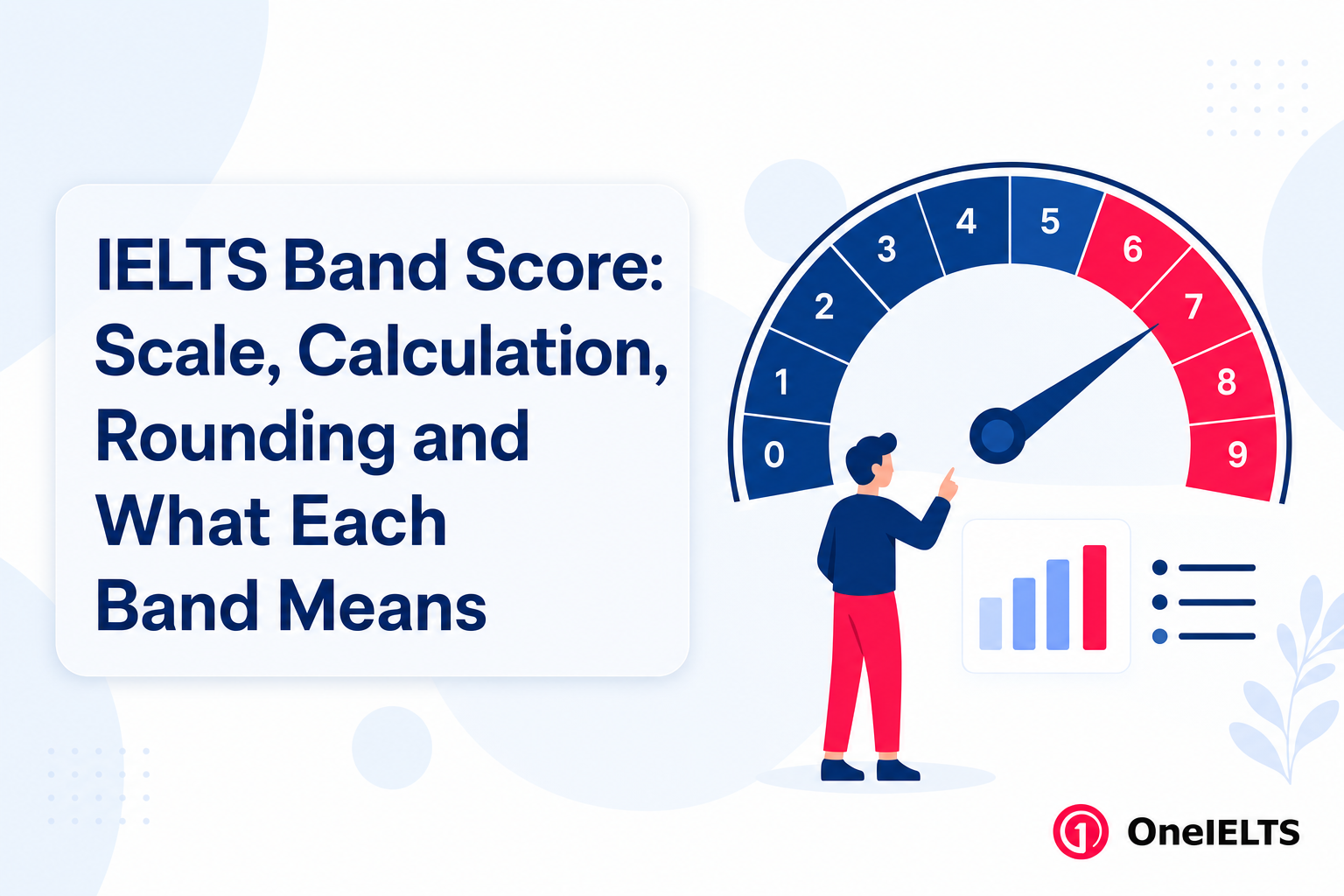
IELTS band scores run from 0 to 9, from Non-User at the bottom to Expert User at the top, reported in whole or half bands. That 0 to 9 scale runs Non-User to Expert User, so a 6.5 sits between a Competent and a Good user rather than scoring a flat percentage.
You receive a band for each of the four sections plus overall, so a single test gives you five numbers, not one. Each section is reported in whole or half bands such as 6.0, 6.5 or 7.0, and the overall follows the same step. There is no quarter-band on a result form.
There is no pass or fail in IELTS; the band you need depends on your goal, and a 6.0 that clears one visa can fall short for another course. A nurse, a master’s applicant and a skilled-migration candidate can all sit the same test and read the same scale toward three completely different targets.
The scale is deliberately broad so it can describe everyone from a beginner to a near-native user on one ruler. Most university and immigration targets cluster between 6.0 and 7.5, so the working part of the scale for real applicants is narrow. A half-band either side of your target is the difference that decides most applications, which is why candidates obsess over fractions rather than the full 0 to 9 range.
How Is the Overall IELTS Band Calculated?
The overall band is the average of the four section scores, rounded to the nearest whole or half band. It is the average of four equally weighted sections, so Listening, Reading, Writing and Speaking each contribute one quarter — there is no bonus for your strongest skill.
Take a worked example. Suppose you score 6.5 in Listening, 6.5 in Reading, 5.0 in Writing and 7.0 in Speaking. Add them (25.0), divide by four, and the average is 6.25. Because the four sections carry equal weighting, that one weak Writing score pulls the whole average down, and the 6.25 then rounds to a reported overall band.
The arithmetic is always the same: sum the four section bands, divide by four, then apply the rounding rule. A candidate scoring 7.0, 7.0, 6.5 and 7.0 averages 6.875, which rounds to 7.0; the same candidate with a 5.5 in one skill instead would land near 6.5. One section moving half a band is enough to shift the reported overall, which is why no single skill can be ignored.
There is a practical lesson buried in the equal weighting. Two strong sections cannot rescue two weak ones, because the average treats every skill the same. A candidate who pours all their preparation into Reading and Listening, then neglects Writing, often lands a lower overall than someone with four balanced bands. Spreading work toward your weakest skill usually buys more overall band than polishing your strongest.
How Is the IELTS Band Score Rounded?
An average ending in .25 rounds up to .5 band, and one ending in .75 rounds up to whole band. In practice 6.25 becomes 6.5 and 6.75 becomes 7.0, so rounding can quietly lift your overall by half a band.
That single rule is why rounding decides borderline cases. A candidate sitting on 6.74 rounds down to 6.5, while 6.75 rounds up to 7.0, and that gap can be the difference between meeting a visa floor and missing it. Candidates most often discover this the hard way, when a single mark in Reading nudges the average across a rounding boundary they did not know existed.
The rule never rounds down a borderline figure that has already reached a .25 or .75 point. An average of 6.25 always becomes 6.5, and 6.75 always becomes 7.0, with no discretion involved. Anything below those thresholds, such as 6.24 or 6.74, falls to the band below, so the cut-offs are exact rather than approximate.
If you want to see how the rounded figure appears on the paperwork, read the IELTS result explainer.
How Many Correct Answers Do You Need for Each IELTS Band?
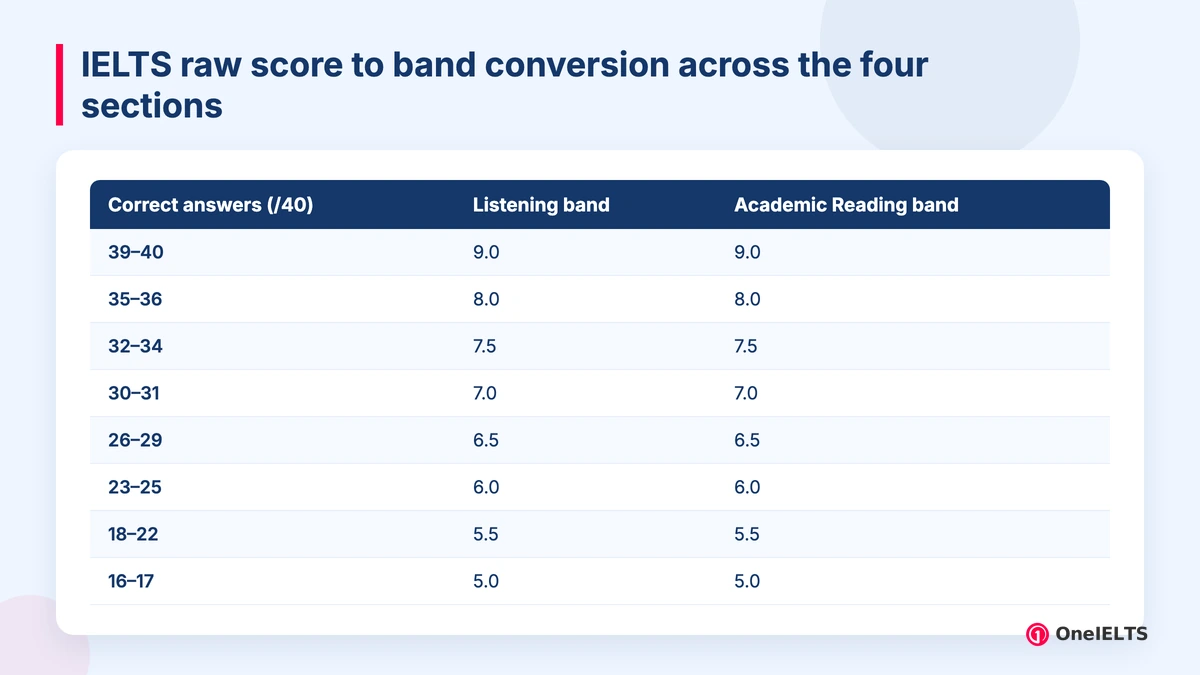
In Listening and Reading each of the 40 questions is one raw score out of 40, converted to a band using a standard conversion table, where 35-36 gives 8.0. Each correct answer earns one mark, so your section band is set entirely by how many of the 40 you get right.
Here are the broad raw-mark bands the official conversion uses, with thresholds confirmed only where the test maker publishes them.
IELTS does not publish an official public raw-score-to-band table; the figures below are the widely-used approximate conversions from Cambridge IELTS practice materials and can vary slightly by test version.
| Correct answers (/40) | Listening band | Academic Reading band |
|---|---|---|
| 39-40 | 9.0 | 9.0 |
| 37-38 | 8.5 | 8.5 |
| 35-36 | 8.0 | 8.0 |
| 32-34 | 7.5 | 7.5 |
| 30-31 | 7.0 | 7.0 |
| 26-29 | 6.5 | 6.5 |
| 23-25 | 6.0 | 6.0 |
| 18-22 | 5.5 | 5.5 |
| 16-17 | 5.0 | 5.0 |
Academic and General Training Reading apply different conversion thresholds even though both have 40 questions. That Academic vs GT thresholds split means the same raw score maps to different bands depending on which test you sit, so you can never read a single chart for both.
What Raw Score Gives Each IELTS Listening Band?
Your IELTS Listening band comes from how many of the 40 questions you answer correctly, where 35-36 gives 8.0. Listening uses a single raw score out of 40, with one mark per correct answer and no penalty for wrong ones, so an educated guess never costs you.
The table below shows the confirmed point on the listening score chart alongside the rows whose exact thresholds the test maker does not publish openly.
| Correct answers (/40) | Listening band |
|---|---|
| 39-40 | 9.0 |
| 37-38 | 8.5 |
| 35-36 | 8.0 |
| 32-34 | 7.5 |
| 30-31 | 7.0 |
| 26-29 | 6.5 |
| 23-25 | 6.0 |
| 18-22 | 5.5 |
| 16-17 | 5.0 |
That same 40-question raw mark feeds both the listening score chart and the overall average. A strong IELTS Listening result therefore lifts your reported band twice over, once as the section score and once through the average.
How Is the IELTS Reading Band Different for Academic vs General Training?
Academic and General Training Reading use the same 40 questions format but different conversion thresholds, so General Training needs more correct answers for the same band. General Training Reading texts are easier and more everyday, which is why the General Training threshold for each band is set higher than for Academic Reading.
That higher GT threshold means you have to get more right to earn the same number. Before you read any reading score chart, check which test your goal requires, because an Academic Reading band and a General Training band of the same value were not earned from the same raw mark. The split between the two tests is covered in the IELTS Academic vs General Training comparison.
What Raw Score Do You Need for Each IELTS Reading Band?
Your IELTS Reading band comes from your raw score out of 40, but the score each band needs differs between Academic and General Training. The two papers share a question count but not a conversion, so the same target band is a different scoreline on each.
The table pairs the two papers side by side, with confirmed cells filled and every unpublished threshold marked for checking.
| Correct answers (/40) | Academic Reading band | General Training Reading band |
|---|---|---|
| 39-40 | 9.0 | 8.5 |
| 37-38 | 8.5 | 8.0 |
| 35-36 | 8.0 | 7.5 |
| 33-34 | 7.5 | 7.0 |
| 30-32 | 7.0 | 6.0 |
| 27-29 | 6.5 | 5.5 |
| 23-26 | 6.0 | 5.0 |
| 19-22 | 5.5 | Below 5.0 |
| 15-18 | 5.0 | Below 5.0 |
Because General Training Reading sets a higher GT threshold for the same band, a General Training candidate must answer more questions correctly than an Academic candidate to reach an identical score. Confirm which reading score chart applies to your test before you read off a target, since aiming at the wrong column will mislead your practice.
How Are IELTS Writing and Speaking Band Scores Marked?
Writing and Speaking are not raw-counted; trained examiners mark them against four criteria, each weighted equally and each worth one quarter of the section band. The examiner gives a band on every criterion, then averages those into the section score.
For Writing, the four criteria are Task Achievement (or Task Response in Task 2), Coherence and Cohesion, Lexical Resource, and Grammatical Range and Accuracy. The first rewards how fully you answer the prompt, the last two reward the range and accuracy of your vocabulary and grammar.
For Speaking, the four criteria are Fluency and Coherence, Lexical Resource, Grammatical Range and Accuracy, and Pronunciation. Because each criterion counts equally, a candidate who speaks fluently but with a thin vocabulary loses ground on Lexical Resource that fluency alone cannot recover.
Each criterion is scored on the same 0 to 9 band scale, and the four criterion scores are then averaged into the section band. Because examiner judgement is involved, an Enquiry on Results can change a Writing or Speaking band more often than a Listening or Reading one. Those two sections are fixed by a raw mark that a remark cannot reinterpret.
The practical takeaway is that Writing and Speaking reward consistency across all four criteria, not a single standout strength. Candidates most often lose half a band in Writing Task 2 by drifting off the prompt, which costs Task Response marks no amount of fancy vocabulary can recover. Treating each criterion as a separate target, rather than writing or speaking in general, is what moves these examiner-marked bands.
How Is the Speaking Band Decided From the Four Criteria?
Your IELTS Speaking band is the average of four equally weighted criteria, so the examiner scores each one separately and the final band is their mean. No single criterion can hand you the band on its own.
The four Speaking criteria are Fluency and Coherence, Lexical Resource, Grammatical Range and Accuracy, and Pronunciation, each marked on the same 0 to 9 scale. A candidate might earn a 7 for fluency and grammar yet a 5 for pronunciation, and the averaging is what pulls the reported Speaking band toward the middle.
Because all four are equally weighted, a single weak criterion drags the Speaking band down rather than being offset by a strong one. The published band descriptors set out exactly what the examiner rewards on each criterion at every band. You can read them in the IELTS band descriptors breakdown to see where you are losing marks.
What Do the IELTS Bands Mean?
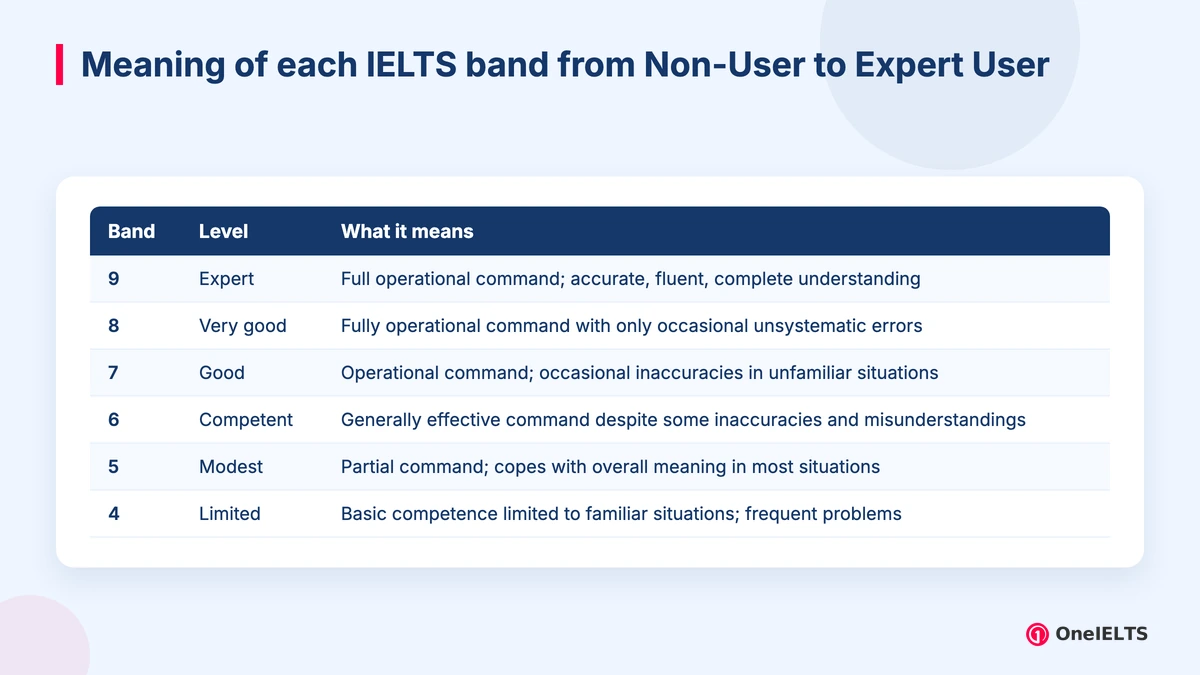
Each band names a level of English, from full command at the top to a partial grasp lower down. The table sets out what each band signals to an admissions officer or visa officer.
| Band | Level | What it means |
|---|---|---|
| 9 | Expert | Full operational command; accurate, fluent, complete understanding |
| 8 | Very good | Fully operational command with only occasional unsystematic errors |
| 7 | Good | Operational command; occasional inaccuracies in unfamiliar situations |
| 6 | Competent | Generally effective command despite some inaccuracies and misunderstandings |
| 5 | Modest | Partial command; copes with overall meaning in most situations |
| 4 | Limited | Basic competence limited to familiar situations; frequent problems |
Band 9 Expert sits at the top of this scale, while Band 7 Good is the standard minimum for most top universities and professional registrations. Band 6 Competent is common for general admissions and skilled visas, and Band 5 Modest clears foundation and some vocational routes.
The labels — Expert, Very Good, Good, Competent, Modest, Limited — describe command of English, not a percentage, so the practical gap between bands widens as you climb. Moving from a 5 to a 6 is a smaller leap than moving from a 7 to an 8, where errors must all but disappear.
For most applicants the meaningful bands sit between 5 and 8. A Band 5 signals a Modest user who copes with familiar material but stumbles on complex tasks, while a Band 7 Good user handles unfamiliar topics with only occasional slips. Knowing which side of that line your target falls on tells you how forgiving your preparation can afford to be.
What Does Each IELTS Band Descriptor Require?
Each band has a published descriptor that defines the command of English it represents, from full operational command at 9 to occasional non-systematic errors at 7. The descriptor turns the band number into concrete behaviour: a Band 7 writer makes only occasional errors, while a Band 6 writer makes more frequent ones that rarely block meaning.
Examiner marking applies the public band descriptors to Writing and Speaking, scoring each of the four criteria against the wording for that band. Reading the descriptor for your target band shows precisely what the IELTS band descriptors reward, so you can practise toward it rather than guessing.
What Is the Difference Between Overall and Sectional Band Scores?
Your overall band is a single rounded average, while your sectional band scores are the four separate scores it averages, so identical overalls can hide very different skill profiles. The overall is one figure, but each of Listening, Reading, Writing and Speaking carries its own band on the score report.
Two candidates with the same overall band can have very different sectional bands. One might score 7.0 across the board, while another posts 8.0 in Listening and Reading but 6.0 in Writing and Speaking — both average to 7.0, yet they are not the same English user. This is exactly why universities and immigration read the skill profile behind the sections, not just the overall.
A strong overall built on one very weak section can still fail a per-section minimum. A 7.0 overall is worthless to a programme that demands at least 6.5 in Writing if your Writing sits at 6.0. That is why the breakdown on your IELTS band score result deserves a closer read than the headline figure.
What Is the IELTS Band Score Chart?
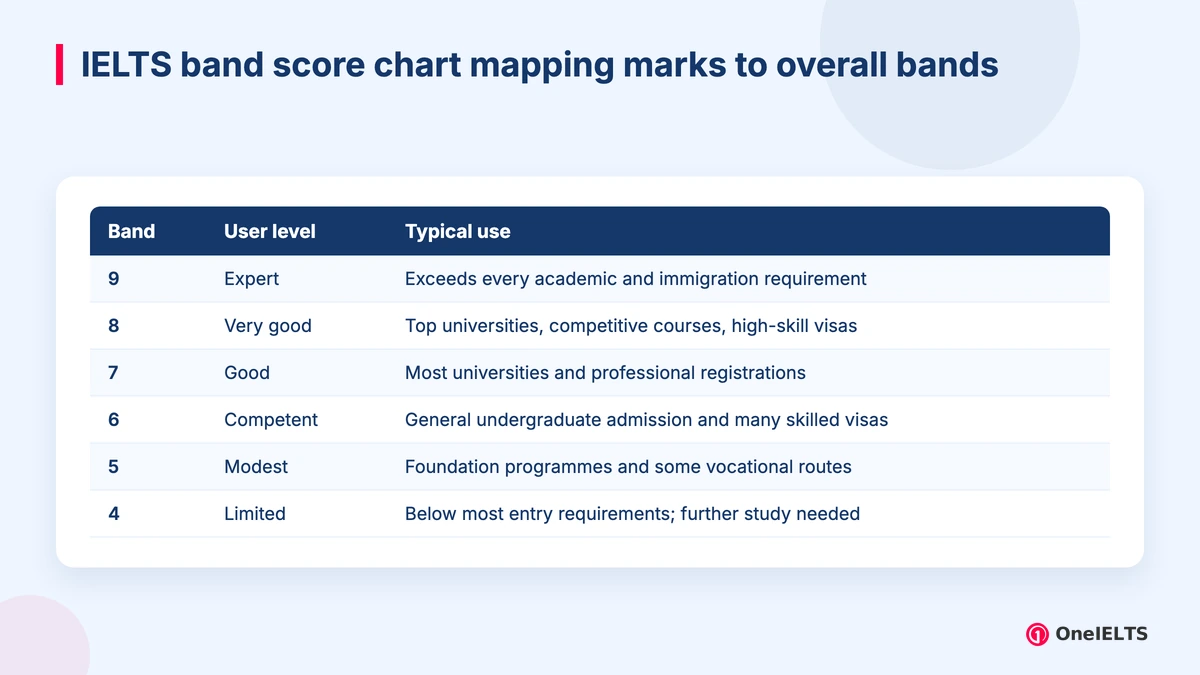
The IELTS band score chart sets out each band from 0 to 9 against its user level and the kind of goal it typically clears. It is the quickest way to read where your number lands and what it usually unlocks.
The reference chart below pairs each user level with its typical use so you can see at a glance what a band is worth.
| Band | User level | Typical use |
|---|---|---|
| 9 | Expert | Exceeds every academic and immigration requirement |
| 8 | Very good | Top universities, competitive courses, high-skill visas |
| 7 | Good | Most universities and professional registrations |
| 6 | Competent | General undergraduate admission and many skilled visas |
| 5 | Modest | Foundation programmes and some vocational routes |
| 4 | Limited | Below most entry requirements; further study needed |
Treat this band score table as a reference, not a pass mark, since the band you actually need is set by your university or visa, not by the chart itself. A 6.5 looks comfortable here yet can still miss a course that asks for 7.0 with no section under 6.5.
Read the chart as a map of doors, not a leaderboard. Each band downward closes a set of options and opens cheaper or slower routes, such as a foundation year in place of direct entry. The gap between a 6.0 and a 6.5 is often the gap between a conditional and an unconditional offer, which is why that single half-band carries so much weight in admissions.
What Do the IELTS Band Descriptors Mean?
The IELTS band descriptors are the published statements that define the command of English each band represents, from full operational command at 9 to a modest grasp at 5. They translate a single number into the specific things an examiner looks for.
The public band descriptors for Writing and Speaking let you see exactly what an examiner rewards at your target band, criterion by criterion. Reading the descriptor for the band above yours shows the gap you need to close. That makes the published IELTS band descriptors the most useful planning tool a candidate has.
How Do IELTS Bands Compare to CEFR Levels?
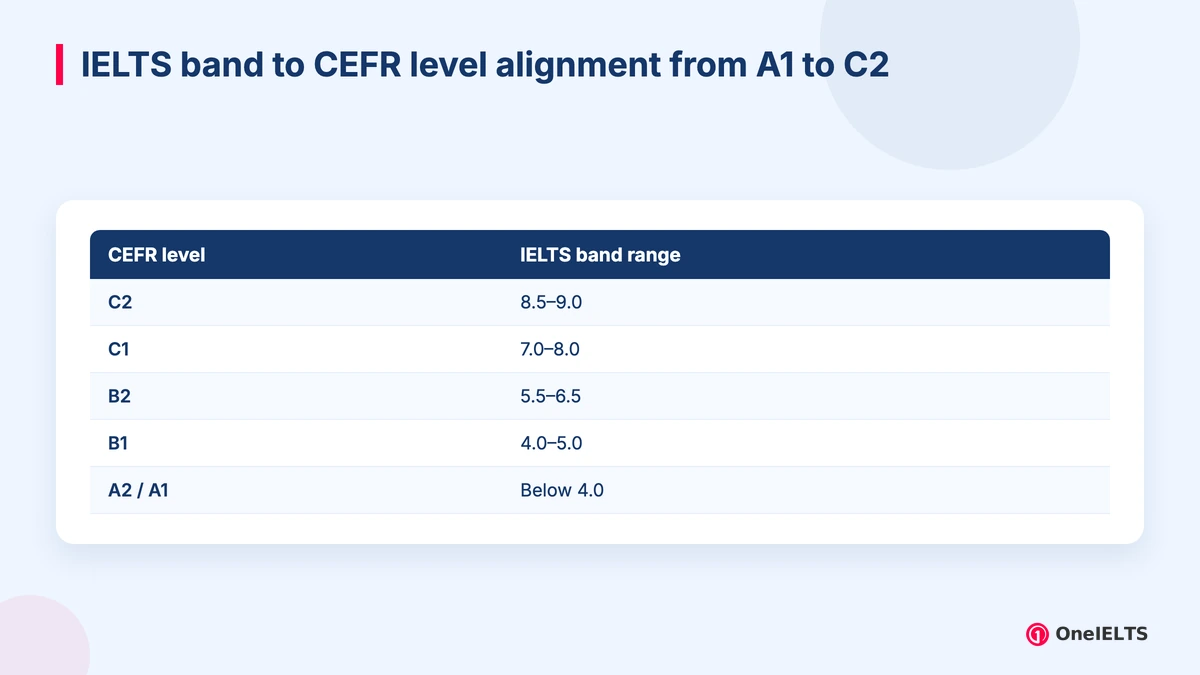
IELTS bands map onto the CEFR A1 to C2 six-level scale, which runs from A1 beginner to C2 advanced and is the framework most European institutions and many employers read. A band tells them where you sit on that shared ladder.
A rough mapping puts band 4-5 at B1, 5.5-6.5 across the B2 and C1 bands boundary, 7-8 firmly at C1, and 8.5-9 reaching C2. CEFR is a level range not score, so a single CEFR letter covers more than one band, and this approximate mapping should be treated as a guide rather than a fixed conversion.
A shared CEFR level matters because European universities and many employers read the CEFR letter directly, so the mapping lets them compare an IELTS band against other English tests on one ladder. The mapping is published by the test maker, not invented by candidates, which makes it a reliable guide — though any single institution can still set its own band requirement on top of it.
The mapping matters most for applicants juggling more than one test. A university that quotes its English requirement in CEFR rather than IELTS lets you read your band straight onto its ladder, so a C1 requirement signals roughly a band 7. Reading the requirement in CEFR also stops you confusing an IELTS 6.5 with a different test’s 6.5, since the two rarely sit at the same CEFR level.
Which CEFR Level Is IELTS Band 7 or 8?
IELTS reads band 7 and 8 C1, with both bands sitting at the advanced operational level where you handle complex academic and professional English. That advanced operational level is why a band 7 and a band 8 can satisfy the same C1 requirement even though they are clearly different scores.
Band 9, and often 8.5, is treated as band 9 C2, the highest CEFR level on the scale. If you need the full band-by-band breakdown, the IELTS vs CEFR comparison lays each one out.
How Does Your IELTS Band Score Affect Your Goal?
What counts as the right band depends entirely on why you are taking the test, because a university cut-off, a migration points table and a registration floor each read your score differently. The same 7.0 is a comfortable pass for one applicant and a near-miss for another.
These are the three goals that decide which number matters and why.
- University admission reads the overall vs section picture: an overall cut-off plus a per-band minimum, so one low skill can sink an otherwise strong overall.
- Skilled migration converts your per-skill migration points band by band, so each section earns points and a weak section costs you directly.
- Professional registration applies a professional registration floor, often a high single-skill minimum in Writing, that you must clear regardless of your overall.
How Hard Is It to Score Band 7, 8 or 9 in IELTS?
A band 7 target is realistic for most prepared candidates, band 8 control of English must be near-error-free, and band 9 rare expert-level performance is held by very few test-takers. The jump from 7 to 8 is large because it demands consistency, not just competence.
Band 7 is the common cut-off for top universities and most professional registrations, while academic band score requirements for elite courses can reach 7.5 or higher. Band 9 means full operational command, and you can see what clearing the first major threshold takes in the IELTS band 7 guide.
What IELTS Band Score Do Different Countries Accept?
Most English-speaking destinations want a 6.0 to 6.5 entry band for general admission, while a 5.5 band accepted on some foundation and vocational routes opens countries like Canada and Australia. The same band opens different doors depending on where you apply.
Each country minimum and visa stream sets its own threshold, so confirm the exact band against the official requirement before you book. A full breakdown by destination sits in the IELTS for countries hub.
What Is a Good IELTS Band Score?
A good IELTS score is whatever clears your goal, and a 6.5 to 7.0 typical band suits most universities while top courses and registrations ask 7.0+. A 6.5 that wins a place on one course can still fall under the bar for a more selective one.
There is no universal pass mark in IELTS, so the target is goal-defined, and a 7.0 plus competitive band is what elite courses look for. The thresholds that count as strong are set out in the good IELTS score guide.
Does Your Overall or Per-Section Band Matter More?
For immigration the per-section bands usually matter more than the overall, while universities look at the overall plus minimum per-band figure. The two systems read the same score sheet in opposite ways.
A weak skill blocks a goal even when the overall looks fine, which is the immigration vs university trap: a 7.0 overall with a 5.5 in Writing fails a 6.0-each rule outright. The points-based reading is explained in the IELTS for Canada guide.
How Can You Improve Your IELTS Band Score?
Improve your band fastest by choosing to lift lowest skill against its descriptors, rather than spreading effort evenly across all four. Because the overall is an average, a half-band gain on your weakest section moves the headline number more than the same effort on a strong one.
In practice, lifting a 5.5 Writing to a 6.0 shifts the average further than pushing an already strong 7.5 Reading to an 8.0. The order you tackle your skills in therefore matters as much as the hours you spend.
Start with a diagnostic mock under timed conditions to find which skill is dragging the average, then aim targeted practice at the band descriptors for the band above. The full method sits in the improve IELTS band guide.
How Long Is an IELTS Band Score Valid?
An IELTS band score normally carries two years validity from the test date, after which most institutions stop accepting it. The clock starts on the day you sit the test, not the day you apply.
Some institutions set a shorter institutional window than two years, so confirm the accepted window before you rely on an older score. The rules and exceptions are covered in the IELTS score validity guide.
Why Does Your Lowest Section Band Matter for Immigration?
For immigration your lowest section band often decides your eligibility, because points programmes convert each skill separately and one weak section can pull your whole language score down. The weakest of your four bands, not the average, is frequently what an officer reads first.
Many points systems map each section band to a language benchmark, so the weakest skill caps the points you earn even when three sections are strong. A candidate with a strong overall but one section below the required floor can be refused outright, which is the most common avoidable rejection in skilled-migration files.
This is why immigration advisers tell candidates to plan around the floor, not the average. If a stream needs a set band in every skill, a single retake of the weakest section can unlock the whole application. Sitting the test again to lift one band beats accepting a strong overall that quietly fails on one number.
When an immigration stream sets a per-skill minimum, target the lowest section first, since clearing that floor protects your whole immigration eligibility. The benchmark conversion that decides this is set out in the IELTS CLB explainer.
Last verified: 30 June 2026
Practice for the Real IELTS Exam
Apply what you’ve learned with free, exam-style practice:
- Take a full IELTS mock test
- Practice by section: Listening, Reading, Writing, Speaking
- Structure your essays with IELTS Writing templates