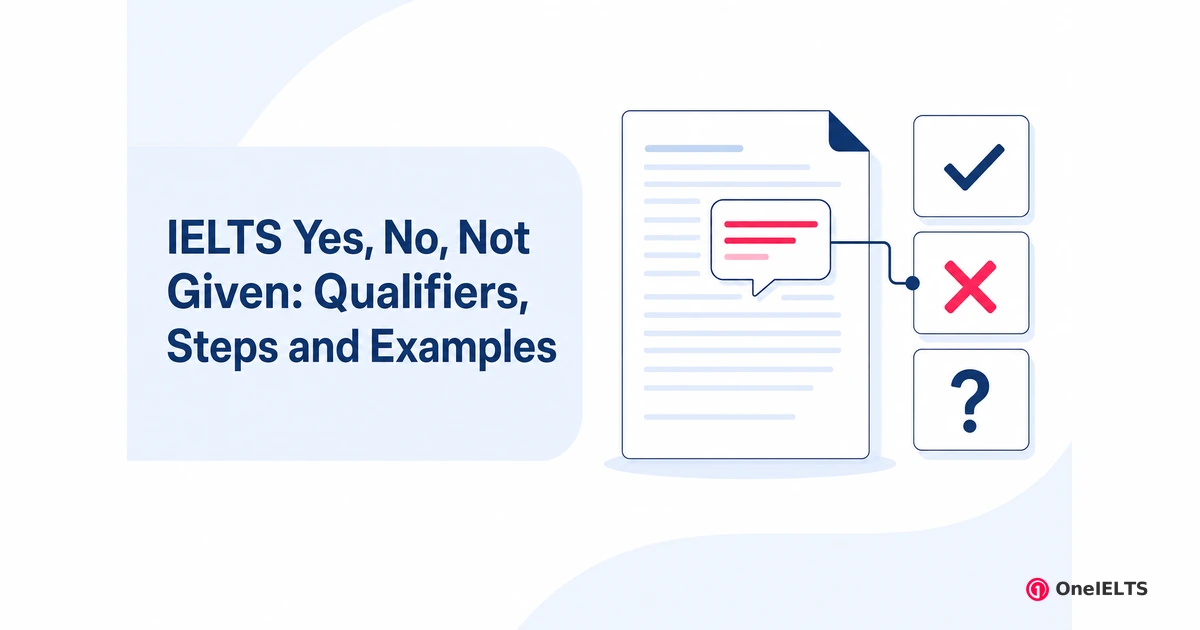
You are handed a statement and three words to choose from, and the passage alone decides which word is right. Yes No Not Given questions in IELTS Reading ask whether a statement matches the writer’s opinion, opposes it, or falls outside the text because there is not enough information to judge. The qualifying words usually settle it.
This page covers the task itself, what each answer option means, the skills it needs, and the seven-step method. It then takes the qualifiers, the common challenges, a worked example, where to practise, the tips, the True/False/Not Given difference, and the type’s place among the other Reading question types.
What Are Yes, No, Not Given Questions in IELTS Reading?
You get a list of statements. For each one you decide whether it agrees with the writer’s view (YES), contradicts it (NO), or is not covered by the passage at all (NOT GIVEN).
The task tests whether you can follow a writer’s opinions, claims and views, rather than verify facts. The instruction line above the set always names the three words you must write. Yes No Not Given appears in Academic Reading and can also turn up in General Training.
The statements normally run in passage order. Statement 2’s evidence sits after statement 1’s, so once you have settled a statement you read on rather than back.
What Is the Meaning of Yes, No and Not Given in IELTS Reading?
The three options divide every statement into agreement, contradiction or absence. Either the writer says the same thing, the writer says the opposite, or the writer never settles the point. Each option carries its own decision rule.
- YES. The statement means the same thing as the writer’s view, even when the wording is completely different, so writer agreement can hide behind synonyms.
- NO. The statement says the opposite of the writer’s view, or the passage directly contradicts the writer, so the opposition sits on the page.
- NOT GIVEN. The passage does not mention the point, or there is not enough information in it to decide, so the writer is simply silent.
That last boundary costs the most marks. NO requires the writer to state the opposite, while NOT GIVEN means the writer never raises it at all. If you cannot point at the contradicting words, the answer is NOT GIVEN.
What Skills Do You Need to Solve Yes, No, Not Given Questions?
Three skills carry this type: scanning to the relevant lines, recognising a paraphrase, and reading the writer’s stance precisely enough to separate disagreement from silence.
The task tests your reading of opinion, so reporting verbs matter as much as topic words. Stance language such as argues, claims, suggests and doubts tells you how firmly a writer holds a position. A writer who suggests something has not proved it, and a statement that says proved is already a NO.
The fourth skill is a negative one. You have to suspend outside knowledge for the hour. A statement can be true in the real world and still be NOT GIVEN, because the passage never makes the claim.
How Do You Answer Yes, No, Not Given Questions in IELTS Reading?
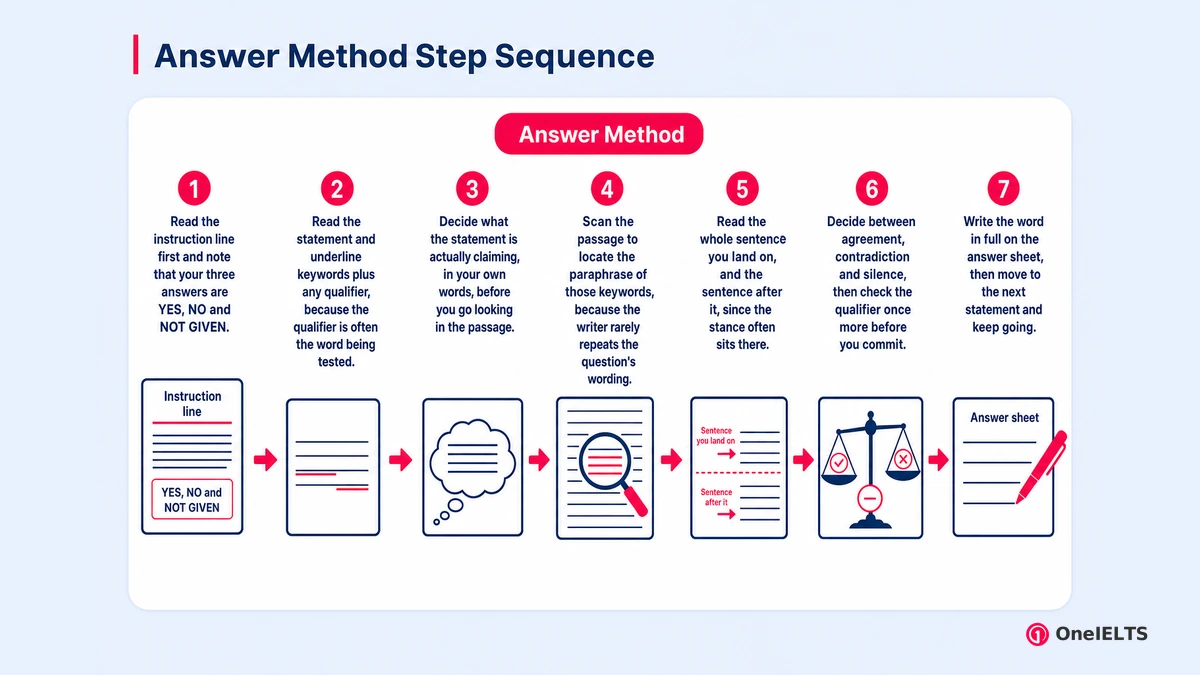
Work one statement at a time and let the passage move forward with you. The sequence asks for evidence before a decision, which is exactly where candidates go wrong.
Seven steps take a single statement from the question paper to a written answer.
- Read the instruction line first and note that your three answers are YES, NO and NOT GIVEN.
- Read the statement and underline keywords plus any qualifier, because the qualifier is often the word being tested.
- Decide what the statement is actually claiming, in your own words, before you go looking in the passage.
- Scan the passage to locate the paraphrase of those keywords, because the writer rarely repeats the question’s wording.
- Read the whole sentence you land on, and the sentence after it, since the stance often sits there.
- Decide between agreement, contradiction and silence, then check the qualifier once more before you commit.
- Write the word in full on the answer sheet, then move to the next statement and keep going.
How Do Qualifying Words Change a Yes, No, Not Given Answer?
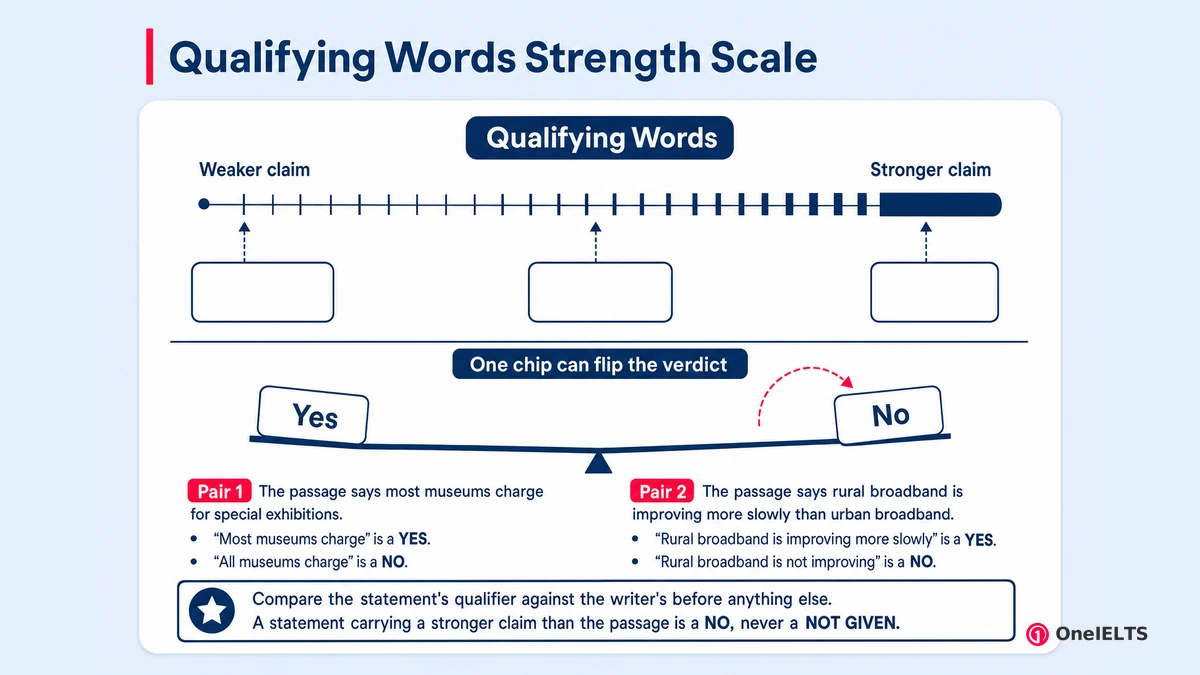
A qualifier is usually what makes a statement agree or disagree. Change “many researchers” to “all researchers” and a YES becomes a NO, without a single content word moving.
Four families of qualifying words determine the answer. Frequency gives you always and never. Quantity gives you all and most. Degree gives you mainly, slightly and more slowly. Certainty gives you will, may and might.
Two pairs show the mechanism. The passage says most museums charge for special exhibitions, so “Most museums charge” is a YES and “All museums charge” is a NO.
The second pair runs the same way. The passage says rural broadband is improving more slowly than urban broadband, so “Rural broadband is improving more slowly” is a YES and “Rural broadband is not improving” is a NO.
Compare the statement’s qualifier against the writer’s before anything else. A statement carrying a stronger claim than the passage is a NO, never a NOT GIVEN.
What Are the Common Challenges With Yes, No, Not Given Questions?
Marks go missing in six predictable places here, and only one of them is about reading speed. The no versus not given line accounts for most of them. Across reviewed practice papers the pattern repeats: candidates pick NO where the writer simply never raised the point.
Six errors show up again and again in marked practice sets.
- Choosing NO when the writer is silent. NO needs stated opposition, and without it the answer is NOT GIVEN.
- Answering from outside knowledge. What you know about the topic is irrelevant, and only what this writer claims decides the answer.
- Missing the qualifier. Candidates match the content words, skip the qualifying words, and hand back a YES that should have been a NO.
- Writing TRUE or FALSE. Writing true instead of yes scores nothing, however sound your judgement was about the writer’s view.
- Hunting for evidence that is not there. A long search usually means NOT GIVEN, so cap the hunt and move on.
- Abbreviating to Y, N or NG. Write the full word, because the instruction line itself asks for YES, NO or NOT GIVEN.
What Does a Yes, No, Not Given Question Look Like in IELTS Reading?
Here is a worked example built on an original opinion passage. Read it, settle your four answers, then check the table.
Most city councils treat cycle lanes as a transport project, and that is where they go wrong. A painted strip beside four lanes of traffic changes almost nothing, because the riders who use it were already riding. What moves the number of cyclists is physical separation: a kerb, a planter, anything solid between the bike and the bus.
Copenhagen worked this out decades ago, and the cities that copied its kerbed network have seen ridership climb. British councils keep announcing paint. Some planners argue that separated lanes slow buses down, though measured journey times in the rebuilt corridors have barely moved. Cycling schemes fail politically, long before they fail as engineering.
- Painted cycle lanes on their own do little to raise the number of cyclists.
- Some planners believe that separated lanes delay buses.
- Every planner believes that separated lanes delay buses.
- Copenhagen’s kerbed network cost less to build than painted lanes.
| Statement | Answer | What settled it |
|---|---|---|
| 1 | YES | “changes almost nothing” and “already riding” restate the statement in different words |
| 2 | YES | “Some planners argue” matches the statement’s strength exactly, so the paraphrase holds |
| 3 | NO | “Every” overstates the writer’s “some”, which flips the same content to the opposite answer |
| 4 | NOT GIVEN | Copenhagen and its network appear, but the writer never gives a cost for either option |
Statements 2 and 3 are the qualifier pair. They carry identical content and differ by one word, and that word moves the writer’s view from matched to overstated. Statement 4 is the not given trap, because the topic is on the page while the writer’s opinion on cost is missing.
Where Can You Practise Yes, No, Not Given Questions in IELTS Reading?
Practise on filtered sets of this one type rather than on mixed reading. You can work through IELTS Reading Yes No Not Given practice on OneIELTS, and practising there needs a free account.
The reason to filter is the passage, not the question. This type only lives in opinion passages, so a general reading drill hands you factual text with no stance to read. A question type drill on argument-led writing builds the exact habit the paper tests, which a broad pool of practice questions cannot.
Review matters more here than volume. When you review your errors, sort each wrong answer into one of three causes: the qualifier, the NO versus NOT GIVEN line, or outside knowledge.
What Are the Best Tips for Yes, No, Not Given Questions in IELTS Reading?
Accuracy on this type comes from habit rather than vocabulary. The seven yes no not given tips here each remove one recurring error.
Seven habits cover the instruction line, the qualifier, the boundary and the clock.
- Write YES, NO and NOT GIVEN in full. Abbreviations and the TFNG words both put the mark at risk.
- Read the qualifier before the content words. Qualifying words decide more answers on this type than topic vocabulary does.
- Treat silence as NOT GIVEN. Only stated opposition earns a NO, so absence of comment is never a NO.
- Ignore what you know about the topic. The passage is the only evidence the marker will accept from you.
- Expect the statements in passage order. Once statement 4 is settled, hunt for statement 5 further down the text.
- Never leave one blank. A wrong answer costs nothing here, and a guess between three options often lands.
- Move on after about ninety seconds. Timing beats certainty, and the statement you skipped is still there later.
How Is Yes, No, Not Given Different From True, False, Not Given in IELTS Reading?
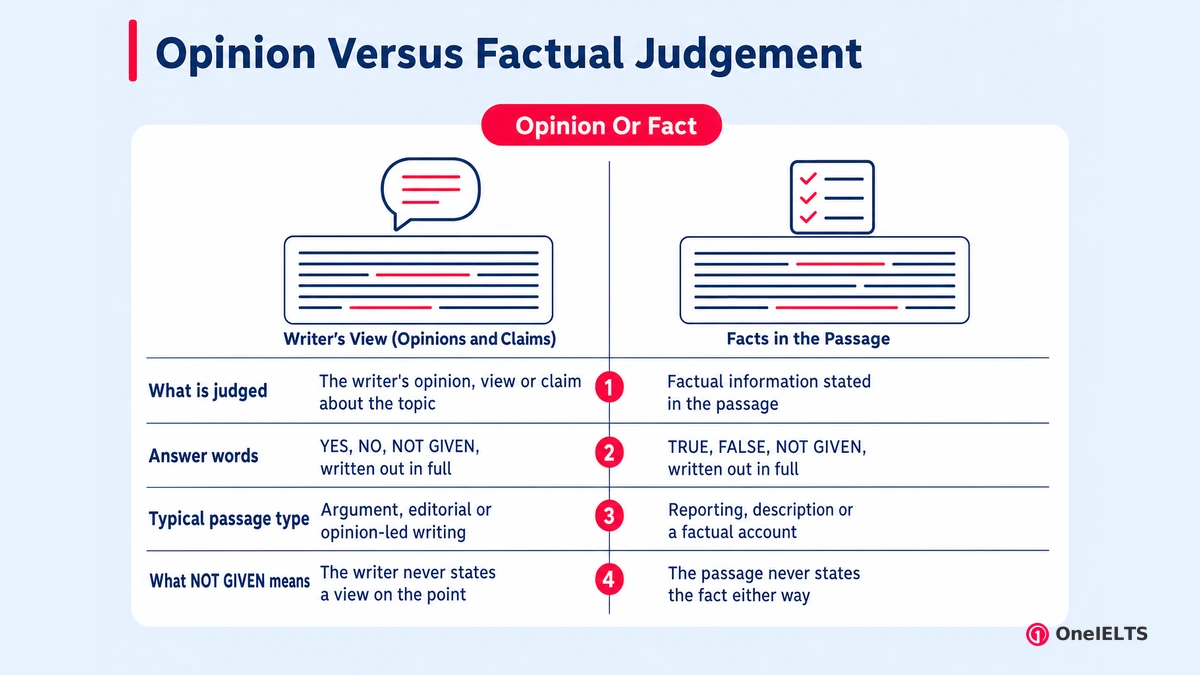
The decision process is the same, but the target differs. True False Not Given tests factual information, while Yes No Not Given tests the writer’s opinions and claims. The two sets of answer words are not interchangeable.
Which one you face is set by the instruction line above the question set, never by the passage itself. A passage of factual reporting usually carries the True/False/Not Given task, and an argument or an opinion piece usually carries Yes/No/Not Given. Some Reading papers use both, in different question sets on different passages, so reading each instruction line is the habit that protects you.
The table sets the two tasks side by side on the four features that actually move.
| Feature | Yes, No, Not Given | True, False, Not Given |
|---|---|---|
| What is judged | The writer’s opinion, view or claim about the topic | Factual information stated in the passage |
| Answer words | YES, NO, NOT GIVEN, written out in full | TRUE, FALSE, NOT GIVEN, written out in full |
| Typical passage type | Argument, editorial or opinion-led writing | Reporting, description or a factual account |
| What NOT GIVEN means | The writer never states a view on the point | The passage never states the fact either way |
How Do Yes, No, Not Given Questions Fit With the Other IELTS Reading Question Types?
Yes No Not Given is one of the eleven official Academic Reading question types, and it belongs to the small group of judgement tasks rather than to the retrieval or completion ones. The official list names it “identifying the writer’s views or claims”. True/False/Not Given is its partner in that group, and matching features sits nearby because it also reads stance.
That grouping explains the answer sheet rules. Completion tasks give you a word limit and take their answers straight out of the passage, so spelling and word count decide the mark. Judgement tasks give you a closed set of three words instead, so the answer sheet rules turn on writing the right word from that set.
Three questions follow from where the type sits, and each one is about how it behaves next to its neighbours.
Is Writing TRUE Instead of YES Wrong in a Yes, No, Not Given Task?
Yes, it is marked wrong — the instruction names the three words you must write, and TRUE is not one of them however correct your judgement was. Writing true instead of yes throws away a mark you had already earned. The reverse applies in a True/False/Not Given task, so read the instruction line before the statements. Our IELTS Reading True False Not Given guide covers the other half.
Do Yes, No, Not Given Answers Appear in Passage Order Like the Other IELTS Reading Types?
Yes, they normally follow the order of the passage, which is why you should never re-scan the whole text for statement 5 once you have settled statement 4. That passage order lets you keep moving forward. Matching tasks are the exception, so the habit does not transfer everywhere. Test it in a free IELTS Reading mock test.
Which Other IELTS Reading Question Types Also Test the Writer’s Opinion?
No single other type is built on opinion the way Yes/No/Not Given is. But matching features asks you to attribute claims to the people who made them, so it reads stance in the same way. You attribute a claim there instead of judging it. Multiple choice can also ask for the writer’s purpose or view, which reuses the stance-reading skill. See our IELTS Reading matching features guide.
Written by Fahimur Rahman, reviewed 14 August 2026.
Last verified: 14 August 2026
Practice for the Real IELTS Exam
Apply what you’ve learned with free, exam-style practice:
- Take a free IELTS mock test — all four skills, real exam timing, AI band scoring
- Sit a Reading section mock — one full timed paper with an instant band score
- Practise by question type — self-paced passages with answer explanations