If you are heading to university or registering with a professional body, IELTS Academic is the test you sit for university admission and registration. It scores you on a band scale from 0 to 9 across four skills.
Only its Reading and Writing modules differ from General Training: you read academic passages drawn from journals, and your Writing Task 1 data comes as a graph or chart you describe. This guide covers what IELTS Academic is, who takes it, the format, scoring, what a good score is, the General Training difference, the online option, and how to prepare.
What Is IELTS Academic?
IELTS Academic is the version of the test built for university admission and professional registration, with academic passages in Reading and a data-description Writing Task 1 that General Training does not use. The full test takes about 2 hours 45 minutes and assesses four skills: Listening, Reading, Writing and Speaking. The identical Listening Speaking content shared with General Training means only the Reading and Writing modules change between the two versions.
Who Should Take the IELTS Academic Test?
You should take IELTS Academic if your goal is study or professional registration rather than work-based migration. The four most common situations that call for IELTS Academic are listed here.
- Undergraduate and postgraduate admission. Universities require IELTS Academic for university admission because it confirms you can handle lectures, reading lists and written assignments in English.
- Professional registration. Bodies in medicine, nursing and engineering require IELTS Academic to prove your English meets the standard for safe, regulated practice in your field.
- Scholarships and research applications. Funding panels use IELTS Academic scores to compare candidates for scholarships and confirm readiness for research conducted in English.
- Study abroad. Applicants who study abroad in the UK, Australia, Canada, New Zealand or the USA take IELTS Academic because institutions and many visa routes there accept it.
What Is the IELTS Academic Test Format?
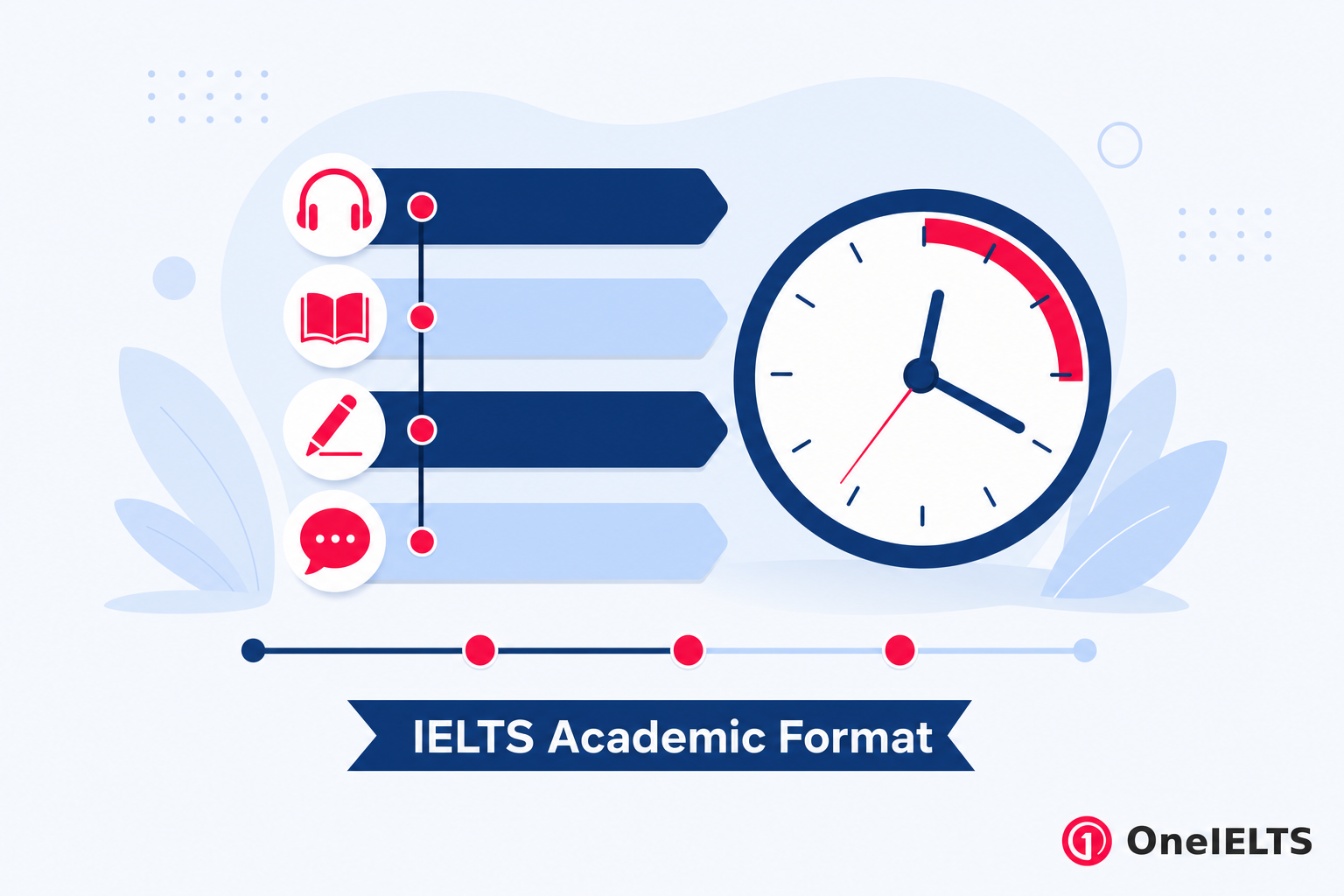
IELTS Academic has four sections – Listening, Reading, Writing and Speaking – totalling about 2 hours 45 minutes. The first three are sat back to back with no break, while Speaking may fall on the same day or up to a week apart. The academic reading texts, the Task 1 visual data task and the Speaking three parts each have their own question load and timing, set out in the table below.
| Section | Questions / Tasks | Time |
|---|---|---|
| Listening | 40 questions across four recordings | 30 minutes |
| Academic Reading | 3 academic-style texts, 40 questions | 60 minutes |
| Academic Writing | Task 1 describes visual data (>=150 words); Task 2 essay (>=250 words) | 60 minutes |
| Speaking | 3 parts (interview, long turn, discussion) | 11-14 minutes |
What Is in the IELTS Academic Reading Test?
Academic Reading presents three academic passages with 40 questions in 60 minutes, and gives no transfer time at the end. The texts come from books, journals and newspapers written for a non-specialist audience, so you face dense argument rather than specialist jargon. You copy answers straight onto the answer sheet as you read, because there is no transfer time once the hour is up.
What Is in the IELTS Academic Writing Test?
Academic Writing has two writing tasks in 60 minutes – the Task 1 visual data summary in at least 150 words and a Task 2 essay of 250 words. Task 1 gives you a graph, table, chart, map or process to describe in your own words, while Task 2 asks for an argument-led essay on a general issue. The Task 2 double weight means it counts twice as much as Task 1 toward your Writing band, so you protect the bulk of your time for it.
How Is IELTS Academic Scored?
IELTS Academic uses a band scale that runs from 0 to 9 band scale points in half-band increments. You get four section bands plus a rounded overall band. Reading and Listening convert a raw mark out of 40 into a band, while examiners score Writing and Speaking against four criteria each, such as task response, coherence, vocabulary and grammar. Your scores carry a two-year validity from the test date, after which most institutions ask you to sit the test again.
What Is a Good IELTS Academic Score?
A good Academic score is set by your university – typically 6.5 overall, with competitive 7.0 plus the norm for selective courses. Many medicine, law and postgraduate programmes sit at the top of that range, so always read the entry requirement for your exact course rather than a general figure.
Check the per-band minimum too, because some courses set a separate floor for Writing or Speaking that you must clear even with a strong overall band. Our guide to a good IELTS score breaks down what each university requirement lets you do.
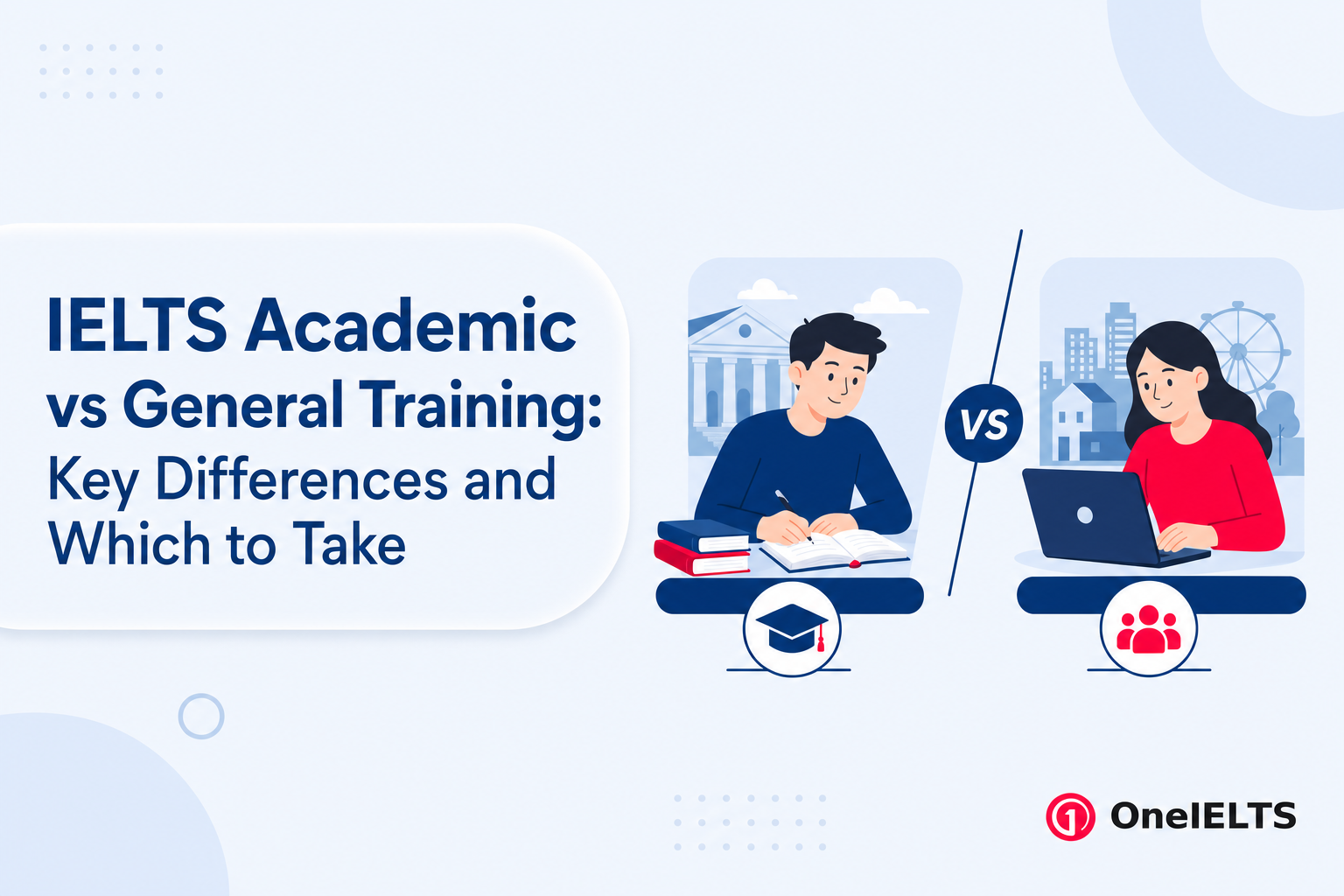
How Does IELTS Academic Differ From General Training?
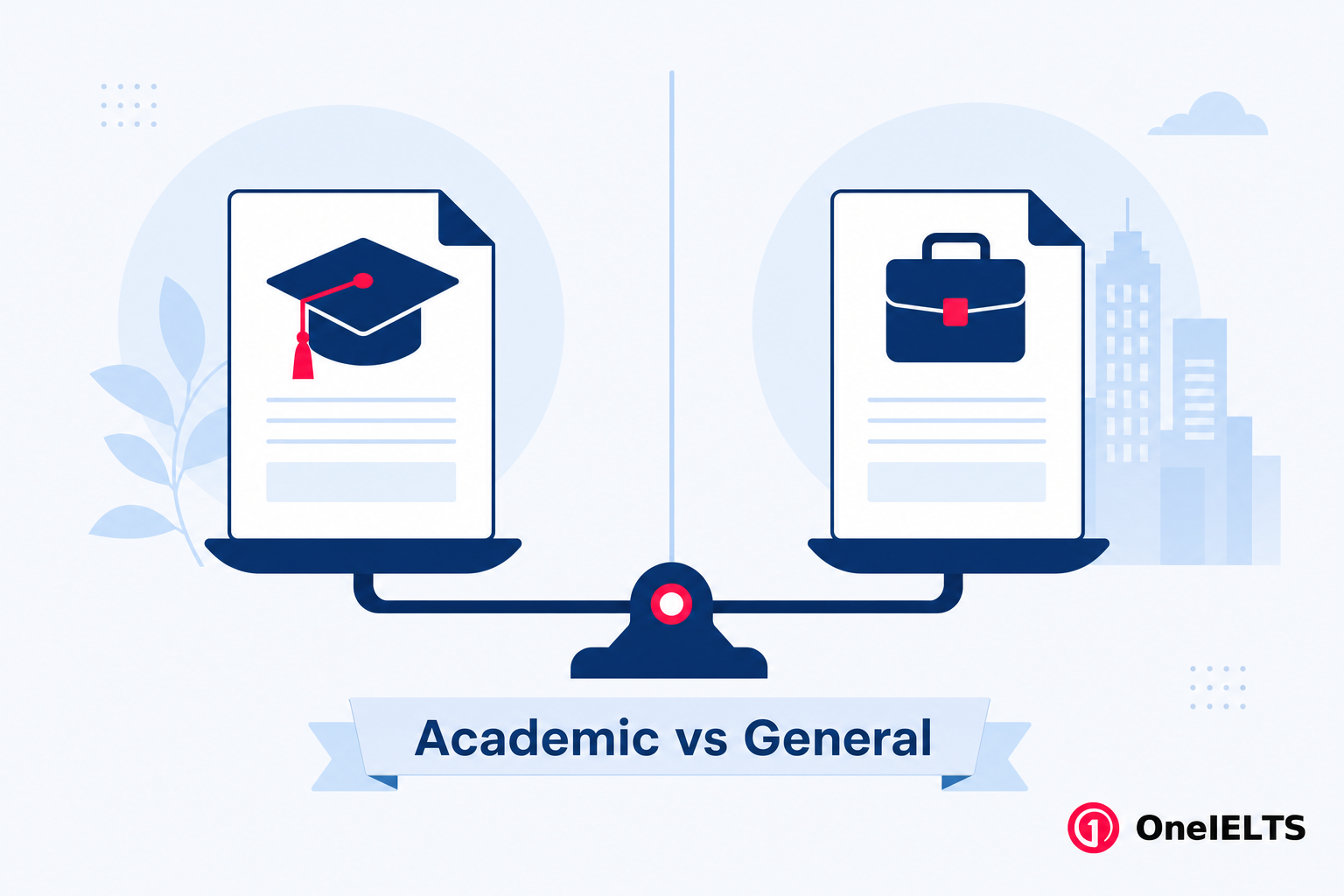
The academic vs everyday reading split and the data task vs letter split in Writing Task 1 are the only real differences; the identical Listening Speaking sections and the same band scale stay constant. The table below sets each aspect side by side.
| Aspect | Academic | General Training |
|---|---|---|
| Reading | Academic texts from journals and books | Everyday texts: notices, ads, workplace material |
| Writing Task 1 | Describe visual data in your own words | Write a letter for a given situation |
| Purpose | University study and professional registration | Work, training and migration |
| Listening & Speaking | Identical to General Training | Identical to Academic |
| Band scale | Same 0-9 half-band scale | Same 0-9 half-band scale |
Only the Reading and Writing content differs between the two versions; everything else you sit is the same test.
Can You Take IELTS Academic Online?
Yes – you can take IELTS Academic in three paper computer online formats: on paper, on computer at a test centre, or remotely. The IELTS Online remote option needs advance booking, plus a private, well-lit space with a stable internet connection, because the test is invigilated live by a remote proctor. The computer-based format at a centre and the remote format mirror each other, so any computer-based practice prepares you for either route.
How Do You Prepare for IELTS Academic?
Preparing for IELTS Academic means rehearsing the academic-specific Reading and Writing skills while keeping Listening and Speaking sharp, then rooting it all in full Academic mocks. Five preparation steps that consistently move the band are set out here.
- Practise Task 1 graphs and processes. Work through bar charts, line graphs, maps and process diagrams until summarising visual data in 150 words feels routine.
- Read journal-style passages and build academic vocabulary. Do daily academic reading from quality journals, noting the formal academic vocabulary and argument structures that show up in the test.
- Time your Academic Reading. Sit the three passages under a strict 60-minute clock so you learn to skim, scan and move on rather than overthinking one hard question.
- Drill Listening and Speaking. Practise the four Listening recordings and the three Speaking parts regularly, since these sections reward steady exposure week on week.
- Take full Academic mocks. Sit complete, timed full Academic mocks end to end so stamina, timing and section transitions feel familiar on test day.
How Do You Prepare for Academic Writing Task 1?
Prepare for Academic Writing Task 1 by learning a fixed Task 1 structure – the overview then data order – and practising graphs and processes. A clear template stops you describing every figure at random and instead groups the data into two or three meaningful trends. The overview then data habit keeps you organised. Aim for at least 150 words 20 minutes in and no longer, so Task 2, which carries more weight, keeps the time it needs.
Where Can You Take IELTS Academic Practice Tests?
Take Academic practice tests on the official prep hubs run by IDP and the British Council and reputable platforms, ideally as full timed mocks. These official prep hubs give you realistic material that matches the question types and academic register you face on the day. Make it a habit to review by cause every wrong answer – a misread question, weak vocabulary, slow timing – rather than just scoring more tests and hoping the band rises on its own.
Is IELTS Academic Harder Than General Training?
Academic Reading and Writing are generally harder because the academic texts harder than everyday material, though the same band scale applies to both. The passages carry denser argument than General Training’s everyday texts, and describing data in Task 1 asks for more precise language than writing a letter.
Because the same band scale applies, scoring well comes down to targeted practice on those two sections, not the version you pick. See how the two compare in our IELTS Academic vs General Training guide.
Last verified: 30 June 2026
Practice for the Real IELTS Exam
Apply what you’ve learned with free, exam-style practice:
- Take a full IELTS mock test
- Practice by section: Listening, Reading, Writing, Speaking
- Structure your essays with IELTS Writing templates