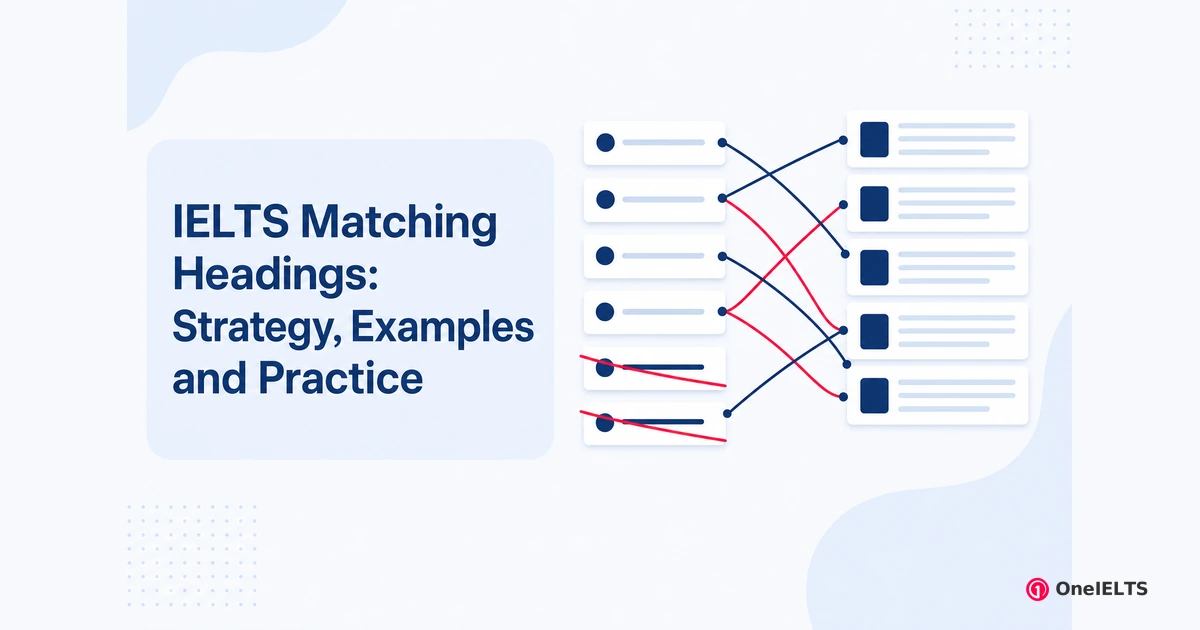
A matching headings task hands you a list of headings and asks which one sums up each of the passage’s paragraphs. There are always spare headings, and the answers run in non-linear order, so the reliable move is elimination rather than matching.
This guide covers what the task is, how many headings you get, and how Academic and General Training samples differ. It then sets out the two strategies, why the type is hard, a worked example, where to practise, the accuracy tips, and how matching headings sits beside the other Reading question types.
What Are IELTS Reading Matching Headings Questions?
A list of headings appears on the question paper, and you choose the one that captures the main idea of each paragraph. The headings carry lowercase roman numerals, the paragraphs carry letters, and you write the numeral beside the letter.
The skill under test is identifying the main idea, not locating a detail. A heading can match one true sentence inside a paragraph and still be wrong, because the paragraph as a whole is about something else. IDP’s overview of the type frames the same point as reading for gist.
The list always carries extra headings, so some of them belong to no paragraph at all. On the question paper this task usually sits before the passage rather than after it, which hints at how the exam board expects you to work, headings first.
How Many Headings Are There in IELTS Reading Matching Headings?
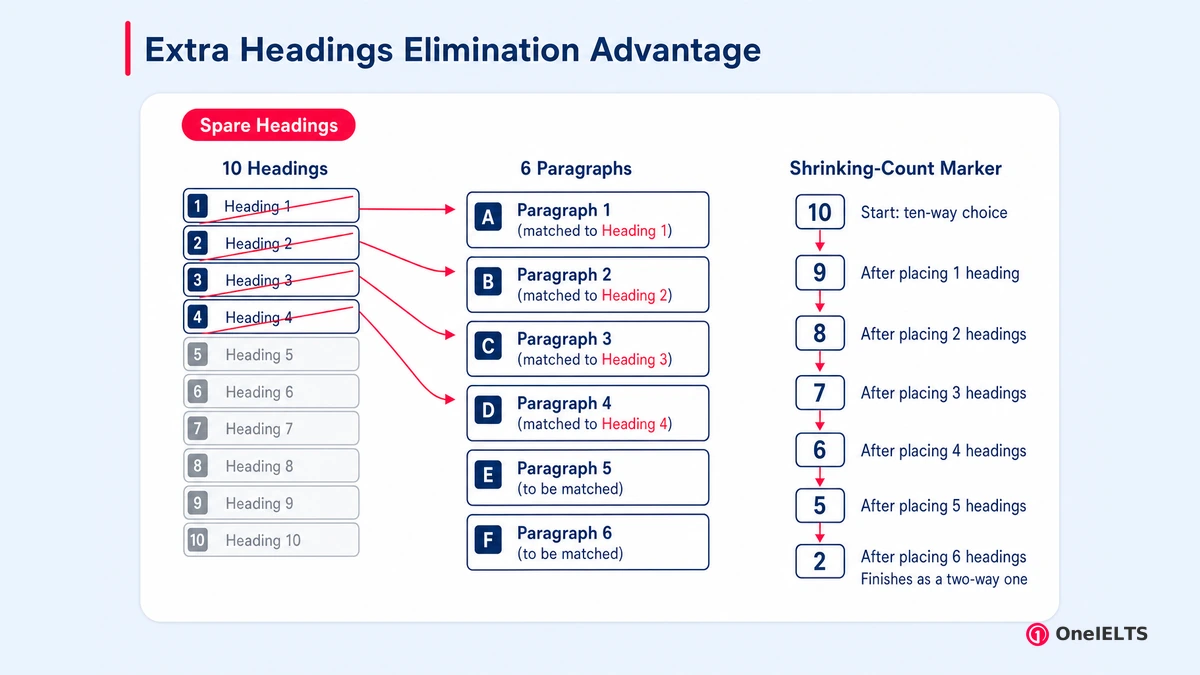
There are always more headings than paragraphs, so at least one heading in a set is never used. Two or three unused headings is normal.
No fixed count exists. Matching headings is one of the official Academic Reading question types, and the number of items changes from paper to paper. The exam board publishes 11 Academic Reading question types, while some prep sites split the same material into 14. Any specific per-test count is.
The unused headings are worth more than candidates realise. Each heading matches one paragraph at most, so a heading you have already placed can be ruled out permanently. A set with ten headings and six paragraphs starts as a ten-way choice and finishes as a two-way one. Most candidates never use that shrinkage.
How Do Academic and General Training Matching Headings Differ?
The mechanics do not change between the two papers. Academic Reading and General Training use the same task, the same instruction line and the same elimination logic. What differs is the material you read.
Academic reading passages come from journals, books and broadsheet features. The register is formal, and the argument builds across four or five sentences, so a heading has to summarise a line of reasoning. The wording of those headings is often abstract.
General Training passages come from notices, leaflets, staff handbooks and workplace documents. Paragraph length is shorter, the register is plainer, and the headings sit closer to a topic label such as “Refunds and cancellations”. Because the logic is shared, drilling on one paper trains you for the other.
What Strategies Work for Matching Headings Questions?
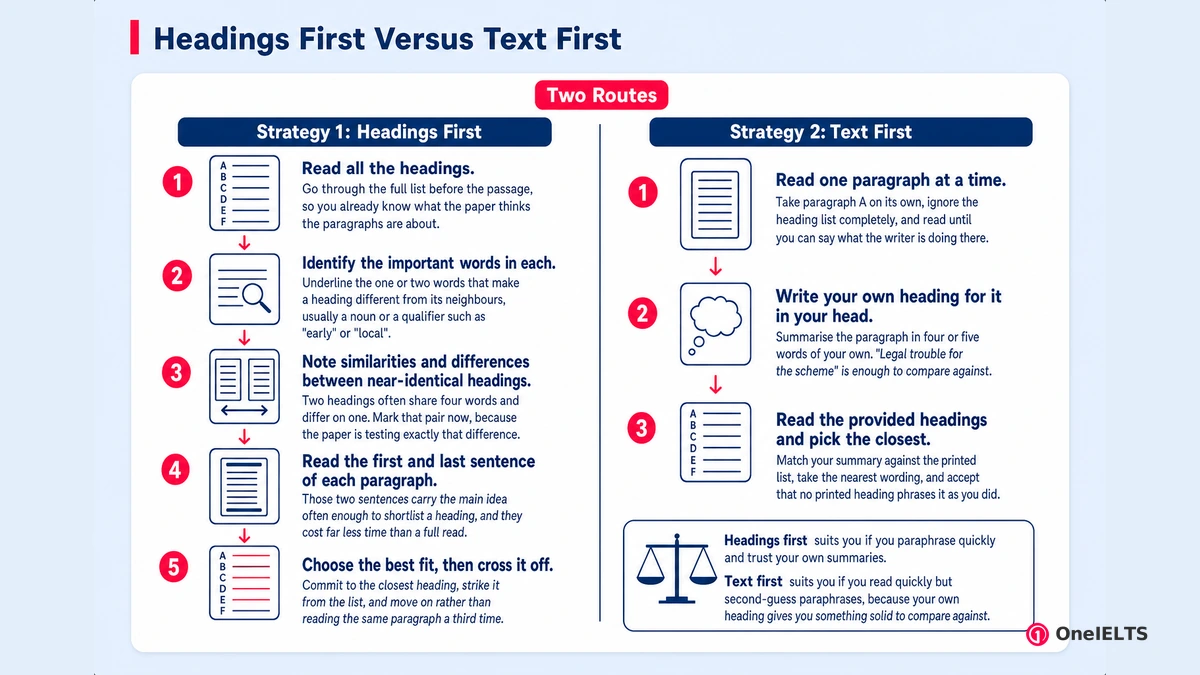
Two directions work on this task, and they run opposite ways. Headings first means you learn the list before you read; text first means you summarise a paragraph before you look at the list.
Both are legitimate, and almost nobody picks one deliberately before test day. The five steps of the headings-first route and the three steps of the text-first route run in the order you would use them.
Strategy 1 is headings first. You work the printed list before you read the passage closely.
- Read all the headings. Go through the full list before the passage, so you already know what the paper thinks the paragraphs are about.
- Identify the important words in each. Underline the one or two words that make a heading different from its neighbours, usually a noun or a qualifier such as “early” or “local”.
- Note similarities and differences between near-identical headings. Two headings often share four words and differ on one. Mark that pair now, because the paper is testing exactly that difference.
- Read the first and last sentence of each paragraph. Those two sentences carry the main idea often enough to shortlist a heading, and they cost far less time than a full read.
- Choose the best fit, then cross it off. Commit to the closest heading, strike it from the list, and move on rather than reading the same paragraph a third time.
Strategy 2 is text first. You read one paragraph cold, then go to the printed list.
- Read one paragraph at a time. Take paragraph A on its own, ignore the heading list completely, and read until you can say what the writer is doing there.
- Write your own heading for it in your head. Summarise the paragraph in four or five words of your own. “Legal trouble for the scheme” is enough to compare against.
- Read the provided headings and pick the closest. Match your summary against the printed list, take the nearest wording, and accept that no printed heading phrases it as you did.
Headings first suits you if you paraphrase quickly and trust your own summaries. Text first suits you if you read quickly but second-guess paraphrases, because your own heading gives you something solid to compare against.
Why Are Matching Headings Questions So Difficult?
Three things stack up. The answers do not follow passage order, the list holds more headings than paragraphs, and near-identical headings are planted on purpose.
Non-linear order asks more of you than candidates expect. Heading ii can belong to paragraph D, so never assume it belongs to paragraph B.
The keyword trap does the rest of the damage. A heading repeats a word from paragraph C, your eye grabs it, and the main idea goes unchecked. A paragraph’s first sentence is not always its topic sentence either, because writers often open with an example and state the point third.
What Does an IELTS Reading Matching Headings Question Look Like?
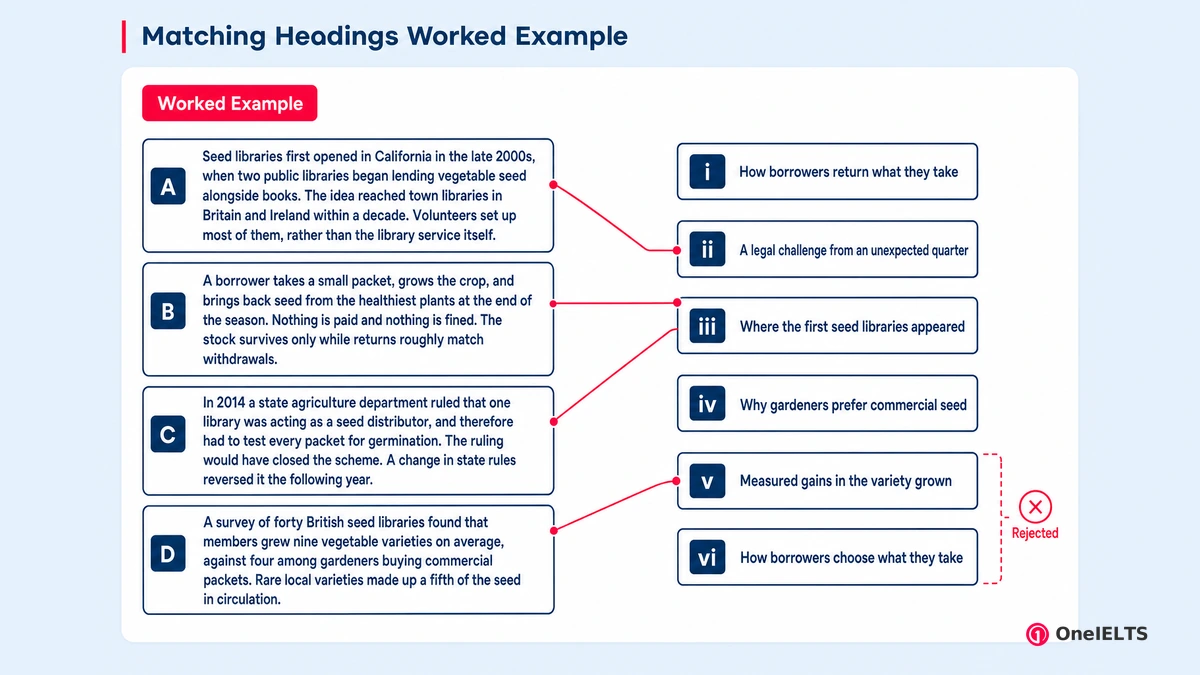
Here is a worked example built on an original passage invented for this page, not a Cambridge or exam-board extract. It runs four paragraphs against six headings, two of which stay unused.
Paragraph A. Seed libraries first opened in California in the late 2000s, when two public libraries began lending vegetable seed alongside books. The idea reached town libraries in Britain and Ireland within a decade. Volunteers set up most of them, rather than the library service itself.
Paragraph B. A borrower takes a small packet, grows the crop, and brings back seed from the healthiest plants at the end of the season. Nothing is paid and nothing is fined. The stock survives only while returns roughly match withdrawals.
Paragraph C. In 2014 a state agriculture department ruled that one library was acting as a seed distributor, and therefore had to test every packet for germination. The ruling would have closed the scheme. A change in state rules reversed it the following year.
Paragraph D. A survey of forty British seed libraries found that members grew nine vegetable varieties on average, against four among gardeners buying commercial packets. Rare local varieties made up a fifth of the seed in circulation.
The question paper prints these six headings.
- i. How borrowers return what they take
- ii. A legal challenge from an unexpected quarter
- iii. Where the first seed libraries appeared
- iv. Why gardeners prefer commercial seed
- v. Measured gains in the variety grown
- vi. How borrowers choose what they take
Four matches settle the set, and each rejected heading has one reason.
- Paragraph A, heading iii. Origin and spread is the whole content of the paragraph, so a “where they first appeared” heading covers all of it.
- Paragraph B, heading i. Returning seed at the end of the season is the paragraph’s main idea, not a side remark.
- Paragraph C, heading ii. A ruling by an agriculture department is a legal challenge, and it arrives from a body nobody expects.
- Paragraph D, heading v. Nine varieties against four is a measured gain, and the paragraph reports nothing else.
- Heading iv is rejected. No paragraph gives a reason for preferring commercial seed. Paragraph D only counts what people grow.
- Heading vi is rejected. This is the near-identical twin of heading i. Paragraph B describes returning seed, never choosing it.
Where Can You Practise IELTS Reading Matching Headings?
Work on OneIELTS rather than on scattered worksheet PDFs. Our IELTS Reading matching headings practice filters the question bank down to this one type. A free OneIELTS account is needed to practise.
A question type drill and a timed test do different jobs. The drill isolates the elimination step, so you can repeat the same decision until it stops going wrong. A timed test puts that decision back among detail questions, a clock, and a passage you have never seen. Drill the type first, then sit the whole paper.
Teacher blogs carry free practice lessons on this type, and they are useful reading. They are also unmarked. Across our own marked Reading practice, wrong matches cluster on the two headings that share a word with the paragraph, not on the paragraphs candidates call hardest. So review every wrong match by naming the cause. Either you followed a repeated keyword, or you missed the paragraph’s main idea.
What Are the Best Tips for IELTS Reading Matching Headings?
Discipline drives accuracy on this type more than reading speed does. The habit that pays most is striking out each heading the moment you place it, because every strike shortens the list for the paragraph you find hardest.
Five matching headings tips carry most of that gain, ordered by how much they save you.
- Read every heading first. Group the near-identical ones into pairs before you touch the passage at all.
- Treat first and last sentences as candidates. They hint at the topic, but the whole paragraph supplies the proof.
- Cross out each heading as you place it. The shrinking list makes every later paragraph easier to settle.
- Leave the hardest paragraph until last. By then two or three headings remain, so the guess narrows sharply.
- Never reuse a heading. Each heading matches one paragraph at most, so a repeated answer guarantees one wrong mark.
How Does Matching Headings Fit With the Other IELTS Reading Question Types?
Among the 11 official Academic Reading question types, matching headings is the main idea task. Every other type sends you hunting for something specific, while this one asks what a paragraph is for.
Its neighbours split into two families. The detail task family covers matching information, sentence completion, table completion, short answer and diagram labelling, and each of those rewards scanning for one fact. The judgement family covers True/False/Not Given and Yes/No/Not Given, where you weigh a claim against the text.
Everything above this line treats matching headings on its own. What follows places it beside those neighbours and inside the way you practise.
Is Matching Headings the Same as Matching Information?
No — matching headings asks for a paragraph’s MAIN IDEA, while matching information asks which paragraph CONTAINS a specific detail; they demand opposite reading modes.
In matching headings the answer is a summary, and one true sentence inside a paragraph proves nothing. In matching information the answer is that one sentence, and the paragraph’s overall topic is irrelevant. Headings run once at most, while an information question can point twice at the same paragraph. Our IELTS Reading matching information guide sets out that reverse method.
Is Matching Headings Harder Than Matching Features?
Yes for most candidates, because headings are abstract summaries while features are concrete labels you can scan for.
Matching features hands you names, dates or researchers, and a name is findable on the page. An abstract summary is not, so you build it yourself from the whole paragraph. Matching features also allows repeats, which removes the elimination pressure that makes matching headings tighten as you go. Our IELTS Reading matching features guide covers the scanning method.
Can You Drill Matching Headings Alongside the Other Question Types?
Yes, and you should — matching headings usually appears with detail tasks on the same passage, so practising it alone leaves the switch between reading modes untrained. A full passage asks you to read for gist on one set of question types and for detail on the next, inside the same twenty minutes. That switch is its own skill. Drill the type until your accuracy holds, then sit a free IELTS Reading mock test.
Written by Fahimur Rahman, reviewed 14 August 2026.
Last verified: 14 August 2026
Practice for the Real IELTS Exam
Apply what you’ve learned with free, exam-style practice:
- Take a free IELTS mock test — all four skills, real exam timing, AI band scoring
- Sit a Reading section mock — one full timed paper with an instant band score
- Practise by question type — self-paced passages with answer explanations