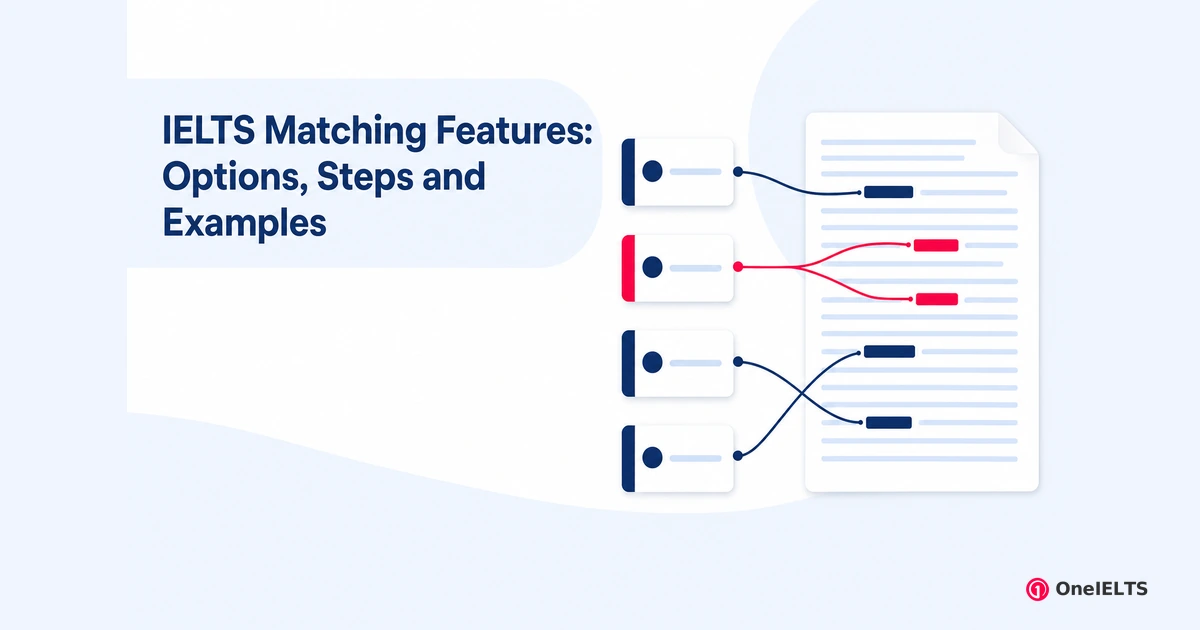
IELTS Reading matching features hands you numbered statements and a lettered list of options, and you write the letter of the option each statement belongs to. Many publishers call the same task matching names.
Two rules make it different. The answers ignore passage order, and one option can be used more than once, so you work from the options in the passage rather than down the statements.
This guide covers the task, the skills it tests, why the answers are out of order, and whether options repeat. It then gives the step by step method, the common mistakes, a worked example, where to practise, the best tips, and how the type fits the other Reading question types.
What Is Matching Features in IELTS Reading?
You are given numbered statements and a lettered list of options (names, researchers, countries, dates), and you write the letter of the option each statement belongs to.
The statements are usually findings, claims or characteristics pulled from the passage and reworded. The option list holds whatever those claims can be attributed to, most often researchers and dates, sometimes countries or individual studies. The two counts need not match, so a set can print six statements against four options, or four statements against eight.
The same task is widely published under the name matching names, which is why two prep sites can describe one question type and look like they are describing two. It turns up in Academic Reading and can appear in General Training. The British Council publishes guidance called IELTS Question Type 6 – Matching features, which is the primary source for the official task description.
What Skills Does IELTS Reading Matching Features Test?
This type tests locating named entities fast, then attributing a reworded claim to the right holder. Two separate skills sit inside that.
The first is visual. You scan for capital letters and figures, which is a different action from reading for meaning, and no other Reading type rewards it as heavily. Capitalised names and four-digit years stand out on the page before you understand a single sentence.
The second is semantic. The matching happens at the level of a paraphrase, because the statement will not repeat the passage’s wording. You attribute a claim to the right name only when the wording matches in meaning, so “reduced spending” and “cut its budget” count as the same claim.
Why Do IELTS Reading Matching Features Answers Not Follow the Passage Order?
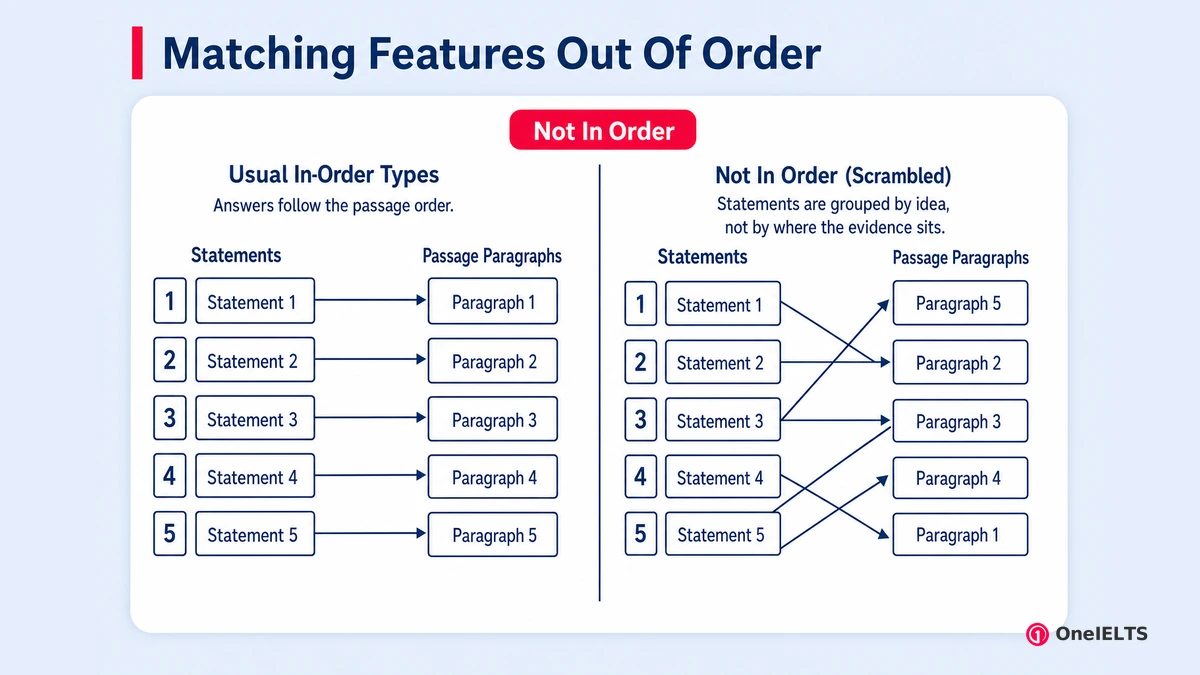
Because the statements are grouped by idea, not by where the evidence sits. Statement 1’s option can appear in the last paragraph and statement 5’s in the first.
In practice that kills the usual method. You cannot move forward through the passage once, answering as you go, and be finished. You locate the options first, marking every capitalised name and year on the page, then read around the name that each statement points to.
The habit this breaks is a real one. True/False/Not Given, Yes/No/Not Given and sentence completion all run in passage order, so most candidates arrive trained to expect it. Matching features and matching paragraph information are the two types where the answers are not in order. Matching sentence endings, despite its shared letter list, does follow the passage.
Can an Option Be Used More Than Once in IELTS Reading Matching Features?
Yes, an option can be used more than once, but only when the instruction says so. The instruction line above the questions is the only place that tells you, and it is the first thing to read.
Two shapes turn up. A note reading “you may use any letter more than once” licenses reuse, so option C can answer questions 2, 5 and 7. A line reading “use each option once only” removes it, and elimination becomes legal. Where reuse is allowed, no elimination: crossing C off after question 2 costs you question 5.
More options than statements is the other case. Eight options against five statements leaves three unused options, which is by design.
How Do You Answer IELTS Reading Matching Features Questions?
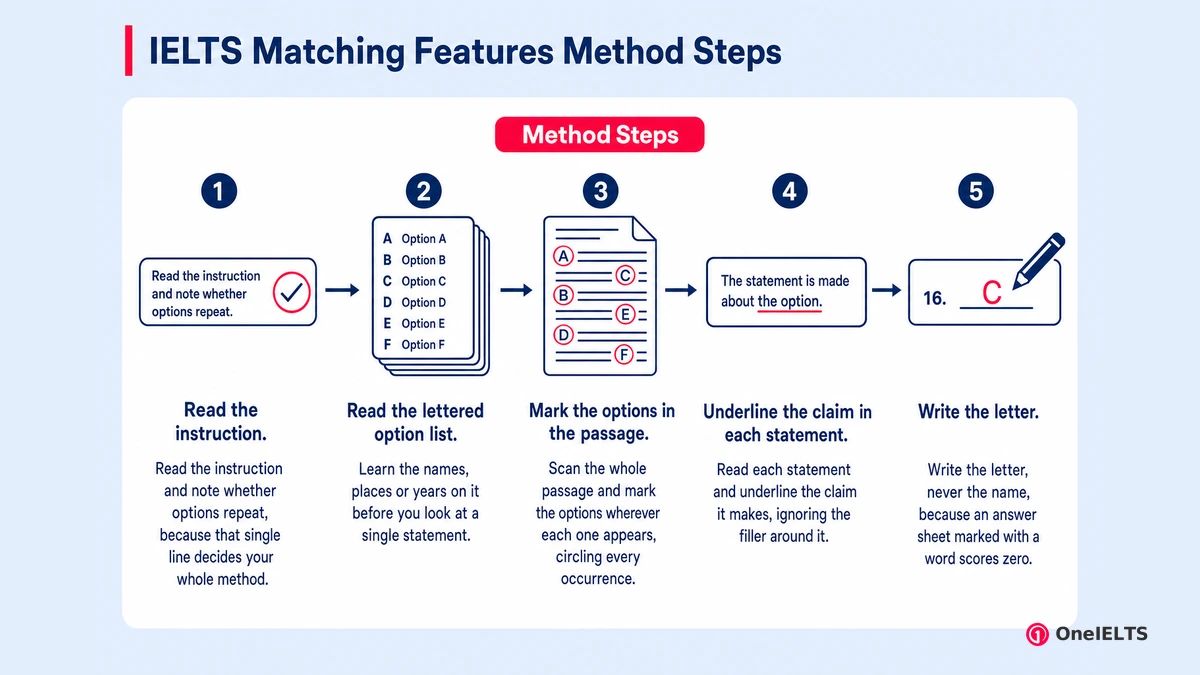
The method starts with the instruction line, then the lettered option list. The statements come fourth, because the options are what you hunt for in the passage.
Eight steps run from the instruction line to the last hard statement.
- Read the instruction. Read the instruction and note whether options repeat, because that single line decides your whole method.
- Read the lettered option list. Learn the names, places or years on it before you look at a single statement.
- Mark the options in the passage. Scan the whole passage and mark the options wherever each one appears, circling every occurrence.
- Underline the claim in each statement. Read each statement and underline the claim it makes, ignoring the filler around it.
- Read around the keyword. Go to that option’s location and read around the keyword, taking in the full sentence, not the name alone.
- Decide which option the claim belongs to. Compare the underlined claim with the sentence you just read and settle the attribution.
- Write the letter. Write the letter, never the name, because an answer sheet marked with a word scores zero.
- Leave the hardest statements until last. Place the easy letters first, then return to the two or three that resisted.
What Are the Common Mistakes in IELTS Reading Matching Features?
Marks go on this type through method rather than vocabulary. Most wrong answers come from the passage order assumption and from matching on a shared word, and both are avoidable before you read a line.
Six mistakes account for most of the lost marks here.
- Assuming the answers run in passage order. The passage order assumption sends you hunting forwards when the evidence sits three paragraphs back.
- Crossing an option off after using it. You may reuse an option whenever the instruction allows it, so elimination costs you later answers.
- Matching on a repeated name without reading the claim. A name printed four times carries four different claims, and only one of them fits.
- Matching on a shared word instead of the paraphrase. A shared word between statement and passage is bait; the real match is a synonym.
- Writing the option’s word instead of its letter. Write the letter beside each statement, because the answer key holds letters.
- Leaving a statement blank. A blank scores zero, while a guessed letter from the list still has a real chance of landing.
What Does an IELTS Reading Matching Features Question Look Like?
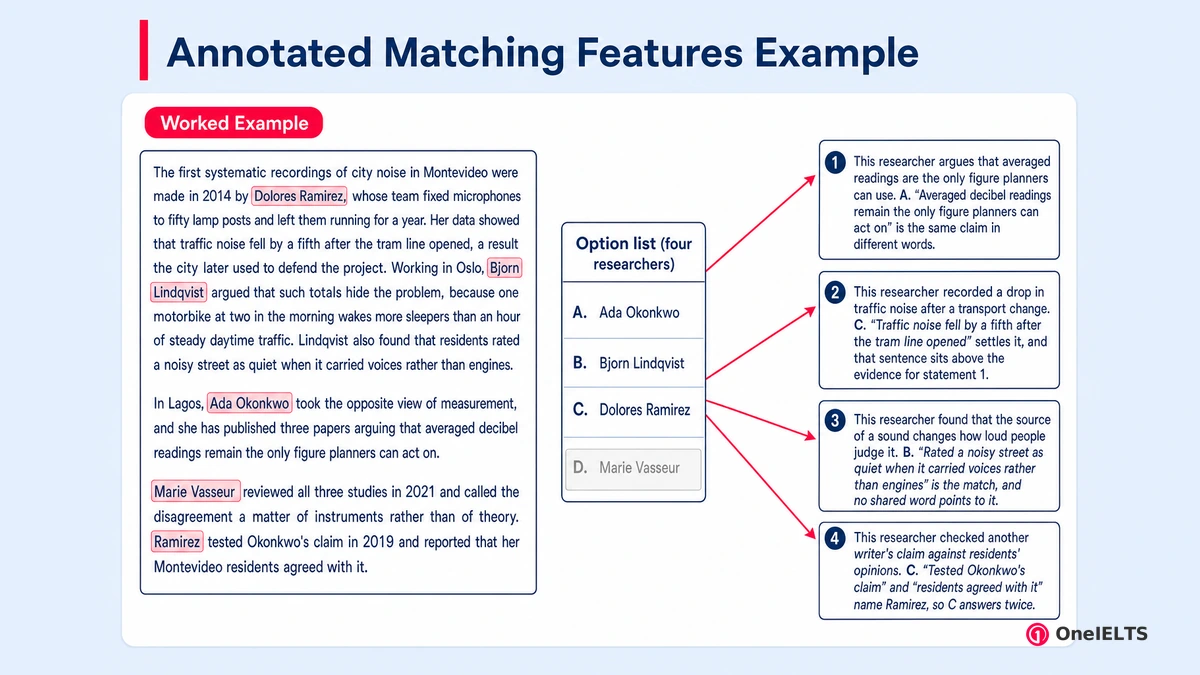
Here is a worked example built on an original extract written for this page, not a Cambridge passage. The instruction line says you may use any letter more than once.
The first systematic recordings of city noise in Montevideo were made in 2014 by Dolores Ramirez, whose team fixed microphones to fifty lamp posts and left them running for a year. Her data showed that traffic noise fell by a fifth after the tram line opened, a result the city later used to defend the project. Working in Oslo, Bjorn Lindqvist argued that such totals hide the problem, because one motorbike at two in the morning wakes more sleepers than an hour of steady daytime traffic. Lindqvist also found that residents rated a noisy street as quiet when it carried voices rather than engines.
In Lagos, Ada Okonkwo took the opposite view of measurement, and she has published three papers arguing that averaged decibel readings remain the only figure planners can act on. Marie Vasseur reviewed all three studies in 2021 and called the disagreement a matter of instruments rather than of theory. Ramirez tested Okonkwo’s claim in 2019 and reported that her Montevideo residents agreed with it.
The option list holds four researchers.
- A. Ada Okonkwo
- B. Bjorn Lindqvist
- C. Dolores Ramirez
- D. Marie Vasseur
Each statement carries its letter and the words that settled it.
- This researcher argues that averaged readings are the only figure planners can use. A. “Averaged decibel readings remain the only figure planners can act on” is the same claim in different words.
- This researcher recorded a drop in traffic noise after a transport change. C. “Traffic noise fell by a fifth after the tram line opened” settles it, and that sentence sits above the evidence for statement 1.
- This researcher found that the source of a sound changes how loud people judge it. B. “Rated a noisy street as quiet when it carried voices rather than engines” is the match, and no shared word points to it.
- This researcher checked another writer’s claim against residents’ opinions. C. “Tested Okonkwo’s claim” and “residents agreed with it” name Ramirez, so C answers twice.
Two structural rules show up in that set. Option C is an option used twice and option D is an unused option, and neither is an error. Statement 2’s evidence also sits earlier in the passage than statement 1’s, which is what out of order looks like on the page.
Where Can You Practise IELTS Reading Matching Features?
Practise this type on OneIELTS rather than on the loose PDF worksheets the search results push at you. Our IELTS Reading matching features practice pages filter practice questions down to this single type. Practising needs a free OneIELTS account.
A general reading drill prepares you badly here. This type only works on passages that carry several named sources, because you need competing people, places or studies to attribute claims between. An article with one author and one argument gives you nothing to match, however hard its vocabulary is.
A question type drill and a full timed passage do different jobs. The drill isolates the scan-and-attribute loop, so you can run it twenty times in an hour. A timed passage puts that loop back among headings, completion sets and a clock.
Review your errors with three questions. Did I assume passage order? Did I miss a reuse? Did I match on a shared word? Across our marked Reading practice, wrong answers on this type cluster on the statement whose evidence sits earliest in the passage, which is the one candidates reach last.
What Are the Best Tips for IELTS Reading Matching Features?
The matching features tips that actually move accuracy are about sequence. Read the instruction, then the options, then the passage, and only then the statements.
Seven habits carry most of the gain on this question type.
- Read the instruction before anything else. That line tells you whether letters repeat, which changes how you work.
- Mark the options in the passage first. Mark the options everywhere they appear before you read a single statement.
- Expect the answers out of order. Statement 4 can be settled two paragraphs above statement 3, so never search forwards only.
- Eliminate only when the instruction allows it. Cross an option off after use only where each option is used once.
- Read the full sentence around a name. The name locates the evidence; the sentence carries the claim.
- Place the easy letters first and come back. Two obvious matches narrow the field for the statements that resisted.
- Write letters, never words. Write letters on the answer sheet, because the answer key is a list of letters.
How Does Matching Features Fit With the Other IELTS Reading Question Types?
Matching features sits among the official Academic Reading question types, and it belongs to the matching family. That is the group whose answers are letters from a list you are handed rather than words lifted out of the passage. Matching paragraph information, matching headings and matching sentence endings are its siblings.
It is also the family member most often published under a second name, which is why candidates meet it twice and count it as two tasks. Everything above this line treats matching features on its own. What follows sets it beside those siblings, so you can tell in two seconds which method a question set wants.
Is IELTS Reading Matching Features the Same as Matching Names?
Yes, they are the same task under two labels: the option list happens to be people’s names, so publishers call it matching names, and any matching-names practice set is matching-features practice. The option list can just as easily hold countries, dates or studies, which is why the official name is the broader one. Any IELTS Reading matching features practice set trains both labels at once.
Is IELTS Reading Matching Features the Same as Matching Paragraph Information?
No, matching features asks which named option a claim belongs to, while matching paragraph information asks which paragraph a piece of information sits in, so the option list is paragraph letters rather than entities. Both share the out of order rule, which is why they feel similar under time pressure. Our IELTS Reading matching paragraph information guide sets out the paragraph-scanning method.
Do Matching Sentence Endings Use the Same Method as IELTS Reading Matching Features?
Only partly. Both ask you to pick letters from a list you are handed, but matching sentence endings follows passage order, and a grammar filter rules out endings that cannot complete the stem.
The shared skill is recognising a paraphrase. The differing skill is where you start reading, because here you start with the options. Our IELTS Reading matching sentence ending guide covers that grammar check.
Written by Fahimur Rahman, reviewed 14 August 2026.
Last verified: 14 August 2026
Practice for the Real IELTS Exam
Apply what you’ve learned with free, exam-style practice:
- Take a free IELTS mock test — all four skills, real exam timing, AI band scoring
- Sit a Reading section mock — one full timed paper with an instant band score
- Practise by question type — self-paced passages with answer explanations