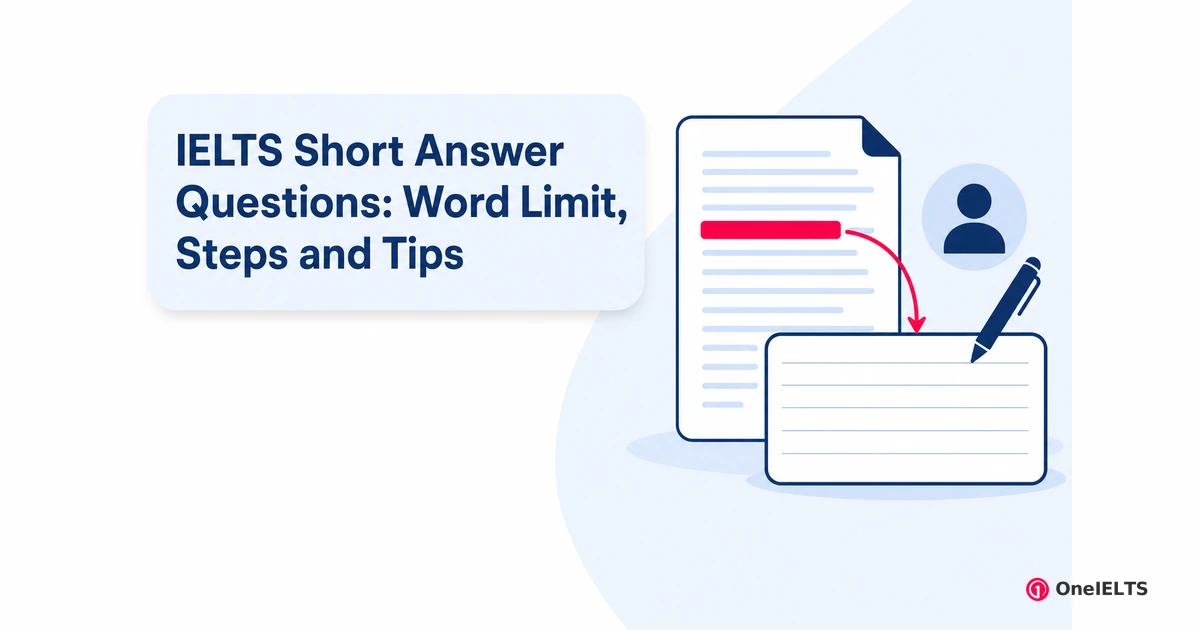
IELTS Reading short answer questions ask you a direct question about the passage and expect the answer in the passage’s own wording, inside a stated word limit. You don’t compose anything. You copy verbatim, and an answer in your own words scores nothing even when the fact is right.
This guide covers the task, the word limit, the six-step method, and why candidates lose marks. It then works through an original example, shows where to practise, lists the tips that raise accuracy, and places the type beside the other Reading question types.
What Are IELTS Reading Short Answer Questions?
IELTS Reading short answer questions ask a direct question about the passage and accept only the exact words the passage uses, within a stated word limit. You read the question, find the one place in the text that answers it, and write that word or phrase on your answer sheet. Nothing is invented, and nothing is picked from a list of options.
The task tests two reading skills at once. You skim and scan: skim to reach the paragraph that holds the answer, then scan those lines for the specific content the question names.
Four answer shapes cover almost every question in this type. An answer is a noun phrase, a number, a date, or a name. That is why the instruction usually allows a number alongside the words.
The questions run in passage order. Question 2’s answer sits somewhere after question 1’s, so once you have found an answer you never need to search the text above it again.
How Many Words Can You Write in an IELTS Reading Short Answer Question?
The instruction above each set sets a hard cap, most often NO MORE THAN THREE WORDS AND/OR A NUMBER, and breaking it scores zero even when your meaning is right. That wording lets you write up to three words and a number together. It never lets you write four words.
The cap is not fixed across the paper. One set can allow three words, the next can allow two, so read the instruction line for every set rather than assuming the last one still applies.
Two smaller rulings decide borderline answers. A hyphenated word such as “shallow-rooted” normally counts as one word, and articles like “the” count towards the word limit once you write them.
How Do You Answer IELTS Reading Short Answer Questions?
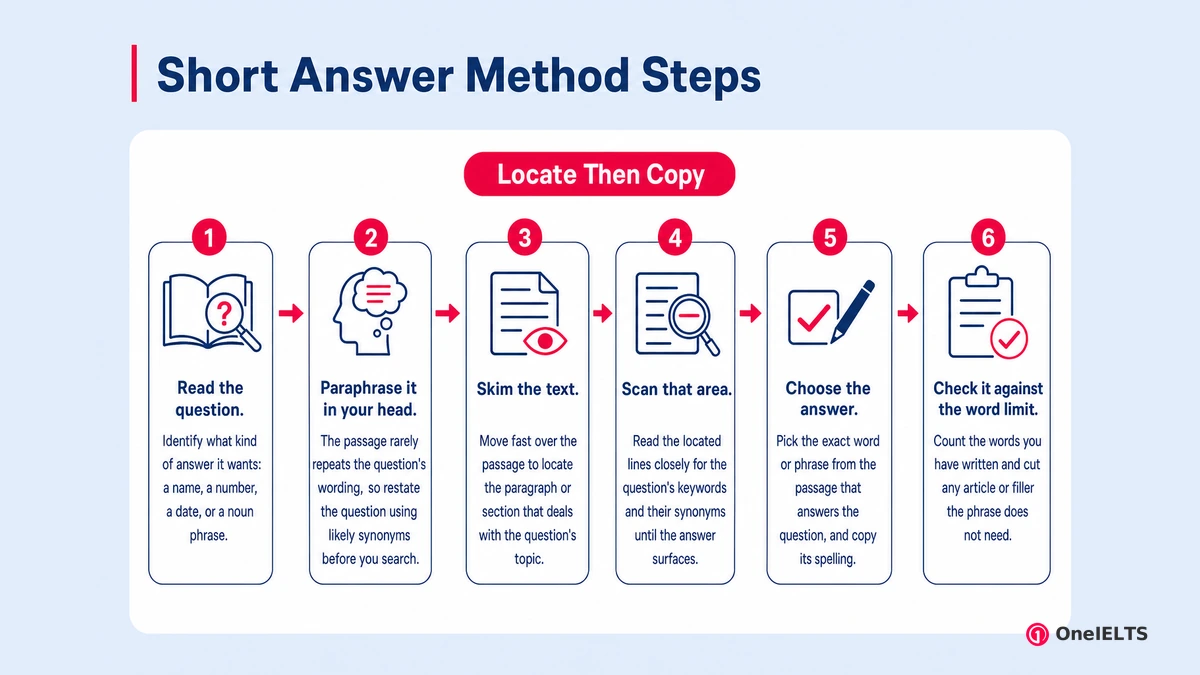
The method is a locate-then-copy routine rather than a comprehension exercise. Six steps take you from reading the question to an answer you have already checked against the cap. The routine runs in this order every time.
- Read the question. Identify what kind of answer it wants: a name, a number, a date, or a noun phrase.
- Paraphrase it in your head. The passage rarely repeats the question’s wording, so restate the question using likely synonyms before you search.
- Skim the text. Move fast over the passage to locate the paragraph or section that deals with the question’s topic.
- Scan that area. Read the located lines closely for the question’s keywords and their synonyms until the answer surfaces.
- Choose the answer. Pick the exact word or phrase from the passage that answers the question, and copy its spelling.
- Check it against the word limit. Count the words you have written and cut any article or filler the phrase does not need.
Why Do Candidates Lose Marks on Short Answer Questions?
Three causes dominate: answering in their own words, breaking the word limit, and writing a grammatically complete sentence when a phrase was wanted. Short answer is the only Reading task where you write the answer rather than select one, and that freedom misleads people.
A factually perfect answer in your own wording still scores nothing. Spelling must match the passage letter for letter, and a full sentence around the answer usually breaks the cap.
What Does an IELTS Reading Short Answer Question Look Like?
This worked example uses an original passage written for this guide, not an exam-board text. Read the instruction line first, then the three questions.
Rooftop farms have spread across northern European cities since the 2010s, and the reason is rarely food. City councils fund them for stormwater control. A planted roof holds part of a heavy rainfall for several hours, then releases it slowly, which keeps the drains from overflowing during a storm. The most common planting is sedum, a shallow-rooted succulent that survives on thin soil. The oldest roof on the city register was planted in 1985 and has never been watered.
Instruction. Answer the questions below. Choose NO MORE THAN THREE WORDS AND/OR A NUMBER from the passage for each answer.
- What do city councils fund rooftop farms for?
- What kind of plant is sedum?
- In which year was the oldest roof on the city register planted?
Here is each answer with the reasoning behind it.
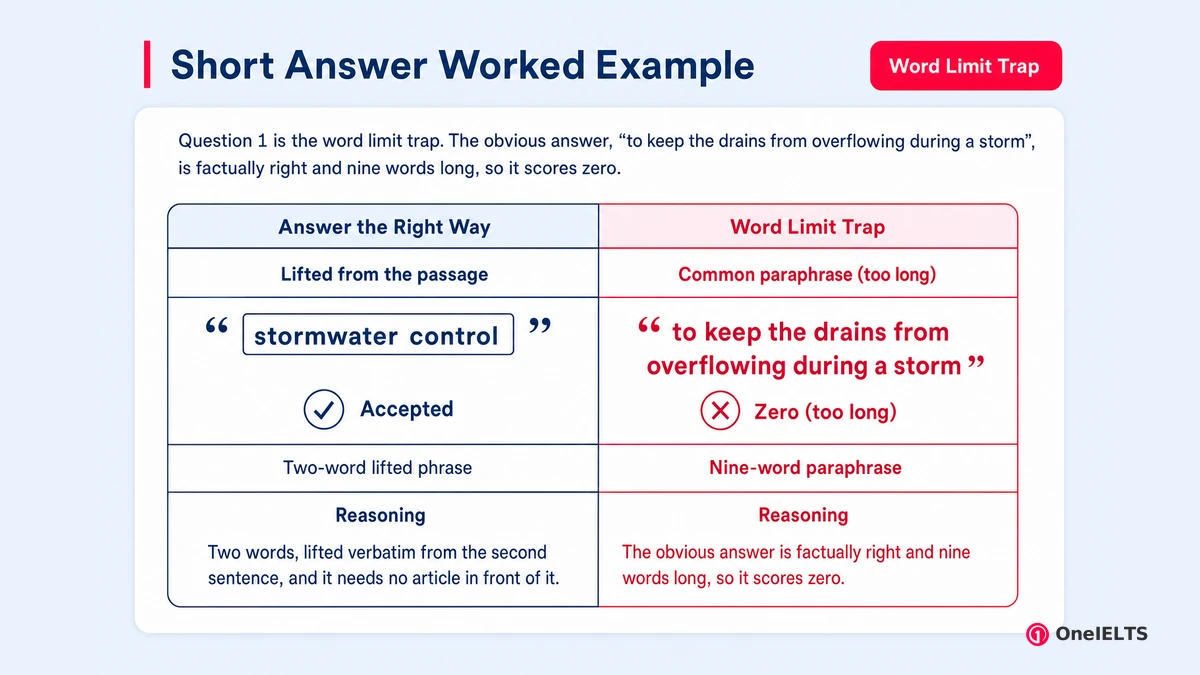
- stormwater control. Two words, lifted verbatim from the second sentence, and it needs no article in front of it.
- shallow-rooted succulent. Two words, because a hyphenated word normally counts as one.
- 1985. A number on its own satisfies the instruction, and writing “planted in 1985” wastes the cap.
Question 1 is the word limit trap. The obvious answer, “to keep the drains from overflowing during a storm”, is factually right and nine words long, so it scores zero.
Where Can You Practise IELTS Reading Short Answer Questions?
Practise this type on OneIELTS rather than on scattered third-party PDFs with disputed answer keys. Our IELTS Reading short answer questions practice page is the place for it, and practising needs a free account.
A question type drill and a timed test train different things. Practice questions of a single type build the locate-and-copy habit until you stop thinking about it. A full timed test trains your pacing across three passages and the handover between types. Drill the type first, then prove it under time.
What Are the Best Tips for IELTS Reading Short Answer Questions?
Accuracy moves when you fix the mechanical errors. Go through a marked practice set and the losses cluster in two places, length and spelling. The short answer tips that matter target both. Five habits separate a clean set of answers from a marked-down one.
- Read the word limit before the questions. The cap changes between sets, and it decides how you phrase every answer.
- Never answer in your own words. Markers accept the passage’s wording, so a correct paraphrase earns nothing.
- Copy spelling exactly. A misspelled answer is marked wrong even when the word you meant was right.
- Leave out articles unless the phrase needs them. Dropping a stray “the” brings a four-word answer inside the cap.
- Expect the answers in passage order. Question 4’s answer sits below question 3’s, so never search the whole text again.
How Do Short Answer Questions Fit With the Other IELTS Reading Question Types?
Short answer sits among the 11 question types in IELTS Academic Reading, and it belongs to the word limit family that also holds sentence, summary, note and table completion. One thing separates it from the rest of that family. Every completion type hands you a gap inside someone else’s sentence, while short answer asks a direct question and leaves you an empty line.
That difference changes how you check your work. A completion task lets the surrounding grammar confirm your answer. A short answer task offers no such confirmation, so the word limit and the passage’s exact spelling are the only checks you have.
Is IELTS Reading Short Answer Easier Than Sentence Completion?
No, and it is often harder. Sentence completion gives you a grammatical frame that narrows the answer, while a short answer question gives you none. A gap in a half-finished sentence tells you the answer is a noun, a plural, or a past-tense verb. A short answer question offers no such signal. Compare the two in our IELTS Reading sentence completion guide.
Does IELTS Reading Summary Completion Use the Same Word Limit as Short Answer?
No, not always. Both are capped by the instruction, but the cap is set per question set, so a three-word limit here and a two-word limit there is normal. Read the instruction above each set and never carry a word limit across from the previous one. Our IELTS Reading summary completion guide covers how the same rule works there.
Can You Practise Short Answer Questions With the Other IELTS Reading Question Types?
Yes, and you should. A full passage mixes short answer with matching and multiple choice, so isolated drilling leaves the switch between them untrained. Timed practice across mixed question types is what a free IELTS Reading mock test gives you, and it needs a free account too.
Written by Fahimur Rahman, reviewed 14 August 2026.
Last verified: 14 August 2026
Practice for the Real IELTS Exam
Apply what you’ve learned with free, exam-style practice:
- Take a free IELTS mock test — all four skills, real exam timing, AI band scoring
- Sit a Reading section mock — one full timed paper with an instant band score
- Practise by question type — self-paced passages with answer explanations