IELTS Listening is the 30-minute first paper that opens every IELTS test, built from four sections of 10 questions each — 40 questions in total, recorded once and played once. The four sections move from an everyday conversation to an academic lecture, and your raw score to band conversion is fixed.
This guide covers the test format, the four-section structure, the question types, scoring, the accents and transfer rules, and timing. It then turns to common mistakes, how to dodge distractors, where to find practice tests, how to build listening skills, and the best tips. One habit separates high scorers: reading the questions ahead and predicting the answer type, not just listening.
Last verified: 30 June 2026
What Is the IELTS Listening Test Format?
The IELTS Listening test has four sections with 40 questions, lasts about 30 minutes, and is identical for Academic and General Training. On paper-based IELTS you get an extra 10 minutes of transfer time after the audio to copy your answers onto the answer sheet. Computer-delivered IELTS instead adds only 2 minutes to check what you typed.
The audio is played once only, so you cannot rewind. Difficulty rises steadily from Section 1 to Section 4, which is why prediction matters more here than in any other paper.
How Is the Listening Test Structured Across the Four Sections?
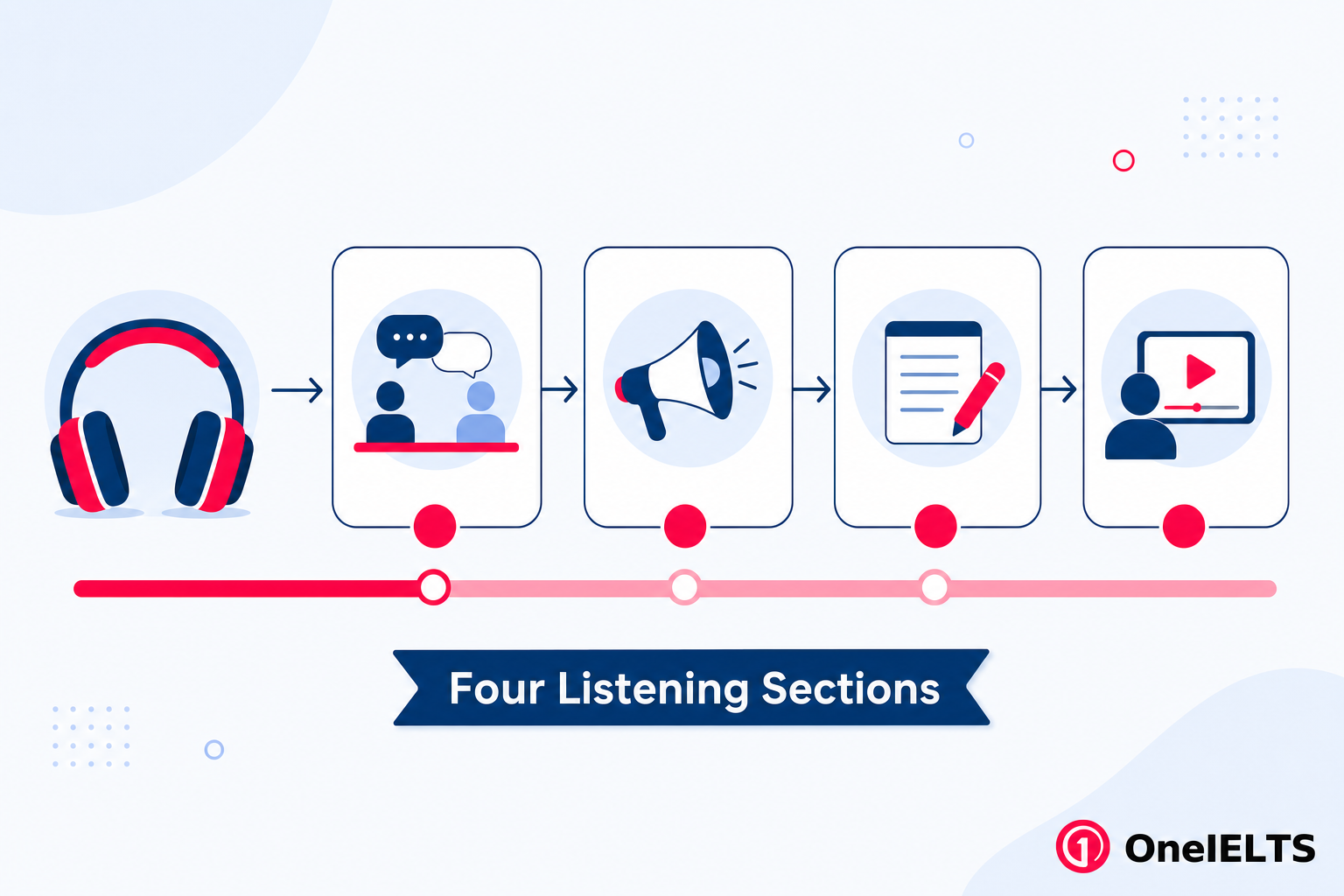
The four sections climb from social to academic content, and the speaker count and task type shift as you go. The conversation vs monologue pattern alternates: Section 1 and Section 3 give you speakers talking together, while Section 2 and Section 4 give you one voice.
This rising difficulty shapes the section contexts by design, carrying you from a casual chat to a university lecture. Each section uses a different speaker count and tests a different listening skill. The four IELTS Listening section contexts are summarised in the table below, each expanded in its own subsection.
| Section | Context | Speakers | Typical question types |
|---|---|---|---|
| Section 1 | Everyday social (e.g. booking, enquiry) | Two speakers | Form and note completion |
| Section 2 | Social monologue (e.g. a place or facility) | One speaker | Map labelling, matching |
| Section 3 | Academic discussion | Up to four speakers | Multiple choice, matching |
| Section 4 | Academic lecture | One speaker | Note and summary completion |
What Happens in Listening Section 1?
Section 1 is a two-person everyday conversation, usually with form completion. It tests how accurately you catch names and numbers, plus dates and addresses, in a transactional exchange such as booking a service or making an enquiry. That focus makes it the most accessible section of the four.
Many candidates bank early marks here, so treat it as the section where you drop nothing. Our IELTS Listening Section 1 guide breaks down the form completion patterns in detail.
What Happens in Listening Section 2?
Section 2 is a single-speaker monologue in a social context, often with map labelling or matching. The speaker commonly describes a place, a facility or an arrangement, such as a museum tour or a new building, so spatial language carries the answers. Our IELTS Listening map labelling guide shows how to track left, right and opposite while the speaker moves through a plan.
What Happens in Listening Section 3?
Section 3 is an academic discussion between up to four speakers, often with multiple choice or matching. Tracking who says what is the main challenge, because students and a tutor may agree, disagree or correct each other within seconds. The recording rewards anyone who maps each opinion to its owner in real time. Our IELTS Listening matching questions guide explains how to pin each opinion to the right speaker before the answer slips past.
What Happens in Listening Section 4?
Section 4 is an academic lecture by one speaker, usually with note completion and no mid-section break. With no break, it runs straight through all 10 questions without the pause you get earlier, so you cannot stop to regroup. This makes it the most academic and the most demanding section. Our IELTS note completion guide covers how to keep your place across a continuous academic talk.
What Are the IELTS Listening Question Types?
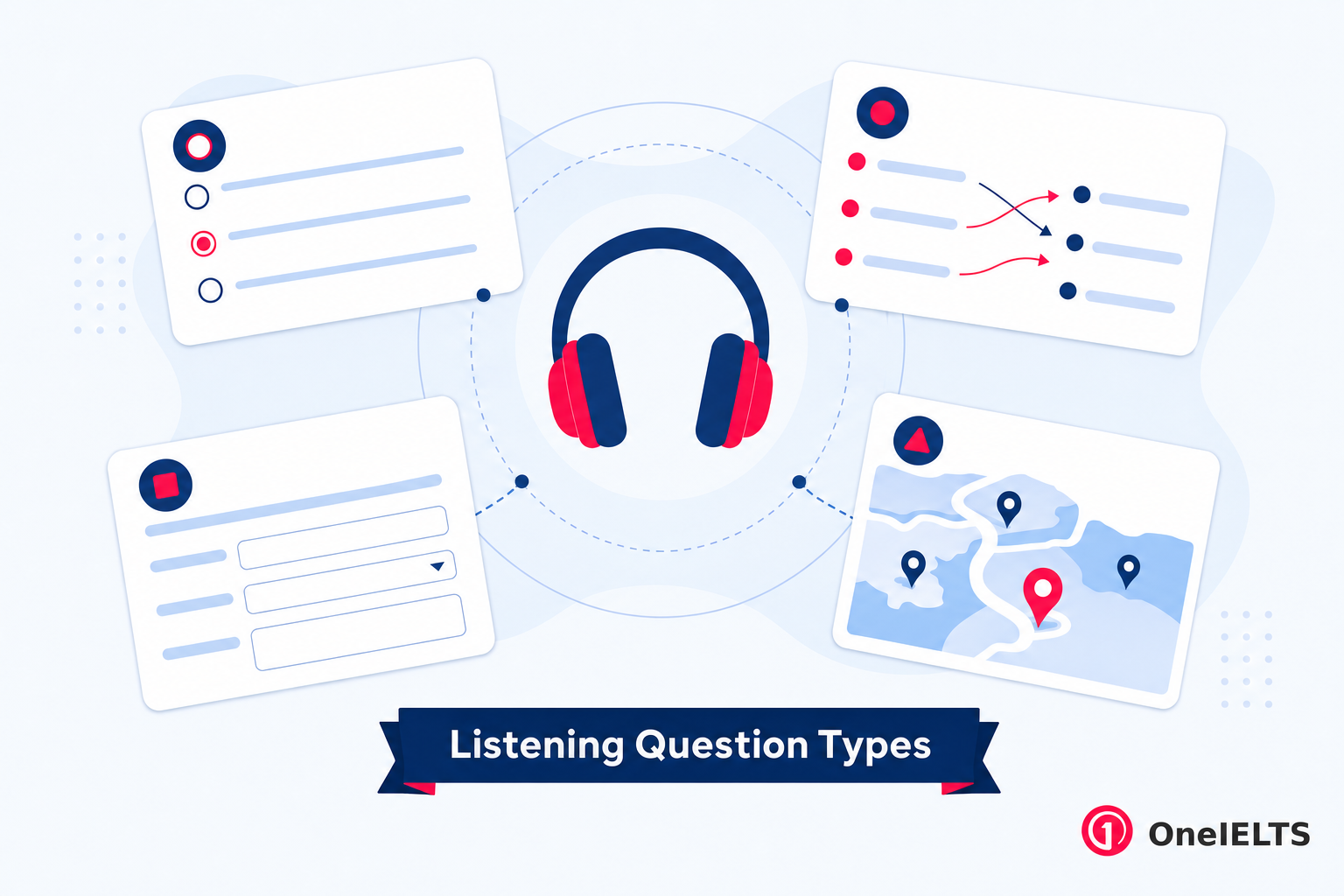
IELTS Listening draws from a fixed set of task formats, and a single section can mix two of them. Knowing each format in advance lets you predict whether an answer will be a word, a letter or a number before the audio starts. The recognised IELTS Listening question types are described below.
- Multiple choice. You pick the correct option from three or four choices. This format appears most in Sections 3 and 4 and tests whether you can follow a speaker’s meaning rather than match the exact words you see printed.
- Matching. You link a list of items to a set of options, often pairing speakers, places or features with their descriptions. It rewards holding several options in mind while the audio moves quickly between them.
- Map, plan or diagram labelling. You label parts of a visual by following the directions and spatial cues as the speaker describes a layout. It depends on locking onto words such as left, opposite and beyond rather than on vocabulary.
- Form, note, table, flow-chart and summary completion. These completion tasks ask you to fill gaps with the exact words you hear, within the stated word limit. They dominate Sections 1 and 4, where names, numbers and key facts carry every mark.
- Sentence completion. You complete a printed sentence with words from the recording, keeping both the grammar and the word limit correct, so a singular gap needs a singular noun and a plural needs the final letter.
- Short answer. You answer a direct question in a few words, again staying inside the word limit set on the paper, which means writing the noun the question asks for and nothing extra.
How Do Form, Note and Table Completion Questions Work?
Form, note and table completion questions give you a partly filled form, set of notes or grid and ask you to fill the gaps with the exact words you hear. Each gap carries a strict word limit, such as “no more than two words and a number”, and breaking it marks a right answer wrong.
Form completion and note completion together dominate Section 1 and Section 4, where names, numbers and key facts carry the answers. Our IELTS form completion guide drills the patterns that catch out spelling and word limit.
How Do Sentence, Flow-Chart and Summary Completion Questions Work?
Sentence, flow-chart and summary completion questions ask you to complete a sentence, a process diagram or a paragraph using words taken straight from the recording. In sentence completion the grammar of the finished sentence must still work, not only the missing word, so a singular gap needs a singular noun.
Flow-chart completion follows a sequence, so the answers usually arrive in order on the audio. Our IELTS flow-chart completion guide shows how to track each stage and keep the grammar fit intact.
How Do Multiple Choice, Matching and Labelling Questions Work?
Multiple choice, matching and labelling questions test understanding rather than dictation, asking you to choose, pair or place answers as the speaker explains them. Multiple choice rewards following meaning, because the wrong options paraphrase parts of the audio as deliberate traps.
Map, plan and diagram labelling depend on spatial language and the order the speaker moves through the layout. Our IELTS Listening multiple choice guide breaks down how to read the options before the audio begins.
How Is the IELTS Listening Score Calculated?
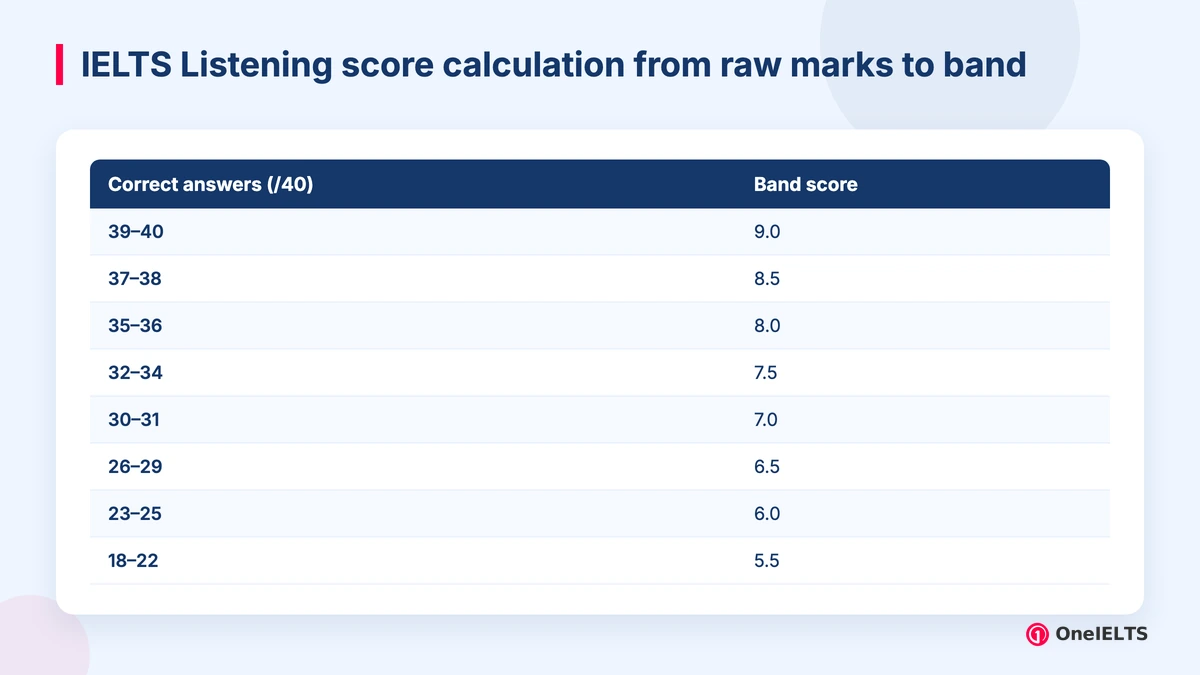
Your raw score out of 40 converts to a band 0 to 9, in whole or half bands, with no negative marking. Each correct answer is worth one mark, and the test deducts nothing for a wrong guess, so attempting every question is the only sensible approach. Per IELTS Australia’s published conversion table, the standard raw-score-to-band mapping is set out below.
| Correct answers | Band score |
|---|---|
| 39-40 | 9 |
| 37-38 | 8.5 |
| 35-36 | 8 |
| 32-34 | 7.5 |
| 30-31 | 7 |
| 26-29 | 6.5 |
| 23-25 | 6 |
| 18-22 | 5.5 |
| 16-17 | 5 |
Because the test removes nothing for an incorrect answer, leave no box empty — a blind guess costs you nothing and occasionally lands.
What Accents Appear in the IELTS Listening Test?
The IELTS Listening test uses a range of varied accents from native English speakers. You hear British, Australian, New Zealand and North American voices, and sometimes others, spread across the four sections rather than grouped together. This British Australian and New Zealand North American mix matters because a vowel or a piece of slang that sounds clear in one accent can blur in another, and a single mishearing costs a mark.
No single accent owns one section, so you cannot predict which voice a section will use, and a candidate trained only on British English can stumble the moment an Australian speaker arrives. The recording mirrors the real English you would meet studying or working abroad, where you do not get to choose who you listen to.
Building accent exposure before test day narrows the gap between what you expect to hear and what the recording delivers. Spend a few weeks with each country’s radio, podcasts and films, and the unfamiliar vowels stop costing you that half-second of hesitation that loses a fast answer.
How Do British, Australian and North American Accents Differ in the Test?
The accents differ most in vowel sounds and in rhythm and stress — British speech clips its vowels, Australian raises them, and North American voices stress the r at the ends of words. A word like “letter” sounds crisp from a British speaker, flatter from an Australian one, and fully rhotic from an American one.
New Zealand voices shift short vowels too, so a date or a place name can sound unfamiliar at first hearing. Accent training on each voice in turn removes the half-second hesitation that loses fast answers. Build that range with the drills in our IELTS Listening improve guide.
How Do You Manage Time and Transfer Answers in Listening?
You get reading time before each section to scan the questions ahead. On paper-based IELTS you then earn a transfer 10 minutes window at the end to copy your answers from the question paper to the answer sheet. Computer-delivered IELTS instead gives you a computer 2 minutes window to check what you typed, not to transfer, because it records your answers as you go.
Write your answers on the question paper first during the test, and keep pace with the audio. Use the short gap the recording gives between sub-parts to glance ahead at the next set of questions, so you are never reading and listening at once.
If you miss one question, abandon it and lock onto the next, because the recording will not wait. Candidates who freeze on a single missed gap routinely lose the two or three answers that follow it, which is a far bigger loss than the one they were chasing.
How Should You Use the 10 Minutes to Transfer Answers on Paper Versus 2 Minutes on Computer?
On paper you get 10 minutes after the audio to transfer answers onto the answer sheet, while the computer test gives only a 2-minute check window, because it saves your typing as you go. The two windows ask for different work, so treat them differently.
Spend the paper transfer window re-checking spelling and plurals as you copy. This is your last chance to catch a dropped “s” or an over-long answer, so do not copy on autopilot. On computer there is no separate transfer step, so use the check window to fix typos and fill any blank you left, working from your scratch notes. Our IELTS Listening strategies guide shows how to build this check into a routine.
What Are the Most Common IELTS Listening Mistakes?
Most lost marks in Listening come from a handful of repeatable errors rather than weak English, and candidates make the same ones year after year. The most common IELTS Listening mistakes are listed here.
- Waiting for exact words. The audio paraphrases the question, so listening only for matching words means you miss the answer the moment it is reworded into a synonym you did not expect.
- Missing the word limit. Writing more words than the instruction allows, such as going past “no more than two words”, turns a fully correct answer wrong even when the content is right.
- Spelling errors. A misspelled answer is marked wrong even when you clearly heard and understood the word, which makes Section 1 names a common and avoidable place to drop marks.
- Losing your place. Falling behind on one question and failing to move on causes a chain of missed answers right afterwards, because the audio keeps moving while you are stuck.
- Ignoring plurals. Dropping a final “s” when the speaker says a plural noun is one of the most frequent avoidable mistakes, and it turns an otherwise perfect answer into a zero.
- Falling for distractors and corrections. Speakers often give a number or name, then correct it, so the first one you hear is a trap that catches candidates who write too early.
- Mishearing connected speech. Words run together in natural speech, so “an apple” can sound like one word, and untrained ears split or merge sounds in the wrong places.
- Transferring answers carelessly. On paper, rushing the 10-minute copy step introduces fresh spelling slips and skipped lines that were correct on the question paper a moment earlier.
How Do You Avoid Distractors and Corrections in the Listening Audio?
Distractors are deliberate traps. The speaker gives one option or number, then corrects or rejects it, so the first answer you hear is usually the wrong one. The test writers build these in precisely to catch candidates who write the moment they hear a plausible word.
Listen for correction signals such as “actually”, “sorry”, “no wait”, “I mean” and “on second thoughts”, which flag that the speaker is about to change the answer. When you hear one, expect the real answer to arrive right after it, and be ready to cross out what you just noted.
Multiple choice options compound the trap, because the wrong choices deliberately paraphrase parts of the audio so they sound familiar. Following meaning across the whole sentence beats matching isolated words, since a phrase you recognise is often planted in a wrong option. Write your answer only after the speaker finishes the thought, not at the first plausible word, and you sidestep most distractors before they cost you a mark.
Where Can You Find IELTS Listening Practice Tests?
Good practice material puts you in front of real-speed audio, a marking key and a transcript, not just a list of questions. The fastest gains come from sources that let you both sit a full mock test and drill one weak question type. The most useful IELTS Listening practice test sources are set out here.
- Official IELTS sample tests. The British Council and IDP publish free sample tests that match the real format, timing and accents exactly, which makes them the most reliable starting point for any candidate.
- Full mock tests with audio and answers. A complete mock test with audio and answers lets you sit all four sections under time and mark yourself, so you measure both accuracy and stamina in one go.
- Sectional drills by question type. Targeted sets of form, matching or map questions let you fix one weak format without a full sitting, which is the most efficient way to repair a specific gap.
- Transcripts for review. A transcript shows the exact moment each answer was spoken, so you can replay the clip, find where you went wrong, and learn from every single miss.
- Daily authentic listening. Podcasts, news bulletins and recorded lectures build the stamina and accent range that timed tests then convert into marks, especially for the demanding Section 4 lecture.
- Computer-delivered practice. Sitting practice in the real on-screen interface trains the typing, navigation and 2-minute check window so the format itself never surprises you on test day.
What Should a Full IELTS Listening Practice Test Include?
A full practice test should include all four sections, real-speed audio played once, an answer key and a transcript. Sit it under timed conditions, including the transfer or check window, so the clock and the single play feel exactly like test day rather than a relaxed study session. Work through official-style papers in our IELTS Listening practice test collection and time every sitting.
How Do You Review an IELTS Listening Mock Test by Cause?
Review a mock test by tagging every wrong answer to its cause — spelling, paraphrase, word limit or lost place — not by counting your total. This review by cause beats a bare score, because it tells you exactly what to drill next.
Replay the audio with the transcript to find the exact moment the answer was spoken, then label why you missed it. Our IELTS Listening strategies guide shows how to turn that error log into a study plan.
How Do You Drill One Weak IELTS Listening Question Type?
Drill a weak question type with back-to-back sectional drills of just that task — only maps, or only matching — until the pattern becomes automatic, rather than spreading the work across one full mixed test. Concentrated repetition builds the reflex faster than scattered exposure.
Pair each drilled set with its transcript so you see how the answer was signalled in the audio, which trains you to spot the same cue next time. Once the weak type stops costing marks, return to full timed tests to rebuild stamina, and check the format breakdowns in our IELTS Listening question types guide.
How Can You Build Stronger IELTS Listening Skills?
Strong listening skills grow from regular exposure to natural English plus targeted practice on IELTS tasks, not from a weekend of cramming before the test. Targeted practice trains the ear to handle connected speech, where words run together, and to settle into a range of accents until they stop feeling foreign.
Train on paraphrase first, because the test almost never repeats the printed words. Then combine authentic listening — podcasts, news and recorded lectures — with timed IELTS tasks, so the comfort you build in real English transfers into marks on the paper.
Breadth matters as much as test volume, so vary your sources rather than replaying the same speaker. A week of one news anchor builds a narrow ear, while mixing interviews, lectures and conversations prepares you for the unpredictable voices the test actually uses.
What Daily Habits Improve Your IELTS Listening Skills?
Daily habits that improve listening are short, active sessions — shadowing audio, noting new words and predicting answers — rather than long stretches of passive background listening. This kind of active listening forces your brain to process every word, so the practice converts into marks.
Listen once for meaning, then again with the transcript to catch what slipped past the first time. Twenty focused minutes beats two distracted hours. Build these routines with the drills in our improve IELTS listening guide.
What Are the Best Tips to Improve Your Listening Score?
Raising your Listening band comes down to a short set of high-impact habits practised until they are automatic, not to listening more hours in general. The single habit that separates high scorers is using the reading window to predict, not just to read. The most effective IELTS Listening tips are set out below.
- Read ahead. Use the reading window before each section to read every question first, so you know exactly what information you are hunting for and which gap comes next before a single word of audio plays.
- Predict answer type. Predict the answer type for each gap in advance — a name, a number, a date or a noun. Your ear is then primed for the right kind of word, and you can dismiss anything that does not fit the slot the moment you hear it.
- Train on paraphrase. Practise hearing ideas reworded rather than repeated, because the recording almost never uses the exact words printed in the question, and a candidate who waits for matching words will miss the answer every time.
- Follow signposting words. Listen for signposting words such as “however”, “the next point” and “finally”, which signal that the speaker is moving to the next answer, so you stay locked to the right question instead of drifting.
- Practise varied accents. Expose yourself to British, Australian and North American speech regularly in the weeks before the test, so an unfamiliar accent on the day does not throw you off a question you would otherwise answer easily.
- Watch spelling and word limits. Check every transferred answer for correct spelling and the stated word limit, since one small slip — a dropped letter or an extra word — turns an answer you heard perfectly into a lost mark.
- Never leave a blank. With no negative marking, write your best guess for every question, because an empty box always scores zero while a reasoned guess based on context sometimes scores the mark you would otherwise have surrendered.
- Use the section break to check. Spend the short gap before the next section glancing at your previous answers for obvious slips, then switch fully to reading the upcoming questions so you start each section already prepared.
What Is a Good IELTS Listening Score?
A band 7 needs about 30 of 40 correct, and a band 8 about 35. That benchmark of 30 of 40 for band 7 and 35 for band 8 is a guide, not a guarantee, since each version of the test shifts the boundaries slightly. Your goal-based target depends on your overall aim, so check the thresholds for your destination in our good IELTS score guide.
Does Spelling Matter in IELTS Listening?
Yes — a misspelled answer is marked wrong even if you heard it correctly. Spelling counts on every single answer, so watch British spelling against American spelling, such as “colour” versus “color”, and keep inside the word limit printed in each instruction. See how every section feeds your overall result in our IELTS band score guide.
How Can You Practise IELTS Listening Effectively?
Practise with full timed tests using real audio, then review every wrong answer by cause. A review by cause beats counting your total, because it tells you whether a miss came from spelling, paraphrase or pace. Build a daily listening habit with English podcasts and news between timed practice tests. Work through official-style papers in our IELTS Listening practice test collection and tag each error by cause.
Is the IELTS Listening Test Hard?
Listening is often the most approachable section, but speed and accents and paraphrase make it deceptively tricky. The speed and accents trip up candidates more than question difficulty does, because the single play and unfamiliar voices punish anyone who hesitates. Preparation closes most of the gap, because timed practice drills the speed and trains the accent range that catch out unprepared candidates. See the targeted habits in our IELTS Listening tips guide.
How Many Questions Are in the IELTS Listening Test?
There are 40 questions, 10 in each of the four sections. That 10 per section split holds across every test. Each question scores one mark each, with no negative marking, so your raw total out of 40 simply counts the answers you get right.
What Quick Tips Raise Your IELTS Listening Band Fastest?
The fastest band gains come from a few quick tips: check spelling and word limits, never leave a blank, and use the reading window for prediction of each answer type. These habits cost no extra study time and recover marks already within reach, since prediction and a filled answer sheet fix careless losses rather than gaps in your English. Drill the full set in our IELTS Listening tips guide.
How Long Does It Take to Improve Your IELTS Listening Score?
Most candidates lift their Listening band within four to eight weeks of focused daily practice, though the time depends on your starting level and target band. Focused practice closes the gap faster than untimed listening alone. Progress is fastest when each session ends with a cause-tagged review rather than another untimed test, because that review converts mistakes into specific drills. Plan a realistic timeline with our improve IELTS listening guide.
Practice IELTS Listening
Put this into practice with real, exam-style questions: