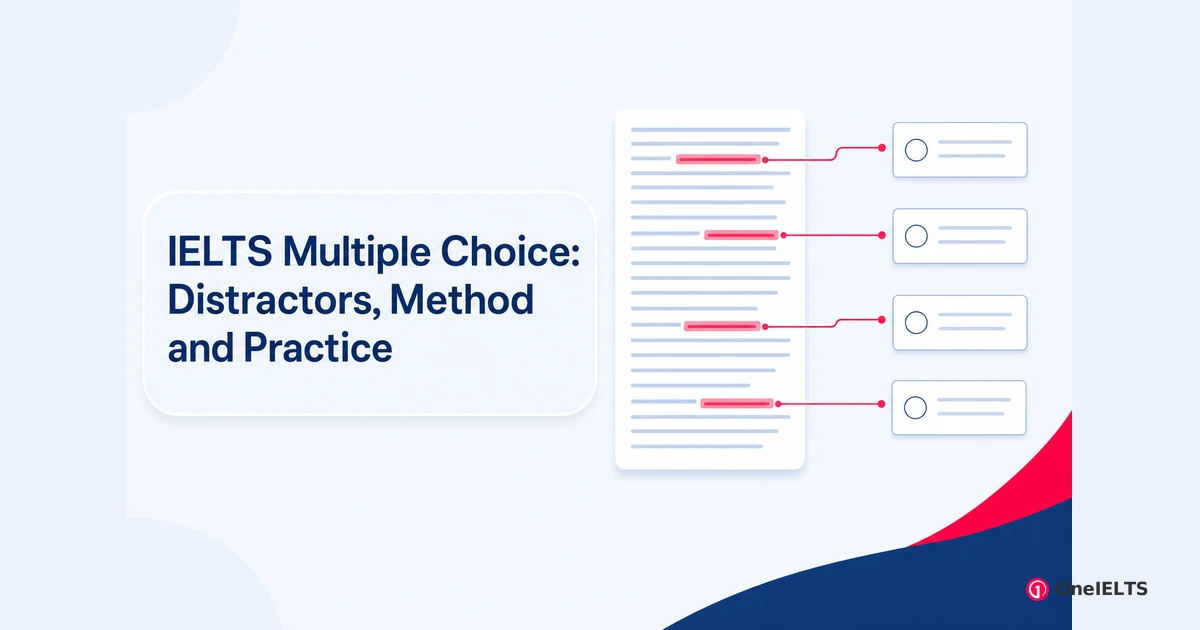
IELTS Reading multiple choice gives you a question or an unfinished sentence, three or four answer options, and one job: pick the option the reading passage supports. The catch is that the wrong options, called distractors, are built from words that genuinely appear in the text, so matching vocabulary picks the trap.
This guide covers what the question type is, how many you face, how the more than one answer variant differs, and the step-by-step answer method. It then covers the challenges candidates report, why distractors mislead, an original worked example, where to practise, and the tips that raise accuracy. Single answer sets follow the passage; multi-select sets don’t.
What Are IELTS Reading Multiple Choice Questions?
IELTS Reading multiple choice gives you a question or an unfinished sentence with three or four options, and you choose the one the reading passage supports. The task itself is small. You read a stem, then test each option against one specific part of the text.
The skills tested cover detail, opinion, implied meaning and main idea, which is why this type turns up in every part of the paper. Each question uses one located stretch of the passage, not the whole thing. How many of the 40 questions use this format changes from paper to paper, so treat any fixed figure as.
Single-answer sets follow the order of text. Question 1 is answered earlier in the passage than question 2, so once you have found the answer to one, you can start reading forward from there for the next.
How Many Multiple Choice Questions Are There in IELTS Reading?
Multiple choice is one of the official Academic Reading question types, and it appears in variable numbers rather than a fixed count per test. No paper is guaranteed to contain it in any set quantity.
The exam board lists 11 Academic Reading question types, while some prep sites split the same material into 14. Each paper uses only a subset per test, so one Reading test may open with multiple choice and another may use it once. What does not change is the total: forty questions across three passages, one mark each.
The number of multiple choice items changes from paper to paper, and no test owner publishes a per-test breakdown.
How Do Multiple Choice Questions With More Than One Answer Differ?
The two formats split on order and marking. Single answer questions follow passage order and have exactly one correct letter each. More than one answer questions ask you to pick two or three letters from a longer list, and they abandon passage order, so their answers can sit anywhere across the text.
That last point changes how you read. With a multi-select set you cannot work forward through the passage question by question; you have to hold the whole list in mind while you read the relevant section.
Marking helps you here. The marks per choice rule means you earn a mark for every correct letter you select, so a half-right answer still scores something. Guessing the remaining letter therefore costs nothing.
How Do You Answer IELTS Reading Multiple Choice Questions?
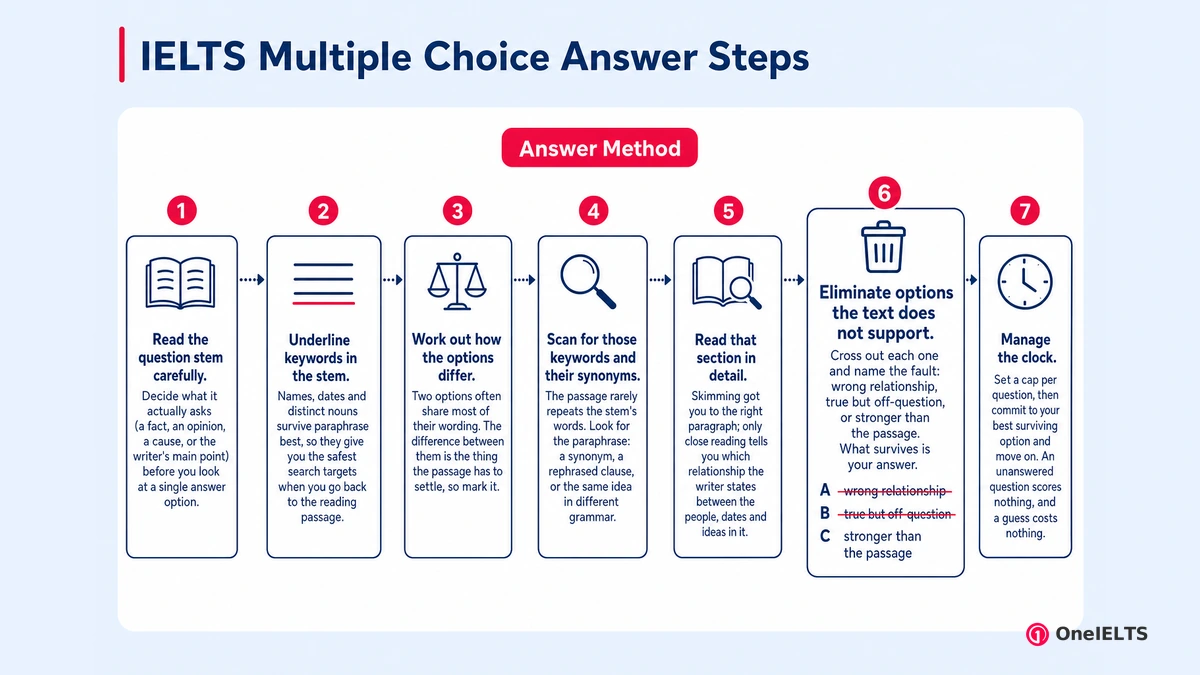
Answering multiple choice well is a process of subtraction. You read the question stem, mark what makes the options differ, find the matching part of the passage, then remove everything the text won’t back. Work the options against the text rather than against each other, and manage time so the last passage still gets a fair read.
Seven steps take you from the stem to a confirmed letter, in the order you should use them.
- Read the question stem carefully. Decide what it actually asks (a fact, an opinion, a cause, or the writer’s main point) before you look at a single answer option.
- Underline keywords in the stem. Names, dates and distinct nouns survive paraphrase best, so they give you the safest search targets when you go back to the reading passage.
- Work out how the options differ. Two options often share most of their wording. The difference between them is the thing the passage has to settle, so mark it.
- Scan for those keywords and their synonyms. The passage rarely repeats the stem’s words. Look for the paraphrase: a synonym, a rephrased clause, or the same idea in different grammar.
- Read that section in detail. Skimming got you to the right paragraph; only close reading tells you which relationship the writer states between the people, dates and ideas in it.
- Eliminate options the text does not support. Cross out each one and name the fault: wrong relationship, true but off-question, or stronger than the passage. What survives is your answer.
- Manage the clock. Set a cap per question, then commit to your best surviving option and move on. An unanswered question scores nothing, and a guess costs nothing.
What Are the Common Challenges With Multiple Choice Questions?
Four challenges account for most of the marks lost on this question type.
- Plausible options. All four read like something the passage could have said, because each one is assembled from its vocabulary. Only one carries the relationship the writer actually states.
- Heavy paraphrasing. The right answer usually shares almost no vocabulary with the sentence it comes from, so candidates who hunt for matching words walk straight past it.
- Time pressure. Every option needs checking against the passage, so one multiple choice question can swallow the time three sentence-completion questions would take.
- Broken passage order. Multi-select sets scatter their answers across the whole text, so the sequence that guides you through single-answer questions stops helping you.
Why Are Distractors So Common in Reading Multiple Choice?
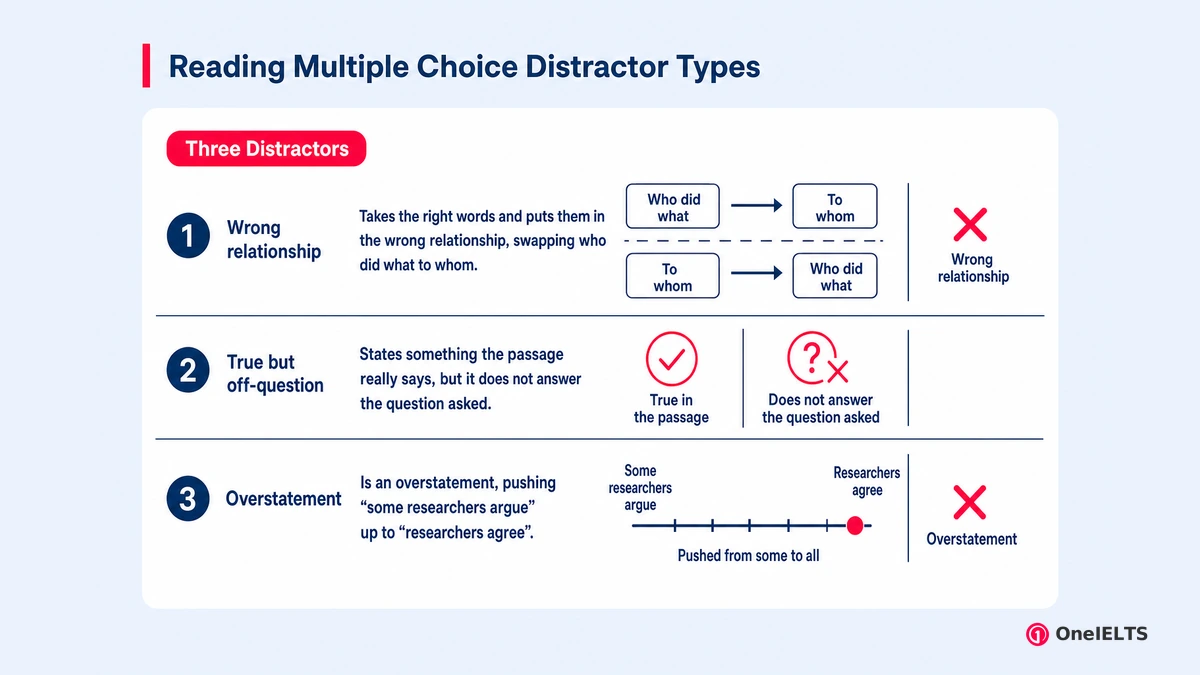
Every wrong option is assembled from words that genuinely appear in the passage, so recognition alone picks the wrong one. Distractors work because the question asks for exact meaning, not identical words.
They come in three shapes. The first takes the right words and puts them in the wrong relationship, swapping who did what to whom. The second states something the passage really says, but it does not answer the question asked. The third is an overstatement, pushing “some researchers argue” up to “researchers agree”.
What Does an IELTS Reading Multiple Choice Question Look Like?
A worked example makes those three shapes concrete. Both extracts here were written for this article, not lifted from a past paper, and both test the same decision.
Extract 1 (single answer)
Between 1908 and 1913, the Ford Motor Company cut the time needed to assemble a Model T from roughly twelve hours to about ninety minutes. Ford’s engineers invented no new machine to do it. They borrowed the moving line from Chicago’s meatpacking plants, where carcasses travelled past workers who stayed in one place. The saving came from removing the walking, not from faster hands.
Question stem: Assembly time for the Model T fell mainly because
- A. Ford’s engineers designed new machinery for the plant.
- B. Ford’s workers learned to work at a faster pace.
- C. the work was brought to workers who stayed still.
- D. Ford copied an entire production system from meatpackers.
The correct answer is C. Option A fails because the extract says the engineers invented no new machine. Option B is ruled out by “not from faster hands”. Option D is the overstatement: Ford borrowed one idea, the moving line, and not a whole system.
Extract 2 (more than one answer)
Greenhouses in the Icelandic town of Hveragerdi are heated with geothermal steam piped from beneath the streets. Tomatoes and cucumbers ripen there through the winter. The heat costs the growers almost nothing, but the crops need artificial light for sixteen hours a day, and the power for those lamps is the largest item on the books. Skilled staff are hard to find, and every crate leaves the island by ship or plane.
Question stem: Which TWO of the following does the writer state as problems for growers in Hveragerdi?
- A. the cost of lighting the greenhouses
- B. the price of the geothermal heat
- C. recruiting enough staff
- D. low winter temperatures inside the greenhouses
- E. competition from imported vegetables
A and C are correct. B is a wrong option because the heat “costs the growers almost nothing”. D contradicts the extract, which says the greenhouses are heated. E never appears at all, since shipping is mentioned and competition is not.
Where Can You Practise IELTS Reading Multiple Choice Questions?
You can practise this type on OneIELTS, where the Reading practice questions are filtered by question type. Our IELTS Reading multiple choice practice set needs a free account, and nothing more than that.
A question type drill and a full timed test train different things. The drill isolates the one decision you keep getting wrong, so you can slow down, compare the options properly and work out why a distractor caught you. The timed test rebuilds the pressure of three passages and one hour, where you get no time to linger.
PDF sets for this question type circulate widely, and plenty of candidates download them. They are static and unmarked, so they will tell you a question went wrong but never which distractor shape did it. That diagnosis is the part worth having.
Alternate the two. Run single-type drills during the week, sit one full timed test at the weekend, then review every wrong answer by distractor shape rather than by score.
What Are the Best Tips for IELTS Reading Multiple Choice?
What moves accuracy on this question type is a decision rule you apply the same way every time. The multiple choice tips that matter all push you towards ruling options out against the text instead of picking the one that feels familiar. One pattern shows up in nearly every review session: the option a candidate wrongly picks is almost always the one repeating a name or a number from the passage word for word.
Five habits separate candidates who hold their accuracy under pressure from those who lose it.
- Read every option before you scan. You can’t spot the difference between options while you’re still inside the passage.
- Underline what makes the options differ. That single word or clause is what the passage has to confirm.
- Never accept an option on shared vocabulary alone. Matching words prove nothing; matching meaning decides the mark.
- Eliminate rather than select. Ruling out three options you can disprove is safer than choosing one that sounds right.
- Cap the time per question and move on. A guessed letter costs nothing; an abandoned final passage costs several marks.
How Does Multiple Choice Fit With the Other IELTS Reading Question Types?
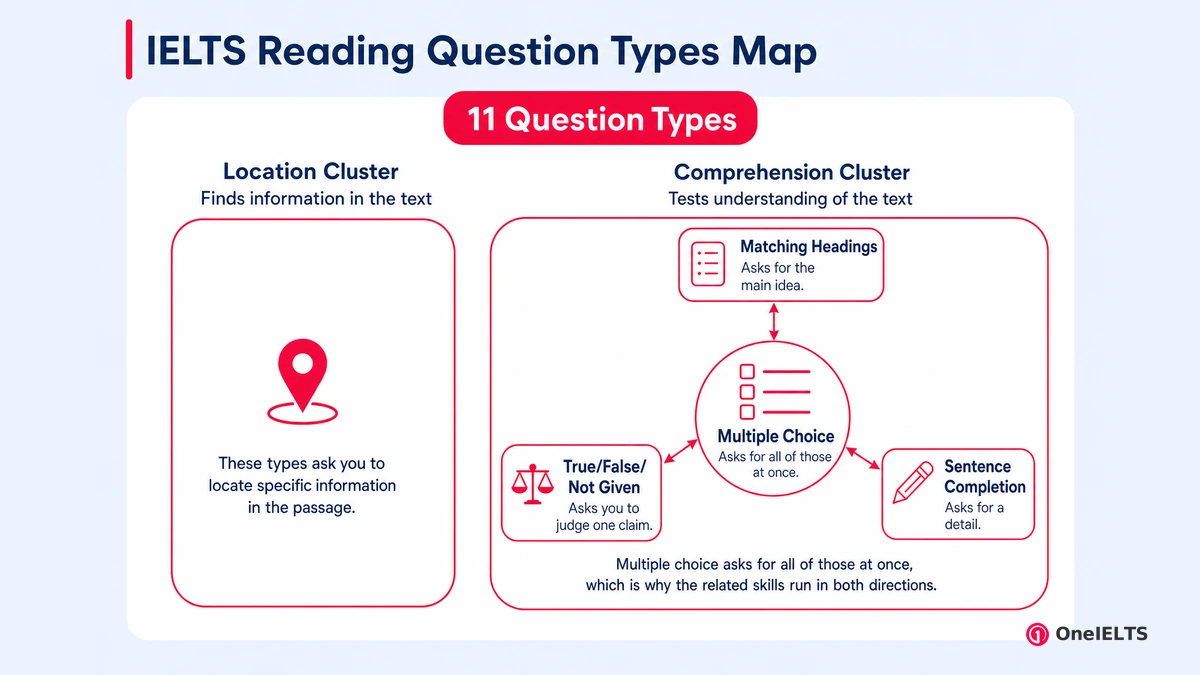
Multiple choice is one of 11 official Academic Reading question types, and it sits with the types that test comprehension rather than location. Matching headings asks for the main idea, True/False/Not Given asks you to judge one claim, and sentence completion asks for a detail. Multiple choice asks for all of those at once, which is why the related skills run in both directions.
Sharpen your elimination habit here and your accuracy across the rest of the reading test rises with it.
Is Multiple Choice Harder Than True, False, Not Given?
No, but it is slower: multiple choice makes you evaluate three or four options while True/False/Not Given asks you to judge a single statement. Both punish word-matching over meaning, so the underlying skill transfers straight across. You evaluate options against each other in one, and against nothing at all in the other. Drill the same habit in our IELTS Reading True False Not Given guide.
Is Multiple Choice the Same in IELTS Listening and IELTS Reading?
No: in Listening the distractors are things the speaker actually says and you hear them once; in Reading the options sit beside a text you can re-read. Reading multiple choice rewards elimination, since you can re-read the passage until the wording settles. Listening rewards prediction, because Listening distractors are gone the second they are spoken. Our IELTS Listening multiple choice guide covers those prediction drills.
Can You Drill Multiple Choice Alongside the Other Reading Question Types?
Yes, and you should: a full Reading passage mixes question types, so drilling multiple choice in isolation only prepares half the skill. Alternate single-type drills with a full passage under timed practice, then review both the same way. A free IELTS Reading mock test gives you that mixed set under the clock.
Written by Fahimur Rahman, reviewed 14 August 2026.
Last verified: 14 August 2026
Practice for the Real IELTS Exam
Apply what you’ve learned with free, exam-style practice:
- Take a free IELTS mock test — all four skills, real exam timing, AI band scoring
- Sit a Reading section mock — one full timed paper with an instant band score
- Practise by question type — self-paced passages with answer explanations