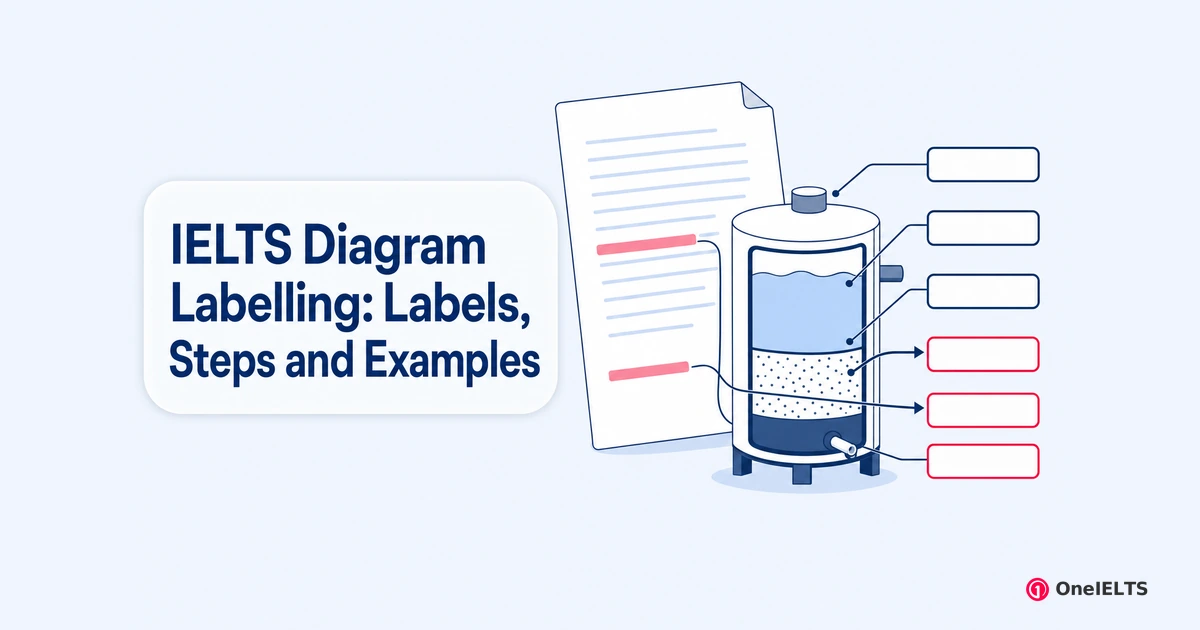
Diagram labelling gives you a picture with some labels missing and a passage that describes the object in words. You copy the missing labels straight from that passage. The official name is diagram label completion, and “labelling a diagram” means the same task.
This guide covers what the task is, the word limit rule, the skills it needs, and how the completed labels work as a free vocabulary key. It then covers why position words settle the answer, the ten-step method, the common problems and a worked example. It closes with where to practise, the best tips, and how the type fits the other Reading question types.
What Is Diagram Labelling in IELTS Reading?
You get a picture, plan or technical drawing with some labels missing, and you write each missing label using words from the passage, copied exactly and kept inside a stated word limit.
The test owners call the task diagram label completion. Ranking guides and search suggestions mostly say labelling a diagram, and both names point at one thing.
The drawing can be almost anything the passage describes. A machine, a natural process such as a life cycle, a cross-section through soil or rock, and a building plan all appear.
Answers are almost always concrete nouns naming parts and components, materials or stages. A full clause almost never fits.
Only part of the passage describes the object. One or two paragraphs usually cover it, and whole sections of the text hold no answers at all.
The diagram is not drawn to scale, and it is not a summary of the passage. It is a picture of a thing the passage describes in words, so the drawing tells you where a part sits and the passage tells you what it is called.
How Many Words Can You Write in an IELTS Reading Diagram Labelling Answer?
The instruction line above the drawing sets a hard cap, and a label that runs over the cap scores zero even when you have found the right part. The most common wording prints in capitals as NO MORE THAN TWO WORDS AND/OR A NUMBER, so it allows two words and a number inside one answer.
That word limit belongs to the question set, not to the paper. Read it again at the top of every set, because a summary task further down the same passage can carry a different figure.
Copy unchanged is the rule that follows from the cap. You never trim a long technical name to make it fit, and you never swap in a shorter word of your own.
When the passage’s fullest term breaks the cap, the answer is a shorter term the same passage also uses for that part. Hunt for it rather than editing.
Technical spelling costs marks here more than anywhere else in Reading, because the words are unfamiliar and your memory of them is unreliable. Transcribe letter by letter off the page. A hyphenated term normally counts as one word
What Skills Does IELTS Reading Diagram Labelling Test?
The task asks you to match text to picture, and that breaks into three smaller skills: noun scanning for one specific term, recognising a paraphrase around it, and reading spatial language accurately.
This is a detail task rather than a gist task. Nothing in it rewards a grasp of the writer’s argument, because every mark sits in a single named part.
Technical vocabulary is not being tested for its own sake either, since every answer already sits in the passage. What the task really measures is whether you can hold the diagram’s geometry in mind while reading prose that moves around the object in its own order.
Prior knowledge of the object is a liability rather than an asset. A candidate who recognises the machine names the parts from memory and stops checking the text.
How Do the Completed Labels Help You in IELTS Reading Diagram Labelling?
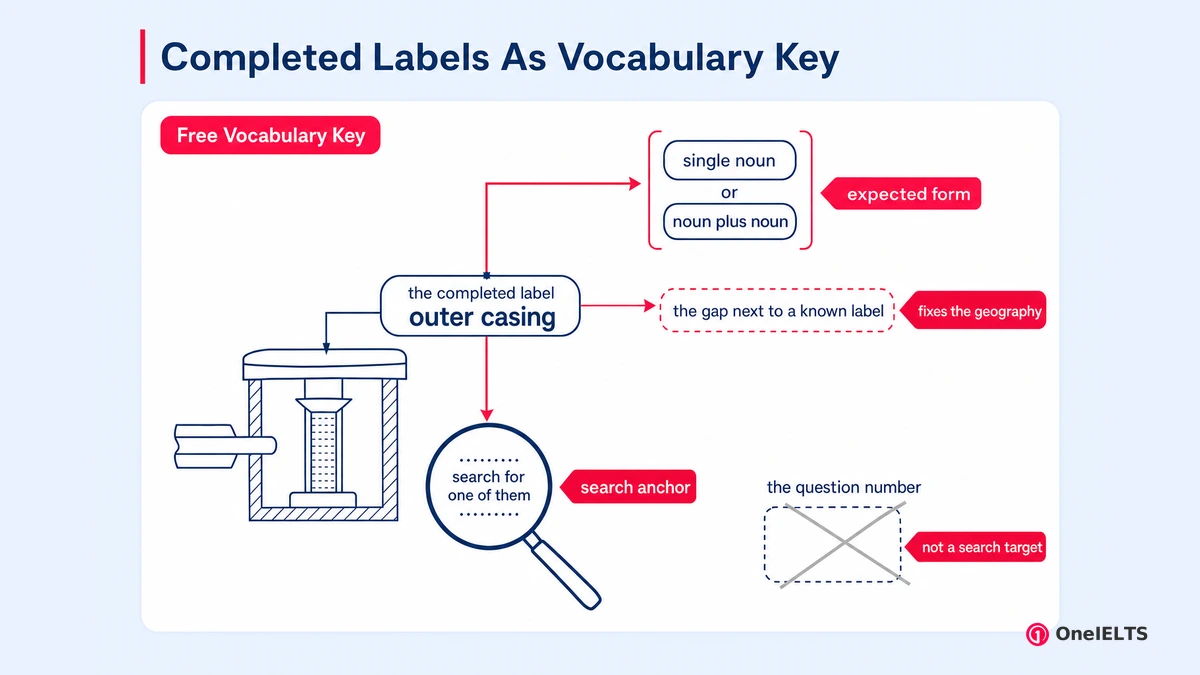
The labels already printed on the drawing are a free vocabulary key. They show the exact terms the passage uses, so you can find the right paragraph by searching for one of them instead of hunting for the gap.
The completed labels fix the geography too. A gap sitting beside a known label has to be described somewhere near that label in the text, usually in the same sentence or the one after it.
They also reveal the expected form of an answer. Where every printed label is a single noun, your gap almost certainly wants a single noun. Where one reads “outer casing”, two-word answers are in play.
So the fastest opening move is to pick a completed label near your first gap and use it as your search anchor. Scanning for the question number tells you nothing.
Why Do Position Words Decide an IELTS Reading Diagram Labelling Answer?
Two parts of the same object are often described in almost the same words, and the only thing separating them is where the passage says they sit. Position words, not the technical vocabulary, are the discriminator.
Watch for above and beneath, on top of, at the base of, surrounding, between, adjacent to, inner and outer, upper and lower. A passage can also describe an object in an order that ignores the drawing’s layout, moving from the oldest part to the newest.
Here is the pattern in miniature. Before: the gap sits under the screen, so I wrote fine sand. After: the passage says the upper bed is coarse gravel and the lower bed is fine sand, so the gap under the screen takes coarse gravel.
Similar technical terms are the paired trap, and the fix is a check against the picture. Re-reading the position phrase with your finger on the drawing proves which part the passage means.
How Do You Answer IELTS Reading Diagram Labelling Questions?
The method inverts the habit most candidates bring from other question types, because you study the diagram first and open the passage second. The picture tells you what kind of answer each gap needs, while the passage only tells you what that part is called.
These ten steps run from the instruction line to the last filled label.
- Read the instruction. Note the cap before anything else, because it decides how long a usable label can be.
- Take in the whole drawing. Work out what the object is and what it does before you read a single line.
- Read every completed label. The printed terms show the passage’s vocabulary and the geography of the object at once.
- Predict the word type. Decide whether each gap wants a material, a part name, a measurement or a stage.
- Choose a known label anchor. Pick the completed label nearest your first gap and scan the passage for that exact word.
- Read around the hit. The sentence before and the sentence after your anchor usually carry the missing part.
- Run the position check. Match the passage’s phrase for where the part sits against the drawing, not against your expectation.
- Copy the exact words. Write what the passage prints, in the same form, without tidying the term into your own English.
- Check the cap and the spelling. Count the words in your label, then compare it letter by letter with the passage.
- Skip a stubborn gap. Leave it, place the others, and come back once the surrounding labels have narrowed the choice.
What Are the Common Problems in IELTS Reading Diagram Labelling?
Marks go missing here for mechanical reasons rather than for failures of understanding. Most wrong labels name a real part of the object that the passage never mentions.
Eight problems account for nearly every lost mark on this type.
- Labelling from prior knowledge. You recognise the object, name the part from memory, and never check whether the passage agrees.
- Confusing two similar terms. Inner casing and outer casing sit a line apart in the text and look identical at speed.
- Ignoring the position words. You take the first plausible noun and label the part next to the one the passage means.
- Expecting the diagram’s order. A description can start at the base, jump to the roof and return, so sequential reading misses answers.
- Shortening a long term. Cutting a three-word name down to two words to fit the cap turns a find into a wrong answer.
- Getting the technical spelling wrong. An unfamiliar word copied with one letter out is marked wrong however clearly you found it.
- Inventing your own word. The passage names the part, so a synonym you prefer, however accurate, earns nothing on the mark scheme.
- Leaving a label blank. A blank scores zero for certain, while a guess drawn from the passage sometimes lands exactly right.
What Does an IELTS Reading Diagram Labelling Question Look Like?
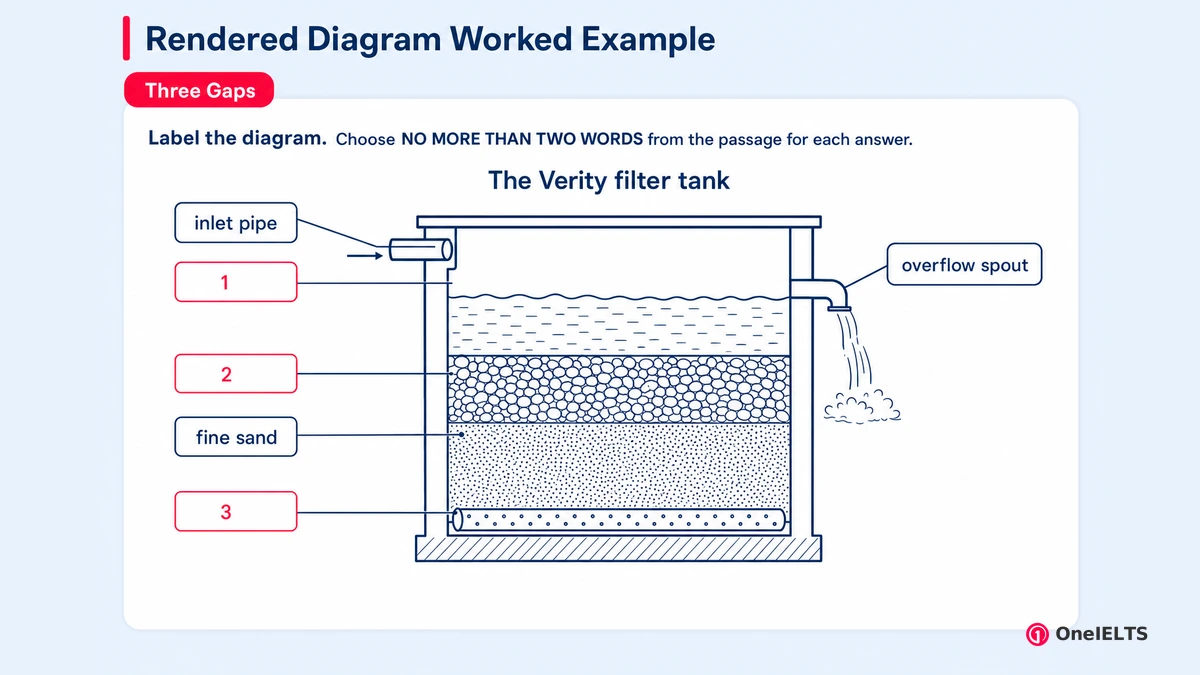
A set prints an instruction line, a drawing with numbered gaps, and a short passage describing the object. Here is a worked example built on an original passage and drawing written for this page.
The rendered diagram above carries six labels, and three of them are gaps.
The Verity filter tank
Rainwater from a roof reaches the Verity tank cold and dirty, and the tank cleans it in four stages before it reaches the pump. Water enters at the top through the inlet pipe. Immediately below that inlet, a debris screen catches leaves and roof grit, and the screen lifts out for cleaning twice a year.
The water then falls through two beds of filtering material. The upper bed is coarse gravel, laid about 200 millimetres deep, and the lower bed is fine sand of roughly the same depth. Both beds rest on a perforated tray.
Whatever the beds have not held back leaves the tank through a perforated clay pipe running the full width of the floor, which the builders call the underdrain. An overflow spout near the rim carries away whatever the tank cannot hold in heavy rain.
Label the diagram. Choose NO MORE THAN TWO WORDS from the passage for each answer.
| Position on the drawing | Label |
|---|---|
| Top left, where water enters | inlet pipe |
| Directly under the inlet | 1……… |
| Upper bed | 2……… |
| Lower bed | fine sand |
| Along the floor of the tank | 3……… |
| Near the rim, right-hand side | overflow spout |
Each note names the completed label used as the search anchor and the position phrase that confirmed the answer.
- 1 = debris screen. Anchored on inlet pipe, and confirmed by “Immediately below that inlet”, which places the part one line down.
- 2 = coarse gravel. Anchored on fine sand, and confirmed by “The upper bed”. Two beds are described in near-identical words, so position alone separates them.
- 3 = underdrain. Anchored on fine sand, and confirmed by “the full width of the floor”. The tempting “perforated clay pipe” runs to three words and breaks the cap.
Where Can You Practise IELTS Reading Diagram Labelling?
Practise this type on OneIELTS rather than chasing worksheet PDFs. Our IELTS Reading diagram labelling practice filter narrows the Reading bank to practice questions of this single type. Opening them needs a free OneIELTS account.
Diagram labelling turns up less often than the prose completion tasks, so volume is not the point of practice. The aim is to make the diagram-first habit automatic, so your eyes go to the drawing and its printed labels before the text.
A question type drill isolates that one decision, which a full timed paper cannot do.
Review your errors with three questions. Did you label from what you already knew, did you miss the position phrase, or did the answer break the cap? In the scripts we mark, the first of those three accounts for most wrong labels on this type.
What Are the Best Tips for IELTS Reading Diagram Labelling?
The diagram labelling tips that move accuracy share one idea. You settle what the answer must look like before you go hunting for it. These habits cover the whole sequence, from the instruction line to the final count.
Eleven habits separate a reliable score on this type from a lucky one.
- Read the instruction first. The cap changes between question sets, so check it before you even look at the drawing.
- Work out the object. Name what the drawing shows before you read, or the passage will not make sense.
- Use completed labels as search anchors. The printed terms are the passage’s own words, so they are findable.
- Predict what each gap wants. A material, a part, a stage or a number narrows the search before it starts.
- Scan for keywords, not sentences. Your eyes hunt one word, and reading whole paragraphs burns the time this task saves.
- Read before and after the keyword. The named part often appears in the clause on either side of your anchor.
- Let the position words settle it. Where the passage says a part sits beats what the part sounds like.
- Never label from your own knowledge. Recognising the machine helps you read, but it never supplies an acceptable answer.
- Copy the spelling exactly. Transcribe unfamiliar words letter by letter, because a near miss scores the same as a blank.
- Skip and return. A gap that resists usually solves itself once the labels around it are in place.
- Check the word limit at the end. Count the words in every label before you leave the passage.
How Does Diagram Labelling Fit With the Other IELTS Reading Question Types?
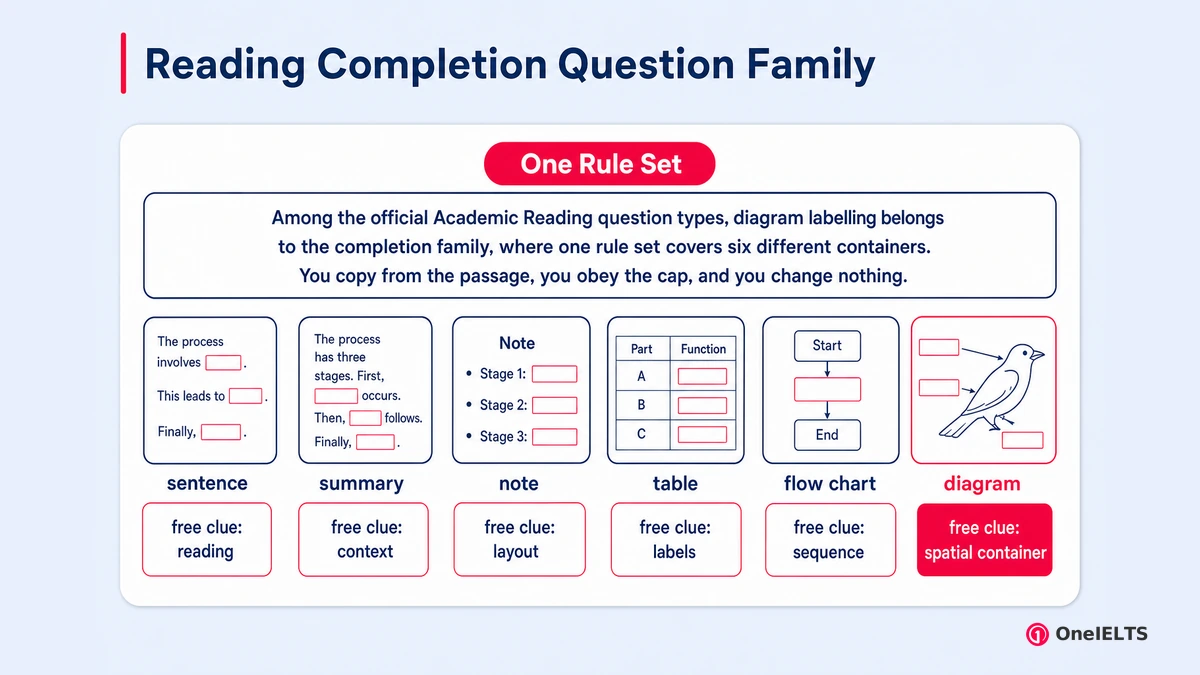
Among the official Academic Reading question types, diagram labelling belongs to the completion family, where one rule set covers six different containers. You copy from the passage, you obey the cap, and you change nothing.
That same rule set runs from sentence completion through summary, note, table, flow chart and diagram completion. Only the container changes.
Diagram labelling is the family member whose container is a spatial container. The picture carries where each part sits, not merely what it is, and that is why position language decides answers here and nowhere else in the family.
Everything above treats the task on its own. What follows sets it against its nearest neighbour in the family, against the Listening task that shares its name, and against the Cambridge papers.
Is IELTS Reading Diagram Labelling the Same as Flow Chart Completion?
No — both fill gaps in a picture under the same word limit, but a flow chart’s boxes carry a sequence while a diagram’s labels carry positions. One is settled by order words, the other by position words. A flow chart’s answers arrive in the passage’s order. A diagram’s need not, because a description can move around an object freely. Our IELTS Reading flow chart completion guide covers the sequenced version.
Is Labelling a Diagram in IELTS Listening the Same as in IELTS Reading?
No — the diagram and the cap work the same way, but in Listening the speaker walks around the object once in real time. You follow their route rather than choose your own search anchors. Listening diagram labelling also leans on plans and maps rather than technical drawings. Reading lets you re-scan the description as often as you like. Our IELTS Listening question types guide covers the audio version.
Do Cambridge IELTS Reading Tests Use Diagram Labelling?
Yes, diagram labelling is an official task type in Academic Reading, and it appears across the Cambridge IELTS papers, though less often than the prose completion tasks. A full passage carries mixed question types, so it sets diagram labelling beside True/False/Not Given and matching tasks, and switching methods becomes part of the training. Practise it whole on our free IELTS Reading mock test.
Written by Fahimur Rahman, reviewed 14 August 2026.
Last verified: 14 August 2026
Practice for the Real IELTS Exam
Apply what you’ve learned with free, exam-style practice:
- Take a free IELTS mock test — all four skills, real exam timing, AI band scoring
- Sit a Reading section mock — one full timed paper with an instant band score
- Practise by question type — self-paced passages with answer explanations