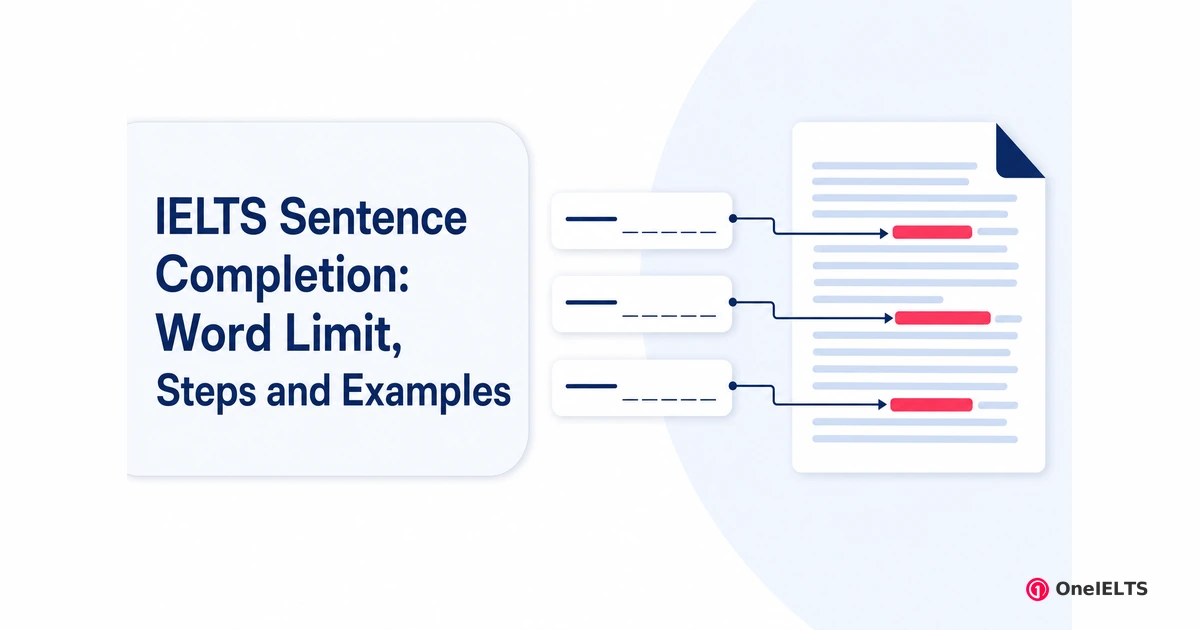
IELTS Reading sentence completion hands you half-finished sentences and asks you to complete each gap with words from the passage, inside a stated word limit.
The sentence grammar around a gap fixes the answer’s shape before you read a line of the text. A word that is factually right but grammatically impossible still scores zero.
This guide covers the task, the word cap, the skills it tests and the method. It then covers why grammar decides the answer, the common problems, a worked example, where to practise, the tips, and how the type sits beside the other Reading question types.
What Is Sentence Completion in IELTS Reading?
You are given incomplete sentences and you fill each gap with words from the passage, inside a stated word limit.
The gap moves around. It can sit at the end of the sentence, in the middle, or right at the start, and a stem that opens with a blank is the one candidates misread most. Read the whole stem before you decide what is missing.
The set runs in passage order. Question 2’s answer sits below question 1’s in the text, so once you have found the first answer you never search backwards. That single rule saves more time than any vocabulary drill.
Sentence completion appears in both Academic and General Training Reading. IELTS Listening uses the same task name, but there the answer comes from what you hear rather than from a printed text. IELTS lists it among the Academic Reading question types as Question Type 8 – Sentence completion.
How Many Words Can You Write in an IELTS Reading Sentence Completion Answer?
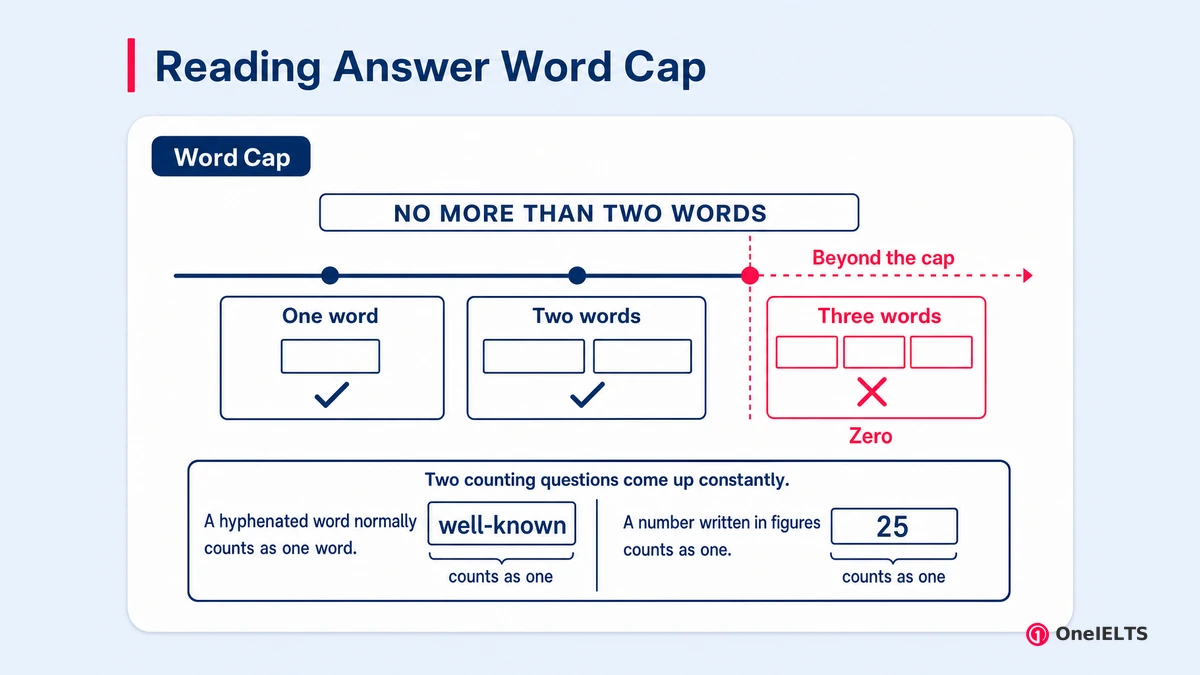
The instruction line sets a hard cap. Most sets print NO MORE THAN TWO WORDS or NO MORE THAN THREE WORDS AND/OR A NUMBER, and going over it scores zero even when the meaning is right.
The cap is not constant. It changes from one question set to the next inside the same paper, so read the instruction every time instead of carrying the last cap forward.
Two counting questions come up constantly. A hyphenated word normally counts as one word. Instructions of the form “NO MORE THAN TWO WORDS AND/OR A NUMBER” allow a number in addition to the words, so read the instruction line rather than assuming how a figure is counted.
Counting is not the whole of the word limit. You copy the word in the form the passage prints it, so you cannot turn “produce” into “production” to make your sentence read better.
What Skills Does IELTS Reading Sentence Completion Test?
The task tests locating specific detail by skim and scan, then recognising a paraphrase and reading grammar accurately.
The question almost never repeats the passage’s wording. Matching happens through synonyms and rephrased structures, so a stem reading “the cost of the scheme fell” points at a passage line reading “the programme became cheaper to run”. Hunting for a shared word takes you to the wrong place.
This is a detail task, not a gist one. The answer sits inside one or two lines of the passage, which is why you skim for the region and then read that region slowly. Grammar accuracy is the fourth skill here, and it is the one candidates rarely practise.
How Do You Answer IELTS Reading Sentence Completion Questions?
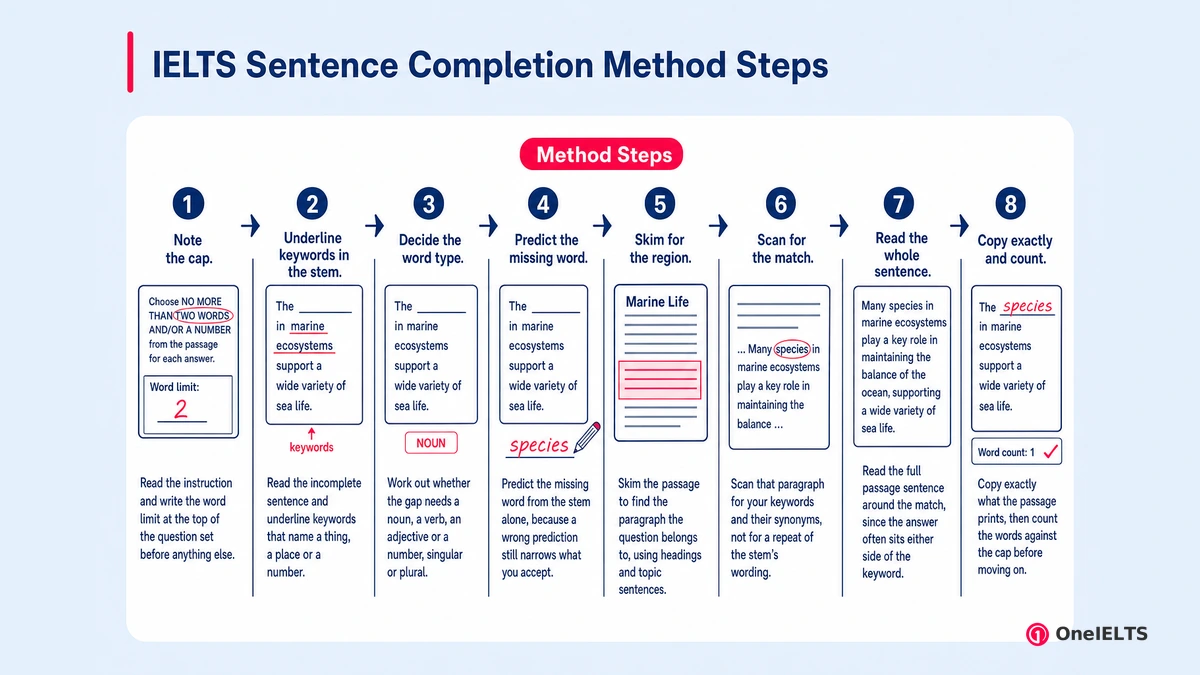
The method runs question first, passage second. You settle the cap, the keywords and the word type before you go looking, so you already know what you are hunting.
Eight steps take you from the instruction line to a checked answer.
- Note the cap. Read the instruction and write the word limit at the top of the question set before anything else.
- Underline keywords in the stem. Read the incomplete sentence and underline keywords that name a thing, a place or a number.
- Decide the word type. Work out whether the gap needs a noun, a verb, an adjective or a number, singular or plural.
- Predict the missing word. Predict the missing word from the stem alone, because a wrong prediction still narrows what you accept.
- Skim for the region. Skim the passage to find the paragraph the question belongs to, using headings and topic sentences.
- Scan for the match. Scan that paragraph for your keywords and their synonyms, not for a repeat of the stem’s wording.
- Read the whole sentence. Read the full passage sentence around the match, since the answer often sits either side of the keyword.
- Copy exactly and count. Copy exactly what the passage prints, then count the words against the cap before moving on.
Why Must a Sentence Completion Answer Fit the Grammar of the Sentence?
Because the words already printed in the stem fix what the gap can be. A gap after “a” needs a singular countable noun, and a gap after “to” needs a base verb, so grammar filters the candidates before meaning does.
Read the two or three words on each side of the gap first. They tell you the part of speech, and they tell you whether the answer is singular or plural. Both are settled before you open the passage.
The rule that costs marks is the copying rule. You keep the word form the passage uses, even when your sentence seems to want a different one. If the text prints “measured” and the stem needs a noun, the noun is somewhere else in that line.
Use sentence grammar as your last check. Read the completed sentence back in your head, and if it does not parse, the answer is wrong however true it looks.
What Are the Common Problems With IELTS Reading Sentence Completion?
Most lost marks here happen after the answer has been found. Candidates locate the right line and then spoil the answer by rewording it, overrunning the cap or changing the ending.
Six problems account for nearly all of the damage on this question type.
- Writing your own words. Using your own words instead of the passage’s wording scores zero, even when your paraphrase is perfectly accurate.
- Going over the word limit. A four-word answer under a three-word word limit is marked wrong, so count before you write.
- Changing the word form. Altering the word form to fit your own sentence breaks the copying rule, so leave the ending as printed.
- Matching a keyword in the wrong paragraph. A keyword repeated twice sends you to the wrong paragraph, where a plausible but unrelated answer waits.
- Copying a spelling wrongly. A misspelled answer scores nothing, so check your spelling letter by letter against the text.
- Leaving a gap blank. A blank gains nothing, while a guess drawn from the right paragraph still has a real chance.
What Does an IELTS Reading Sentence Completion Question Look Like?
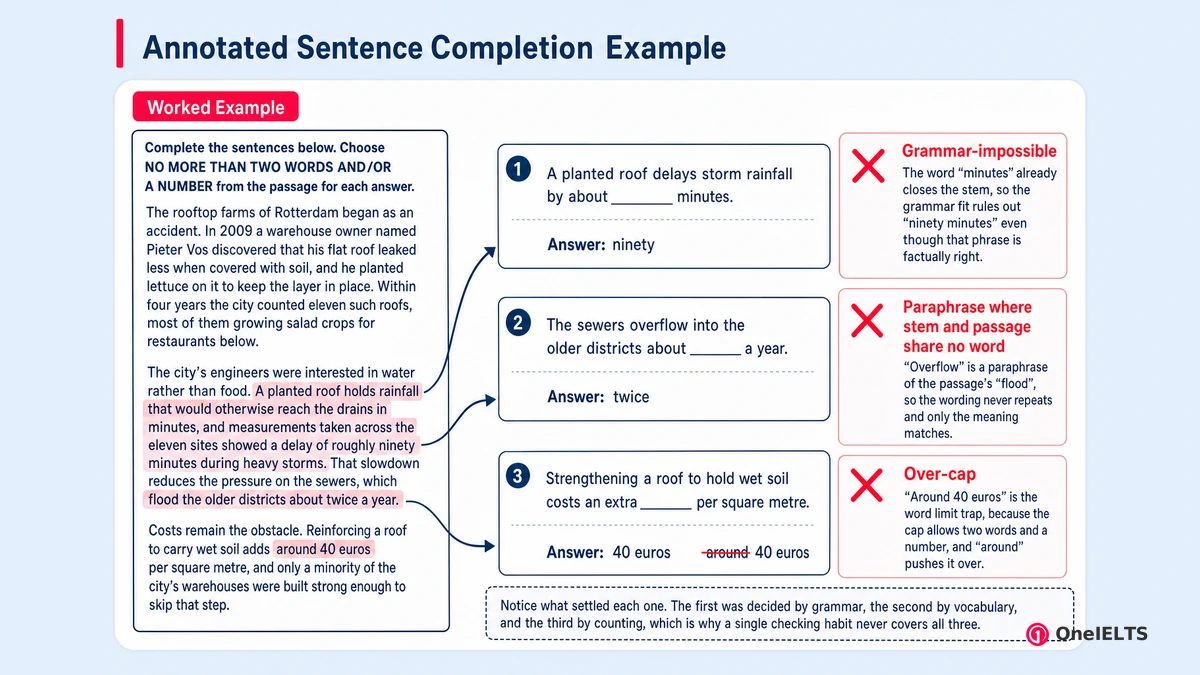
This worked example uses an original passage written for this page, not a Cambridge extract. The instruction line reads Complete the sentences below. Choose NO MORE THAN TWO WORDS AND/OR A NUMBER from the passage for each answer.
The rooftop farms of Rotterdam began as an accident. In 2009 a warehouse owner named Pieter Vos discovered that his flat roof leaked less when covered with soil, and he planted lettuce on it to keep the layer in place. Within four years the city counted eleven such roofs, most of them growing salad crops for restaurants below.
The city’s engineers were interested in water rather than food. A planted roof holds rainfall that would otherwise reach the drains in minutes, and measurements taken across the eleven sites showed a delay of roughly ninety minutes during heavy storms. That slowdown reduces the pressure on the sewers, which flood the older districts about twice a year.
Costs remain the obstacle. Reinforcing a roof to carry wet soil adds around 40 euros per square metre, and only a minority of the city’s warehouses were built strong enough to skip that step.
Three sentences follow, each with its answer and the reason the answer wins.
- A planted roof delays storm rainfall by about \_\_\_\_\_\_ minutes. Answer: ninety. The word “minutes” already closes the stem, so the grammar fit rules out “ninety minutes” even though that phrase is factually right.
- The sewers overflow into the older districts about \_\_\_\_\_\_ a year. Answer: twice. “Overflow” is a paraphrase of the passage’s “flood”, so the wording never repeats and only the meaning matches.
- Strengthening a roof to hold wet soil costs an extra \_\_\_\_\_\_ per square metre. Answer: 40 euros. “Around 40 euros” is the word limit trap, because the cap allows two words and a number, and “around” pushes it over.
Notice what settled each one. The first was decided by grammar, the second by vocabulary, and the third by counting, which is why a single checking habit never covers all three.
Where Can You Practise IELTS Reading Sentence Completion?
Practise this type on OneIELTS rather than on the loose PDF worksheets the search results push at you. Our IELTS Reading sentence completion practice pages filter practice questions down to this one type. Practising needs a free OneIELTS account.
A question type drill and a timed passage train different things. The drill repeats one loop, from reading the cap to counting the words you copied, so you can run it many times in a sitting. A timed passage puts that loop back among matching questions and True/False/Not Given, with the clock running.
Drill first, then move to a full timed passage once the copying rule has become automatic. Across our marked Reading practice, the commonest wrong answer on this type is a correct word written in the wrong form.
Review your errors against three causes. Was it the grammar, the paraphrase or the cap? Sort every wrong answer into one of those boxes for a week and the pattern in your own work becomes obvious.
What Are the Best Tips for IELTS Reading Sentence Completion?
The sentence completion tips that raise accuracy are all about order of operations. Settle the cap and the word type before you touch the passage.
Seven habits do most of the work here.
- Read the word limit first. Read the cap before the sentences, because it decides how much you may copy.
- Fix the part of speech first. Decide the part of speech the gap needs before you search the passage.
- Search for the paraphrase, not the keyword. Hunt the synonym, because the stem rarely repeats the passage’s wording.
- Read the whole sentence around your match. The answer often sits before the keyword rather than after it.
- Copy the spelling exactly. Transfer the letters as printed, since a misspelled answer earns nothing at all.
- Expect the answers in passage order. Question 5’s answer sits below question 4’s, so never search backwards.
- Cap your timing on one gap. Leave a gap after about ninety seconds and come back to it later.
How Does Sentence Completion Fit With the Other IELTS Reading Question Types?
Sentence completion is one of the official Academic Reading question types, and it belongs to the completion family alongside summary completion, note completion, table completion and flow chart completion. The instruction line sets a word limit for every member of that family, and every answer is copied out of the passage rather than picked from a lettered list.
What separates sentence completion from its siblings is the grammar frame. Each stem is a whole sentence with one piece removed, so the words around the gap tell you the answer’s form in advance. A summary gap gives you less of that frame, because the prose around it is itself compressed.
Everything above this line treats sentence completion on its own. What follows sets it beside the two tasks it is most often confused with, and beside the Cambridge papers where you meet it.
Is Sentence Completion the Same as Summary Completion in IELTS Reading?
No, they are different tasks. Sentence completion gives you separate standalone sentences, while summary completion gives you one connected paragraph whose gaps have to keep the summary reading as a whole. Summary completion also sometimes provides a word box of options, and sentence completion never does. Our IELTS Reading summary completion guide covers the connected version.
Is IELTS Listening Sentence Completion the Same Task as IELTS Reading Sentence Completion?
No, the gap-filling rule is the same, but in Listening the answer is spoken once and you cannot re-read it, so prediction of the word type matters even more. Reading lets you scan back and forth, while listening sentence completion asks you to be ready before the answer arrives. You predict the word type before the recording reaches it. Our IELTS Listening sentence completion guide covers it.
Do Cambridge IELTS Reading Tests Use Sentence Completion Questions?
Yes, sentence completion appears across the Cambridge IELTS Reading papers, which is why it is worth drilling inside a full passage rather than in isolation. A full passage mixes sentence completion with matching and True/False/Not Given, so isolated drilling leaves the switch between mixed question types untrained. Our free IELTS Reading mock test sets it inside a full sectional paper.
Written by Fahimur Rahman, reviewed 14 August 2026.
Last verified: 14 August 2026
Practice for the Real IELTS Exam
Apply what you’ve learned with free, exam-style practice:
- Take a free IELTS mock test — all four skills, real exam timing, AI band scoring
- Sit a Reading section mock — one full timed paper with an instant band score
- Practise by question type — self-paced passages with answer explanations