IELTS Reading sets 40 questions in 60 minutes across three passages, and the answer transfer happens inside that hour. Academic and General Training share those mechanics, so these tips apply to both unless stated. Judge every tip by one question: does it buy time or spend it? A better band score comes from managing the clock.
The 15 IELTS Reading tips, each unpacked in its own section, are named here.
- Learn each question type
- Skim before the questions
- Scan for names and figures
- Expect paraphrase everywhere
- Split the hour unevenly
- Transfer per passage
- Read the instruction line
- Check every spelling
- Underline and number proof
- Move past unknown words
- Never leave a blank
- Do matching headings last
- Treat NOT GIVEN as absent
- Build speed with retention
- Practise full timed passages
1. Learn What Each IELTS Reading Question Type Actually Asks
Technique only works once you know which rule a question follows. Each of the question types carries its own rule about passage order, word limit and answer format, so the type decides the tactic before any reading starts. Aim a good technique at the wrong target and it still misses.
Five properties are worth learning for every type before you practise it.
- Order. True/False/Not Given and completion sets follow the passage order; matching tasks jump around it.
- Word cap. Completion and short-answer tasks cap your answer; multiple choice and matching never do.
- Letter answers. Matching headings, matching features and multiple choice want a letter or a Roman numeral.
- Opinion tests. Yes/No/Not Given asks what the writer thinks; True/False/Not Given asks what the passage states.
- Questions first. Completion and matching-features sets reward reading the questions first; matching headings does not.
2. Skim the Reading Passage Before You Look at the Questions
Skimming gives you a map of the passage rather than an understanding of it. Two to three minutes of it tells you the general topic and the paragraph structure, which is what you need in order to find things later. Reading for meaning at this stage costs minutes you want back in Passage 3.
A skim has a fixed shape, and these five moves make up all of it.
- Title and subheadings first. They name the topic and often the writer’s angle before you read a single paragraph.
- First and last sentence. Read the opening and closing sentence of every paragraph and skip everything between them.
- Mark the turns. Note in the margin where the passage changes subject, since answers cluster near those shifts.
- Cap the clock. Give the skim two minutes on Passage 1 and three on Passage 3, never more.
- Look nothing up. Stopping at an unknown word turns a skim into a slow first read.
3. Scan the Reading Passage for Names, Dates and Numbers
Scanning works on shape, and capitals and figures are visible without reading. Your eye finds proper nouns and years on a page it has not understood, so a scan uses typography rather than meaning. Dates and figures survive the rewrite; almost nothing else does.
Five markers repay a scan, and the last one is where scans usually fail.
- Proper nouns. People, places, organisations and titles keep their capital letters, so they stand out at a glance.
- Years and figures. Dates, percentages, measurements and money almost never change form between the question and the passage.
- Technical nouns. A specialised term such as photosynthesis or sediment appears in few places, which narrows the search fast.
- Italics and quotation marks. Typography flags a definition, a coined term or a quoted source that questions often target.
- The synonyms too. Scan for likely synonyms of each keyword, because the passage rewords everything that is not a name.
4. Expect Every IELTS Reading Answer to Be Paraphrased
The question’s wording is deliberately not the passage’s wording. That design choice sets the word matching trap, because the writer plants a question’s exact words beside the wrong information. Read for the idea and the paraphrase becomes visible.
Paraphrase in IELTS Reading takes five predictable shapes.
- Synonym swap. Single words change first, so cost becomes expenditure, and synonyms carry most of the rewriting you meet.
- Voice flip. An active sentence in the passage turns passive in the question, which moves the subject to the end.
- Clause rebuild. A noun phrase such as population growth reappears as a clause, the number of people grew.
- Qualifier shift. A qualifier moves up or down, so most in the passage becomes all in a false statement.
- The exception. Names and figures usually stay put, which is exactly why they make the best scanning targets.
5. Split Your 60 Minutes Unevenly Across the Three Reading Passages
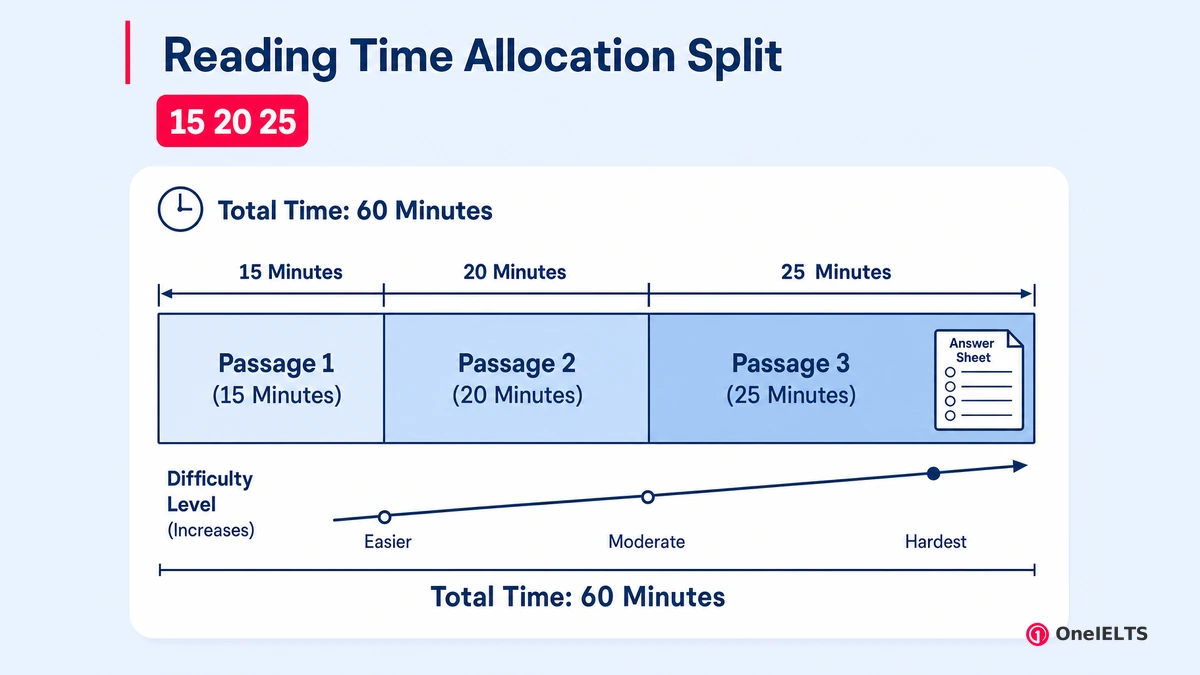
Give Passage 1 about fifteen minutes, Passage 2 about twenty, and Passage 3 about twenty-five. Teachers call it the 15 20 25 split. The design makes the third passage hardest, and your 60 minutes also has to cover the answer transfer, so an even three-way share leaves you short where marks are hardest to win.
Time allocation is the skill Reading actually tests. Judge every tip on this page by one question: does it buy you time or spend it? Skimming buys time. Re-reading a whole passage to settle one NOT GIVEN spends it.
The allocation works as five rules rather than one.
- Passage 1, about 15 minutes. The texts are shortest and the questions most literal, so bank time here.
- Passage 2, about 20 minutes. Argument and opinion appear, and matching tasks start costing more than completion sets.
- Passage 3, about 25 minutes. The longest text meets the densest question mix, so it earns the extra ten minutes.
- Cap any passage at 20 minutes. If you are running level rather than ahead, stop at twenty and move on.
- Spend the last minutes checking. Use the closing minutes on blanks and spellings rather than on opening a new question.
The pattern shows up in almost every timed mock we mark. Candidates finish Passage 1 with minutes in hand, then leave four or five Passage 3 questions empty. The lost marks sit at the end of the paper, not in the hard vocabulary.
6. Transfer Your IELTS Reading Answers as You Finish Each Passage
Reading gives no extra transfer time. Reading has no separate window at the end, so every second spent entering answers comes out of the same hour. Candidates who plan to copy everything at the end are the ones who run out.
Four habits keep answer-recording cheap.
- Transfer per passage. Copy each passage’s answers as you finish it, not once at the end of the paper.
- Copy in blocks of ten. Ten at a time keeps your eye on the numbering and stops a column shifting.
- Check the number, not the answer. Read the question number on the sheet before you write the word beside it.
- On computer-delivered, review instead. Nothing needs transferring on screen, so spend the minutes you save rechecking answers.
7. Read Every IELTS Reading Instruction Line and Respect the Word Limit
The instruction line above each question set, and not the question itself, sets the rules you are marked against. It fixes the word cap, the answer format and whether options repeat, and it changes between sets inside one passage. Two seconds of reading it protects a whole set of otherwise correct answers.
Check these five things in the line before you answer anything under it.
- The word cap. NO MORE THAN TWO WORDS means two, and the line says whether a number counts as a word.
- Whether you may reuse options. Some matching sets let you reuse options and some use each letter once only.
- Letters or words. The line tells you to write a letter, a Roman numeral or words from the passage.
- YES/NO or TRUE/FALSE. Write the pair the line names, because the wrong pair scores zero.
- The cap changes mid-passage. One passage caps answers at two words in one set and three in the next.
8. Check the Spelling of Every IELTS Reading Answer You Copy
A misspelled answer is a wrong answer, even when you found the right words in the right place. Reading marks the string you write, so spelling is worth as much as comprehension on every completion task. The words sit printed in front of you, which makes these the cheapest marks on the paper to protect.
Five small checks protect marks you have already earned.
- Copy letter by letter. Read the word off the passage as you write it rather than from memory.
- Keep singular and plural exact. If the passage prints emissions, write emissions, because the missing s costs the mark.
- Keep the capital letters. Proper nouns keep their capital letters on the answer sheet exactly as the passage prints them.
- Watch one-letter differences. Technical pairs such as adaption and adaptation look alike and are marked as different words.
- British or American spelling. Copy the form the passage uses; and where a word has two standard spellings, both British and American forms are accepted.
9. Underline the Proof in the Reading Passage and Number It
Underline the proof rather than the whole sentence, and you never search for the same evidence twice. When you come back to check an answer, the words that settle it are already on the page with a question number beside them. That second search is what costs the minutes.
The marking system has five parts, and every one of them works on screen too.
- Underline the words, not the sentence. Mark only the phrase that proves the answer, so the proof stays findable.
- Margin numbering. Write the question number in the margin beside the underlined phrase and the pairing survives any gap.
- Dot the doubtful ones. A dot beside a question you were unsure of makes the review list build itself.
- Eliminate options visibly. Cross out the options you have ruled out so a second look does not reconsider them.
- Use the highlight tool. The computer test gives a highlight tool and a notes box for the same two jobs.
10. Keep Moving Past Unknown Words in the Reading Passage
Nobody asks you to understand the passage. You are marked on 40 answers, so unknown words only matter when an answer depends on them. Most do not, and the reader who stops at every hard term loses more marks to the clock than to vocabulary.
Handle an unknown word in five steps, in this order.
- Ask whether it matters. Check first whether the question depends on that word at all, because most questions do not.
- Use the context for its role. The surrounding sentence tells you what the word does, which is usually enough.
- Read the part of speech. A verb, a noun or an adjective each keeps the sentence moving without a definition.
- Skip and return. Leave the question, mark it with a dot, and come back once the passage is finished.
- Cap the cost at seconds. No single word earns more than a few seconds of a 60-minute paper.
11. Never Leave an IELTS Reading Answer Blank
IELTS Reading applies no penalty for guessing, so a blank scores zero while a guess sometimes scores one. On a True/False/Not Given item a blind pick lands one time in three. The no blank answers rule is arithmetic, not optimism.
Guess with a method, and these four beat picking at random.
- On True/False/Not Given. Pick the option you have used least, because the three appear in rough balance.
- On matching tasks. Use a letter you have not placed yet, since most matching sets spread the options.
- On completion tasks. Write the most plausible words from the right part of the passage; an educated guess often lands.
- In the last two minutes. Sweep the answer sheet for empty boxes and fill every one before the clock stops.
12. Leave Matching Headings Until Last in an IELTS Reading Passage
Matching headings needs the whole passage understood, and the other question sets teach you those paragraphs for free. Do them first and you reach the headings already knowing what paragraph C argues, which turns a slow task into a quick one. Order of attack decides how expensive this type is.
Four moves make the heading set cheap.
- Read for the main idea. Decide what each paragraph is mainly doing before you look at the heading list.
- Eliminate headings as you go. Do the obvious paragraphs first and eliminate headings already used, which shrinks every later choice.
- Watch the one-word pairs. Two headings often differ by a single word such as causes against effects.
- Expect extra headings. The list always carries more headings than paragraphs, so unused options prove nothing about your answers.
13. Treat NOT GIVEN as Absent, Not as False, in IELTS Reading
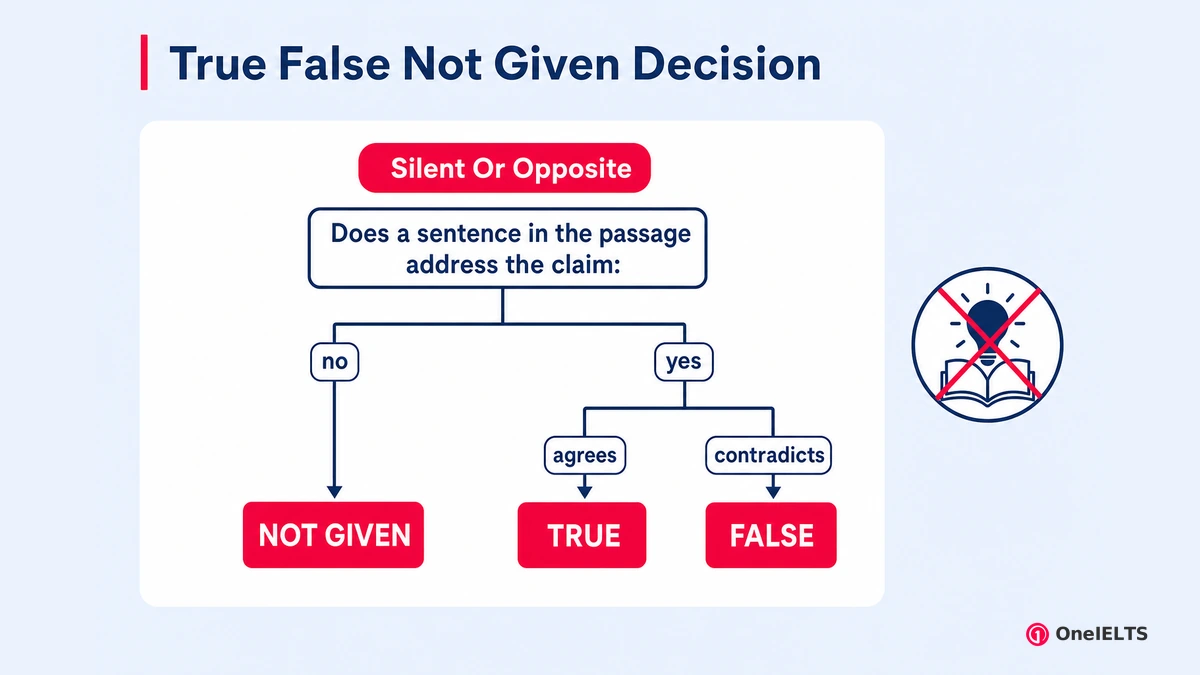
FALSE means contradicted by the passage, while NOT GIVEN means the passage never says. A statement is NOT GIVEN whenever the text stays silent about it, so a claim can sound completely wrong and still be NOT GIVEN.
Separating silence from contradiction comes down to five questions.
- Hunt the contradiction first. Choose FALSE only when you can point at the sentence that says the opposite.
- Read silence as NOT GIVEN. If no sentence addresses the claim, mark NOT GIVEN however wrong the statement sounds.
- Leave outside knowledge out. What you know about the topic has no marks attached; only the passage counts.
- Compare the qualifying words. Match some against all and often against always, because qualifying words decide most of these items.
- Write the words in full. Use the set the instruction names and write it out rather than abbreviating to letters.
14. Build IELTS Reading Speed Without Losing Comprehension
Speed bought by skipping meaning comes back as wrong answers. Reading speed grows out of habit rather than effort, because a rushed reader still has to find the proof. Pace and retention improve together or not at all.
Five habits raise pace without costing accuracy.
- Read long non-fiction daily. Feature journalism and popular science build stamina that exam extracts alone never reach.
- Time one passage weekly. Record the minutes and the score together, because either number alone hides the trade-off.
- Stop sub-vocalising. Saying words in your head caps you near speaking pace, which sits far below reading pace.
- Grow the academic vocabulary. The passages reuse the same academic vocabulary, so every learned word pays across many papers.
- Test retention in one sentence. Summarise each paragraph in a single sentence; if you cannot, the pace is too high.
15. Practise on Timed Full IELTS Reading Passages, Not Loose Extracts
The unit of practice is a whole passage under the clock, because the skill being tested is spreading an hour across mixed question types. A single-type worksheet trains recognition and trains nothing about allocation. Timed practice on a full passage is the only exercise that reproduces the pressure.
Five rules make reading practice count.
- Do full passages weekly. Sit at least one complete passage to time every week, with the clock visible throughout.
- Drill a named weakness only. Single-type drills fix a weakness you have already identified, and they replace nothing else.
- Review the cause, not the answer. Ask why the wrong option looked right, because the cause repeats.
- Keep an error log. Record every mistake by question type, and the weakest family shows up within three papers.
- Test two strategies. Try questions-first on one paper and passage-first on the next, then keep the better score.
Which IELTS Reading Tips Change With the Question Type?
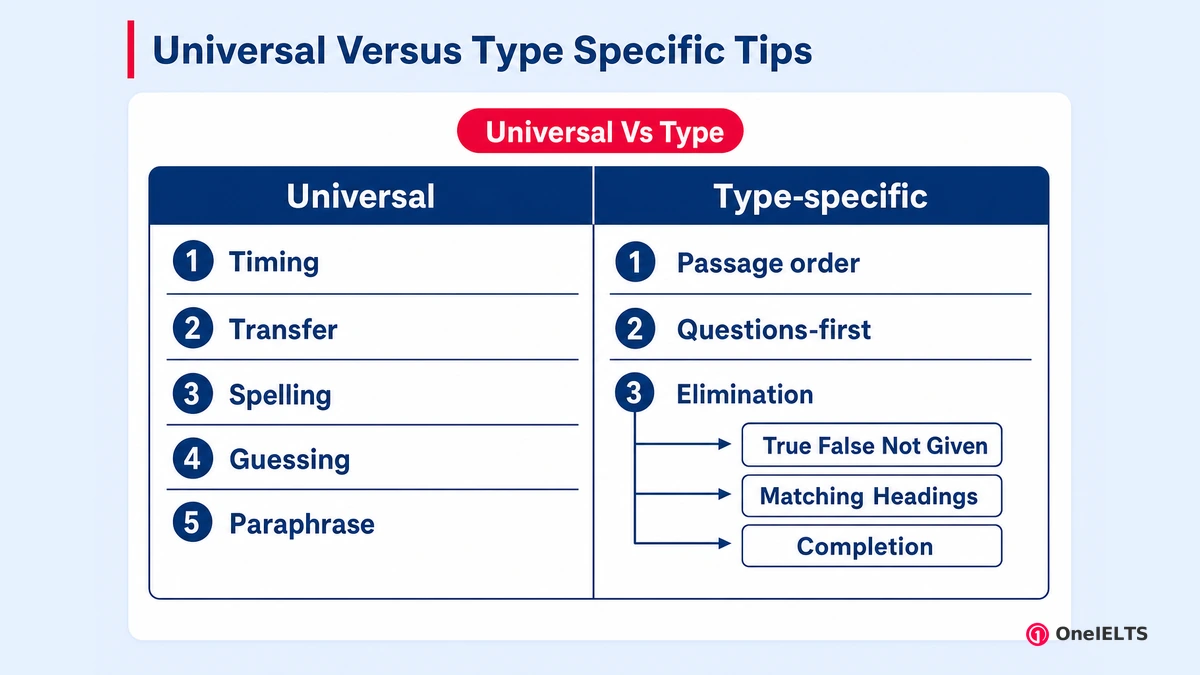
Five of the fifteen tips hold everywhere and three do not. Timing, transfer, spelling, guessing and paraphrase-awareness are the universal tips, because they belong to the hour rather than to any single item. The three that shift with the question types are the assumption that answers run in passage order, the habit of reading the questions first, and the elimination method.
Carried across the wrong type, those three cost marks. Answers follow the passage order in completion and True/False/Not Given sets and ignore it in matching tasks. Reading the questions first pays on completion sets and wastes time on matching headings. Elimination matters most where the options outnumber the slots.
The split is not our invention. IDP’s tips page divides its advice into type-specific tips for matching headings and for True, False and Not Given, and Google’s AI Overview for this query carries a Question-Specific Strategies block. The four sub-questions below take the split one type at a time.
Which IELTS Reading Tips Help Most With True, False, Not Given?
The paraphrase tip and the qualifier check do most of the work here, because the difference between FALSE and NOT GIVEN usually turns on one adverb rather than on the topic words. Qualifying words determine the answer. The no-blank rule pays best here, where an educated guess between three options beats a blank. Our IELTS Reading True False Not Given guide works through the decision step by step.
Do the Same IELTS Reading Tips Work for Matching Headings?
Mostly not — matching headings is the one type where reading the questions first wastes time, because the headings only make sense once you know what each paragraph is doing. Read for the main idea first, then choose. Elimination matters more here than anywhere else, because the list always holds extra headings and each heading you place uses up one option. Our IELTS Reading Matching Headings guide shows that order in full.
Which IELTS Reading Tips Matter Most for Completion Questions?
The instruction-line tip and the spelling tip decide completion questions, because a correct idea written in your own words or over the word cap scores nothing. Check the word limit on the instruction line, then copy unchanged from the passage. Predicting the part of speech before you scan is this family’s own shortcut, and the whole family shares one rule set. See our IELTS Reading Sentence Completion guide.
Where Should You Practise These IELTS Reading Tips?
On full timed passages first, because the tips that matter most are about allocating the hour, and only a whole passage puts that under pressure. Timed practice on a full passage comes first, and a per-type drill is for fixing a weakness your error log has already named.
Our IELTS Reading practice pages need a free OneIELTS account. For the multi-week plan behind these tips, read how to improve IELTS Reading skills.
Written by Fahimur Rahman, reviewed 14 August 2026.
Last verified: 8 October 2026
Practice for the Real IELTS Exam
Apply what you’ve learned with free, exam-style practice:
- Take a free IELTS mock test — all four skills, real exam timing, AI band scoring
- Sit a Reading section mock — one full timed paper with an instant band score
- Practise by question type — self-paced passages with answer explanations