Sixty minutes, three sections, forty questions, and not one spare minute to copy anything out. That is the IELTS Reading test format, and the test owners publish those numbers as rules rather than advice. Two papers run on it: IELTS Academic Reading and IELTS General Training Reading. Reading is the component where the two differ most, so the paper you booked changes what you meet.
This page covers the format itself, its structure and timing, and how the modules differ. It then takes the Academic passages, the General Training sections, the eleven question types, the skills tested, and the computer-delivered version. The last three parts give a plan for the hour, where to practise, and how forty marks become a band.
What Is the IELTS Reading Test Format?
The IELTS Reading test format is the published rule set for the paper’s length, its sections, its question count and its question types. Those numbers are fixed by the test owners, so nothing in this section is a suggestion.
Reading is the second of the four timed components, taken on the same day as Listening and Writing. Two versions of the paper exist, and Reading is where IELTS Academic Reading and IELTS General Training Reading part company most sharply.
Computer-delivered IELTS uses the same passages, the same forty questions and the same hour as the paper sitting. Only the interface and the answer-recording step change. Both test partners run the same paper, so where you book it changes nothing about the format.
This page owns the format itself. Strategy, reading speed and score improvement sit on the other OneIELTS Reading pages.
What Is the Structure and Timing of the IELTS Reading Test?
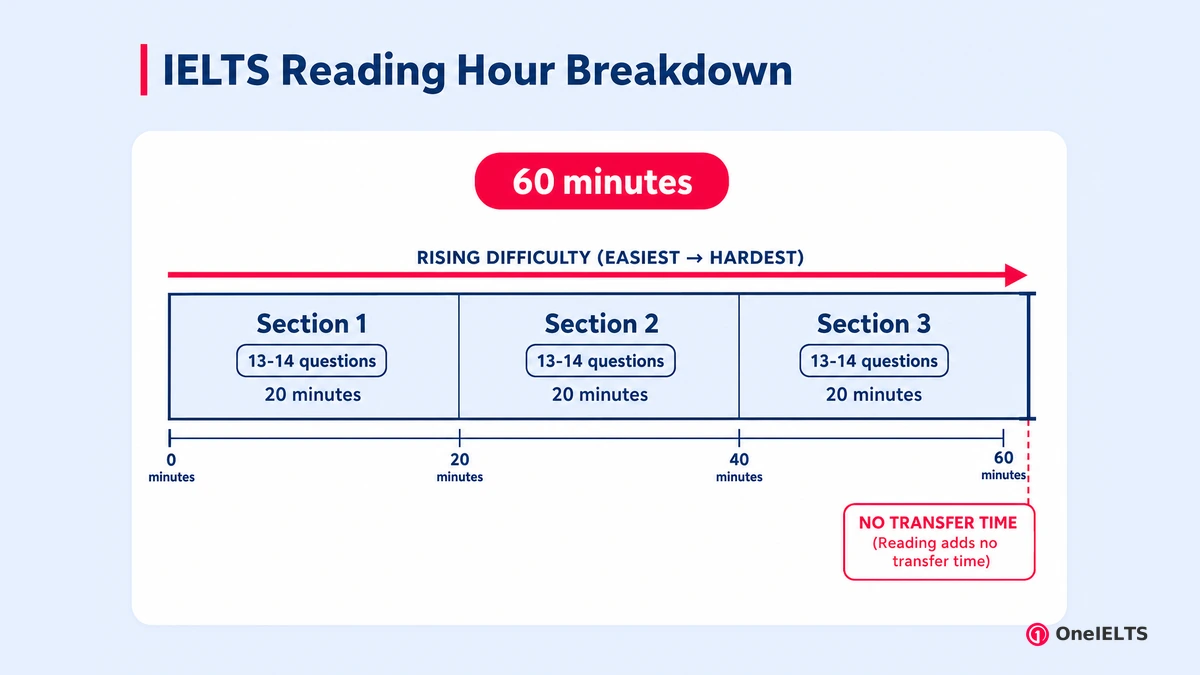
The paper runs sixty minutes, three sections and forty questions, with no extra time to transfer answers. The hour includes everything. Here is how that hour splits, with what each section holds and how many questions it carries.
| Section | What it contains | Number of questions | Suggested time |
|---|---|---|---|
| Section 1 | The easiest text of the paper, with the most direct wording and the shortest route from question to answer | 13-14 | 20 minutes |
| Section 2 | A middle text that mixes fact and opinion, with more paraphrase sitting between the question and the passage | 13-14 | 20 minutes |
| Section 3 | The longest and densest text, set as the hardest by design, and the one candidates most often run short on | 13-14 | 20 minutes |
The three sections rise in increasing difficulty, so the last one is hard by design rather than by luck. The forty questions divide roughly thirteen to fourteen per section, and that even split is where the twenty-minute default plan comes from.
On the paper-based test you write each answer straight onto the answer sheet as you go. Reading adds no transfer time the way Listening does. Every correct answer is worth one mark and a wrong one costs nothing, so an unanswered question is the only certain zero on the paper.
What Are the Differences Between the Academic and General Training Reading Formats?
The hour, the three sections and the forty questions are identical in both modules. What changes is where the texts come from, how long they are, how each section is built, and how many correct answers a given band needs. This comparison sets the two papers side by side on the eight features that actually move.
| Feature | IELTS Academic Reading | IELTS General Training Reading |
|---|---|---|
| Purpose | Proves you can cope with English-medium university study and the reading load of a degree course | Proves you can handle everyday English at work and in daily life in an English-speaking country |
| Number of passages or texts | Three long passages, one per section, so the passage count and the section count match exactly | Five to six shorter texts spread across three sections, so texts outnumber sections in this module |
| Text sources | Books, journals, magazines and newspapers, all written for a general audience rather than for specialists | Notices, advertisements, timetables, contracts, staff handbooks and manuals, plus one general-interest article |
| Total word count | 2,150 to 2,750 words across the three passages, which is the heavier reading load of the two modules | Shorter overall, because the survival and workplace texts are brief rather than extended pieces of writing |
| How the sections are built | One self-contained passage per section, each carrying its own two or three question sets | Section 1 social survival, Section 2 workplace survival, Section 3 one longer text of general interest |
| Difficulty progression | Rises passage by passage, with the third passage the longest and the most heavily argued | Rises text by text, with Section 3 the only piece of extended reading in the paper |
| Question types used | Drawn from the official inventory of eleven types, so drilling a type is never wasted work | Drawn from the same eleven-type inventory, so a type you practise for one module transfers to the other |
| Raw score needed for the same band | Fewer correct answers out of forty are needed for a given band on this module | More correct answers out of forty are needed for the same band on this module |
Both modules draw their questions from the same official inventory, so a type you drill for one paper is not wasted on the other. General Training is not the easier paper in scoring terms. Its texts are shorter and plainer, and the raw score conversion answers that by asking for more correct answers. That last table row is the one candidates miss.
What Do the IELTS Academic Reading Passages Look Like?
Three long passages of general academic interest, 2,150 to 2,750 words in total, taken from books, journals, magazines and newspapers, and set in rising order of difficulty. An Academic passage is a real piece of published writing, reprinted with light editing, not a text written for the exam. Academic Reading passages come from sources any general reader could pick up, so the subject never sits behind a specialism. Six characteristics describe what you actually meet on the page.
- Writing styles. Passages run descriptive, factual and analytical, and a discursive text argues a case instead of only reporting facts.
- Non-specialist topics. Every passage is written for a general audience, so no subject knowledge is assumed, tested or rewarded.
- Diagrams and graphs. A passage may carry diagrams, graphs or illustrations, and some questions point at those rather than at the prose.
- Glossary support. A short glossary appears with the passage whenever the writer uses genuinely technical terms you could not infer.
- One argued passage. At least one of the three may present a detailed argument or a single writer’s point of view.
- The third passage. Passage 3 is the longest and densest by design, which is why it eats the most time.
No subject knowledge is rewarded, so a biology graduate holds no edge on the biology passage. The sheer length is the reason the format punishes reading every word.
What Do the IELTS General Training Reading Sections Look Like?
Three sections of everyday English: short survival texts first, workplace texts second, and one longer general-interest text last. Each General Training Reading section carries its own theme, its own text count and its own kind of source material.
| Section | Theme | Texts in it | What the texts are |
|---|---|---|---|
| Section 1 | Social survival | Two to three short factual texts, so this section carries the most separate pieces of reading | Notices and advertisements, timetables, public information leaflets and short service descriptions from daily life |
| Section 2 | Workplace survival | Two work-related texts, fewer pieces than Section 1 but longer and denser than the notices | Contracts, staff handbooks, job descriptions and training manuals, the workplace texts an employee reads on an ordinary day |
| Section 3 | General reading | One longer text only, which is why the number of sections and the number of texts differ | A single extended piece on a topic of general interest, carrying a more developed argument than the earlier texts |
Section 1 can carry three texts while section three carries exactly one, so the number of texts and the number of sections are different counts. The everyday sources are why General Training reads more easily than the Academic paper. That ease is priced in: the conversion still asks for more correct answers at the same band.
What Are the 11 IELTS Reading Question Types?
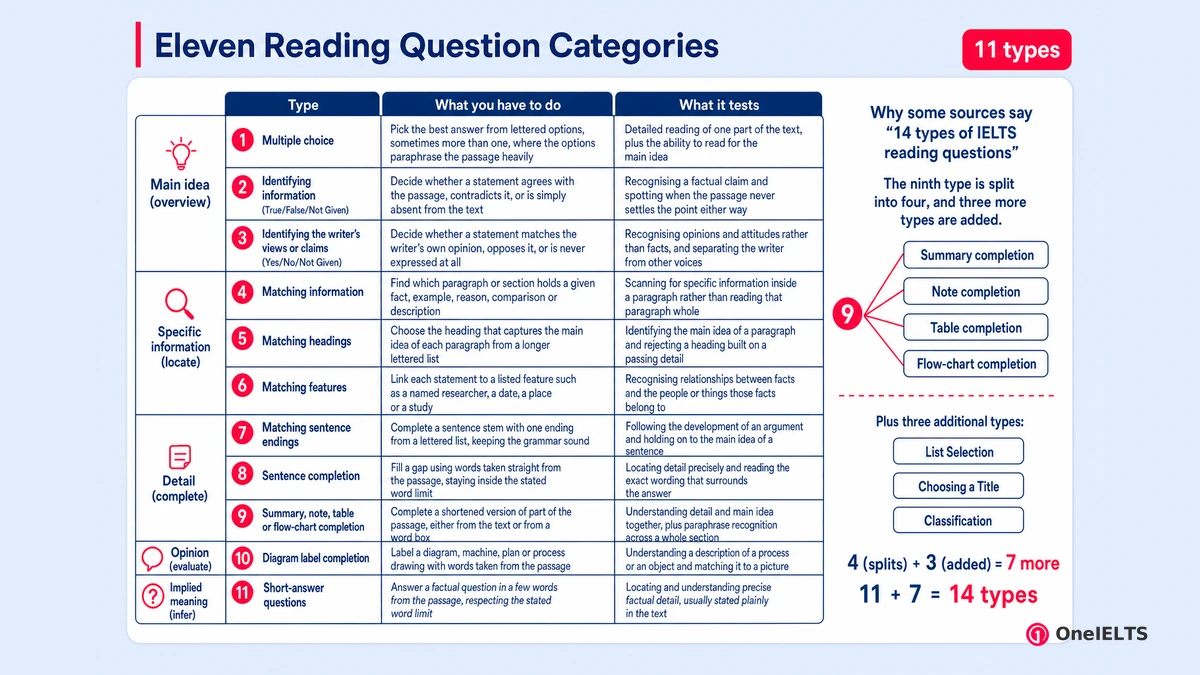
IELTS Reading uses eleven official question types, and the test owner names them in a fixed order. They run: multiple choice, identifying information, identifying the writer’s views or claims, matching information, matching headings, and matching features. The list then continues with matching sentence endings, sentence completion, summary or note or table or flow-chart completion, diagram label completion, and short-answer questions.
The table sets out all eleven IELTS Reading question types with what each one asks, what it tests and how many questions it can carry.
| Type | What you have to do | What it tests |
|---|---|---|
| Multiple choice | Pick the best answer from lettered options, sometimes more than one, where the options paraphrase the passage heavily | Detailed reading of one part of the text, plus the ability to read for the main idea |
| Identifying information (True/False/Not Given) | Decide whether a statement agrees with the passage, contradicts it, or is simply absent from the text | Recognising a factual claim and spotting when the passage never settles the point either way |
| Identifying the writer’s views or claims (Yes/No/Not Given) | Decide whether a statement matches the writer’s own opinion, opposes it, or is never expressed at all | Recognising opinions and attitudes rather than facts, and separating the writer from other voices |
| Matching information | Find which paragraph or section holds a given fact, example, reason, comparison or description | Scanning for specific information inside a paragraph rather than reading that paragraph whole |
| Matching headings | Choose the heading that captures the main idea of each paragraph from a longer lettered list | Identifying the main idea of a paragraph and rejecting a heading built on a passing detail |
| Matching features | Link each statement to a listed feature such as a named researcher, a date, a place or a study | Recognising relationships between facts and the people or things those facts belong to |
| Matching sentence endings | Complete a sentence stem with one ending from a lettered list, keeping the grammar sound | Following the development of an argument and holding on to the main idea of a sentence |
| Sentence completion | Fill a gap using words taken straight from the passage, staying inside the stated word limit | Locating detail precisely and reading the exact wording that surrounds the answer |
| Summary, note, table or flow-chart completion | Complete a shortened version of part of the passage, either from the text or from a word box | Understanding detail and main idea together, plus paraphrase recognition across a whole section |
| Diagram label completion | Label a diagram, machine, plan or process drawing with words taken from the passage | Understanding a description of a process or an object and matching it to a picture |
| Short-answer questions | Answer a factual question in a few words from the passage, respecting the stated word limit | Locating and understanding precise factual detail, usually stated plainly in the text |
No per-type question count is published. The exam board fixes the eleven types and the forty questions, not how many items each type carries, so one paper may run three matching sets and another none. Read the instruction line above each set rather than planning a fixed split.
A live related-search chip asks for “14 types of IELTS reading questions”, and that count is not a contradiction. Aggregators split the ninth type (summary, note, table and flow-chart completion) into four separate types, then add List Selection, Choosing a Title and Classification. The traceable source for the longer list is ieltsliz.com/ielts-reading-question-types, which enumerates fourteen. Eleven and fourteen describe the same paper.
The types are not evenly distributed, and no paper carries a fixed number of each. Drilling one type is preparation, not prediction.
What Skills Does the IELTS Reading Format Test?
The format tests seven reading skills, and each question type goes after one of them rather than testing general reading ability. Every type in the table above exists because a named skill sits behind it. Read the two lists together and the paper stops looking like a random pile of tasks. Here are the seven skills with the question type that targets each one.
- Identifying the main idea. Matching headings attacks this skill head on, asking you to name what a whole paragraph is about rather than what it mentions in passing.
- Locating specific information. Matching information sends you hunting for one fact inside a named paragraph, which rewards scanning far more than reading the paragraph line by line.
- Understanding detail. Sentence completion and table completion test whether you read the exact words around an answer, because one wrong word loses the whole mark.
- Recognising opinions and attitudes. Yes/No/Not Given works on the writer’s claims, so you decide whether the writer holds a view, rejects it, or never states it anywhere.
- Understanding implied meaning. True/False/Not Given works on facts and punishes guessing, because Not Given means the passage never settles the point in either direction.
- Following the development of an argument. Matching sentence endings and flow-chart completion follow how a writer builds a case from one stage to the next one.
- Understanding vocabulary in context. Short-answer questions and summary completion turn on paraphrase, so the passage word and the question word are almost never the same word.
Skimming and scanning are missing from that list on purpose. They are techniques for reaching these skills faster, and the format scores the skill, never the technique.
How Does the Computer-Delivered IELTS Reading Format Differ From Paper?
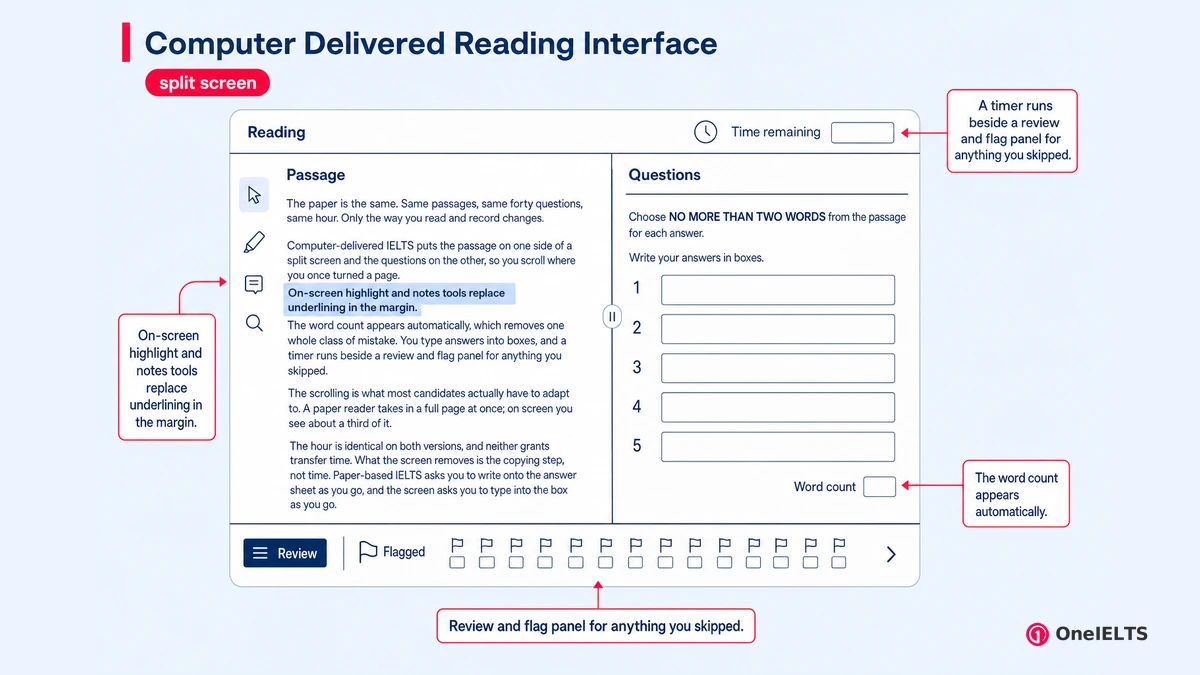
The paper is the same. Same passages, same forty questions, same hour. Only the way you read and record changes.
Computer-delivered IELTS puts the passage on one side of a split screen and the questions on the other, so you scroll where you once turned a page. On-screen highlight and notes tools replace underlining in the margin. The word count appears automatically, which removes one whole class of mistake. You type answers into boxes, and a timer runs beside a review and flag panel for anything you skipped.
The scrolling is what most candidates actually have to adapt to. A paper reader takes in a full page at once; on screen you see about a third of it.
The hour is identical on both versions, and neither grants transfer time. What the screen removes is the copying step, not time. Paper-based IELTS asks you to write onto the answer sheet as you go, and the screen asks you to type into the box as you go.
How Do You Use the IELTS Reading Format to Plan Your 60 Minutes?
Spend twenty minutes per section, then break that rule on purpose. Take under twenty on Section 1 so the hardest section gets more than twenty. The plan comes out of the format, not out of a technique. Three sections of rising difficulty, thirteen to fourteen questions in each, and no transfer time at the end leave you one hour and nothing to spend it on. Seven steps turn that format into an actual timetable.
- Read the instruction line above each question set first, because it fixes the word limit and the shape of the answer.
- Work through Section 1 in fifteen to seventeen minutes, banking every minute you save for the end of the paper.
- Write each answer onto the answer sheet or into the box as you finish it, never in a batch.
- Treat twenty minutes as the hard ceiling for Section 2, and move on the moment it runs out.
- Give every remaining minute to section three, which the format sets as the hardest by design.
- Answer all forty questions, because a wrong answer costs nothing and a blank one is a guaranteed zero.
- Spend the final minute filling the gaps you left rather than re-checking answers you already trust.
The common failure here is arithmetic, not reading. In reviewed mock papers the pattern repeats: candidates give each section an equal share, then reach the hardest passage with eight minutes left and drop four or five marks they could have read for.
Where Can You Practise the IELTS Reading Test in the Real Format?
Sit a full-length mock test under the real hour. The OneIELTS Reading mocks run the whole three-section paper, which is the only setup that rehearses what the format really tests.
A ten-question practice set cannot rehearse the thing that decides your band, which is how the hour runs out. Four of the eight live related searches for this topic ask for a PDF or an answer key, so most candidates arrive wanting the answers rather than the paper. An answer key earns its keep only in review by cause. That paper is what a free IELTS Reading mock test gives you, on a free account. Book a computer-delivered mock if that is the sitting you booked, because paper practice cannot teach the split screen.
On every wrong answer, check four things: the instruction line, the word limit, a paraphrase you missed, or time.
How Does the IELTS Reading Format Convert Into a Band Score?
Each correct answer is one mark, there is no negative marking, and your raw total out of forty converts onto the nine-band scale. The conversion is not the same for Academic and General Training Reading.
A General Training candidate needs more correct answers than an Academic candidate for the same band, because the General Training texts are easier to read. The General Training conversion therefore asks for a higher raw score at every band. The direction is the part that matters here, and the exact figures belong to the current official table.
Half bands exist in Reading, so a single mark can move you across a boundary. Spelling has to be correct for a copied answer to score, which is a format rule and not a study tip. The conversion is fixed rather than curved to the day’s cohort, so nobody’s band depends on how the rest of the room performed.
The five questions that follow are the ones candidates actually ask about the raw score, and each one answers a piece of this conversion.
Is 31 Out of 40 a Band 7 in IELTS Reading?
Broadly yes for Academic Reading. A raw score in the low thirties is the usual Band 7 zone, though it is not a fixed promise, and the same 31 is a lower band on the General Training paper. The figure people repeat comes from the Academic conversion, then gets quoted at candidates whose General Training conversion sits higher. Our IELTS Band Score page carries the full scale.
What Is 7.5 in IELTS Reading?
A 7.5 is a half band between 7 and 8, reached by a raw score a few marks above the Band 7 threshold, and most university and visa requirements sit there. Reading awards half bands off the raw conversion, while Writing and Speaking reach them through the descriptors, so Band 7.5 here is a counted number of correct answers. Against a component requirement of 7 with nothing below 6.5, it buys room elsewhere. See our IELTS Band 7.5 breakdown.
How Do You Get 8.5 in IELTS Reading?
At Band 8.5 you are allowed only a handful of wrong answers across all forty questions, so the work is not faster reading but removing whole categories of error. Three survive at this level: the instruction line and its word limit, the paraphrase trap in the writer’s-views types, and Section 3 timing. Reading is where a 9 is most reachable, because every answer sits in the passage. Our IELTS Band 9 guide covers the rest.
How Do You Get Band 6.5 or 7 in IELTS Reading?
The jump from Band 6.5 to 7 is usually three or four extra correct answers, and they sit in the two question types you keep guessing. Diagnose it by tallying error by question type across three mock papers, then drill your two worst types. At this level a mock paper review beats vocabulary work, because time management costs the last few answers. See How to Improve IELTS Reading Skills.
Does General Training Reading Need More Correct Answers for the Same Band?
Yes. The General Training conversion asks for more correct answers out of forty than the Academic conversion does for the same band, because the General Training texts are shorter and easier. The consequence bites during preparation. A candidate who benchmarks against an Academic raw score chart over-estimates their band, and that is the most common scoring mistake in this cluster. Our IELTS General Reading page covers the module in full.
Written by Fahimur Rahman, reviewed 14 August 2026.
Last verified: 14 August 2026
Practice for the Real IELTS Exam
Apply what you’ve learned with free, exam-style practice:
- Take a free IELTS mock test — all four skills, real exam timing, AI band scoring
- Sit a Reading section mock — one full timed paper with an instant band score
- Practise by question type — self-paced passages with answer explanations