If you are moving abroad for work or settlement, the test most immigration programmes ask for is IELTS General Training, not Academic. It measures the everyday and workplace texts you actually read and the practical English you use on the job.
That focus on migration and work is the only real difference from Academic, because both versions sit on the same band scale. This guide covers what General Training is, who takes it, the format, the Reading and Writing modules, how it differs from Academic, scoring, registration, and preparation that builds your letter writing for Task 1.
What Is IELTS General Training?
IELTS General Training is the version for migration and work and below-degree study, testing everyday English rather than academic texts. The whole test takes about 2 hours 45 minutes across four skills, sat in one sitting. The Listening and Speaking sections are identical Listening Speaking content to Academic, so only the Reading and Writing material changes. That swap means practical English replaces lab reports and lectures, and the questions reflect the notices, letters, and job-style sources you meet in daily life.
Who Should Take IELTS General Training?
General Training suits people who need English proof for a destination, a job, or a school place rather than a university degree. It is the standard requirement for permanent residence and most below-degree routes. The main groups who sit General Training are listed here, with what each route uses the score for.
- Migration applicants. People applying for permanent residence or skilled-worker visas to Canada, Australia, the UK or New Zealand submit a General Training score to immigration authorities as English proof.
- Workers needing registration. Professionals seeking work registration below degree level use General Training to show employers and licensing bodies that their English meets the role.
- Below-degree students. Candidates entering below-degree study and training, such as diplomas, foundation programmes or vocational courses, present General Training rather than the Academic version.
- School-bound teenagers. Families arranging secondary schooling abroad often need a General Training score so a teenager can enrol in an English-medium high school overseas.
What Is the IELTS General Training Format?
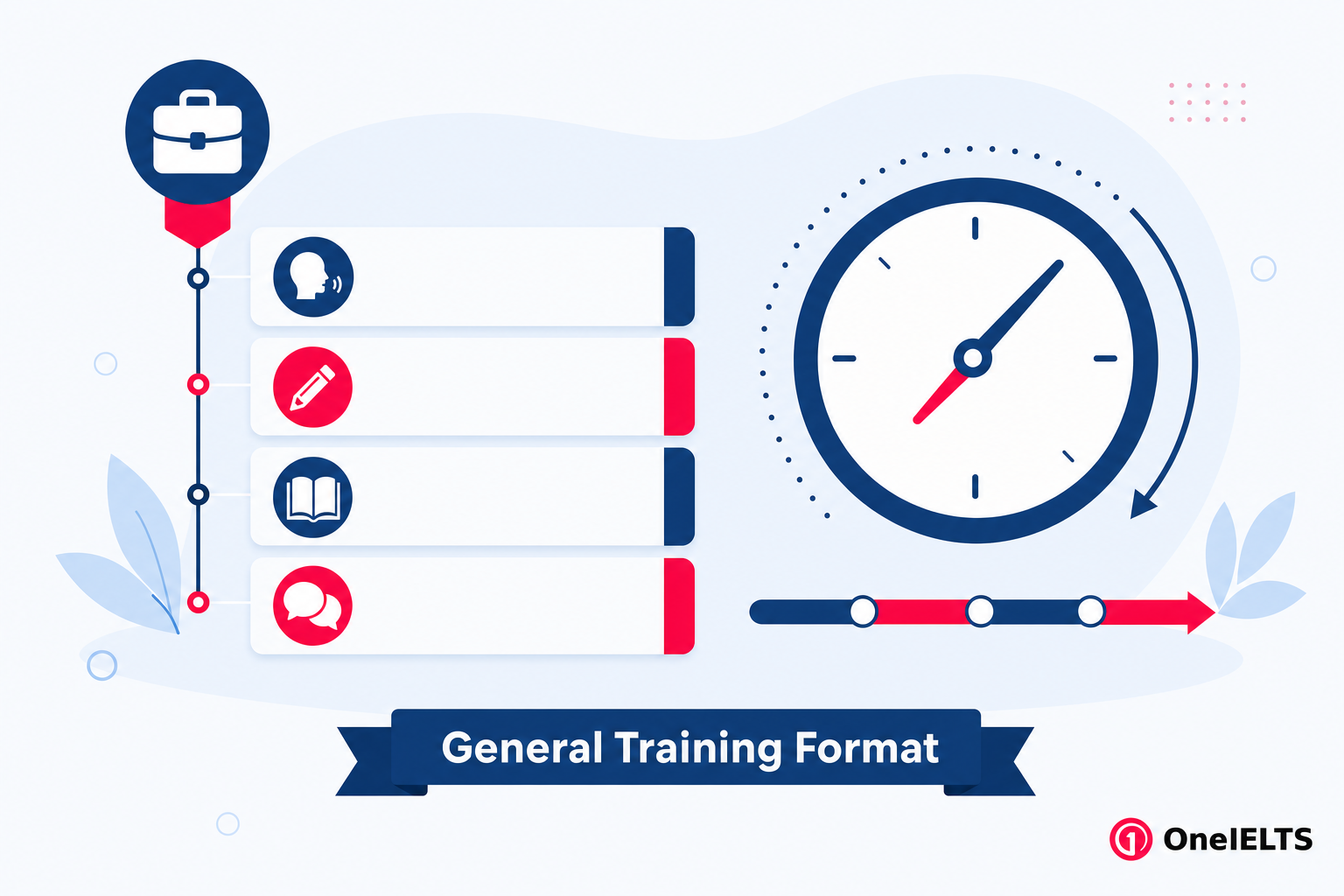
IELTS General Training has four sections — Listening, Reading, Writing and Speaking — totalling about 2 hours 45 minutes. GT Reading draws on GT everyday texts and the Speaking three parts interview closes the test, as the table below sets out for each section, its content, and its timing.
| Section | Content | Time |
|---|---|---|
| Listening | 40 questions across four recordings, identical to Academic | 30 minutes |
| GT Reading | Everyday and workplace texts, 40 questions | 60 minutes |
| GT Writing | Task 1 letter and Task 2 essay | 60 minutes |
| Speaking | Three parts, face-to-face interview | 11–14 minutes |
What Is in the GT Reading Test?
GT Reading uses everyday and workplace texts — notices and manuals, advertisements and articles — with 40 questions in 60 minutes. The test moves from short practical pieces to longer ones. Its final section is the most academic-like passage, a longer continuous article that tests the same close reading you would meet in Academic.
What Is in the GT Writing Test?
GT Writing has two tasks in 60 minutes — Task 1 is a letter of at least 150 words and the Task 2 essay is a 250-word essay, so the split is 150 and 250 words. Task 1 letters can be formal semi-formal informal in tone depending on the situation, so the same prompt might ask you to write to a manager, a neighbour, or a friend. Reading the scenario tells you which register the examiner expects.
How Does General Training Differ From Academic?
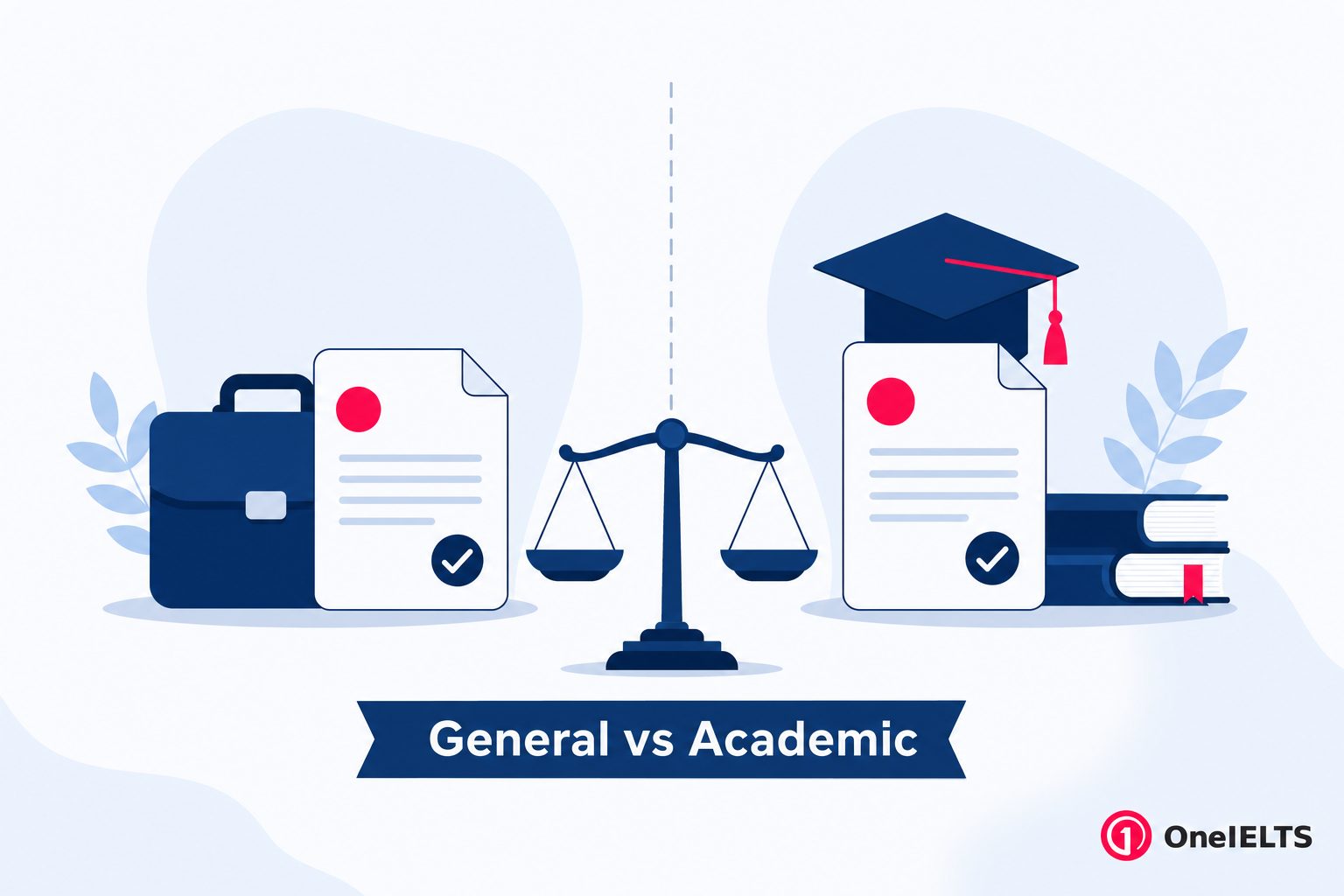
The everyday vs academic reading split and the letter vs data task in Writing are the two points where the versions diverge. Everything else holds steady, as the comparison below shows across the points that matter when you choose.
| Aspect | General Training | Academic |
|---|---|---|
| Reading | Everyday and workplace texts | Academic texts and journals |
| Writing Task 1 | Write a letter | Describe data, a chart or a process |
| Purpose | Work and migration | University study |
| Listening & Speaking | Identical | Identical |
| Band scale | Identical 0–9 scale | Identical 0–9 scale |
Only the Reading and Writing content differs between the two versions. The identical Listening Speaking sections and the same band scale mean a band 7 proves the same level of English in either test, so the choice rests on purpose, not difficulty.
How Is IELTS General Training Scored?
General Training uses the same 0 to 9 scale as Academic, giving you a band per section plus a rounded overall averaged from the four skills. GT Reading needs more correct answers than Academic for the same band, because the everyday texts are easier, so the GT reading conversion sets a higher raw-mark threshold.
Examiners mark Writing and Speaking against four criteria each, such as task achievement, coherence, vocabulary and grammar. Those four section bands combine into the rounded overall score you report to a visa office or employer.
What Is a Good Score in IELTS General Training?
A good GT score is goal-based — many migration streams need 6.0 to 7.0 per skill rather than a single overall figure. Always check the specific program or visa stream’s exact per-skill requirement before you book, because a stream can demand a higher band in one skill than another. Our guide to a good IELTS score breaks down what different bands mean for each migration stream.
How Do You Register for IELTS General Training?
You register through IDP or British Council, choosing paper or computer delivery, then picking a centre and date and paying the fee online. Computer-delivered General Training offers more frequent dates and returns results in three to five days, which suits applicants on a visa deadline.
Before booking, confirm GT route — that your route needs General Training, not Academic — because the two are not interchangeable and a wrong booking wastes the fee. The booking site asks you to select the test type, so read the route requirement first.
How Do You Prepare for IELTS General Training?
Good preparation matches your practice to the GT-specific Reading and Writing content rather than to generic IELTS drills. You build the letter-writing skill Academic candidates never train, then keep the shared Listening and Speaking sharp. The core steps that get a General Training candidate ready are set out below.
- Practise the three letter types. Drill formal, semi-formal and informal letters for Task 1 so your letter writing practice covers every tone a prompt might demand.
- Read everyday texts daily. Read everyday texts like notices, ads and manuals, the same material GT Reading draws on, to build speed with practical English.
- Time your GT Reading. Sit timed GT reading sets at 40 questions in 60 minutes so pacing becomes automatic before the real test day.
- Drill Listening and Speaking. Keep the shared skills sharp with regular Listening sets and spoken practice, since these mirror Academic and carry equal weight.
- Take full GT mocks. Sit full GT mocks under exam conditions to test stamina across all four skills and find which section needs more work.
How Do You Write a GT Writing Task 1 Letter?
Write a GT Task 1 letter by matching the tone to the reader — match the tone, cover all three bullet points, and use a clear greeting and sign-off. Aim for 150 words 20 minutes on the letter, spending about 20 minutes and at least 150 words so Task 2 keeps its full 40 minutes. Map each of the three bullet points to a short paragraph, then your letter answers the prompt in full.
Do Canada and Australia Require IELTS General Training?
For Canada and Australia permanent residence you need IELTS General Training, not Academic — General Training for PR is the rule across both. For Canada Australia migration the immigration authorities accept only General Training, so an Academic score is not immigration accepted and will not be valid for a PR application. If Canada is your destination, our guide to IELTS for Canada sets out the exact bands each immigration stream expects.
Is IELTS General Training Easier Than Academic?
GT Reading and Writing feel more approachable, but the band scale is identical, so the same band scale means it is not “easier” to score well. The everyday texts read more simply than academic journals, yet the GT reading conversion demands more correct answers for the same band. Difficulty depends on skills, not the version you sit, as our IELTS Academic vs General Training comparison explains.
Last verified: 30 June 2026
Practice for the Real IELTS Exam
Apply what you’ve learned with free, exam-style practice:
- Take a full IELTS mock test
- Practice by section: Listening, Reading, Writing, Speaking
- Structure your essays with IELTS Writing templates