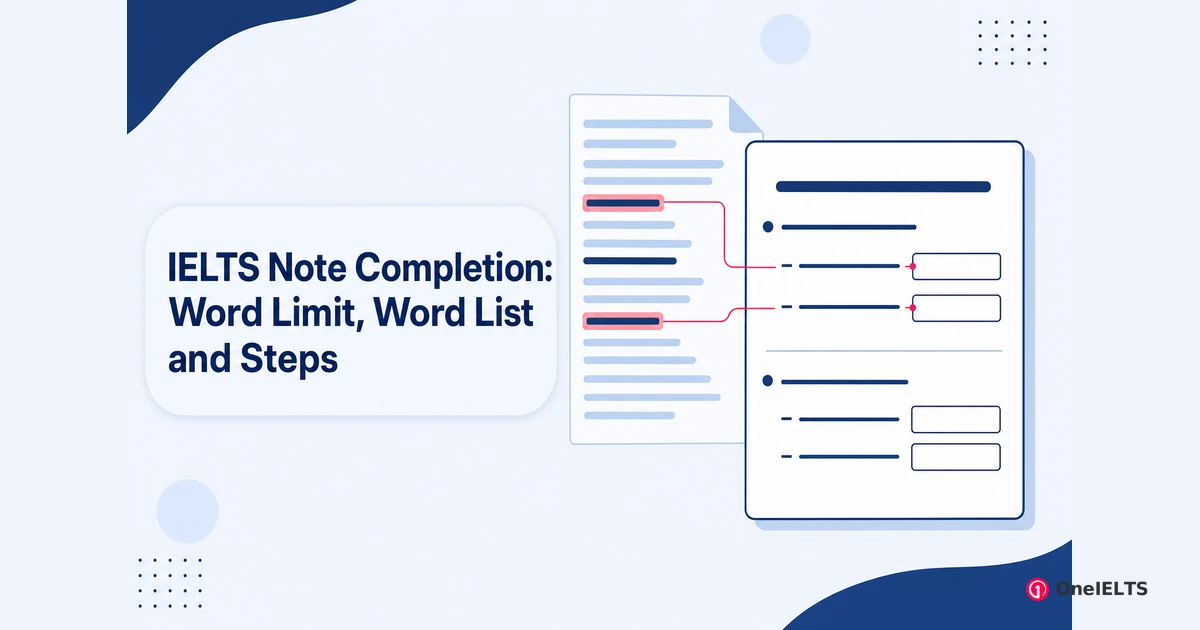
IELTS Reading note completion gives you a set of incomplete notes and asks you to fill each gap with words taken from the passage. The notes are compressed fragments under headings and dashes, so the layout carries the meaning and shows what each gap needs.
Two rules decide the marks. A word limit caps every answer you write, and some question sets hand you a word list instead, which cancels that cap.
This guide covers the task, the word limit, the word list version, the skills tested and the step by step method. It then takes passage order, the common mistakes, a worked example, where to practise, the tips, and how the type fits the other Reading question types.
What Is Note Completion in IELTS Reading?
You are given a set of summarised notes with gaps in them, and you fill each gap with words from the passage. When the instruction says so, you choose the words from a supplied list instead.
The notes are incomplete sentences and fragments rather than full prose. They are laid out with headings and bullets and dashes, so the structure itself shows which detail belongs where. A sub-bullet answers to the heading above it, and that relationship tells you what category a gap wants.
A note set usually summarises one part of the passage rather than all of it, which is why finding that part is the first job. The gaps themselves are typically nouns, numbers, dates or short noun phrases, so a verb is rarely what a gap needs.
The British Council publishes guidance called “Dealing with completion questions”, which is the primary source for the official task description.
How Many Words Can You Write in an IELTS Reading Note Completion Answer?
The instruction sets a hard cap on every answer, and an answer over the cap is marked wrong even when its meaning is right. The commonest cap is two words and a number, printed on the paper as NO MORE THAN TWO WORDS AND/OR A NUMBER.
Read that cap every time, because it is set per question set. The word limit above questions 14 to 18 can differ from the one above questions 19 to 22 in the same paper.
Two counting rules settle most disputed answers. Numbers in letter form count as one word, so “nineteen” fills a single slot. Hyphenated words normally count as one word too.
Copy the word unchanged. Adjusting its form so the note reads more smoothly is the fastest way to lose a mark you had already found.
When Does IELTS Reading Note Completion Give You a Word List?
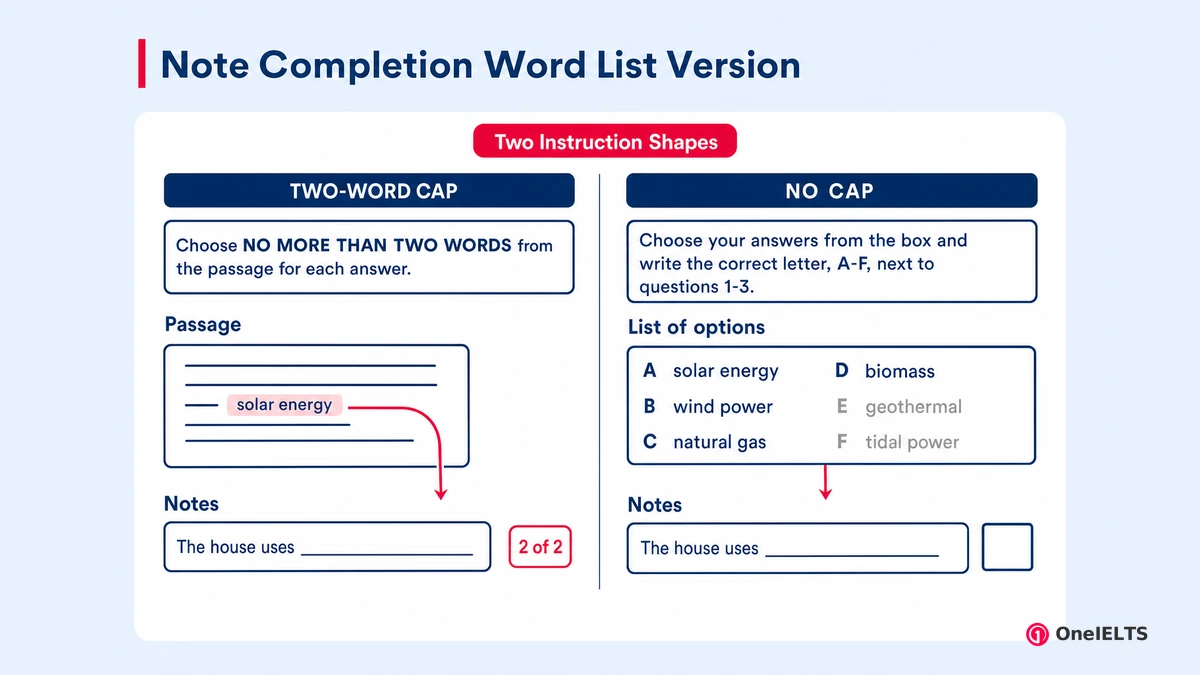
A word list appears when the instruction line tells you to choose from the box of options instead of taking words from the passage. In that version the word limit no longer applies, because the wording is already fixed for you.
The instruction line alone tells you which version you have, so read it before the notes. A supplied list always holds more options than gaps, so unused options are normal rather than a warning sign.
Your answer is then a letter, or the listed word exactly as printed. The underlying skill does not change. You still locate the paraphrase in the passage first, then pick the option that matches it.
To drill that shape, our IELTS Reading word list practice filter gathers the completion sets that hand you a box. A free OneIELTS account opens them.
What Skills Does IELTS Reading Note Completion Test?
Note completion tests four skills at once. You skim to find the right part of the passage, scan for a specific detail, recognise a paraphrase, and read the note layout well enough to know what each gap is asking for.
Predicting the part of speech of each gap is a named step on this type, and it does real filtering work. A gap that must take a number rules out every noun in the paragraph.
Names, dates and unique nouns in the notes are your search keys, because they survive rewording. A date printed in the notes turns up as the same digits in the passage.
This type needs both halves of skim and scan, which is not true of every Reading question type.
How Do You Answer IELTS Reading Note Completion Questions?
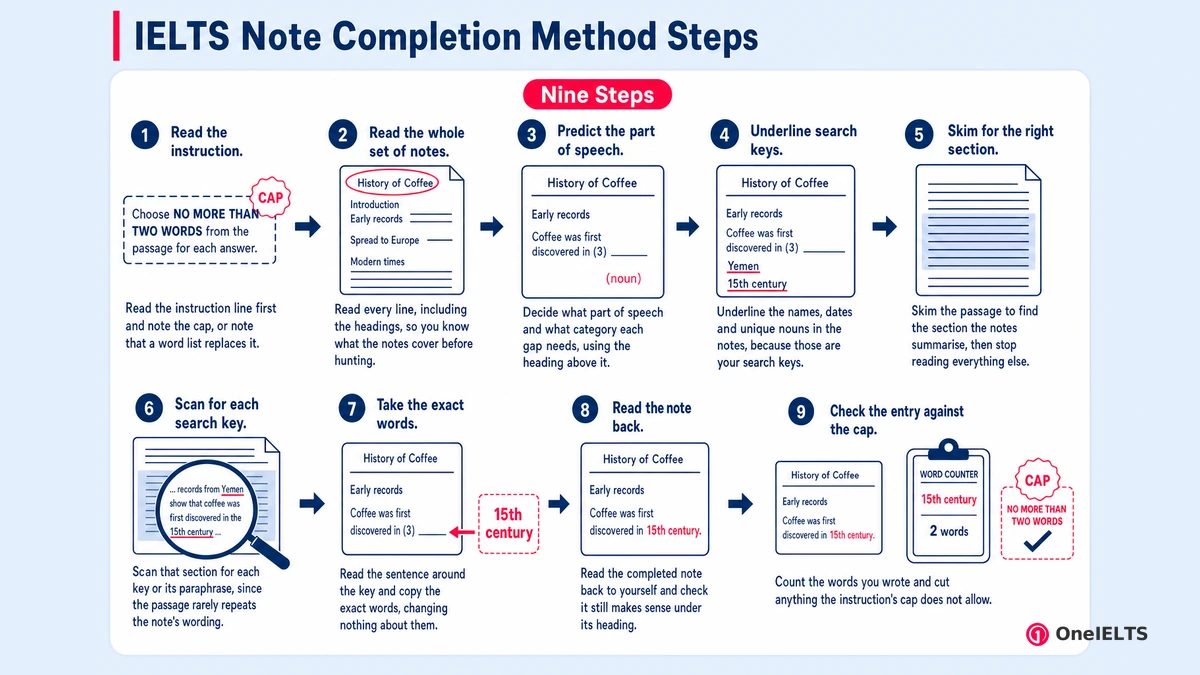
The method starts with the instruction line, because that one line decides whether you are copying words out of the passage or selecting them from a box. Everything after it is a locate-and-copy loop you run once per gap.
Nine steps take you from the instruction line to the final check.
- Read the instruction. Read the instruction line first and note the cap, or note that a word list replaces it.
- Read the whole set of notes. Read every line, including the headings, so you know what the notes cover before hunting.
- Predict the part of speech. Decide what part of speech and what category each gap needs, using the heading above it.
- Underline search keys. Underline the names, dates and unique nouns in the notes, because those are your search keys.
- Skim for the right section. Skim the passage to find the section the notes summarise, then stop reading everything else.
- Scan for each search key. Scan that section for each key or its paraphrase, since the passage rarely repeats the note’s wording.
- Take the exact words. Read the sentence around the key and copy the exact words, changing nothing about them.
- Read the note back. Read the completed note back to yourself and check it still makes sense under its heading.
- Check the entry against the cap. Count the words you wrote and cut anything the instruction’s cap does not allow.
Do IELTS Reading Note Completion Answers Follow the Order of the Passage?
Usually, but not always. Treat passage order as a starting assumption, and drop it the moment a gap refuses to resolve where you expect.
The sources disagree in emphasis, which is worth knowing. Google’s AI Overview says the answers usually follow the order of the text, citing grade-online. The page ranking first for this query states twice that answers do not necessarily come in order. The honest position is that they are usually in order and never guaranteed to be.
When the order breaks, widen the search to the whole section the notes cover, then hunt on the rarest noun, date or name in the note line. Matching information differs again, because that type carries no order at all.
What Are the Common Mistakes in IELTS Reading Note Completion?
Most wrong answers here come from copying the wrong number of words, or the right word in the wrong form. Very few come from failing to find the answer at all, which is what makes this type so frustrating to review.
Eight mistakes account for most of the marks lost on note completion.
- Writing your own words. Filling a gap with your own words scores zero, because the answer key holds the passage’s wording.
- Exceeding the word limit. A three-word answer under a two-word cap is marked wrong, even when its meaning is right.
- Changing the word form. Switching a singular to a plural, or a noun to a verb, breaks the copy rule and loses the mark.
- Missing a supplied word list. Copying from the passage when a box of options was printed gives an answer the key never expects.
- Ignoring the note heading. A gap answered from the wrong sub-point is wrong, because the note heading fixes which detail belongs there.
- Assuming a strict passage order. Treating the order as guaranteed sends you forward when the answer sits two paragraphs back.
- Copying a spelling wrongly. A misspelled answer is marked wrong, so check every letter against the passage before moving on.
- Over-spending time on one gap. Leave a stubborn gap, finish the set, and come back with the surrounding answers already placed.
What Does an IELTS Reading Note Completion Question Look Like?
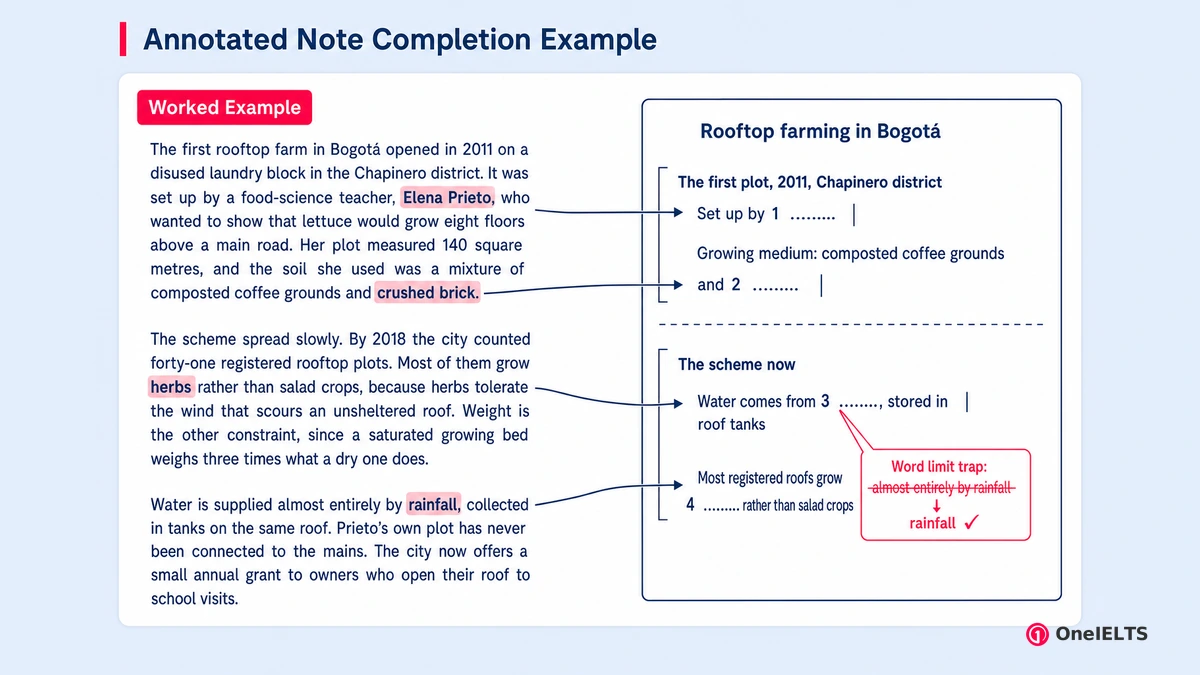
Here is a worked example built on an original passage written for this page, not a Cambridge extract. The instruction line says to complete the notes with no more than two words from the passage.
The first rooftop farm in Bogotá opened in 2011 on a disused laundry block in the Chapinero district. It was set up by a food-science teacher, Elena Prieto, who wanted to show that lettuce would grow eight floors above a main road. Her plot measured 140 square metres, and the soil she used was a mixture of composted coffee grounds and crushed brick.
The scheme spread slowly. By 2018 the city counted forty-one registered rooftop plots. Most of them grow herbs rather than salad crops, because herbs tolerate the wind that scours an unsheltered roof. Weight is the other constraint, since a saturated growing bed weighs three times what a dry one does.
Water is supplied almost entirely by rainfall, collected in tanks on the same roof. Prieto’s own plot has never been connected to the mains. The city now offers a small annual grant to owners who open their roof to school visits.
The notes sit under a heading, with indents showing which detail belongs to which block.
Rooftop farming in Bogotá
- The first plot, 2011, Chapinero district
- Set up by 1………
- Growing medium: composted coffee grounds and 2………
- The scheme now
- Water comes from 3………, stored in roof tanks
- Most registered roofs grow 4……… rather than salad crops
Each answer carries the part of speech the note layout demanded and the passage words that supplied it.
- Elena Prieto. A person, because the line reads “Set up by”. The passage names her as the teacher who ran the first farm.
- crushed brick. A noun phrase, because the gap follows “and” in a two-part list. The passage pairs it with composted coffee grounds.
- rainfall. A noun naming a source. The passage says water is supplied almost entirely by rainfall.
- herbs. A plural noun naming a crop. The passage says most plots grow herbs rather than salad crops.
Two features of this set are deliberate. Gap 3 is the word limit trap, because the tempting phrase “almost entirely by rainfall” runs to four words and scores nothing. Gap 4’s answer sits earlier in the passage than gap 3’s, which is what a broken order assumption looks like on the page.
The same gap in the word list version looks different. The instruction changes to choosing one word from the box, and the cap disappears with it.
- A rainfall
- B mains water
- C coffee grounds
- D crushed brick
- E structural survey
- F school visits
Gap 3 is answered by A, or by the word rainfall exactly as the box prints it. Options B, C, E and F stay unused, which is how a box is built.
Where Can You Practise IELTS Reading Note Completion?
Practise this type on OneIELTS rather than on the loose PDF worksheets the search results push at you. Our IELTS Reading note completion practice filter narrows the practice questions down to this single type. Practising needs a free OneIELTS account.
Meet both instruction shapes while you train. Copy-from-passage and choose-from-list behave differently under time pressure, because the first asks you to police a word limit and the second asks you to reject wrong options. A candidate drilled on one shape only loses time working out which rules apply.
A question type drill and a full timed passage do different jobs. The drill isolates the locate-and-copy loop, so you can run it twenty times in an hour. A timed passage puts that loop back among headings, matching sets and a clock.
Review your errors with four questions. Did I break the cap? Did I change the word form? Did I answer under the wrong heading? Did I assume a strict order?
Across our marked Reading practice, the gap that goes wrong most often is the one whose note line sits under a heading the candidate never read.
What Are the Best Tips for IELTS Reading Note Completion?
The note completion tips that move accuracy are about order of operations. Read the instruction, then the headings, then the gapped lines.
Nine habits carry most of the gain on this question type.
- Read the instruction before the notes. That line decides whether you copy words from the passage or pick them.
- Do the word list check first. Look for a box of options before you read a single gap.
- Read the note headings. The heading above a gapped line tells you the category the answer must belong to.
- Predict the part of speech first. A gap wanting a number rules out every noun you might otherwise grab.
- Search on the rarest noun. Hunt the least common name, date or noun in the note line first.
- Read it back to yourself. A finished note that reads oddly usually holds a wrong or over-long answer.
- Copy the spelling exactly. The passage in front of you holds the correct letters, so use them.
- Treat passage order as likely. Expect the answers in order, then widen your search the moment one refuses.
- Leave nothing blank. A blank scores zero, while a sensible guess from the passage sometimes lands.
How Does Note Completion Fit With the Other IELTS Reading Question Types?
Note completion is one of the official Academic Reading question types, and it belongs to the completion family. Sentence completion, summary completion, table completion, flow chart completion and diagram label completion make up the rest of that family.
Every member runs on the same rule set. You copy from the passage, you obey the cap, and you change nothing about the words you take. What varies is the container, and each type simply wraps the gaps in a different container: a sentence, a summary, notes, a table, a flow chart or a diagram.
Note completion is the family member whose container carries the most meaning, because the headings and indents do the work a sentence’s grammar does elsewhere. It is also the member that most regularly supplies a word list.
Everything above this line treats note completion on its own. What follows sets it beside its closest relatives, including the Listening version, so you can tell at a glance which method a question set wants.
Is IELTS Reading Note Completion the Same as Sentence Completion?
No, sentence completion gives you a full grammatical sentence whose structure narrows the answer, while note completion gives you fragments whose layout does that job instead. Notes carry no grammatical frame, so the heading above a gap does the narrowing.
One ranking page teaches both under a single “Steps for sentence / note completion” method, which is why they are so often taught together. Only note completion may supply a word list. Our IELTS Reading sentence completion guide covers the grammar check.
Is IELTS Reading Note Completion the Same as Summary Completion?
No, a summary is connected prose that has to keep reading as a paragraph, while notes are deliberately broken up. A summary gap is constrained by the sentence around it, and a note gap by the heading above it. Both may supply a word box, and both obey the same cap when they do not. Our IELTS Reading summary completion guide covers the paragraph-level version.
Is IELTS Listening Note Completion the Same Task as IELTS Reading Note Completion?
No, the note layout and the cap work the same way, but IELTS Listening note completion gives you the answers in recording order and only once. Predicting each gap’s part of speech before the audio starts is essential rather than merely useful, so you predict before listening rather than after.
Reading lets you re-scan the passage as often as you like, which is why the same task feels far less punishing here. Our IELTS Listening question types guide sets out the full Listening set.
Written by Fahimur Rahman, reviewed 14 August 2026.
Last verified: 14 August 2026
Practice for the Real IELTS Exam
Apply what you’ve learned with free, exam-style practice:
- Take a free IELTS mock test — all four skills, real exam timing, AI band scoring
- Sit a Reading section mock — one full timed paper with an instant band score
- Practise by question type — self-paced passages with answer explanations