IELTS has no pass mark. Each university, employer and immigration body writes its own IELTS score requirement, mostly between 5.5 and 7.5 overall. When a university and a visa both set one, the higher figure decides your application.
A requirement sets the lowest overall band accepted, and usually a minimum band score for each of Listening, Reading, Writing and Speaking. That per-section minimum stops more applicants from India than the overall figure. It also names a version: universities want Academic, immigration authorities often take General Training, and UK visas ask for IELTS for UKVI.
This page compares the IELTS band requirement across countries, universities and visas. Good bands, band calculation and country guides have their own pages.
Checked on 7 October 2026 against official sources.
What Is an IELTS Score Requirement?
An IELTS score requirement is the minimum overall band, and usually a minimum band for each of the four sections, that a university, employer, professional regulator or immigration authority sets before it accepts your English. IELTS has no passing mark: results sit on the 0-9 band scale and each organization decides what it accepts.
Three kinds of body set these rules: universities and colleges, employers and professional regulators, and immigration authorities. Each one also names a version, such as IELTS Academic, IELTS General Training, IELTS for UKVI or IELTS Life Skills. Requirements are minimums, so a higher score doesn’t win admission by itself.
Searchers from India often ask about a 12th percentage first. The test has none; check IELTS eligibility, because only the university’s admission rule looks at school marks. Your overall band is the average of the four section bands, rounded to the nearest half band, as the IELTS band score page explains.
Why Do IELTS Score Requirements Vary by Country?
Each country’s immigration body writes its own English rule for its visas, and each university writes its own rule for its courses. So the same band can be enough in one country and too low in another.
Organizations set the bar by course demands (a law or nursing course needs more than a foundation program), by immigration policy, and by links to the CEFR scale that many governments write into their rules. Countries require English so migrants can study, work and settle safely in an English-speaking system.
Rules move. Home Affairs raised the Australian student visa minimum from 5.5 to 6.0 for applications lodged from 23 March 2024, and GOV.UK lifted the Skilled Worker level from B1 to B2 for new applicants from 8 January 2026. Professional regulators, such as nursing and medical councils, set the highest bars of all. Check the list of countries that accept IELTS before you plan a route.
How Do You Understand IELTS Band Requirements for Each Section?
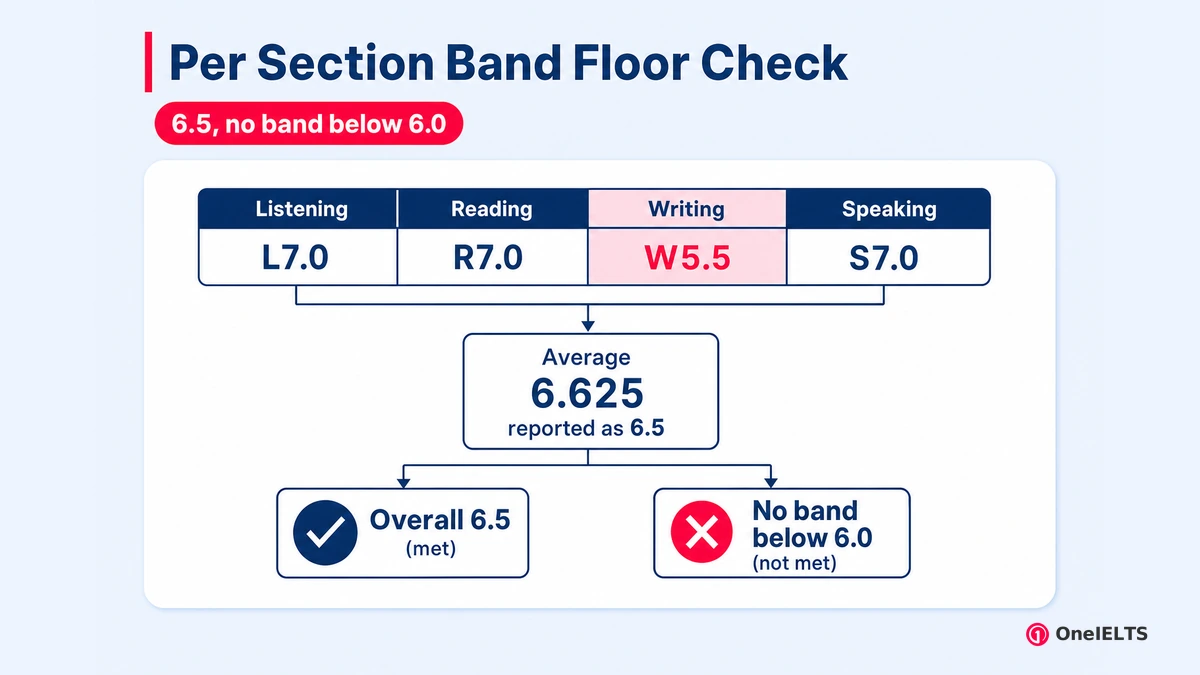
Most requirements have two parts, an overall band and a minimum for every section, and you have to meet both. It’s often written as “no band below 6.0”. Three wording patterns cover almost every requirement you’ll read, each tested here against a real score line.
| How the requirement is written | What it means | Example score that passes | Example score that fails |
|---|---|---|---|
| Overall band only (for example 6.5 overall) | Only the averaged overall band counts; a weak section score can hide inside it. | L7.0 R7.0 W5.5 S7.0 averages 6.625, reported as 6.5 | L6.5 R6.5 W5.5 S6.0 averages 6.125, reported as 6.0 |
| Overall band with no section below a set band (for example 6.5, no band below 6.0) | You need the overall band and every section at or above the stated floor. | L7.0 R6.5 W6.0 S6.5 gives 6.5 with no section under 6.0 | L7.0 R7.0 W5.5 S7.0 gives 6.5, but Writing 5.5 breaks the floor |
| A set band in every section (for example 6.0 in each of the four sections) | The overall band doesn’t matter; each component score must reach the set band on its own. | L6.0 R6.5 W6.0 S6.0 meets 6.0 in all four | L8.0 R7.5 W5.5 S7.0 averages 7.0 yet fails on Writing |
Some rules single out one skill. The UK Nursing and Midwifery Council asks for a 6.5 Writing band against 7.0 in the other three, and the US VisaScreen list asks for a 7.0 Speaking band on top of 6.5 overall. Immigration bodies usually set a band in each section, while universities more often set an overall band plus a floor.
That floor is why Writing is the section most applicants from India retake. IELTS’s own 2024-2025 test taker data puts the India Academic mean at 6.24 for Writing, the lowest of the four sections.
What Are the Minimum IELTS Scores by Country?
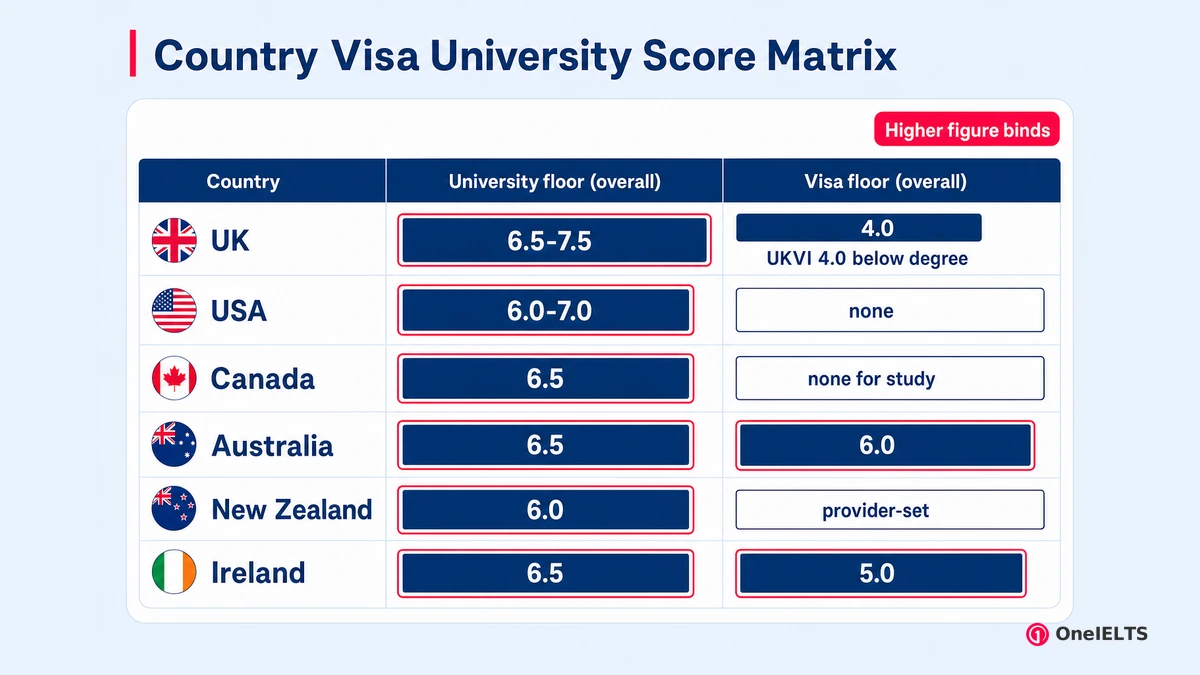
Across the six main destinations, universities ask for 6.0-7.5 overall and student visas mostly defer to the university. Skilled work and residence routes set a band in every section, from 4.0 (UK below-degree study) to 8.0 (Australia’s top points band). Compare the university column with the three visa columns first, then read the last column to see which number governs your application.
| Country | Typical university requirement (overall) | Student visa rule | Skilled work visa rule | Permanent Residency or migration rule | IELTS version accepted | Which requirement binds |
|---|---|---|---|---|---|---|
| United Kingdom | 6.5 at Imperial (standard level) to 7.5 at Oxford for undergraduates | Degree courses: university assesses at B2; below degree: UKVI 4.0 each | Skilled Worker visa: IELTS for UKVI 5.5 in each section since 8 January 2026 | Indefinite Leave to Remain (ILR): B1 Speaking and Listening, such as IELTS Life Skills B1 | IELTS Academic for degrees; IELTS for UKVI or Life Skills for visas | The university for degrees; the UKVI floor only applies below degree level |
| United States | 6.0 at UH-Clear Lake (graduate) to 7.0 at MIT and Boston University | No federal IELTS minimum for the F-1; the school issues the Form I-20 | Health-care workers need VisaScreen: IELTS 6.5 overall with Speaking 7.0 | USCIS publishes no IELTS band for green card applications | IELTS Academic for universities; VisaScreen’s May 2026 list names no module | The university, because the F-1 adds no language floor of its own |
| Canada | 6.5, no band below 6.0 (Toronto); colleges 6.0 with 5.5 each | No IRCC minimum since the Student Direct Stream closed on 8 November 2024 | Federal Skilled Worker: CLB 7, which is IELTS General Training 6.0 in each section | Express Entry: CLB 7 minimum, with more points for every higher benchmark | IELTS Academic for study; IELTS General Training only for Express Entry | The designated learning institution for study; IRCC’s CLB floor for migration |
| Australia | 6.5 overall with no band below 6.0 at Sydney and UNSW | Student visa: 6.0 overall, or 5.0 with an ELICOS course first | Department of Home Affairs Competent English: 6.0 in each section | Points test: 7.0 in each adds 10 points, 8.0 in each adds 20 | IELTS Academic for study; Academic or General Training for skilled visas | The university, because its 6.5 sits above the 6.0 visa minimum |
| New Zealand | 6.0 overall with no band below 5.5 (Auckland undergraduate) | The education provider confirms your English in its offer of place | Immigration New Zealand: Skilled Migrant Category asks 6.5 overall | Skilled Migrant Category grants residence, so the same 6.5 overall applies | IELTS Academic for study; General Training or Academic for residence | The provider for study; Immigration New Zealand’s 6.5 for residence |
| Ireland | 6.5 overall with 6.0 in each band (Trinity College Dublin standard) | Visa floor: IELTS Academic 5.0 for third-level courses; colleges set more | Regulated professions set their own bands, such as nursing through NMBI | No IELTS band found in the residence routes checked for this page | IELTS Academic for study and the visa; regulators name their own version | The college, because its 6.5 sits above the 5.0 visa floor |
Each row comes from the country’s own sources: GOV.UK and its SELT list (UKVI), the US Department of State and HRSA, and IRCC. Australia’s figures come from the Department of Home Affairs and Study Australia, then Immigration New Zealand and Irish Immigration Service Delivery, all checked on 7 October 2026. The country guides hold the visa-by-visa detail; this matrix keeps only the number that governs each line.
What Minimum IELTS Score Do Universities Require?
Most universities ask for 6.0-6.5 overall for undergraduate study and 6.5-7.0 for postgraduate study, with no section below 5.5 or 6.0. The bar climbs with each study level, and every figure below comes from a named university’s own page.
| Study level | Typical overall band | Typical per-section floor | IELTS version |
|---|---|---|---|
| Foundation and pathway programs | From 5.0 overall at Trinity College Dublin’s first pre-sessional entry | 5.0 Writing and 4.5 elsewhere at that entry point | IELTS Academic, the version pre-sessional and foundation program offers name |
| Diploma and college programs | 6.0 overall for George Brown Polytechnic diplomas in Canada | Minimum 5.5 in each of the four skill bands | IELTS Academic, as George Brown lists for its admissions |
| Undergraduate degrees | 6.0 at Auckland; 6.5 at Toronto, Sydney and UNSW | 5.5 at Auckland; 6.0 at Toronto, Sydney and UNSW | IELTS Academic; Oxford rules out General Training and Life Skills |
| Postgraduate taught degrees (master’s) | 6.5 at Imperial (standard) to 7.0 at Oxford (standard) | 6.0 at Imperial; 6.5 at Oxford’s standard level | IELTS Academic, from one sitting at Oxford and Imperial |
| Research degrees and competitive programs | 7.0 at Harvard GSAS and MIT; 7.5 at Oxford’s higher level | Speaking 6.5 at Harvard GSAS; 7.0 each at Oxford’s higher level | IELTS Academic; MIT departments can set a higher bar |
| Medicine, law, teaching and nursing courses | 7.0 overall for UNSW undergraduate Business and Law programs | Set course by course, so check the faculty page first | IELTS Academic, matching the regulator’s version where registration follows |
Universities ask for IELTS Academic; General Training isn’t accepted for degree admission in the main destinations. The rule is a course requirement, not a university-wide one, so two undergraduate or postgraduate courses at one university can differ by a full band.
Your score also has to sit on the Test Report Form before the offer deadline. Learn how to send your IELTS score to a university well before that date. Every row was checked on 7 October 2026.
Which Minimum IELTS Scores Do Top Universities Set?
Top universities ask for 6.5 to 7.5 overall. Toronto, Sydney and UNSW sit at 6.5 with 6.0 in each section, MIT, Boston University and Harvard GSAS sit at 7.0, and Oxford undergraduate entry sits at 7.5 with 7.0 in each section. The ten universities below are the ones Indian searchers look up most, ordered by country and then by overall band.
| University | Country | Level | Overall band | Minimum in each section | Official page checked |
|---|---|---|---|---|---|
| Imperial College London | UK | Standard level (higher level 7.0) | 6.5 | 6.0 (higher level 6.5) | imperial.ac.uk, 7 October 2026 |
| University of Oxford | UK | Undergraduate | 7.5 | 7.0 | ox.ac.uk undergraduate page, 7 October 2026 |
| University of Houston-Clear Lake | USA | Graduate | 6.0 | No section minimum published | uhcl.edu, 7 October 2026 |
| Harvard University | USA | Graduate (GSAS) | 7.0 | Speaking 6.5; programs may ask more | gsas.harvard.edu, 7 October 2026 |
| Massachusetts Institute of Technology (MIT) | USA | Graduate (recommended minimum) | 7.0 | Not published; department rules override | oge.mit.edu, 7 October 2026 |
| Boston University | USA | Undergraduate | 7.0 | No section minimum published | bu.edu, 7 October 2026 |
| Stanford University | USA | Graduate | No university-wide IELTS minimum published | Not published; GSB MBA asks 7.0 overall | bulletin.stanford.edu and gsb.stanford.edu, 7 October 2026 |
| University of Toronto | Canada | Undergraduate | 6.5 | 6.0 | future.utoronto.ca, 7 October 2026 |
| University of Sydney | Australia | Most courses (Level 1) | 6.5 | 6.0 | sydney.edu.au, 7 October 2026 |
| UNSW Sydney | Australia | Standard programs | 6.5 | 6.0 | unsw.edu.au, 7 October 2026 |
Where a university offers two tiers, the higher-level requirement covers its more language-heavy courses: Imperial’s higher level is 7.0 with 6.5 in each, and Oxford’s graduate higher level is 7.5 with 7.0 in each. University of Oxford graduate courses at the standard level ask 7.0 with 6.5 in each. A band of IELTS 7.5 clears every overall figure in this table, provided no section falls under its floor.
Which Universities Accept a Low IELTS Score?
Universities that accept 5.5-6.0 overall exist in every main destination, mostly through pathway programs, conditional offers and less selective undergraduate courses. In admissions terms a low score means 5.0-6.0 overall, below the 6.5 that most master’s courses ask for.
Is 5.0 a good score in IELTS? Band 5.0 is a modest user level, below every degree requirement above, but it can open a pathway or pre-sessional route. Five routes lead into a university with a lower band.
- Foundation year and international pathway programs: A foundation year teaches academic English with subject modules, then moves you into year one once you pass.
- Conditional offers with a pre-sessional English course: A conditional offer lets you start pre-sessional English below the entry band and progress on passing the course.
- College diplomas that transfer into a degree: A college diploma, such as George Brown’s at 6.0 overall, can transfer credit into a later bachelor’s degree.
- Undergraduate courses with a 6.0 overall requirement: Some undergraduate courses ask 6.0 overall, like Auckland’s 6.0 with no band under 5.5.
- Universities that waive IELTS for English-medium schooling: An IELTS waiver accepts English-medium instruction at school or degree level instead of a fresh test score.
Name the route, not a list of “low-score universities”: check every pathway program on the university’s own page. If you’d rather skip the test entirely, read how to study without IELTS.
Which IELTS Exam Should You Take for Each Requirement?
The version matters as much as the band: universities ask for IELTS Academic, and most work and migration routes accept IELTS General Training. UK visas ask for IELTS for UKVI, and UK family and settlement routes ask for IELTS Life Skills. Four versions cover every requirement on this page.
| IELTS version | Who asks for it | Typical use | Can it meet a university requirement? |
|---|---|---|---|
| IELTS Academic | Universities, colleges and professional regulators such as the NMC and GMC | Degree admission and professional registration in English-speaking countries | Yes, it’s the version universities in all six countries name |
| IELTS General Training | IRCC for Express Entry and caregiver pilots; Immigration New Zealand and Home Affairs | Skilled migration, work routes and permanent residence applications | No, General Training doesn’t meet degree admission requirements |
| IELTS for UKVI (Academic or General Training) | UK Visas and Immigration, through its Secure English Language Test list | UK Skilled Worker visas and Student visas for courses below degree level | Academic version yes, if the university accepts a UKVI result |
| IELTS Life Skills (A1, A2, B1) | The UK Home Office for family visas and settlement | Speaking and Listening only, at A1, A2 or B1 | No, Life Skills tests no Reading or Writing |
A score from the wrong version can’t be reused. General Training doesn’t meet a degree requirement, and a standard IELTS result doesn’t meet a UK visa route that names IELTS for UKVI, a Secure English Language Test. Canada’s Express Entry accepts General Training only. Compare formats in IELTS Academic vs General and the IELTS for UKVI guide.
Most bodies also accept TOEFL or PTE, so read the same requirement page against the English tests accepted by universities.
What IELTS Score Is Required for a Student Visa?
In the UK, the USA, Canada, New Zealand and Ireland, the student visa follows the university’s own IELTS requirement for degree courses; Ireland keeps a 5.0 visa floor beneath it. Australia is the main exception, with its own visa minimum of 6.0 overall. Six student visas, each with the body that sets its language rule, are compared here.
| Country | Student visa | Who sets the IELTS requirement | Visa-level minimum (if any) | CEFR level named |
|---|---|---|---|---|
| UK | UK Student visa | The university for degree courses; UKVI for courses below degree | IELTS for UKVI 4.0 in each section below degree level | CEFR B2 at degree level, CEFR B1 below it |
| USA | US F-1 visa | The SEVP-approved school before it issues the Form I-20 | None published by the US Department of State | None named for the F-1 visa |
| Canada | Canada study permit | The designated learning institution named in your letter of acceptance | None since the Student Direct Stream closed in November 2024 | None named by IRCC for the study permit |
| Australia | Australia Student visa (subclass 500) | The Department of Home Affairs, with the university setting its own higher bar | 6.0 overall, or 5.0 with an ELICOS course, since 23 March 2024 | None named; Home Affairs writes IELTS bands directly |
| New Zealand | New Zealand student visa | The education provider, which confirms your English in its offer of place | No separate degree-level visa band found on Immigration New Zealand pages | None named for degree-level student visas |
| Ireland | Ireland study visa | The college, above a visa floor set by Irish Immigration Service Delivery | IELTS Academic or UKVI 5.0 for third-level courses | None named on the study visa page |
The UK ties its rule to CEFR levels. A course below degree level needs CEFR B1, and GOV.UK’s approved test list sets that at IELTS for UKVI 4.0 in each section. Degree-level study needs CEFR B2, which is 5.5 in each section, though the university may assess B2 itself. See how the two scales line up in IELTS vs CEFR.
A visa officer can still refuse you at a visa interview if your spoken English seems weaker than the score suggests, so the score is necessary but not sufficient. Rules checked on 7 October 2026.
What IELTS Score Do Skilled Worker Visas Require?
Skilled work routes set a band in every section rather than an overall band. The UK Skilled Worker visa asks for CEFR B2 (IELTS for UKVI 5.5 in each section), and Canada’s Federal Skilled Worker program asks for CLB 7 (IELTS General Training 6.0 in each section). The six routes below show how far apart those floors sit.
| Country | Work route | Minimum in each section | IELTS version | Official body |
|---|---|---|---|---|
| UK | UK Skilled Worker visa | 5.5 in each section (CEFR B2) for applications from 8 January 2026 | IELTS for UKVI, Academic or General Training, at an approved centre | UK Visas and Immigration, under Home Office rules on GOV.UK |
| Canada | Canada Federal Skilled Worker program | 6.0 in each section, equal to Canadian Language Benchmark 7 | IELTS General Training only; Academic isn’t accepted for Express Entry | Immigration, Refugees and Citizenship Canada (IRCC) |
| Canada | Canada caregiver pilots | CLB 4: Listening 4.5, Reading 3.5, Writing 4.0, Speaking 4.0 | IELTS General Training, under the Home Care Worker Immigration pilots | IRCC, Home Care Worker Immigration pilots page |
| Australia | Australia skilled visas (Competent English) | 6.0 in each of Listening, Reading, Writing and Speaking | IELTS Academic or General Training, either one accepted | Department of Home Affairs, Competent English page |
| USA | US VisaScreen for health-care workers | 6.5 overall with Speaking 7.0 for registered nurses | IELTS; the May 2026 list no longer names a module | HRSA test list, applied by TruMerit (formerly CGFNS) |
| UK | UK nursing registration (NMC) | 7.0 Listening, Reading and Speaking; 6.5 Writing | IELTS Academic only; General Training isn’t on the accepted list | Nursing and Midwifery Council (NMC) |
Professional registration often sets a higher bar than the visa. The Nursing and Midwifery Council asks more than the Skilled Worker visa does, and the General Medical Council asks doctors for IELTS Academic 7.5 overall with 7.0 in each section. Read IELTS for nurses and IELTS for doctors for the full rules.
Canada’s caregiver pilots ask for only CLB 4, far below the CLB 7 that Express Entry’s Federal Skilled Worker program needs. Competent English in Australia sits between the two. All six rows were confirmed on the named official pages on 7 October 2026.
What Minimum IELTS Score Do Immigration and Permanent Residency Routes Need?
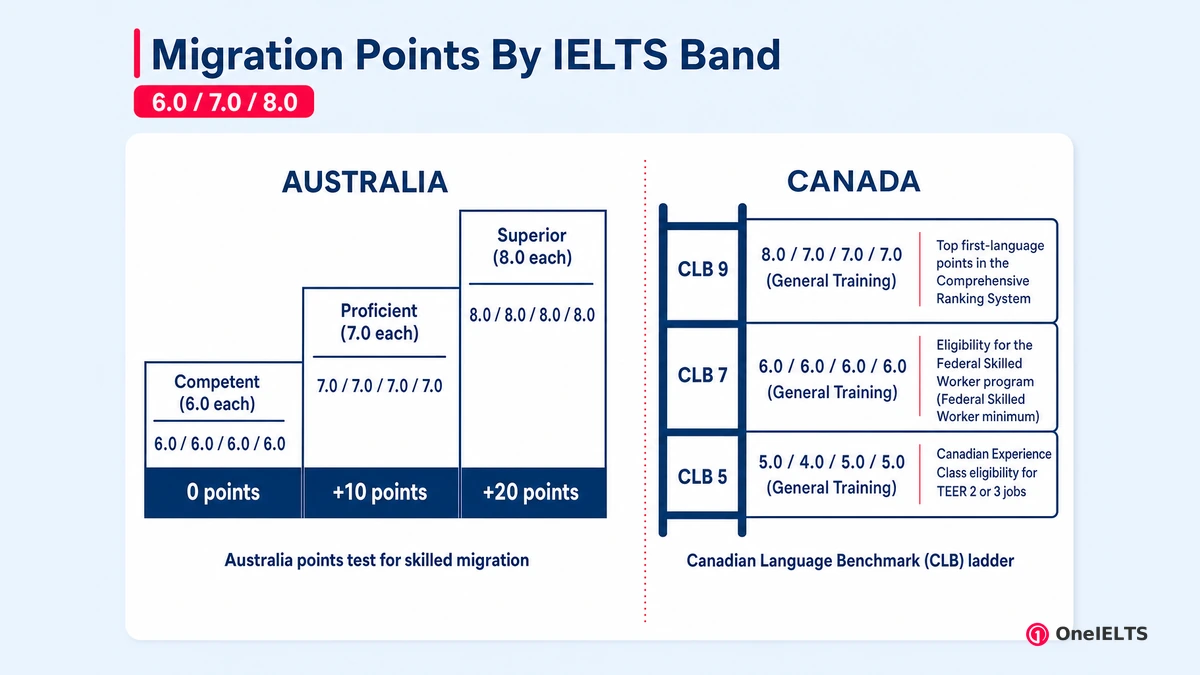
Permanent Residency routes set a minimum band in every section and then reward higher bands with points. Canada’s Express Entry needs at least CLB 7 (IELTS General Training 6.0 in each section) for Federal Skilled Workers. Australia’s points test starts at Competent English (6.0 in each section) and adds 10 points at 7.0 and 20 points at 8.0. Each row turns a band line into what it unlocks.
| Program | IELTS bands needed (L / R / W / S) | What it unlocks |
|---|---|---|
| Canada Express Entry – CLB 7 minimum (FSW) | 6.0 / 6.0 / 6.0 / 6.0 (General Training) | Eligibility for the Federal Skilled Worker program |
| Canada Express Entry – CLB 9 (maximum language points) | 8.0 / 7.0 / 7.0 / 7.0 (General Training) | Top first-language points in the Comprehensive Ranking System |
| Canada Experience Class – CLB 5 for TEER 2 and 3 jobs | 5.0 / 4.0 / 5.0 / 5.0 (General Training) | Canadian Experience Class eligibility for TEER 2 or 3 jobs |
| Australia – Competent English (6.0 each) | 6.0 / 6.0 / 6.0 / 6.0 | Baseline English for skilled visas, with zero English points |
| Australia – Proficient English (7.0 each, +10 points) | 7.0 / 7.0 / 7.0 / 7.0 | Proficient English adds 10 points to the points test |
| Australia – Superior English (8.0 each, +20 points) | 8.0 / 8.0 / 8.0 / 8.0 | Superior English adds 20 points, the maximum for English |
| New Zealand Skilled Migrant Category (6.5 overall) | 6.5 overall, no section minimum named | Skilled Migrant Category residence eligibility for principal applicants |
| UK settlement (B1 Speaking and Listening) | Speaking and Listening only, at B1 | The English part of Indefinite Leave to Remain |
The Canadian Language Benchmark values come from IRCC’s equivalency chart, Australia’s from Home Affairs and its points table, New Zealand’s from Immigration New Zealand, and the UK line from GOV.UK settlement guidance. Each was checked on 7 October 2026.
Provincial programs such as the BC PNP set their own language floor per stream, so check the stream page before you book. The UK calls its settlement status Indefinite Leave to Remain (ILR); this page uses Permanent Residency for the same idea.
How Can You Meet Your Target IELTS Score?
Work out the binding requirement first: the higher of the university and visa figures, including every per-section floor. Then test yourself against that number, not the overall band alone.
Find the exact requirement and IELTS version on the official page. Take a timed mock test to see the gap section by section, and set your target band from the binding requirement. Train the weakest section, which for most Indian candidates is Writing. Then book the test with enough time before your application deadline to retake if a band falls short.
The questions below cover what usually goes wrong at this stage: one section below the floor, a score that expires before assessment, and misjudging whether a band is high enough.
Can the One Skill Retake Lift a Single Band to the Minimum?
Yes, the One Skill Retake lets you resit one section within 60 days of your original test, so a single band below the per-section floor can be lifted without retaking the whole test. Acceptance is the receiving organization’s call: UKVI accepts it for computer-delivered tests in selected locations, but IRCC refuses it for Express Entry, and Oxford and Imperial want one sitting. Read the IELTS One Skill Retake rules before booking.
Does IELTS Score Validity Affect Your Application?
Yes, most universities and immigration bodies accept an IELTS score only for two years from the test date, and some count to the date your application is assessed rather than the date you apply.
That two-year validity is strict for Express Entry, which wants results under two years old when you create your Express Entry profile and again when you submit for Permanent Residency. Check the date on your Test Report Form against the IELTS score validity rules.
Is 7 a Good Score in IELTS?
Yes, a band 7 meets the overall requirement of most universities in the table above and clears every work and migration floor except the top points bands. IELTS labels band 7 a good user. The catch: a 7.0 overall still fails a per-section floor if Writing sits at 5.5, which competitive programs check. See what makes a good IELTS score.
Can an IELTS Score Calculator Tell You If You Meet a Requirement?
Yes, an IELTS score calculator converts your section bands, or your correct answers out of 40 in Listening and Reading, into an overall band you can check against the requirement. The official Listening conversion table turns a raw score of 32-34 into band 7.5 and 39-40 into band 9. The calculator shows the overall band only, so check each floor yourself with the IELTS band score calculator.
Written by Fahimur Rahman, reviewed 7 October 2026.
Last verified: 7 October 2026
Practice for the Real IELTS Exam
Apply what you’ve learned with free, exam-style practice:
- Take a free IELTS mock test — all four skills, real exam timing, AI band scoring
- Start with the free mock test — one full test, no payment needed
- Practice skill by skill — Listening, Reading, Writing and Speaking sets