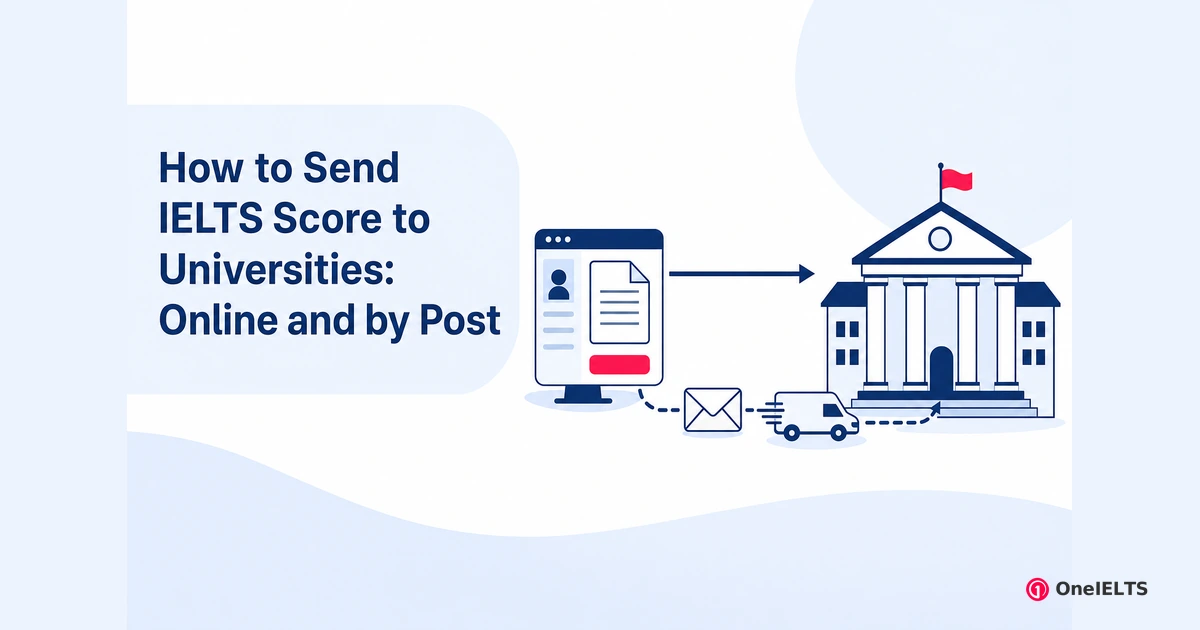
Once your results are out, you ask your test provider, IDP or the British Council, to deliver your official result to each university, which checks it directly. Recognizing organizations trust only results the provider sends or that they verify themselves. Electronic delivery through a portal such as the British Council’s Test Taker Portal is the default and fastest route. Paper copies by post, each an Additional TRF, remain for universities that ask.
This page covers the Test Report Form, the three routes, online steps, the posted copy, downloading your electronic TRF, fees, US, Canadian and German universities, and the rules that limit a send. Result release and the TRF document have their own OneIELTS pages.
What Is an IELTS Test Report Form (TRF)?
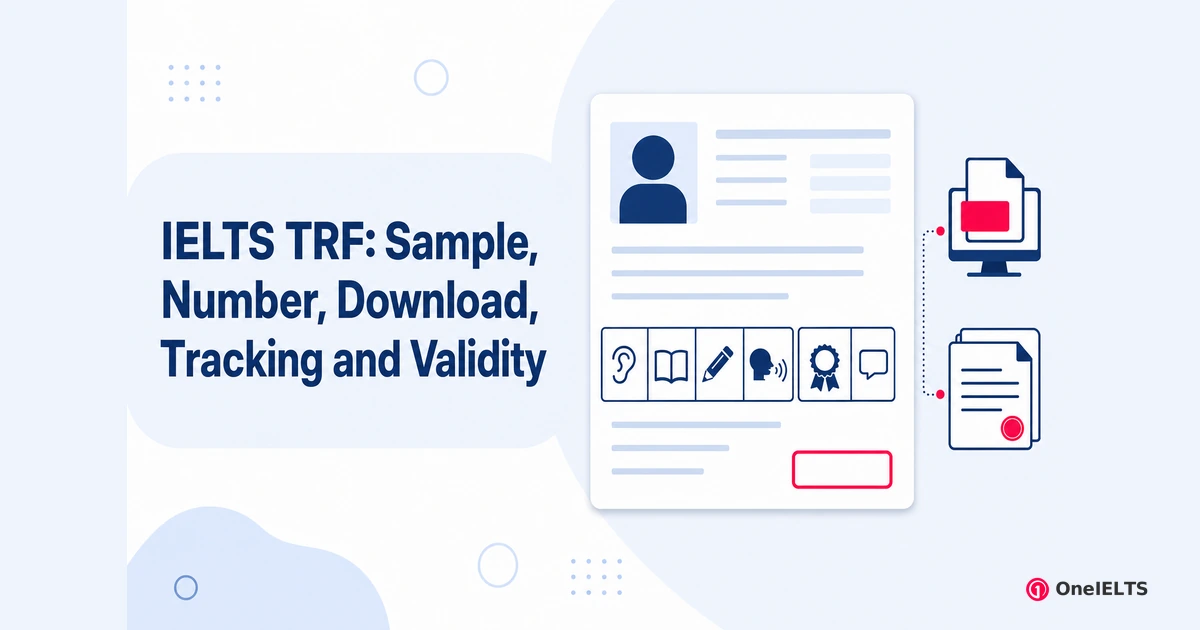
The Test Report Form is the official IELTS results document that records your Listening, Reading, Writing and Speaking bands and your overall band. Most universities now receive the eTRF, an electronic copy they download or confirm through results verification using the TRF reference number. Every copy sent to a university is a separate official copy rather than a scan of yours, and the IELTS TRF guide covers the form itself.
What Are the Methods to Send IELTS Scores to Universities?
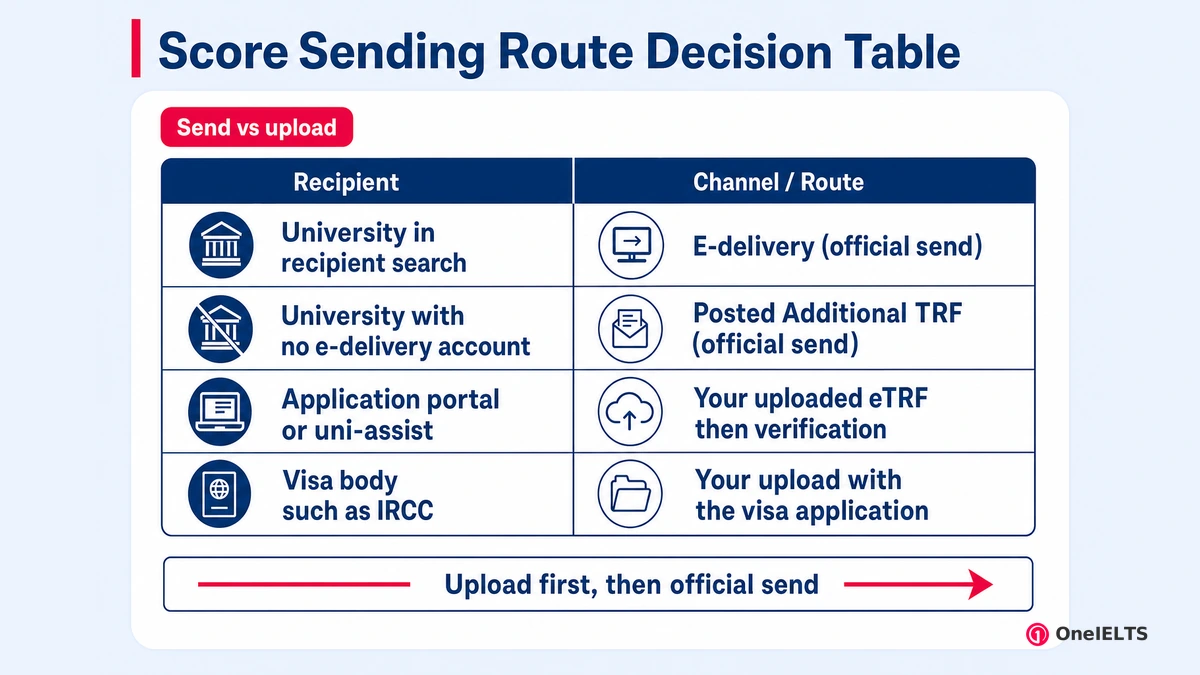
There are three routes: electronic delivery from the provider, a paper Additional TRF posted by the test center, and your own upload of a downloaded TRF. Only the first two count as an official send. Which route you use depends on what the university’s admissions page asks for.
| Method | How it reaches the university | Typical speed | Cost | Use it when |
|---|---|---|---|---|
| Electronic delivery (e-delivery) | The provider releases your result to the university’s IELTS verification account | Fastest; IDP India processes requests within 7 to 10 working days of payment | Free for the first five universities; INR 350 each after that at IDP India | The university appears in the provider’s recipient search |
| Paper Additional TRF by post or courier | The test center posts or couriers a printed official copy to the admissions office | Slowest; processing plus about 4 days by courier or 2 weeks by post | INR 400 post or INR 1,750 courier at IDP India; INR 250 or INR 1,250 at British Council India | The university asks for paper or has no e-delivery account |
| Applicant upload of a downloaded TRF | You upload a PDF of your eTRF to the university’s application portal | Immediate | Free | A portal asks for a copy now and verifies it later |
Match the route to the recipient. A university listed in the provider’s recipient search takes e-delivery. One without an e-delivery account asks for a posted Additional TRF, sent by post or courier. An application portal, including uni-assist in Germany, wants your uploaded copy first and verifies it later.
A visa body such as IRCC takes your upload with the visa application, not a university-style send. For any single university, follow its admissions page rather than a general rule.
How Do You Send IELTS Scores to Universities Online?
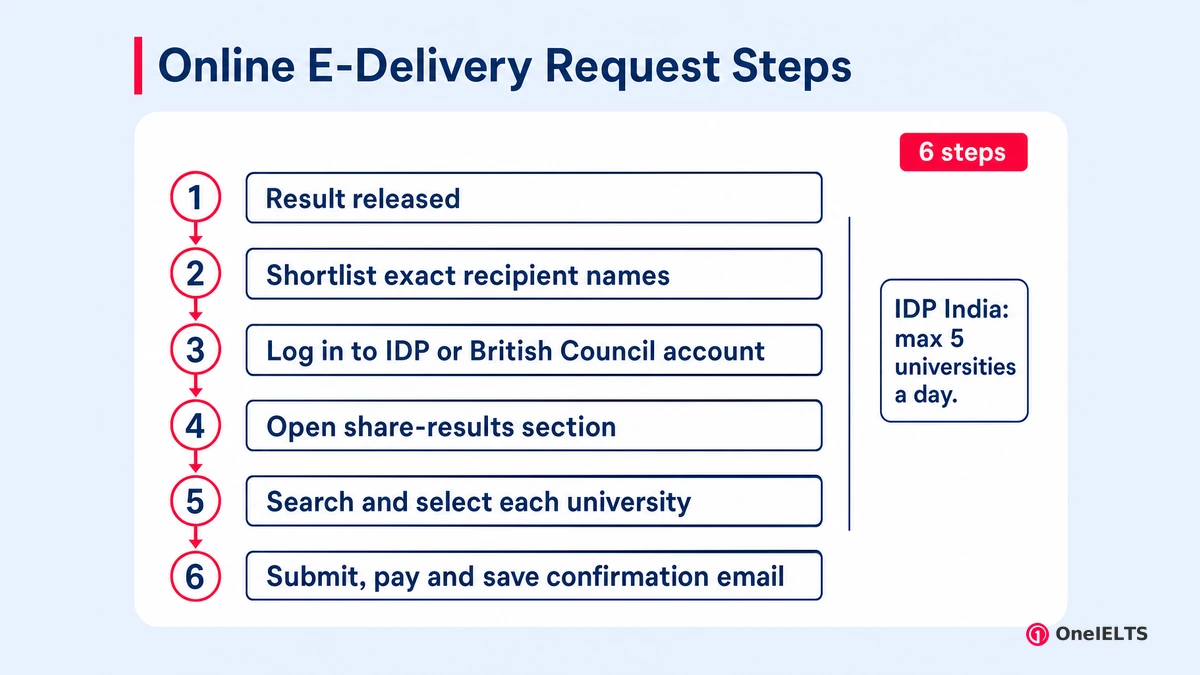
Sending online means logging in to your provider’s portal after results release, picking each university from its recipient list and confirming. The university then downloads or verifies your eTRF through e-delivery. “Online” and “electronically” describe the same route, so guides that use either word mean this process.
The portal names differ. IDP India runs requests through the candidate login on ieltsidpindia.com, while the British Council uses its Test Taker Portal. Each university appears as a recipient organization that you find by country and name. IDP India accepts electronic requests for at most five universities a day. Six short steps move your result from your account to an admissions team.
- Check that your result is released. The send option stays locked until your scores appear in your account.
- Shortlist the universities and their exact recipient names. Copy each name from the admissions page, including campus or department.
- Log in to your IDP or British Council account. Use the login you booked the test with.
- Open the request or share-results section. Its label differs by provider, but it sits next to your scores.
- Search for and select each university. Filter by country, then name, and choose the right campus or department listing.
- Submit, pay any fee and keep the confirmation. Save the confirmation email as proof the request went through.
How Do You Send IELTS Scores to Universities With an Additional TRF?
An Additional TRF (ATRF) is an extra official copy that the test center sends straight to a university, used when the university asks for paper or isn’t set up for e-delivery. IDP India has taken every ATRF application online since 01 February 2020, when it stopped accepting physical forms.
A posted copy adds postal or courier time on top of 7 to 10 working days of processing at IDP India. That makes it the slow route for a near deadline. Address it to the admissions office, not the university’s general address. Ordering a paper copy takes four steps, plus a wait for delivery.
- Confirm the university wants a paper copy. Many accept only e-delivery, so paper often wastes the fee.
- Submit the ATRF application online with the university’s postal address. Give the admissions office address, with department and postcode.
- Pay the ATRF and courier fee. IDP India charges INR 400 by post or INR 1,750 by courier.
- Track the dispatch with the test center. Ask for the tracking number and tell the university to expect it.
How Do You Download Your IELTS TRF for a University Application?
Your eTRF download is a PDF from your IDP or British Council account, which you upload to the application portal while noting the TRF number the form asks for. The upload isn’t an official copy, so upload first and trigger the official send next, unless the admissions page says online verification of the TRF number is enough. Download screens and the form’s layout sit in the IELTS TRF guide.
Can You Send IELTS Scores to Universities for Free?
Yes, in most cases the first set of electronic sends is free, and you pay for sends beyond that set and for courier delivery. At IDP India, free e-delivery covers the first five universities. After that the ATRF fee is INR 350 per university electronically, INR 400 by post or INR 1,750 by courier, so courier charges dominate a paper send.
British Council India sends up to five copies free when you add the addresses at booking, then charges INR 250 per electronic or postal copy and INR 1,250 per courier address. Naming universities at booking costs less than adding them later. Fees checked on 7 October 2026; check the current fee page before you pay.
How Do You Send IELTS Scores to US and German Universities?
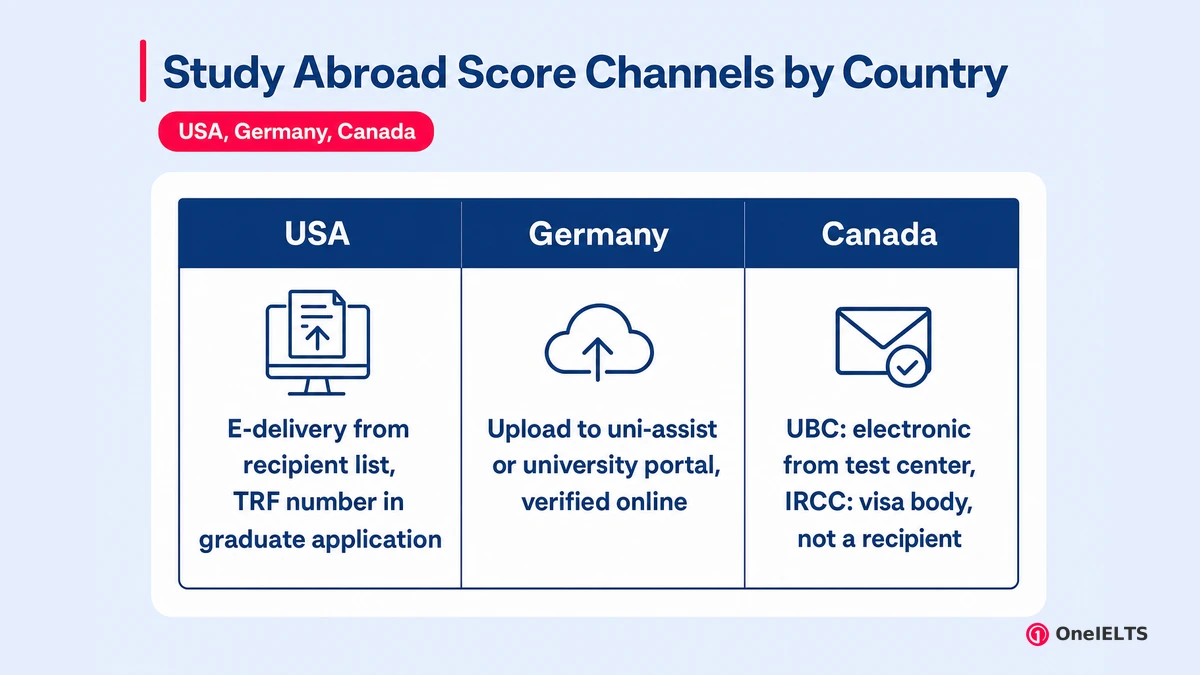
The sending steps stay the same everywhere, but what the university does with your score changes by country. A test taker in India planning to study abroad checks one thing per destination before sending. Three countries handle the score in their own ways.
- USA: Most universities take e-delivery from the recipient list; a graduate school may also want the TRF number, and Arizona State needs no institutional code for IELTS.
- Germany: uni-assist and university portals take your uploaded copy, and uni-assist says it verifies the IELTS Test Report Form online, so the upload usually does the job.
- Canada: Universities such as UBC take e-delivery; UBC wants the official score sent electronically from the test center. IRCC is a visa body, not a recipient you send to.
Each line was checked on 7 October 2026 against one named page: Arizona State University graduate admissions, uni-assist’s language certificates page and UBC Graduate Studies.
What Are the Rules for Sending IELTS Scores to Universities?
Sending follows four limits on who sends, where it goes, how many go at once and which channel counts. Your test provider is the only sender, and each send produces an official copy the university trusts. The recipient limit depends on the portal: search summaries repeat a cap of 10 digital recipients at a time, but IDP India publishes five universities a day. Check the university’s preferred channel before you send.
A send fails when it breaks any one of these four limits.
- Only the provider that ran your test can send it. An IDP test goes through IDP, and a British Council test goes through the British Council.
- Each university needs its own request under its exact recipient listing. Sending to the wrong campus or faculty listing means the admissions office never sees your result.
- Each request has a recipient cap set by the provider portal. IDP India accepts electronic requests for at most five universities a day, so a long shortlist takes several days.
- The university, not the provider, decides which channel it accepts. A university without an e-delivery account can’t receive one, so its admissions page overrides your preference.
How Do You Send IELTS Scores to Universities From IDP?
If you sat the test with IDP IELTS India, the online steps above apply through your IDP IELTS account, with five free e-delivery requests and a five-a-day cap. The IELTS with IDP guide covers booking and results with IDP. IDP’s version shortens to four moves.
- Log in to your IDP IELTS account. Use the candidate login on ieltsidpindia.com with your booking details.
- Open the results and send-to-organizations option. Choose electronic score reporting, free for your first five universities.
- Select each university and submit. Watch for the acknowledgement email IDP India sends instantly after each request.
- Apply online for an Additional TRF if paper is required. Choose post or courier, and enter the admissions office address.
How Do You Send IELTS Scores to Universities From the British Council?
For a test with the British Council in India, the online steps above apply, and only the portal and fees differ. The British Council’s results service runs through its Test Taker Portal, where the share results option lists universities as recognizing organizations. British Council India sends five copies free if you add them at booking.
Our IELTS with the British Council guide covers the rest. Here’s the sequence, from sign-in to an optional paper copy.
- Sign in to the British Council results account. Use the Test Taker Portal login from your booking.
- Choose the option to share your results with organizations. The portal calls universities recognizing organizations.
- Search for the university and confirm. Check the campus name first, because a wrong listing sends your score elsewhere.
- Request a posted copy only if the university asks for one. British Council India charges INR 250 by post.
When Should You Send IELTS Scores to Universities?
The best time to send IELTS scores to universities is as soon as your result is released and at least a few weeks before the application deadline. A posted Additional TRF takes weeks, so a near deadline needs e-delivery or an upload first. Under two-year validity, an IELTS score validity check shows whether yours lasts to enrollment. Below the program’s requirement? Retake first, testing the score requirement with a full mock test.
Do You Need to Check Your IELTS Result Before Sending It to Universities?
Yes, you need to check your IELTS result before sending it, because the send request opens only after the result is released and you should confirm it meets the university’s band. Computer-delivered IELTS results arrive within days and paper-based IELTS results take 13 days, as the IELTS result guide explains under result release. Planning an Enquiry on Results? Send after the outcome, since a changed band means a new TRF.
Written by Fahimur Rahman, reviewed 7 October 2026.
Last verified: 7 October 2026
Practice for the Real IELTS Exam
Apply what you’ve learned with free, exam-style practice:
- Take a free IELTS mock test — all four skills, real exam timing, AI band scoring
- Start with the free mock test — one full test, no payment needed
- Practice skill by skill — Listening, Reading, Writing and Speaking sets