An IELTS 7.5 puts you in the “Very Good User” band, meaning fully operational English with only occasional slips. It clears the cut-off at almost every university and visa stream you are likely to target. That is the real headline: a 7.5 already meets nearly every requirement, so the only open question is whether an 8 is worth chasing.
This guide explains what a 7.5 score means, why it counts as a good IELTS score, the benefits it unlocks, which universities accept it, how rare it is, and the strategies that get you there. Sitting at CEFR C1, a 7.5 lands above the typical university cut-off, which is why so few candidates need to push higher.
Last verified: 30 June 2026
What Does an IELTS 7.5 Score Mean?
A 7.5 marks a Very Good User with fully operational command of English and only occasional inaccuracies, which the British Council aligns roughly with CEFR C1. At this level you handle complex argument and unfamiliar topics with confidence, and the occasional inaccuracies that remain rarely cause misunderstanding. Relatively few test-takers reach 7.5; most candidates land a band or more lower, so a 7.5 signals genuinely advanced ability rather than an average pass.
Why Is 7.5 Considered a Good IELTS Score?
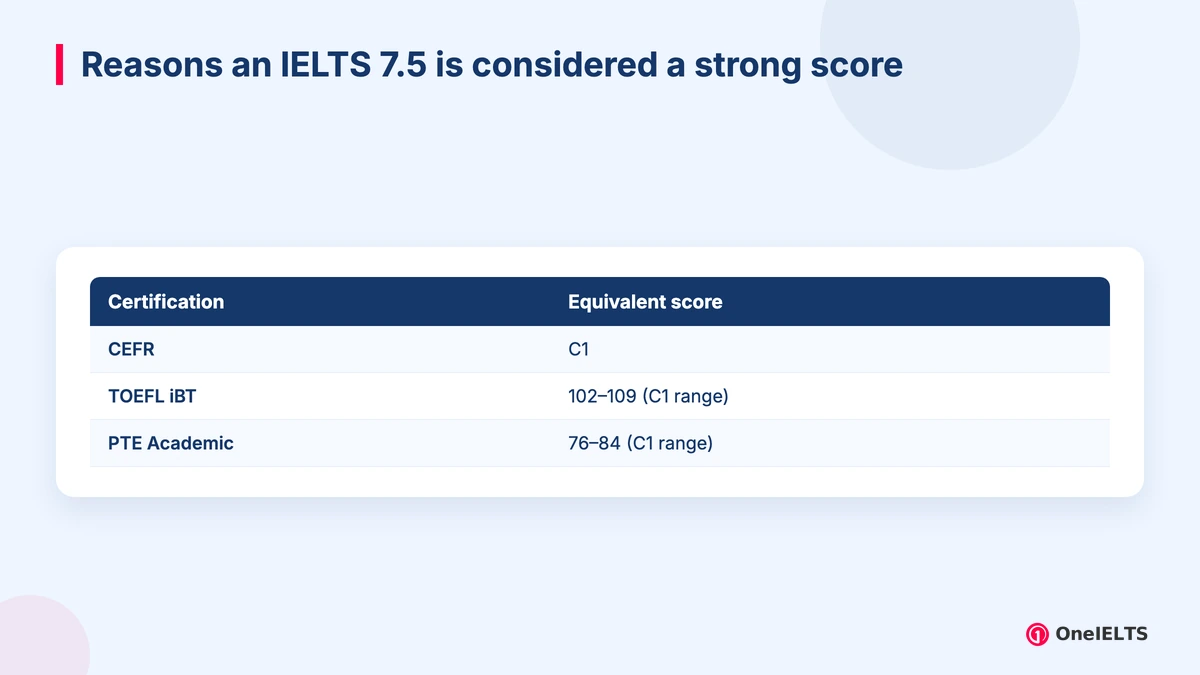
A 7.5 is highly valued because admissions officers, employers, and immigration authorities read it as advanced proficiency that comfortably exceeds standard thresholds. It opens top-tier admissions, satisfies professional registration bodies, and adds weight to a migration file. The table below sets the equivalent scores beside a 7.5, which corresponds to CEFR C1 on the other major English tests.
| Certification | Equivalent score |
|---|---|
| CEFR | C1 |
| TOEFL iBT | 102-109 (C1 range) |
| PTE Academic | 76-84 (C1 range) |
The TOEFL iBT and PTE Academic figures follow each test owner’s published CEFR mapping, so read them as the C1-equivalent band rather than a single fixed point.
What Are the Benefits of an IELTS 7.5 Score?
A 7.5 unlocks the parts of study and migration that a 6.5 cannot reliably reach: competitive courses, funded places, and stronger immigration profiles. The concrete advantages a 7.5 delivers are set out below.
- Top-tier university admission. A 7.5 clears the English requirement at selective universities and competitive programmes that ask for scores above the common 6.5 entry floor.
- Scholarship eligibility. Many merit awards screen on English proficiency, and a 7.5 keeps you inside the shortlist where a borderline score would quietly remove you from scholarship eligibility.
- Postgraduate and research access. Master’s and research programmes often set higher language bars, and a 7.5 satisfies the postgraduate access requirements that gatekeep these advanced degrees.
- Stronger work-visa profile. Skilled-worker routes reward higher English, so a 7.5 strengthens the language portion of a work-visa application well beyond the bare minimum threshold.
- Higher PR/CRS points. Permanent-residence systems award a PR points boost for advanced English, and a 7.5 typically earns near the top language band on points-based immigration grids.
- Lower visa-rejection risk. A clear, well-above-threshold score reduces doubt about your English, which supports visa approval and trims one common reason that application files get refused.
Which Universities Accept an IELTS 7.5 Score?
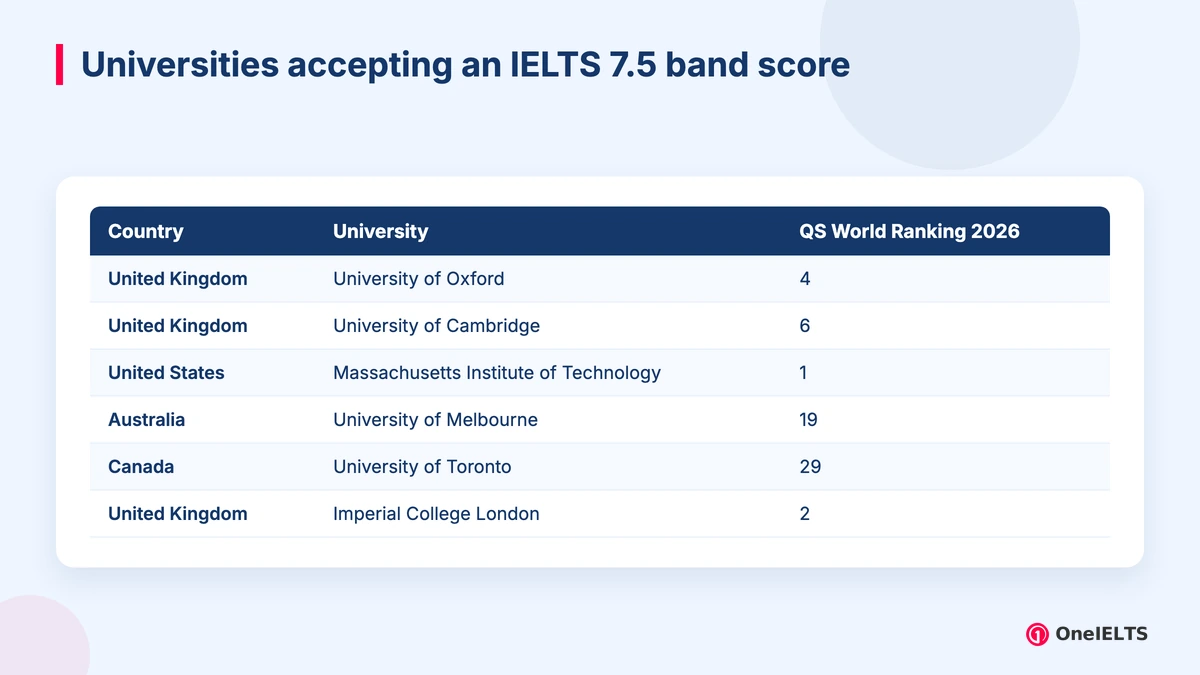
Most top universities accept IELTS, and a 7.5 sits at or above the entry requirement for nearly all of them. The well-known institutions below, weighted toward those popular with Indian students and listed with each QS ranking, all accept a 7.5 overall.
| Country | University | QS World Ranking 2026 |
|---|---|---|
| United Kingdom | University of Oxford | 4 |
| United Kingdom | University of Cambridge | 6 |
| United States | Massachusetts Institute of Technology | 1 |
| Australia | University of Melbourne | 19 |
| Canada | University of Toronto | 29 |
| United Kingdom | Imperial College London | 2 |
Requirements vary by course, so confirm the exact per-course requirement on each university’s official admissions page before you apply. Last verified: 30 June 2026.
How Rare Is an IELTS 7.5 Score?
A 7.5 is uncommon but far from rare, sitting in the upper range that only a minority of test takers reach, yet its rarity vs band 9 is modest, since far fewer than 1% hit band 9. Most candidates finish around the typical 6.0 to 6.5 outcomes, with Writing often the cap that holds the overall down, because it is the hardest section to lift. Clearing 7.5 means raising that weakest section, not just nudging the average.
What Strategies Help You Reach a 7.5 Band Score?
Reaching a 7.5 comes from targeted, skills-based practice rather than generic study, with the sharpest gains in Writing and Speaking. The strategies that move candidates into the 7.5 range are listed here.
- Diagnose your current level with a mock. Sit a full diagnostic mock under exam conditions first, so you know which sections drag your overall down before studying.
- Build a skills-based study plan. Map your weakest sections to specific skills and schedule focused practice for each, rather than re-reading material you have already mastered.
- Practise under timed conditions. Use timed practice for every section, because the band gap at 7.5 is often pacing under pressure rather than a gap in your underlying English.
- Immerse in English. Surround your day with English podcasts, news, and conversation, so the language feels automatic and your spoken responses come without conscious translation.
- Use authentic materials. Train on authentic materials and past papers, since these match the real exam’s question style far more closely than generic worksheets do.
- Sharpen Writing task response. Address every part of the prompt directly, because weak task response, not grammar, is where most candidates lose half a band in Writing Task 2.
- Develop speaking fluency. Rehearse extended answers aloud and record yourself, building the speaking fluency and natural rhythm that examiners reward in the Speaking section.
Is an IELTS 7.5 Equal to CEFR C1?
Yes, a 7.5 maps to CEFR C1, evidence of advanced English capability on the Common European Framework. The official IELTS-to-CEFR alignment places the 7.0 to 8.0 overall range at C1, and that official alignment lets universities and employers read a 7.5 as advanced capability, proof of confident, near-native operational English.
Is It Hard to Get a 7.5 in IELTS?
A 7.5 is challenging but reachable with targeted preparation, especially in Writing and Speaking, the two sections where most candidates plateau. To land a 7.5 overall you usually need per-section bands clustered around 7.0 to 8.0, with no single skill dragging far below. Structured study closes that gap; our IELTS preparation guide walks through how to build the plan.
Is a 7.5 Better Than a Band 8 to Aim For?
For most goals a 7.5 already clears most cut-offs, so an 8 is worth chasing only when a program or stream specifically demands it. The decision is really effort vs requirement. When 8 is required by a target university, employer, or visa stream, the extra months are justified.
When the listed minimum is 7.5 or lower, the marginal points to an 8 rarely change the outcome. See what an 8 demands in our how to get band 8 guide before deciding.
Practice for the Real IELTS Exam
Apply what you’ve learned with free, exam-style practice:
- Take a full IELTS mock test
- Practice by section: Listening, Reading, Writing, Speaking
- Structure your essays with IELTS Writing templates