If you want to study, work, or migrate abroad, IELTS eligibility is far simpler than most candidates fear. There is almost no formal bar: no minimum qualification, no degree, and only a recommended age limit of 16. What actually matters is a valid passport and the right test for your goal.
This guide walks through who can take IELTS, the age rule, the mandatory documents, the academic-qualification question, the test fee, which countries accept it, and how your goal sets the score you need.
Last verified: 30 June 2026
Who Is Eligible to Take the IELTS Exam?
Anyone can take IELTS, because there is no minimum qualification and a valid passport is the main requirement. The test is open to all, including students and professionals as well as migrants, regardless of educational background, nationality, or gender. A school leaver, a registered nurse, and a software engineer all register through the same process and sit the same exam. IDP and the British Council set no entry screen of their own, so eligibility never turns on your past marks.
Is There an Age Limit for IELTS?
There is no strict age limit for IELTS, which is recommended for candidates aged 16 and above and carries no upper limit. A retiree applying for a spouse visa registers exactly as an 18-year-old undergraduate does. Younger candidates may sit it too, usually with parental consent given at registration. The test owners suggest 16 because the content and timing suit that maturity, not because the rule is enforced.
Can a 12th-Pass Student Take IELTS?
Yes, a 12th-pass student can take IELTS, because there is no minimum percentage or qualification to apply. As a 12th pass candidate the exam never asks for your board marks, your stream, or a college admission letter. Even a school student still in classes can sit it, provided they meet the recommended age of 16. In practice, many candidates book IELTS in their final school year so the result is ready when university and visa deadlines arrive.
What Are the Mandatory Documents for IELTS?
You need very little paperwork to register and sit IELTS, but what you do need is non-negotiable: government-issued photo identity that proves who walked into the test room. The same primary ID you register with is the one you present on test day, and a mismatch can cancel your booking. The three items every candidate must arrange are set out here.
- Valid passport. This is your primary ID for IELTS, and you present the physical booklet on test day rather than a copy or a photo of it.
- The same passport number at registration. You enter the exact passport number when booking, and it must match the document you carry to the centre.
- A recent passport-style photo. For computer-delivered IELTS this is handled at the centre, where staff capture your photograph during check-in.
Is a Passport Mandatory for IELTS?
Yes, in most countries a valid passport is mandatory for IELTS, with other ID not accepted in most centres for registration or on test day. The passport mandatory rule exists because the passport is the single trusted identity record that travels across the borders the test serves.
A national ID exception applies only where a test centre explicitly allows it, so confirm with your centre before booking if you hold no passport. You can check the score side of your plan in our good IELTS score guide.
Is Any Academic Qualification Required for IELTS?
No academic qualification is required for IELTS, so there is no minimum degree, percentage, or educational background to clear. IDP and the British Council set no pass or fail mark on the test itself; it measures your English on a nine-band scale. Your required score is set by institution instead, whether that institution is a university, an employer, or an immigration authority. Eligibility to sit the test and the score you must hit are two separate things.
What Is the IELTS Exam Fee?
In India the IELTS fee is around ₹19,000, and IDP and the British Council set this price, so confirm the current figure directly from one of them before you book. Fees move year to year, so treat any quoted number as a guide and check the live price (Last verified: 30 June 2026). UKVI IELTS and the One Skill Retake carry their own separate fees, which differ from a standard academic or general booking.
Which Countries Accept IELTS for Eligibility?
IELTS is accepted for study work migration across the UK Australia Canada bloc, plus New Zealand, the USA, and many others, which is why it remains the most widely recognised English test. Being accepted can mean different things by destination: it may unlock university admission, professional registration with a licensing body, or one of several visa routes.
Each destination sets its own required band, and a score that clears a Canadian work permit may fall short for a UK degree. Always check the exact requirement for your destination band before you book your test.
How Does Your Goal Affect IELTS Eligibility and Scores?
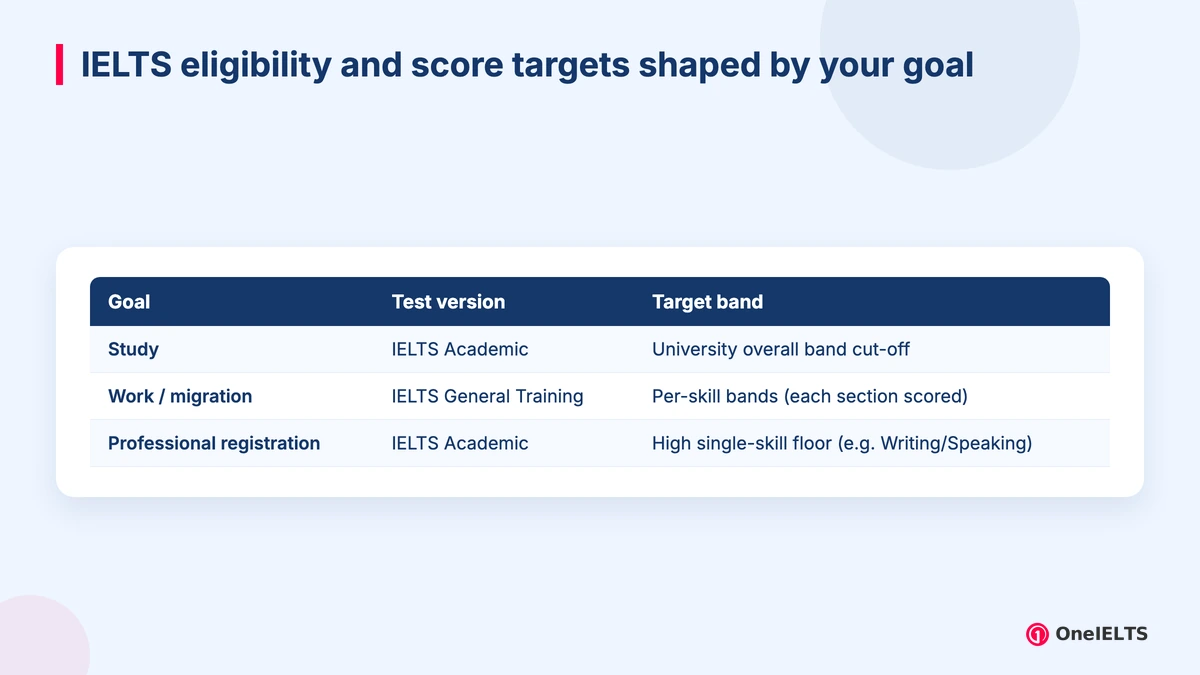
Your purpose, more than anything else, decides which IELTS test you sit and which target band makes you eligible. A study target, a work migration plan, and professional registration each point to a different test version and a different score, so naming your goal first saves you booking the wrong exam. The three common goals map to tests and targets like this.
- Study. You take IELTS Academic and aim for the university band cut-off, which is the overall study target your chosen course and country combination demands for admission to the programme.
- Work or migration. You usually take IELTS General Training and meet per-skill bands, since work migration systems score Listening, Reading, Writing, and Speaking individually rather than on the overall figure alone.
- Professional registration. You face a high single-skill floor, because licensing bodies for fields such as nursing often set a demanding target band in one skill, typically Writing or Speaking, above the overall.
What IELTS Qualification Score Do You Need?
There is no universal qualifying score; your target is set by institution, the employer, or the visa route you are applying to. A Canadian study permit, a UK Skilled Worker visa, and an Australian nursing body each publish their own number. Most routes sit between 6.0 to 7.5 overall, often with a per-skill minimum you must clear in every section. The safest move is to find your destination’s published requirement first, then aim a half band higher for a margin.
How Many Times Can You Take IELTS for Eligibility?
There is no limit on IELTS attempts, so you get unlimited attempts to retake it as often as you need to reach your required score. No waiting period is imposed between sittings, and your best valid result is the one you submit.
If only one section is holding you back, the One Skill Retake offers a cheaper single section option at eligible computer-delivered centres, letting you re-sit just Listening, Reading, Writing, or Speaking. You can read how that works in our One Skill Retake guide.
Practice for the Real IELTS Exam
Apply what you’ve learned with free, exam-style practice:
- Take a full IELTS mock test
- Practice by section: Listening, Reading, Writing, Speaking
- Structure your essays with IELTS Writing templates