If you trained in medicine abroad and want to practise in the UK, Australia or Canada, your IELTS for doctors result is the language proof your medical regulator checks before granting medical registration. The bar is set by the council, not the visa: the UK GMC asks for 7.5 overall with 7.0 each band, and Australia’s AHPRA wants 7.0 each band. Both sit higher than most university or migration minimums.
This guide covers why doctors need IELTS, how registration works, and the country-specific score requirements. It then explains why clinicians lose marks on Writing, how to prepare around shifts, which test each regulator wants, and how the One Skill Retake and OET fit in.
Why Do Doctors Need IELTS?
Doctors need IELTS to register with a medical council and prove they can communicate safely with patients. A regulator such as the GMC or AHPRA treats your IELTS score as evidence of the English proficiency that consultations, consent and handover notes demand. This is a registration requirement, and it sits separate from the work visa your employer or immigration route handles. You can hold a valid visa and still be blocked from the register until your English score clears the council’s threshold, because patient safety, not border control, is what the language rule protects.
How Do Doctors Complete IELTS Registration?
The registration path runs in a fixed order, and each step gates the next. The numbered steps below set out what an internationally trained doctor does from booking the test to sitting any licensing exam.
- Take IELTS Academic and reach the band score your chosen medical regulator demands, with no section below its per-band floor.
- Submit your scores to the medical regulator, either through its online portal or by authorising IELTS to send the result directly.
- Complete the regulator’s registration application, attaching your qualifications, identity documents and the verified language result.
- Sit any required licensing exam, such as the UK PLAB or Australia’s clinical assessment, once your English evidence is accepted.
What Are the Country-Specific IELTS Score Requirements for Doctors?
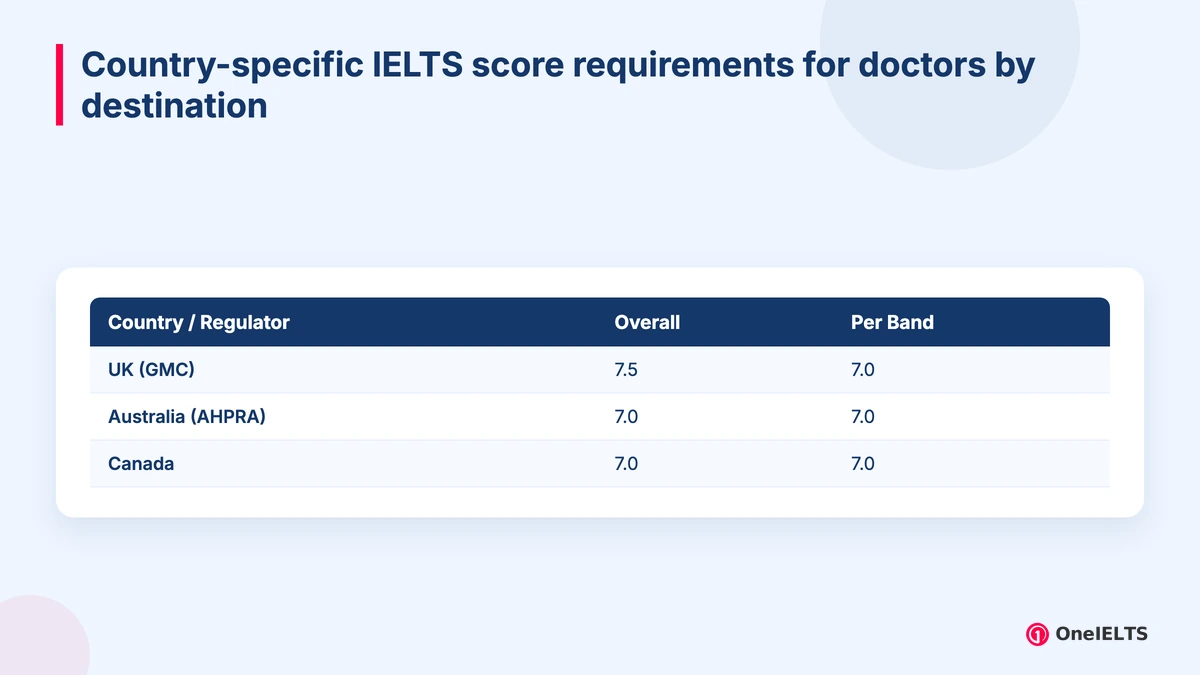
Each regulator publishes its own overall band and per band rule, and the gap between them is where applicants slip. The table sets out the IELTS thresholds the main English-speaking councils apply to doctors.
| Country / Regulator | Overall | Per Band |
|---|---|---|
| UK (GMC) | 7.5 | 7.0 |
| Australia (AHPRA) | 7.0 | 7.0 |
| Canada | 7.0 | 7.0 |
Last verified: 30 June 2026. Confirm the current figure on your regulator’s own page before you book, as councils revise these rules.
Why Do Doctors Struggle With IELTS Writing?
Clinicians who speak English on the ward every day still lose marks on IELTS Writing, because the test rewards a skill their job rarely uses. Writing Task 2 demands a structured academic argument under timed pressure, not a discharge summary or a referral letter. The formal register, the explicit question analysis and the 40-minute clock differ sharply from medical writing, where shorthand and house style carry the meaning. Fluent medical English does not produce a Band 7 Writing score on its own, and many doctors are surprised to land a 6.5 on their first attempt.
How Can Doctors Prepare for IELTS?
A working clinician’s revision has to fit around rotas, so the tips below target the skills that move a doctor’s band fastest in the least time. Each one trades scarce hours for the marks examiners actually award.
- Drill Writing Task 2 with a strict 40-minute timer twice a week, since timing and structure cost doctors more marks than vocabulary does.
- Record yourself answering Speaking practice prompts on your commute, then check fluency and pronunciation against the band descriptors.
- Read one broadsheet opinion piece daily to absorb the formal academic register that IELTS rewards and medical English omits.
- Sit at least one full timed mock under exam conditions, because pacing all four papers in a single sitting is its own skill.
- Lean on your existing medical English for Reading and Listening, then spend your scarce, time-poor preparation hours on the two productive papers.
Which IELTS Test Is Required for Doctors?
Doctors usually need IELTS Academic, though some regulators also accept OET as an alternative language route. IELTS Academic suits doctors because its Reading and Writing papers use the formal, source-based style a medical regulator expects for registration, whereas General Training does not meet most council rules. Where a regulator publishes both options, OET applies when you prefer a healthcare-specific exam and IELTS Academic applies when you want a widely recognised general test. The council you register with sets which result it will read.
Is the One Skill Retake Accepted for Medical Registration?
Some regulators accept a One Skill Retake combined result, but you must confirm with your council before relying on it. A One Skill Retake lets you re-sit just one paper and merge that mark into your original sitting to form a combined result, which can rescue a single weak band. The GMC’s stance is to verify acceptance per applicant rather than publish a blanket yes. Treat the merged score as conditional until your regulator confirms it in writing. Check the rules in our One Skill Retake guide before you book a re-sit.
Is IELTS or OET Better for Doctors?
OET is medical-specific while IELTS is general academic English, so choose based on which your regulator accepts and which suits you. OET sets every task in a clinical context, from patient letters to case notes, which many doctors find closer to their medical English than IELTS Writing’s abstract essays. IELTS, by contrast, is a general test accepted far beyond medicine, useful if you may also need it for a visa or further study. Both are widely accepted for medical registration, so let regulator acceptance and your own strengths decide; our IELTS vs OET comparison weighs the formats side by side.
Practice for the Real IELTS Exam
Apply what you’ve learned with free, exam-style practice:
- Take a full IELTS mock test
- Practice by section: Listening, Reading, Writing, Speaking
- Structure your essays with IELTS Writing templates