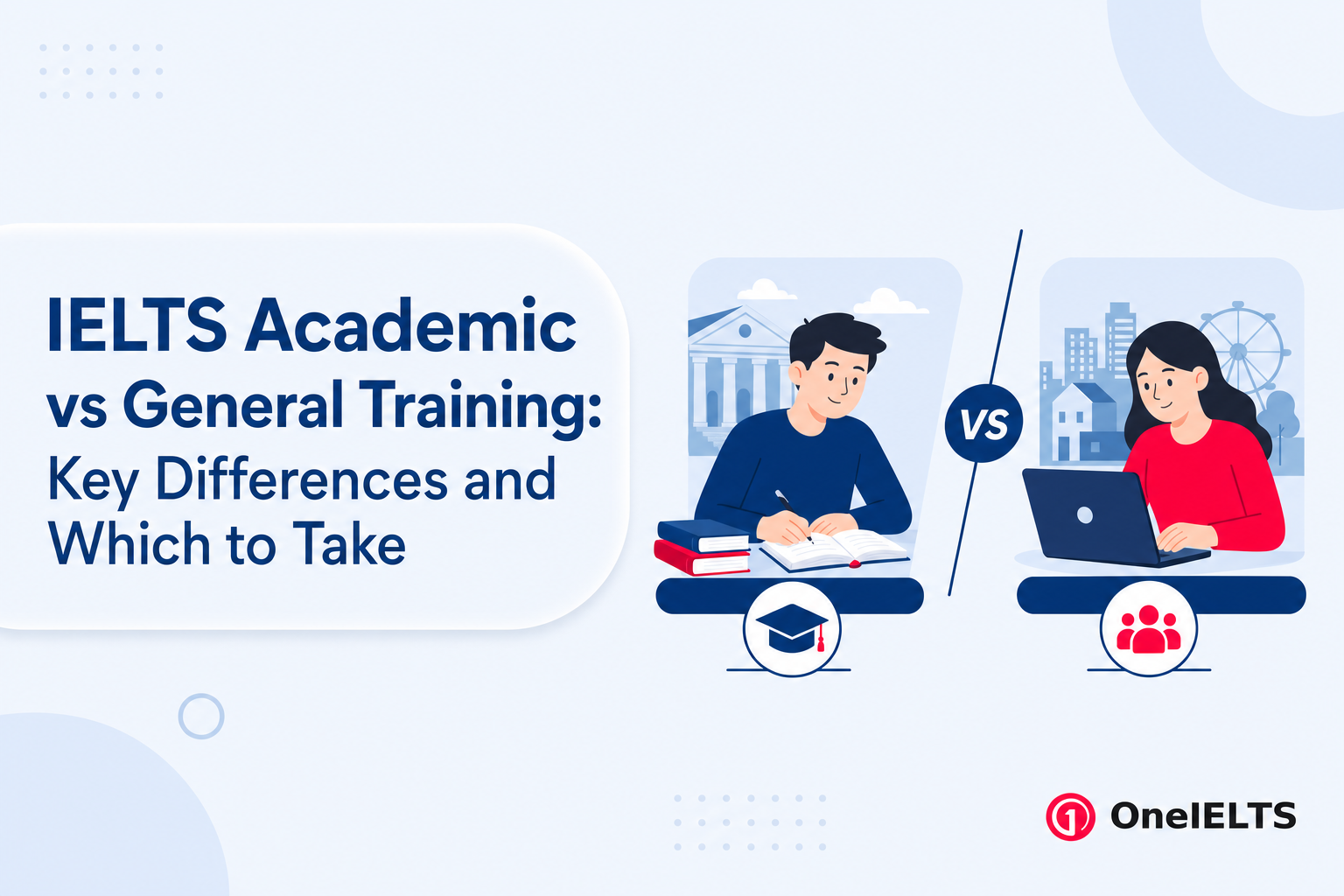
Choosing between IELTS Academic and IELTS General Training comes down to your destination, not which paper feels harder. IELTS Academic suits university admission and professional registration. IELTS General Training suits migration, work, and below-degree study. The two share an identical Listening and Speaking section and the same 1-9 band scale; only Reading and Writing Task 1 change. This guide explains what each version is, the key differences between them, whether General Training is easier, which test universities and visas require, and how to decide which to take.
Last verified: 30 June 2026
What Is IELTS Academic?
IELTS Academic measures whether your English is ready for degree-level study and regulated professions. Universities use it for university admission, and councils for nursing and medicine use it for professional registration. Its academic reading passages come from journals, books, and reports written for a degree-level audience. Writing Task 1 is a data Task 1: you describe a graph, chart, table, or process in your own words rather than writing a letter.
What Is IELTS General Training?
IELTS General Training measures everyday and workplace English for people moving abroad rather than entering a degree. It supports migration and work routes and below-degree study such as foundation or vocational courses. Its everyday reading texts are notices, advertisements, timetables, and workplace documents you meet in daily life. Writing Task 1 is a letter Task 1: you write a formal, semi-formal, or personal letter to respond to a given situation.
What Are the Differences Between IELTS Academic and General Training?
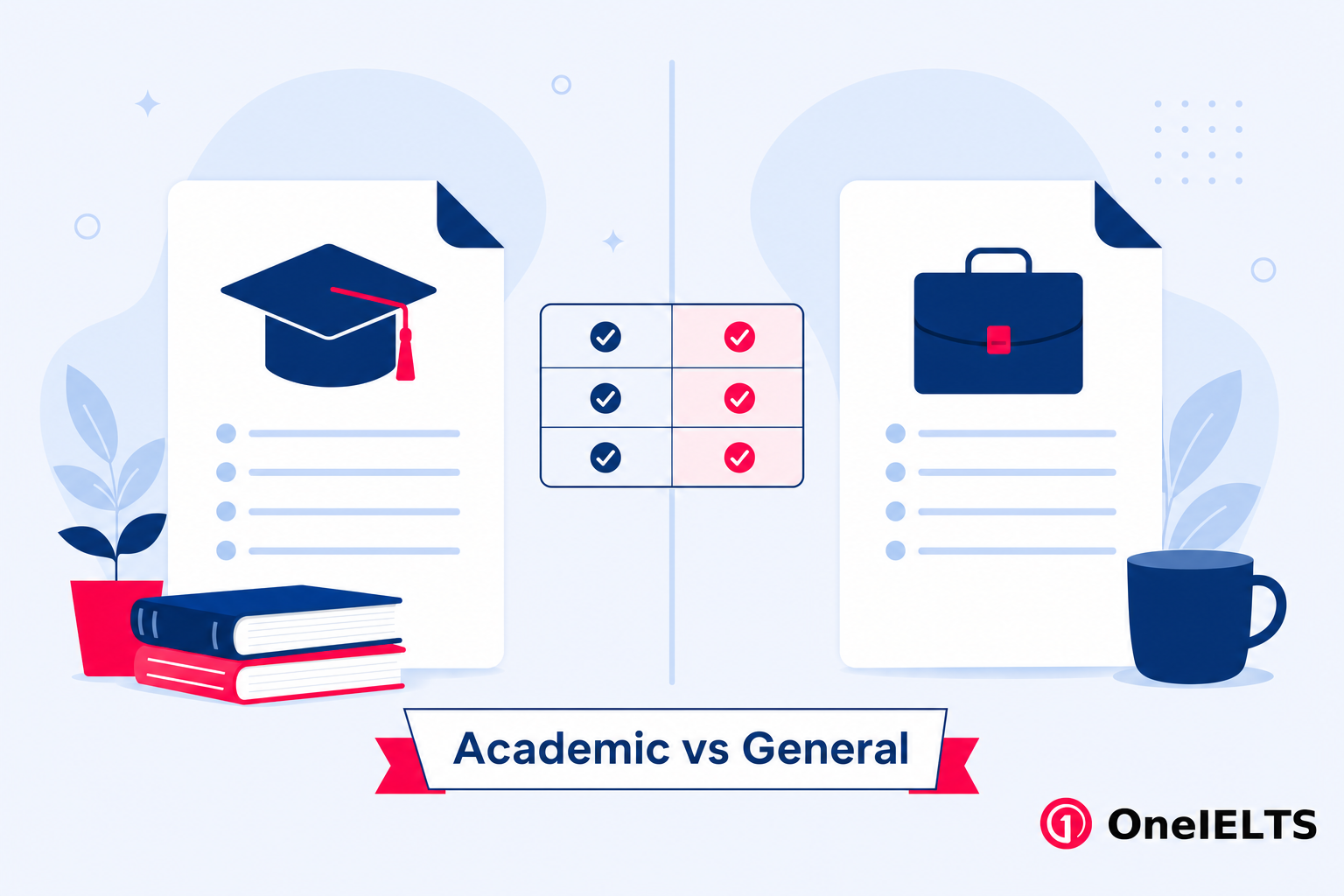
Both versions test the same four skills and report on the same scale, yet the test purpose, the reading section, and writing task 1 set them apart, while score interpretation depends on your destination. Five differences separate IELTS Academic from IELTS General Training, each explained in the sections below.
- Test purpose. Academic targets university study and professional registration; General Training targets migration, work, and below-degree study, so your goal decides the version.
- Reading section. Academic Reading uses long journal-style passages, while General Training Reading uses short notices, advertisements, and workplace texts across its three parts.
- Writing Task 1. Academic Task 1 asks you to describe a graph, chart, or process, while General Training Task 1 asks you to write a letter responding to a situation.
- Listening and Speaking. These two sections are identical in both versions, using the same recorded audio and the same face-to-face examiner interview for every candidate.
- Score interpretation. Both report on the same 1-9 band scale, so the score means the same thing; only the required minimum changes by destination.
1. Test Purpose
The split here is study vs migration. You take IELTS Academic for study and registration: a university place or a professional body such as a medical or engineering council. You take IELTS General Training for migration, work, and below-degree study. Put simply, the choice is university vs immigration. If your destination is a degree or a regulated profession, Academic is required; if it is a work visa or a college course at below-degree level, General Training is required.
2. Reading Section
Academic Reading draws on academic passages taken from journals, textbooks, and serious periodicals, with longer arguments and a denser vocabulary. General Training Reading uses everyday workplace texts such as job adverts, staff handbooks, notices, and timetables. It builds from short factual pieces to a longer general-interest text. Both papers contain 40 questions answered in 60 minutes, so the format and timing match even though the source material differs.
3. Writing Task 1
In Academic Writing Task 1 you describe data: you summarise a graph, chart, table, map, or process diagram in about 150 words. In General Training Writing Task 1 you write a letter of about 150 words, asking for information, explaining a problem, or making a request in the right tone. Task 2 essay both versions share: a 250-word argument essay on a given topic that carries the larger share of the Writing score.
4. Listening and Speaking
The Listening and Speaking papers are identical sections in both IELTS Academic and IELTS General Training. Every candidate hears the same audio in the Listening test, with four recordings and 40 questions answered over about 30 minutes. Every candidate sits the same interview in Speaking. That interview is an 11-to-14-minute talk with a trained examiner covering a familiar topic, a long turn, and a discussion.
5. Score Interpretation
Academic and General Training report results on the same band scale, the identical 1 to 9 scale set by the British Council, IDP, and Cambridge. It runs from non-user to expert user in half-band steps, so a 7.0 means the same level of English in either version. What changes is the destination requirements: a university might set a 6.5 overall with a per-band minimum of 6.0, while an immigration program sets its own threshold.
Is IELTS General Training Easier Than Academic?
GT Reading and Writing feel more approachable, but the band scale is identical, so neither version is easier to score. The General Training passages and letter task use more familiar language than the journal extracts and data report of the Academic paper. That is why so many candidates rate GT more approachable and assume it is the softer option.
It is not easier to score, though: difficulty depends on your own skills and the target band. A strong analytical writer may score higher in Academic, while a confident everyday communicator may prefer General Training. The examiner applies the same band scale to both, so a 7.0 demands the same standard either way.
Which IELTS Do Universities and Visas Require, Academic or General?
Universities and professional bodies require IELTS Academic; most work and migration visas require IELTS General Training. Academic for university admission is the rule almost everywhere, and professional registration with councils for nursing or accountancy also relies on it. General Training for migration covers the bulk of work and permanent-residence routes, including Canada and Australia. Some immigration routes accept either version, so always check the receiver. Read the exact requirement published by your university, professional body, or immigration program before you book.
Which IELTS Should You Take, Academic or General Training?
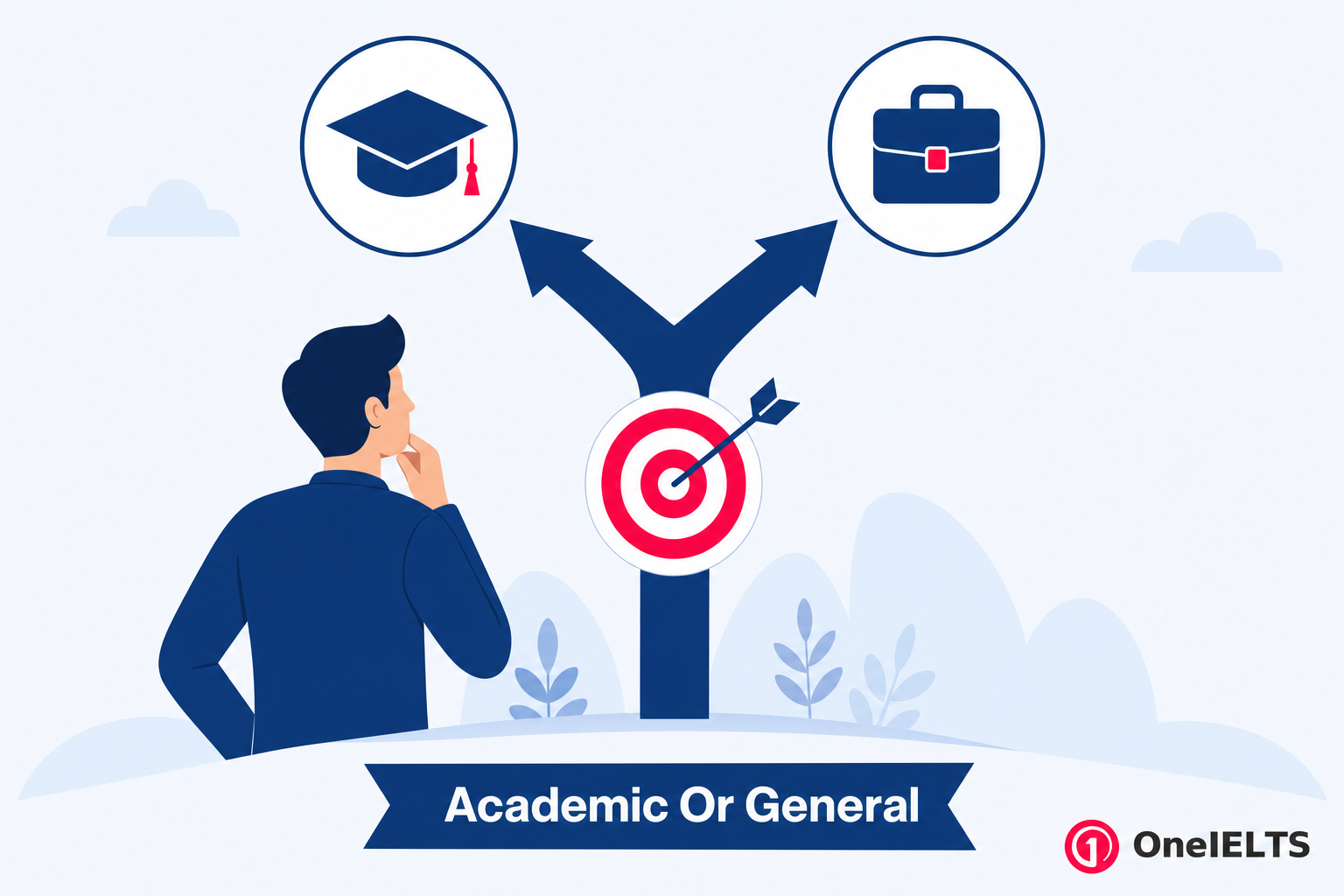
Choose your IELTS version by where you are headed, not by which paper looks easier: your destination dictates the test, and taking the wrong one means re-sitting the exam. Three decision rules cover almost every candidate, set out here so you can match your goal to the right version.
- Take Academic for study. Choose IELTS Academic if you are applying to a university, college degree, or professional register such as a medical, nursing, or engineering council.
- GT for migration. Take IELTS General Training for Canada, Australia, or UK migration and for most work routes that ask for proof of everyday English.
- Always confirm the requirement. Confirm requirement details with your institution or immigration program before booking, because a few routes accept either version and a wrong choice wastes the fee.
Can You Use IELTS Academic for Immigration?
Usually no – the major economic-migration programs require General Training for PR, though some routes accept Academic. Canada Australia programs are built around the General Training version, so an Academic result is not accepted for most permanent-residence applications. A handful of work or professional routes do take Academic. Always check the program and its accepted version before you sit the test. Read the English-test rules for your specific route in our IELTS for Canada guide before booking.
Do Academic and General Training Use the Same Band Scale?
Yes – both versions use the identical 1 to 9 scale and the same overall calculation, averaging your four section scores and rounding to the nearest half band. A 6.5 in Academic represents the same level of English as a 6.5 in General Training, so scores are read the same way. Only the reading conversion differs between versions: General Training needs a few more correct answers than Academic to reach the same Reading band. See how the nine bands are built and averaged in our IELTS band score guide.
Practice for the Real IELTS Exam
Apply what you’ve learned with free, exam-style practice:
- Take a full IELTS mock test
- Practice by section: Listening, Reading, Writing, Speaking
- Structure your essays with IELTS Writing templates