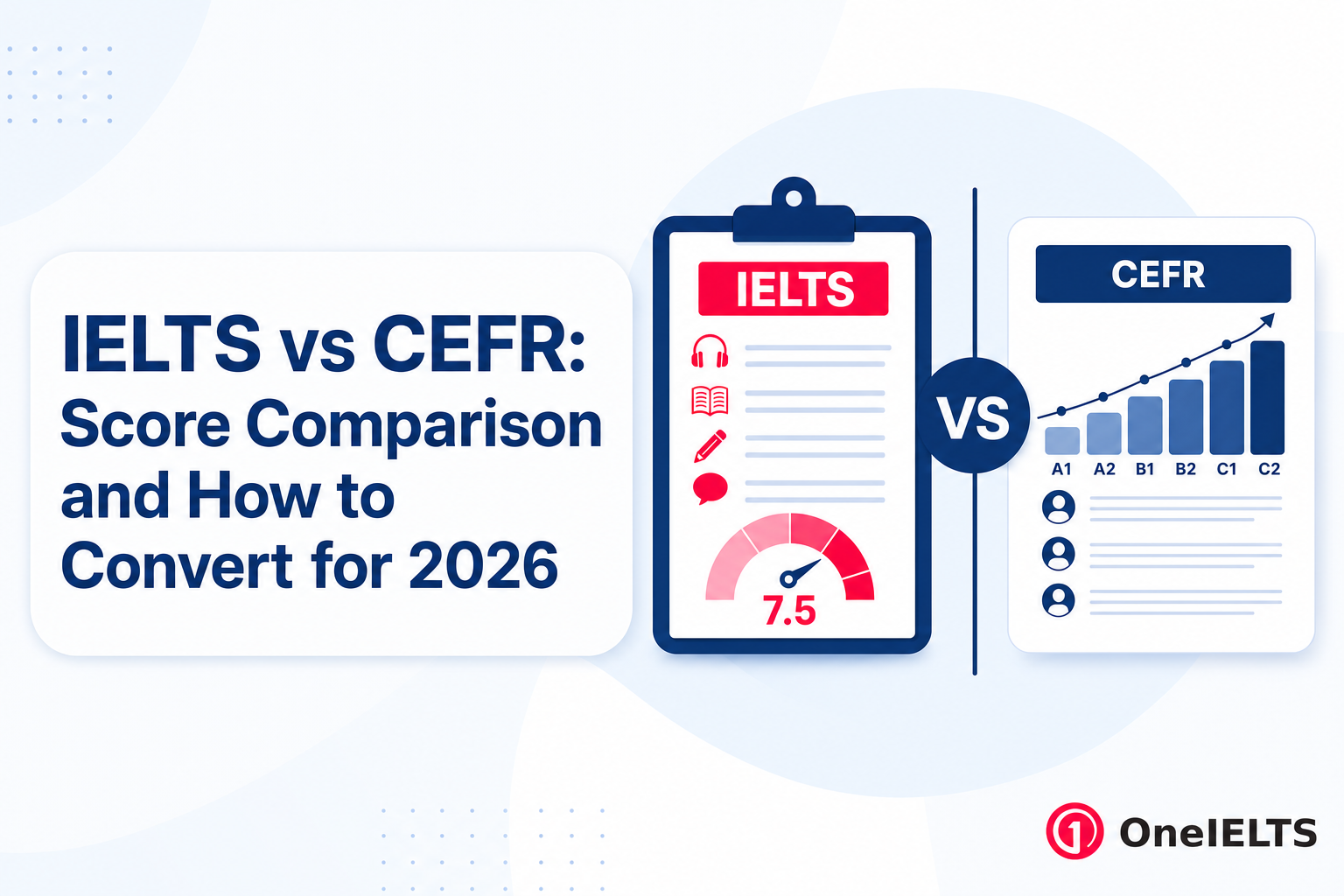
The CEFR levels sort language ability into six rising rungs, A1 to C2, and your IELTS band tells you where you sit on that ladder: a 6.5 reads as B2, a 7.5 as C1. Going from IELTS to CEFR gives you a level range, not a single conversion number, because each CEFR level covers a band of IELTS scores rather than one exact match.
This guide explains what the CEFR is, how IELTS maps to its levels, what CEFR level each IELTS band represents, which band counts as C1, and how to convert your own score step by step.
What Is the CEFR?
The CEFR (Common European Framework of Reference) is a six-level scale, A1 to C2, for describing language ability in reading, writing, listening, and speaking. The six levels run from beginner to mastery. Schools, employers, and exam boards worldwide use them to compare language qualifications, so an IELTS band, a TOEFL score, and a Cambridge certificate read against the same scale.
How Does IELTS Map to CEFR Levels?
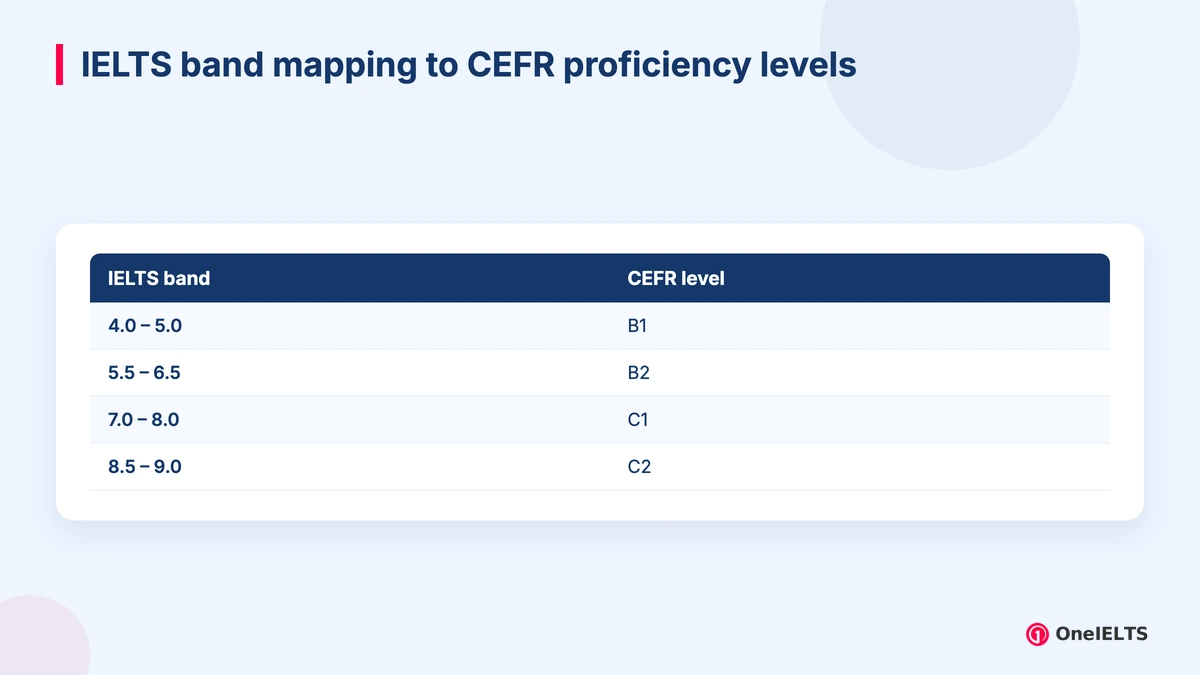
The table below pairs each IELTS band with its CEFR level under the official mapping that the test owners publish as the IELTS alignment.
| IELTS band | CEFR level |
|---|---|
| 4.0 – 5.0 | B1 |
| 5.5 – 6.5 | B2 |
| 7.0 – 8.0 | C1 |
| 8.5 – 9.0 | C2 |
The band-to-level reading runs from B1 to C2 across the scores most candidates earn, with B2 and C1 covering the bulk of academic results. The IELTS alignment maps each band to a level, so reading band to level is the direction that works; you cannot reverse it into one exact score.
What CEFR Level Is Each IELTS Band?
Reading band by band, IELTS 4.0-5.0 corresponds to B1, IELTS 5.5-6.5 ~ B2, IELTS 7.0-8.0 ~ C1, and IELTS 8.5-9.0 corresponds to C2. Because each level spans bands, a single CEFR rung covers more than one IELTS band: B2 alone takes in three half-bands, and C1 stretches across 7.0, 7.5, and 8.0. That is why a half-band gain inside a level does not move you up a CEFR rung, while crossing from 6.5 to 7.0 does.
What Do the CEFR Levels A1 to C2 Mean?
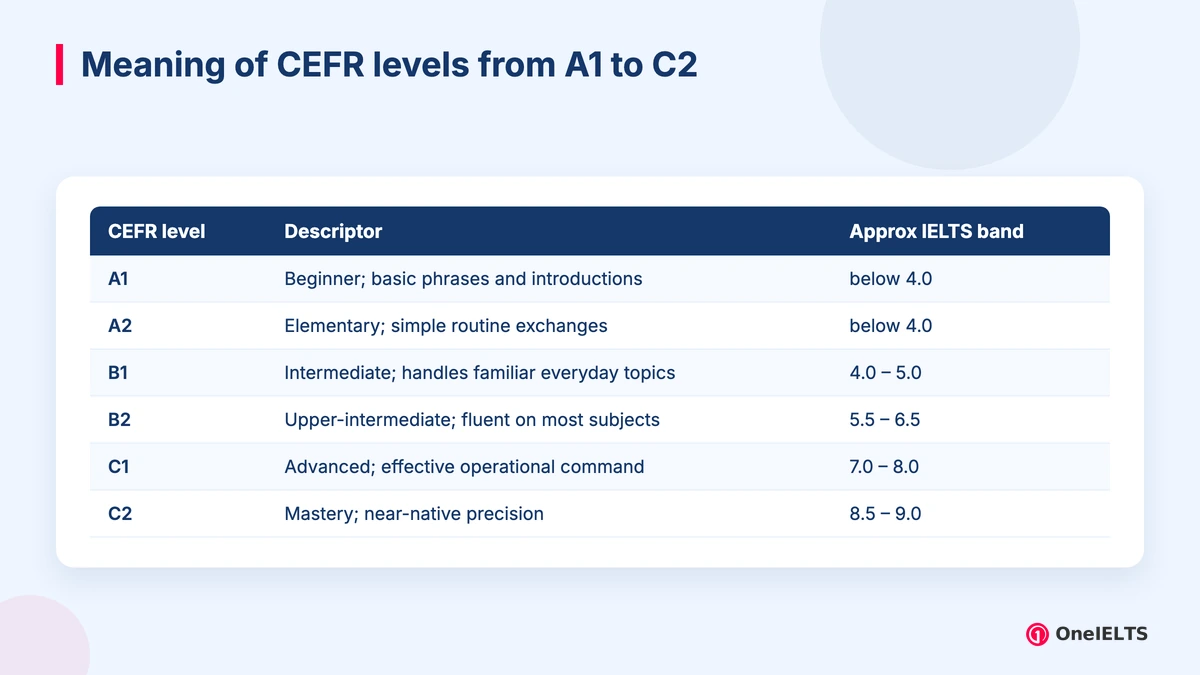
The CEFR levels A1 to C2 run from beginner to mastery, and the table sets each proficiency descriptor against the approx IELTS band that matches it.
| CEFR level | Descriptor | Approx IELTS band |
|---|---|---|
| A1 | Beginner; basic phrases and introductions | below 4.0 |
| A2 | Elementary; simple routine exchanges | below 4.0 |
| B1 | Intermediate; handles familiar everyday topics | 4.0 – 5.0 |
| B2 | Upper-intermediate; fluent on most subjects | 5.5 – 6.5 |
| C1 | Advanced; effective operational command | 7.0 – 8.0 |
| C2 | Mastery; near-native precision | 8.5 – 9.0 |
The proficiency descriptor at each level explains the jump in what you can do, from beginner phrases at A1 to mastery at C2. The approx IELTS band shows that A1 and A2 sit below the IELTS reporting floor, so the test starts describing ability from B1 upward.
Which IELTS Band Is CEFR C1?
IELTS bands 7.0-8.0 = C1, the university-accepted level most English-speaking universities require for admission. A 6.5 sits on the B2/C1 borderline, so it reads as upper B2 rather than full C1, and C2 at 8.5+ marks the top of the scale. If a course or visa route names C1, target a 7.0 overall as the practical floor.
How Do You Convert Your IELTS Score to CEFR?
Converting your IELTS score means reading your band against the official alignment and treating the result as a range — the conversion is range not exact. The five steps below walk through the conversion from your band to a target requirement.
- Take your IELTS overall band, or your per-skill band if a target sets a minimum for reading, writing, listening, or speaking separately.
- Find that band on the official alignment that IELTS publishes, the same chart the British Council and IDP use for score comparison.
- Read across to the matching CEFR level the chart assigns, for example a 7.5 landing inside the C1 band on that scale.
- Remember the level is a range, not exact, so a half-band shift inside C1 keeps you at the same matching CEFR level.
- Check what CEFR level your target requirement names, then compare it against your converted level to see whether you clear it.
Is IELTS Band 7 Equal to CEFR C1?
Yes – an IELTS 7-8 ~ C1, the advanced band on the scale. C1 indicates advanced English with operational command: you can follow demanding academic texts and argue a position with control. A band 7 is the entry point to that level, which is why so many degree courses set it as their minimum. For a fuller breakdown of what each band signals, see our guide to the IELTS band score scale.
What CEFR Level Do Universities Require?
Most universities expect CEFR B2 to C1, equivalent to roughly IELTS 5.5-7.5, with the exact threshold set by the course rather than the institution. A competitive C1 requirement is common on courses in law, medicine, and postgraduate research, which means a 7.0 overall and often 7.0 in each skill. Foundation and pathway programmes more often accept B2 at 5.5 to 6.0.
To judge where your own result lands, read what counts as a good IELTS score for your goal.
Why Is CEFR a Range, Not an Exact Score?
Each CEFR level describes a band of ability, so it maps to a range of scores rather than one number. B2 covers 5.5, 6.0, and 6.5, and C1 covers 7.0 through 8.0, because the framework groups what a learner can do rather than measuring a single point. This grouping is why every IELTS-to-CEFR reading is an approximate conversion: your band names the level you have reached, not a one-to-one equivalent.
Last verified: 30 June 2026
Practice for the Real IELTS Exam
Apply what you’ve learned with free, exam-style practice:
- Take a full IELTS mock test
- Practice by section: Listening, Reading, Writing, Speaking
- Structure your essays with IELTS Writing templates