To study, work, or settle in the United Kingdom, you prove your English to UK Visas and Immigration (UKVI). For most applicants that proof is IELTS for UK. The International English Language Testing System (IELTS) comes in a visa-grade form called IELTS for UKVI. It is a Secure English Language Test (SELT), booked at a Home Office-approved centre.
Settlement instead uses IELTS Life Skills. This guide sets out the IELTS requirements by visa type and how IELTS helps you study at UK universities. It covers the bands top Russell Group institutions expect, working in the UK, the UK visa process, and the route to Permanent Residency, or Indefinite Leave to Remain (ILR).
Last verified: 30 June 2026 — UK visa rules and university bands change, so confirm current figures before you apply.
Which IELTS Tests Does the UK Accept?
The UK accepts IELTS for UKVI (Academic), IELTS for UKVI (General Training), and IELTS Life Skills as its visa-grade tests, plus regular IELTS Academic for university offers. Only IELTS for UKVI is Home Office approved as a Secure English Language Test (SELT). Each version maps to a purpose. You take IELTS for UKVI Academic for degree study, Academic or General Training for skilled work, and IELTS Life Skills for settlement and family routes.
IELTS Life Skills itself comes in three levels — A1, A2, and B1 — each tied to a different family or settlement stage. A regular IELTS score still wins a university place. Any visa, though, needs the UKVI version, because UK Visas and Immigration runs extra identity checks at approved centres. Confirm both early, since IELTS for UK splits across a UK student visa, a UK skilled worker visa, and settlement routes.
How Does IELTS for UKVI Differ From Standard IELTS?
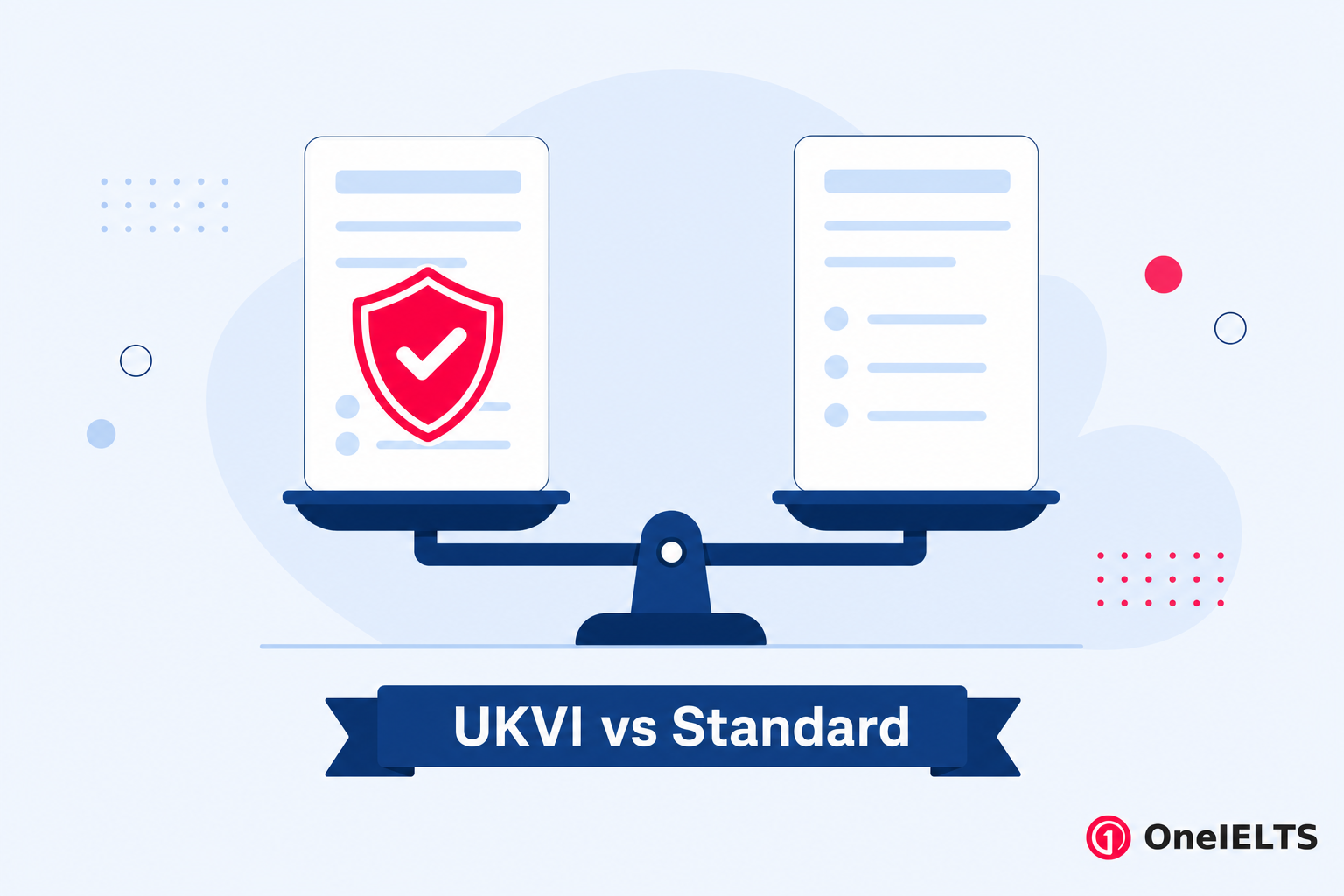
Standard IELTS and IELTS for UKVI share identical test content, format, difficulty, and scoring — the difference is approval, security, and paperwork, not the questions. Only IELTS for UKVI is a Home Office approved Secure English Language Test (SELT), so only it counts for a UK visa. You sit a UKVI test in person at a government-approved test centre, under added security such as video recording of the session. Your Test Report Form (TRF) then states the test was taken for UK Visas and Immigration purposes, which is exactly what a caseworker checks.
Standard IELTS still works for a university offer. Swap to the UKVI version the moment a visa is involved. One practical catch: UKVI slots sit at fewer centres than standard IELTS, so popular dates in Indian cities fill weeks ahead. The two compare like this.
| Aspect | Standard IELTS | IELTS for UKVI |
|---|---|---|
| Test content and scoring | Four skills, 0-9 band scale | Identical four skills, same 0-9 scale |
| Approval / visa acceptance | Accepted for university offers | Home Office approved SELT for visas |
| Security | Standard test-day checks | Added checks, including video recording |
| Where taken | Any IELTS test centre | In person at a government-approved test centre |
| Paperwork (TRF) | Standard Test Report Form | TRF marked for UK Visas and Immigration |
How Do You Book an IELTS for UKVI Test in India?
You book IELTS for UKVI in India through IDP or the British Council, choosing a UKVI test and an approved centre online. The process is short once your documents are ready. These six steps take you from account to test day.
- Create an account with IDP or the British Council. Register on either official provider’s India site using passport details that match the name on your booking.
- Select IELTS for UKVI (Academic or General Training) or IELTS Life Skills. Pick the version your route needs, not standard IELTS, or the score will not count for a visa.
- Choose a UKVI-approved test centre and date. Book online at a UKVI-approved test centre near you, since slots in busy months fill early.
- Pay the test fee online. Pay the fee for your chosen test to confirm the booking and lock your seat.
- Receive your confirmation and sit the test. Carry the same passport you booked with on test day for the identity checks.
- Download your Test Report Form (TRF). Use the TRF as your English evidence when you submit the visa application.
What Are the IELTS Requirements for UK?
The IELTS requirements for UK depend on whether you study, work, or settle, so three core thresholds matter before you book. Each maps to a CEFR level that UK Visas and Immigration (UKVI) sets, proven through the IELTS Academic test or a Home Office approved SELT. Get the level wrong and a visa can be refused even when your overall band looks strong, because UKVI reads every section against the floor. These three tiers split the study, work, and settlement thresholds.
- IELTS Score for UK Student Visa — the IELTS for UKVI Academic threshold for degree study.
- IELTS Score for UK Skilled Worker Visa — the level sponsored work needs from you.
- IELTS Score for UK Indefinite Leave to Remain — the settlement English test.
Each tier is detailed in its own section below, with the exact scores.
1. IELTS Score for UK Student Visa
A UK Student visa (Student route) needs IELTS for UKVI Academic at CEFR Level B2, which means 5.5 in every section. This level applies to any degree-level course at a UK university, from a bachelor’s degree to a master’s. A pre-sessional below degree (B1) course accepts the lower CEFR B1 instead, so a foundation or English-support programme sets an easier bar. You take IELTS for UKVI Academic for a UK Student visa, because its content matches degree study.
Visa caseworkers accept it as the approved SELT, while many universities also want to see the same Academic score on your offer. Selective institutions such as Oxford and Cambridge often ask for 7.0 to 7.5, far above the 5.5 visa floor, so the offer, not the visa, usually sets your real target.
2. IELTS Score for UK Skilled Worker Visa
A UK Skilled Worker visa needs CEFR Level B1, scored as 4.0 in every section of IELTS for UKVI. The Health and Care Worker visa uses the same B1 threshold for eligible NHS and social care roles. You can take IELTS for UKVI General Training or Academic for a UK Skilled Worker visa, since both prove the B1 English the Home Office requires for sponsored employment. Once you hold the score, your sponsoring employer ties it to your Certificate of Sponsorship when they assign the role. Some regulated professions, such as nursing, set a higher English bar than the visa minimum through their own registration bodies like the NMC.
3. IELTS Score for UK Indefinite Leave to Remain
UK Indefinite Leave to Remain (ILR) requires IELTS Life Skills B1, a Pass or Fail Speaking and Listening test, not an Academic band. You take IELTS Life Skills B1 for ILR after 5 years continuous residence, sat alongside the Life in the UK test. The settlement English level sits at CEFR Level B1. Life Skills reports only Pass or Fail, so there is no band to chase, just the clear B1 standard.
Because it tests only speaking and listening, it is a shorter, cheaper sitting than a full Academic test. Plan it as a distinct booking near year five, since it does not overlap with any Academic score you sat earlier for study or work.
How Does IELTS Help You Study in UK?
IELTS helps you study in UK because it unlocks the visa and the university offer together. UK Visas and Immigration treats an approved score as a visa gate, and admissions teams read it as proof of English language proficiency. Five gains stand out, each tied to your visa or your offer.
- Student Visa Approval. UK Visas and Immigration accepts an approved IELTS score as the English proof your UK student visa approval needs. With the band on file, the caseworker clears the language condition attached to your Confirmation of Acceptance for Studies, so the visa decision turns on documents you already hold.
- University Admission. Meeting a course’s IELTS Academic minimum makes you eligible for an offer at a UK institution. Admissions teams read the band as evidence you can follow lectures, seminars, and assessments delivered entirely in English, which is why a conditional offer often hinges on it.
- Competitive Advantage. A higher band strengthens applications for selective courses and scholarships. When places at popular programmes run short, a strong score gives Indian students a clear edge over applicants who only scrape the minimum requirement.
- Course Selection. A strong score widens the courses and universities you can pick. It opens Russell Group universities that set thresholds above the sector norm, rather than limiting you to lower-requirement options or a pre-sessional add-on.
- Preparation for Academic Life. Training for IELTS builds the English language proficiency that English-medium study demands. The reading, writing, and listening practice maps directly onto the essays, seminars, and lectures you will face from your first week on campus.
Can You Study in the UK Without IELTS?
Yes, many UK universities admit international students without IELTS, though whether you can study without IELTS depends on your background. Instead of a band, they may accept a high school English score of about 70-75%+, a Medium of Instruction (MOI) letter from your previous institution, or alternative tests like PTE or Duolingo. The University of Warwick and University of Bristol are among the names that consider applicants this way for some courses. One caution carries real weight here: a UK visa may still need IELTS for UKVI even when the university waives the test, so check the visa rule on its own before you skip the exam.
What Are the Top Universities in UK That Accept IELTS?
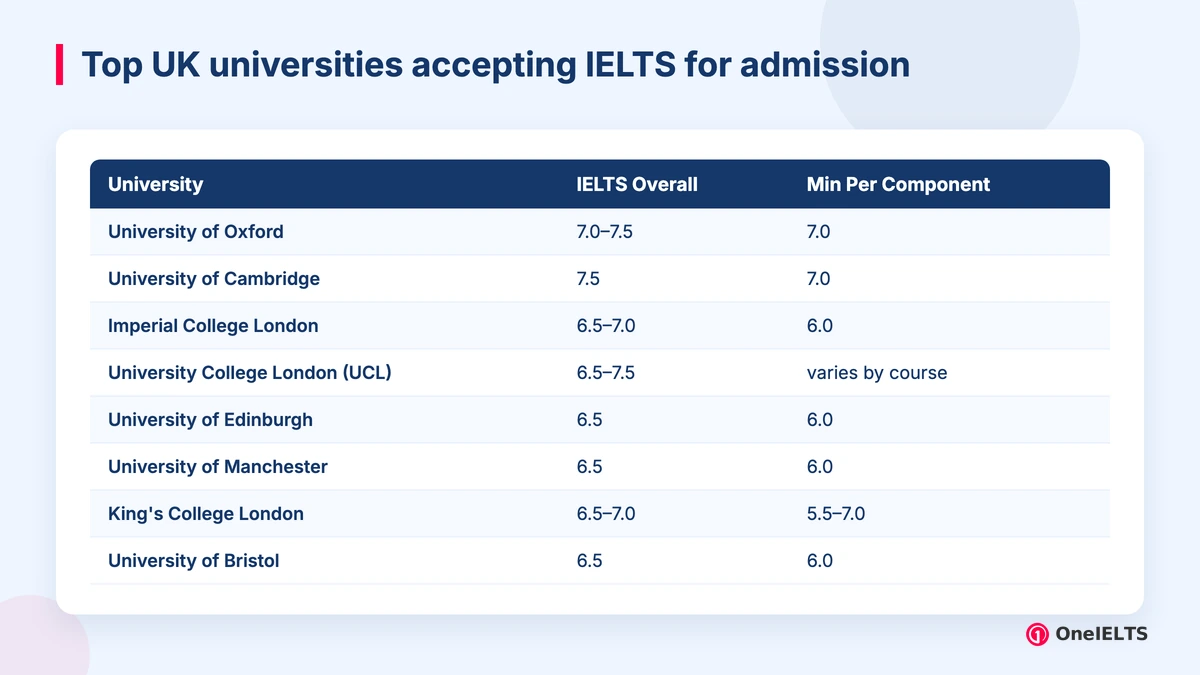
Nearly every UK university accepts IELTS, but the band rises with selectivity — about IELTS 6.5-7.5 overall, with a minimum 6.0-6.5 per component. The IELTS Academic test is the version these undergraduate and postgraduate programs read for admission. These ten top universities in UK, several of them Russell Group members, set the bands Indian applicants most often target. Exact minimums vary by course, so confirm each on the university’s own page.
| University | IELTS Overall | Minimum Per Component |
|---|---|---|
| University of Oxford | 7.0-7.5 | 7.0 |
| University of Cambridge | 7.5 | 7.0 |
| Imperial College London | 6.5-7.0 | 6.0 |
| University College London (UCL) | 6.5-7.5 | varies by course |
| University of Edinburgh | 6.5 | 6.0 |
| University of Manchester | 6.5 | 6.0 |
| King’s College London | 6.5-7.0 | 5.5-7.0 |
| University of Bristol | 6.5 | 6.0 |
| University of Warwick | 6.5-7.0 | 6.0 |
| University of Glasgow | 6.5 | 6.0 |
How Can You Work in UK with IELTS?
Working in UK with IELTS means proving CEFR Level B1 to your sponsor, scored as 4.0 in every section of a Home Office approved SELT. You take IELTS for UKVI General Training or Academic, and your employer issues a Certificate of Sponsorship. Each UK work visa applies the English bar in its own way.
- Skilled Worker visa. This route needs CEFR B1, scored as 4.0 in every section of IELTS for UKVI, plus a Certificate of Sponsorship from a licensed UK employer. The job must sit on an eligible occupation and meet the salary floor the Home Office sets, and your English score is checked against the route before the visa is granted.
- Health and Care Worker visa. This visa uses the same CEFR B1 English at 4.0 per section through IELTS for UKVI. It covers eligible NHS and adult social care roles, and stays one of the most-used routes for Indian nurses and carers, who often pair it with professional registration such as the NMC.
- Graduate visa (Post-Study Work). This route carries no fresh IELTS test, because your earlier student-route score already proved your English to the Home Office. It lets graduates stay and work, or look for work, for two years after their degree, and three years for doctoral graduates.
- Global Talent visa. This visa relies on endorsement by a recognised body in academia, research, arts, or technology. It sets no formal IELTS or sponsorship requirement for most applicants, who instead prove their standing through achievements and references in their field.
- Innovator Founder visa. This route requires CEFR B2 English, a step above the Skilled Worker level, proven through a Home Office approved SELT. It suits founders building an endorsed, scalable UK business rather than taking up sponsored employment with a single company.
What Is the UK Visa Process with IELTS?
The UK visa process with IELTS runs as a proof-of-English step you finish before you apply. You sit IELTS for UKVI as a Secure English Language Test (SELT), then the Home Office matches your result to the route. Seven steps carry you from test booking to decision.
- Identify your visa type. Confirm whether you need a Student, Skilled Worker, or settlement route first, because each one sets a different CEFR level and points you to a different IELTS test.
- Book an IELTS for UKVI test at an approved SELT centre. Choose Academic or General Training to suit your route, and book a slot at a UKVI-listed centre rather than a standard test venue.
- Achieve the required section scores. Hit the CEFR level your route sets in every section, not just the overall band, since UKVI checks each skill against the minimum.
- Submit your IELTS Test Report Form (TRF). Upload the TRF as your English evidence with the visa application, making sure it is still inside its two-year validity window.
- Complete the UKVI online application. File your route form, travel dates, and supporting documents through the UKVI online application portal in your country.
- Pay the Immigration Health Surcharge (IHS). Settle the health surcharge that funds your NHS access for the full length of the visa you are applying for.
- Give biometrics at a Visa Application Centre. Book a centre slot to record your fingerprints and photograph, the last step before a caseworker reviews and decides. Priority and super-priority services can speed the decision for an extra fee, but your English evidence must already be in order before you pay for them.
How Much Does IELTS for UKVI Cost in India?
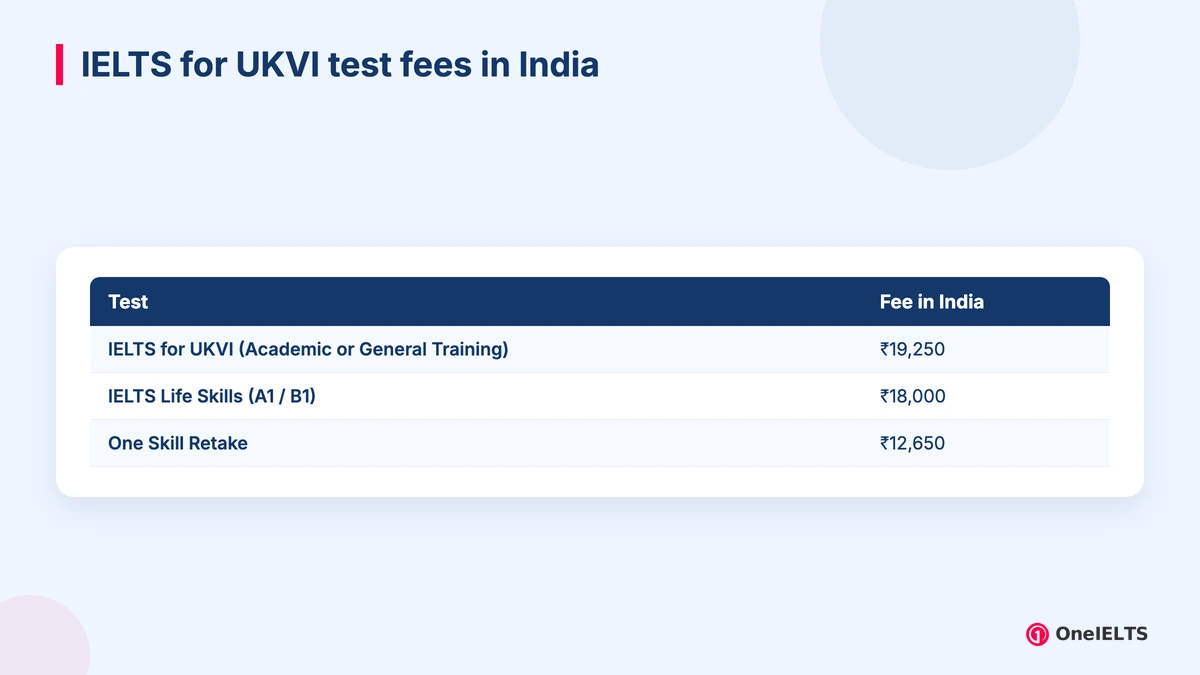
In India, IELTS for UKVI (Academic or General Training) costs ₹19,250, and IELTS Life Skills (A1 or B1) costs ₹18,000. The IELTS for UKVI fee is the same whether you sit the computer-delivered or paper-based format. If you only need to lift one section, the One Skill Retake fee is about ₹12,650, well below a full resit. IDP and the British Council set and collect these fees, and they change from time to time, so treat the figures as current-cycle guidance. Last verified: 30 June 2026.
| Test | Fee in India |
|---|---|
| IELTS for UKVI (Academic or General Training) | ₹19,250 |
| IELTS Life Skills (A1 / B1) | ₹18,000 |
| One Skill Retake | ₹12,650 |
How Can You Get Permanent Residency (PR) in UK with IELTS?
You reach Permanent Residency in the UK by completing five years on an eligible route and applying for Indefinite Leave to Remain (ILR). Permanent Residency is the everyday name; the official status is Indefinite Leave to Remain (ILR). You prove your English with IELTS Life Skills B1, and IELTS for UKVI covers routes that need an Academic band. The settlement steps run as follows.
- Choose a qualifying visa route (Skilled Worker / Spouse / Long Residence). Start on a route whose years count toward settlement, since not every visa builds to ILR.
- Maintain 5 years continuous residence. Live in the UK without breaching your visa conditions or the absence limits, which usually cap time outside the UK each year.
- Pass the Life in the UK test. Clear the 24-question test on British history, culture, and law before you submit the settlement application.
- Meet the English requirement (IELTS Life Skills B1). Pass the Speaking and Listening test that proves CEFR B1 for settlement, unless an exemption already applies to you.
- Submit the ILR (SET) application. File your settlement form through the UKVI online portal with your evidence of residence, English, and tests.
- Provide biometrics at UKVCAS. Attend a UK Visa and Citizenship Application Services centre to give your fingerprints and a photo for the record.
- Receive confirmation of your settled status. The Home Office issues your settlement decision and the proof of status you use for work and travel. After twelve months holding ILR, most routes let you apply for British citizenship, where the same Life in the UK test counts again.
What IELTS Band Score Is Required for UK Permanent Residency?
UK Permanent Residency requires IELTS Life Skills B1, a Pass or Fail test, not an IELTS Academic band. IELTS Life Skills B1 tests Speaking and Listening only, and reports a single Pass or Fail result. A Pass meets the ILR English requirement at CEFR Level B1, the standard settlement applicants must clear. A regular IELTS band score of 4.0 is sometimes compared to B1, but it is not what the settlement route asks for.
Because Life Skills runs at fewer centres, book the sitting early to avoid a wait near your application date. See the full scale in our IELTS band score guide.
Is IELTS Academic or General Training Better for UK PR?
Neither — UK PR specifically requires IELTS Life Skills B1, a separate test from IELTS Academic or General Training. IELTS Academic supports university admission, and IELTS General Training supports work and migration routes. For settlement, the UK reads IELTS Life Skills instead, because it proves the everyday Speaking and Listening English the route needs. So for UK PR you sit Life Skills B1, not an Academic or General band.
If you took Academic or General Training earlier for study or work, you still sit Life Skills separately for ILR. Compare the formats in our IELTS Academic vs General Training guide.
When Does Your IELTS Score Expire for UK Visa and PR Applications?
An IELTS score expires 2 years from the test date for a UK visa application. UKVI requirements measure the 2-year validity period against the day you submit, not the day you sit the test. So your IELTS Test Report Form (TRF) must still be inside the window when you apply. In practice, applicants most often get caught out by a score that lapses during a slow document-gathering month.
Build a buffer of a few months so a delayed offer or sponsorship does not push you past the deadline. Read the rules in our IELTS score validity guide.
Can IELTS One Skill Retake Help You Achieve the Required Score Before Expiry?
Yes, IELTS One Skill Retake lets you resit a single section within 60 days to lift a UK score before it expires. One Skill Retake covers a computer-delivered IELTS Academic and General Training test only, so paper sittings do not qualify. It does not apply to IELTS Life Skills, which means it can fix a study or work score but never a settlement result. Candidates most often fall half a band short in Writing alone, which is exactly the single section this option rescues.
In India the retake costs about ₹12,650, well below the price of sitting all four skills again. See how it works in our IELTS One Skill Retake guide.
Practice for the Real IELTS Exam
Apply what you’ve learned with free, exam-style practice:
- Take a full IELTS mock test
- Practice by section: Listening, Reading, Writing, Speaking
- Structure your essays with IELTS Writing templates