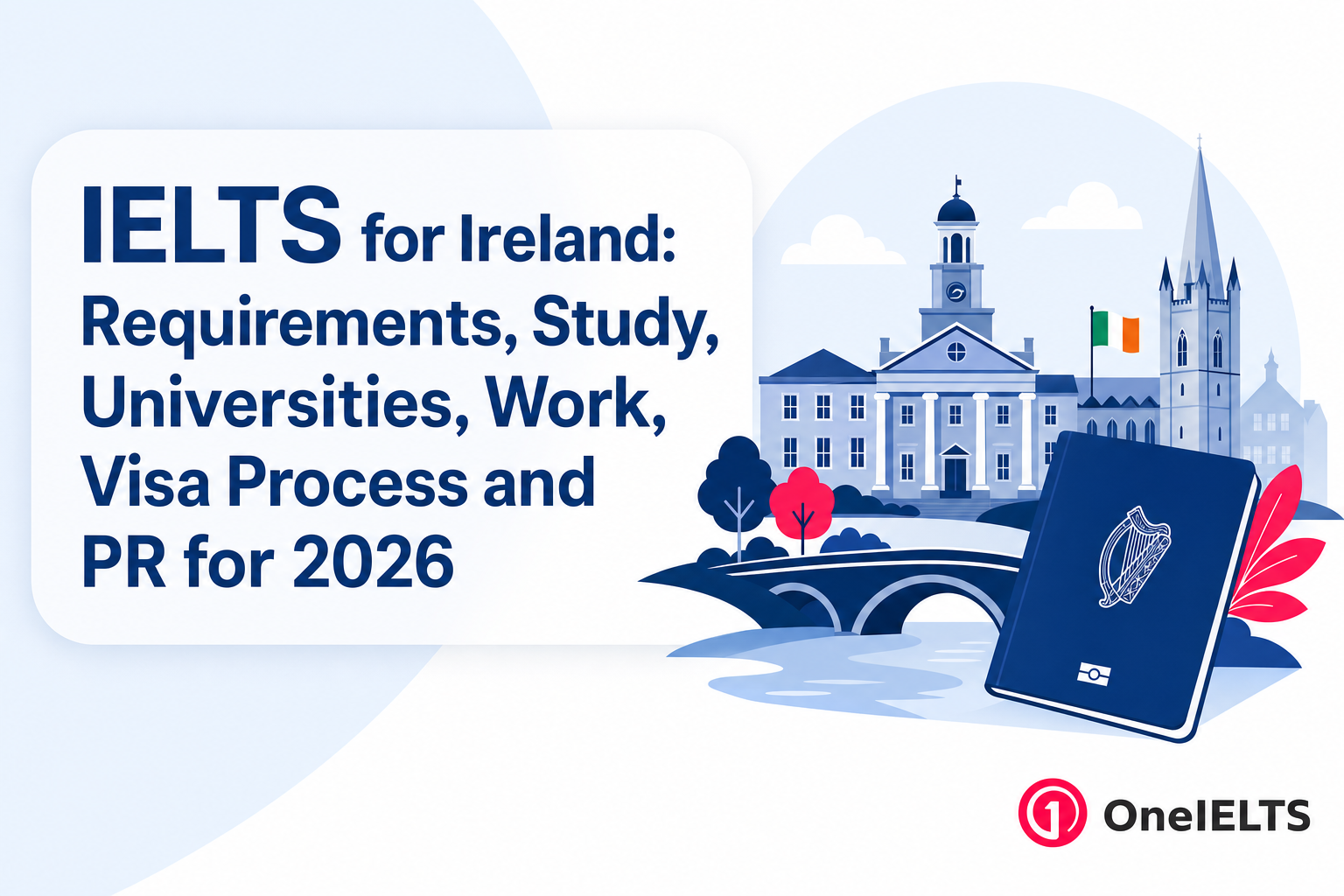
To study, work, or settle in Ireland you prove your English with IELTS for Ireland. It comes in two forms — IELTS Academic for university and the student visa, and General Training for some other routes. The International English Language Testing System (IELTS) sits at a common 6.5 Academic minimum for study.
This guide covers which tests Ireland accepts, the IELTS requirements across study and residence, and how IELTS helps you study. It also covers the top Irish universities and colleges, how to work in Ireland with NMBI registration for nurses, the Ireland visa process, and how long-term residence (Stamp 4) works. One thing to flag up front: an employment permit needs no IELTS, and the student visa is where the Irish Naturalisation and Immigration Service (INIS) gates English.
Last verified: 30 June 2026
Which IELTS Tests Does Ireland Accept?
Ireland accepts IELTS Academic and IELTS General Training, with IELTS Academic the version Irish universities and the immigration service recognise for study. The Irish Naturalisation and Immigration Service (INIS) sets a common minimum of 6.5 Academic. Ireland uses the standard IELTS sat at any test centre, so there is no special secure version — unlike the UK, which runs a separate IELTS for UKVI.
That same standard IELTS is accepted broadly by all Irish universities, colleges, and immigration authorities. One valid result usually serves study and the visa step together, which is why IELTS for Ireland is simpler than the UK system. For nurses, the regulator NMBI accepts IELTS or OET as proof of English for registration.
What Are the IELTS Requirements for Ireland?
The IELTS requirements for Ireland depend entirely on your purpose, and the IELTS Academic number for study is not the band for professional work or long-term residence. Universities set an admission band, regulators set a registration band, and residence sets none at all. The three tiers below name where each requirement applies — the student visa, professional work, and permanent residence — with the full scores given in the sections that follow.
- The score an Irish student visa and university admission need.
- The score working in Ireland and an employment permit or NMBI registration need.
- How IELTS sits alongside permanent residence in Ireland.
1. IELTS Score for an Irish Student Visa
An Irish student visa puts you on Stamp 2, the immigration permission for full-time international students. Your IELTS Academic score is the English evidence the university and visa process rely on. The common minimum sits at overall 6.0–6.5: undergraduate programmes often accept 6.0–6.5, while a masters in Ireland usually wants 6.5.
Most courses set no band less than 6.0 across the four skills. The Irish Naturalisation and Immigration Service (INIS) references a 6.5 Academic minimum as its benchmark. Which type of IELTS test should you take for an Irish student visa? You take IELTS Academic, since that is the version universities and the immigration service assess.
2. IELTS Score for Working and Professional Registration in Ireland
Working in Ireland splits into two questions, and IELTS only touches one of them. Most Irish employment permits, including the Critical Skills Employment Permit and the General Employment Permit, require no IELTS score. The permit is employer- and salary-based, decided on your job offer and pay rather than an English test.
Professional registration is different. The rule of IELTS 7.0 for nurses applies to NMBI registration: nurses need 7.0 with no band below 6.5, or OET B. Other regulated professions set similar English rules. Which type of IELTS test should you take for work in Ireland? You take IELTS Academic, the version professional bodies want for registration.
3. IELTS and Permanent Residence (Long-Term Residence) in Ireland
Irish long-term residence, often called Stamp 4, is reached through years of legal residence and employment in the State. There is no IELTS band for Irish permanent residence, because the application turns on how long you have lawfully lived and worked here.
English ability still matters earlier, at the study or professional-registration step that first brought you to Ireland. That earlier stage, plus eventual naturalisation, is where English shows up — never the residence form itself. Is an IELTS score required for Irish PR? There is no IELTS requirement set for long-term residence.
How Does IELTS Help You Study in Ireland?
To study in Ireland with IELTS works because the test proves your English language proficiency and is the result Irish universities recognise. Universities use it to confirm you can cope with English-medium teaching. The immigration service treats a valid score as part of your student visa Stamp 2 permission. Five concrete ways IELTS supports your Irish study plan follow as bullet points.
- Student Visa (Stamp 2) approval. A valid IELTS Academic result gives the immigration service the English evidence it needs to grant your Stamp 2 permission. The visa step then turns on a score you already hold rather than a separate test later.
- University and college admission. Meeting a course’s IELTS minimum makes your application eligible at Irish universities and colleges. Admissions teams treat the band as the entry gate that confirms you can follow lectures and assessment in English.
- Masters and postgraduate eligibility. Postgraduate programmes usually ask for 6.5 overall, so a strong IELTS Academic score opens taught masters and research places. These demand more English than undergraduate entry, widening the courses you can realistically apply to.
- Competitive advantage. Scoring above a course minimum strengthens your file where places are limited. A higher IELTS band reassures admissions tutors on competitive courses, such as business or law, that your English will not hold you back.
- Pathway to the Third Level Graduate (Stamp 1G) route. Studying on Stamp 2 with a recognised IELTS result puts you in line for the Third Level Graduate scheme. This post-study work permission lets eligible graduates stay and work in Ireland after finishing.
Can You Study in Ireland Without IELTS?
Yes, several Irish universities admit international students without IELTS, provided you prove your English another way, so you can study in Ireland without IELTS. The common alternatives are a Medium of Instruction (MOI) letter confirming you studied in English, prior study in an English system, or an accepted test such as PTE Academic / TOEFL / Duolingo.
Example institutions that may waive IELTS include University College Dublin, University of Limerick, and Dublin City University, though you should verify each one’s policy. Even where the university issues a conditional offer without IELTS, the student visa may still carry its own English requirement, so confirm both.
What Are the Top Universities in Ireland That Accept IELTS?
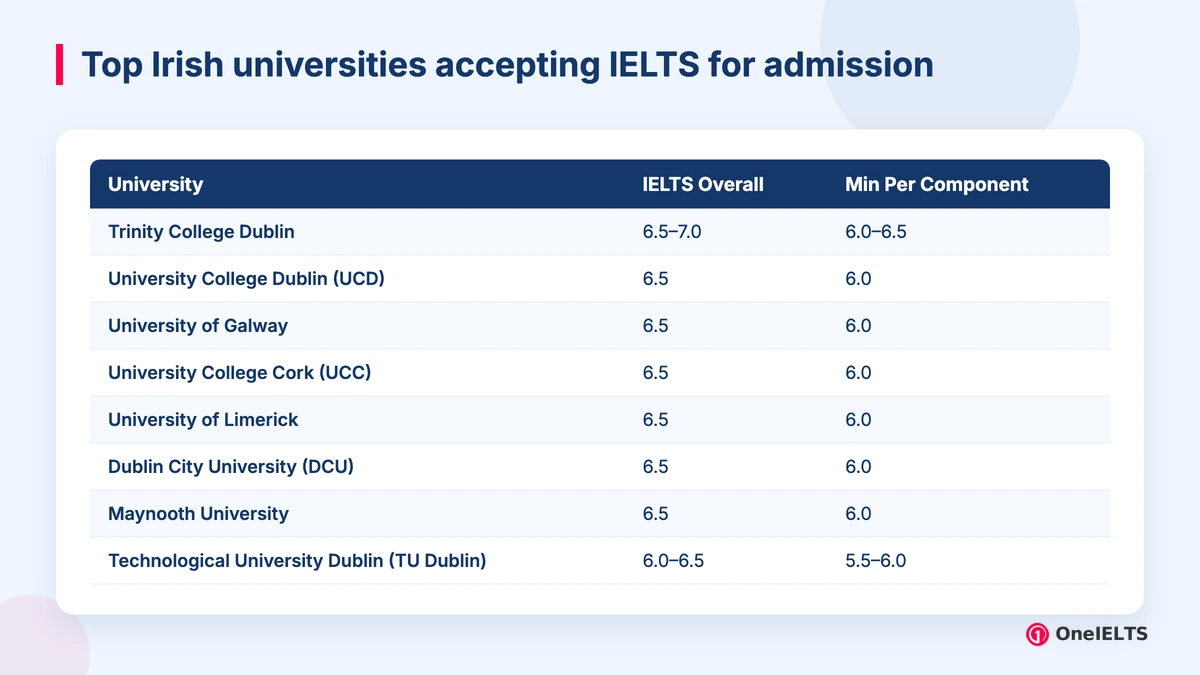
Virtually every one of the top universities in Ireland accepts IELTS, and competitive courses such as medicine, law, and business often ask for 7.0 or higher. The typical minimum is IELTS 6.5 overall with no band below 6.0, but the overall band score you need varies by course, so always check the specific programme page. The IELTS Academic minimums for eight widely chosen Irish institutions are set out in the table below.
| University | IELTS Overall | Minimum Per Component |
|---|---|---|
| Trinity College Dublin | 6.5–7.0 | 6.0–6.5 |
| University College Dublin (UCD) | 6.5 | 6.0 |
| University of Galway | 6.5 | 6.0 |
| University College Cork (UCC) | 6.5 | 6.0 |
| University of Limerick | 6.5 | 6.0 |
| Dublin City University (DCU) | 6.5 | 6.0 |
| Maynooth University | 6.5 | 6.0 |
| Technological University Dublin (TU Dublin) | 6.0–6.5 | 5.5–6.0 |
Exact minimums vary by course and rise for competitive programmes. Last verified: 30 June 2026.
How Can You Work in Ireland with IELTS?
Working in Ireland rarely needs an IELTS score for the Irish employment permit itself, which is decided on your job offer and salary, while professional registration with a regulated profession’s body does require IELTS. For that registration step you take IELTS Academic, the version regulated bodies assess. The five main Irish work routes, and exactly where IELTS applies on each, are set out as bullets.
- Critical Skills Employment Permit (no IELTS for the permit). This route targets high-demand occupations and is granted on your job offer, salary, and qualifications. The Critical Skills Employment Permit needs no IELTS score, as English is judged through your role rather than a test report.
- General Employment Permit (no IELTS for the permit). The General Employment Permit covers a wider range of occupations and, like Critical Skills, is employer- and salary-based. It requires no IELTS for the permit itself; an exam only enters the picture if your profession is separately regulated.
- NMBI nurse registration (IELTS 7.0 or OET B). Nurses and midwives need NMBI registration, and that step does require English evidence: the standard of IELTS 7.0 for nurses with no band below 6.5, or OET B, before they can practise regardless of the employment permit.
- Other regulated-profession registration (CORU, Medical Council). Health and social-care staff registering through bodies such as CORU or the Medical Council face their own English rules. These typically mirror the nursing standard, so confirm the exact IELTS band your regulated profession demands before applying.
- Third Level Graduate (Stamp 1G) post-study work. Graduates of eligible Irish courses can stay on the Third Level Graduate scheme (Stamp 1G) to seek work. This builds on the IELTS score that supported their study and gives employers a route to sponsor a permit later.
What Is the Ireland Visa Process with IELTS?
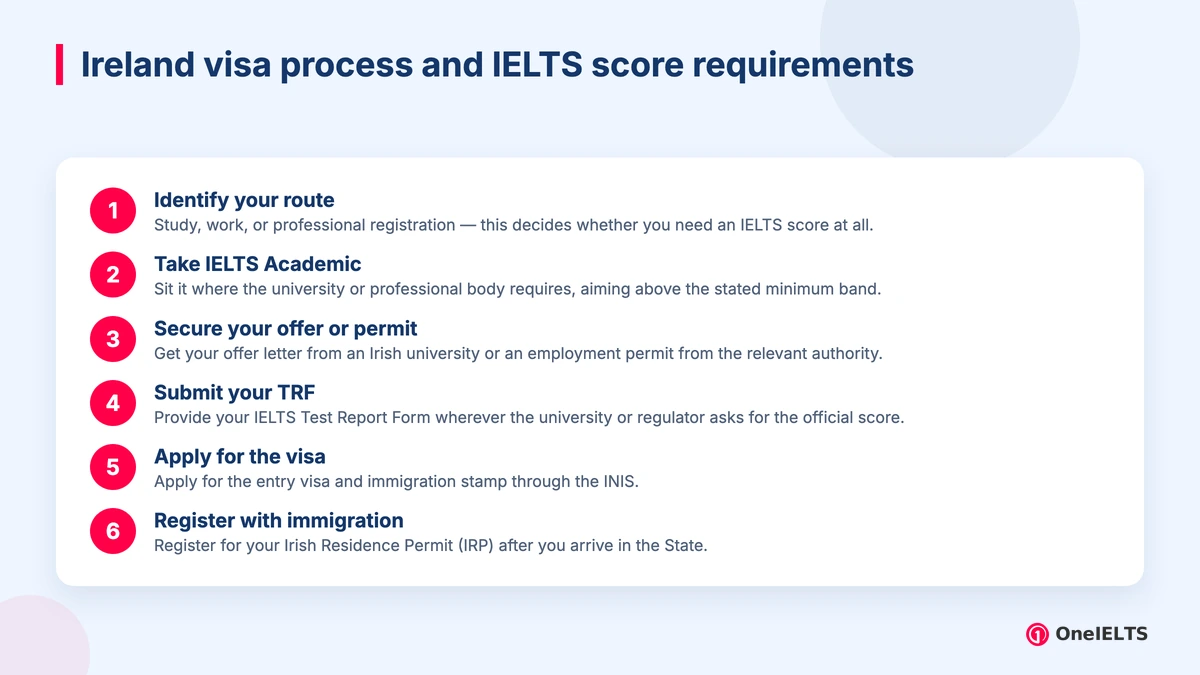
The Ireland visa process runs from choosing your route to registering with immigration after arrival, and your IELTS result sits early in that timeline. The main routes are the student visa Stamp 2, an employment permit, and professional registration. IELTS is needed for study and for regulated-profession registration, not for the permit itself. The six steps of the Ireland visa process with IELTS follow as a numbered list.
- Identify your route — study, work, or professional registration — since this decides whether you need an IELTS score at all.
- Take IELTS Academic where the university or professional body requires it, and aim above the stated minimum band.
- Secure your offer letter from an Irish university or your employment permit from the relevant authority.
- Submit your IELTS Test Report Form (TRF) wherever the university or regulator asks for the official score.
- Apply for the relevant entry visa and immigration stamp through the Irish Naturalisation and Immigration Service (INIS).
- Register with immigration for your Irish Residence Permit (IRP) after you arrive in the State.
How Much Does IELTS Cost in Ireland?
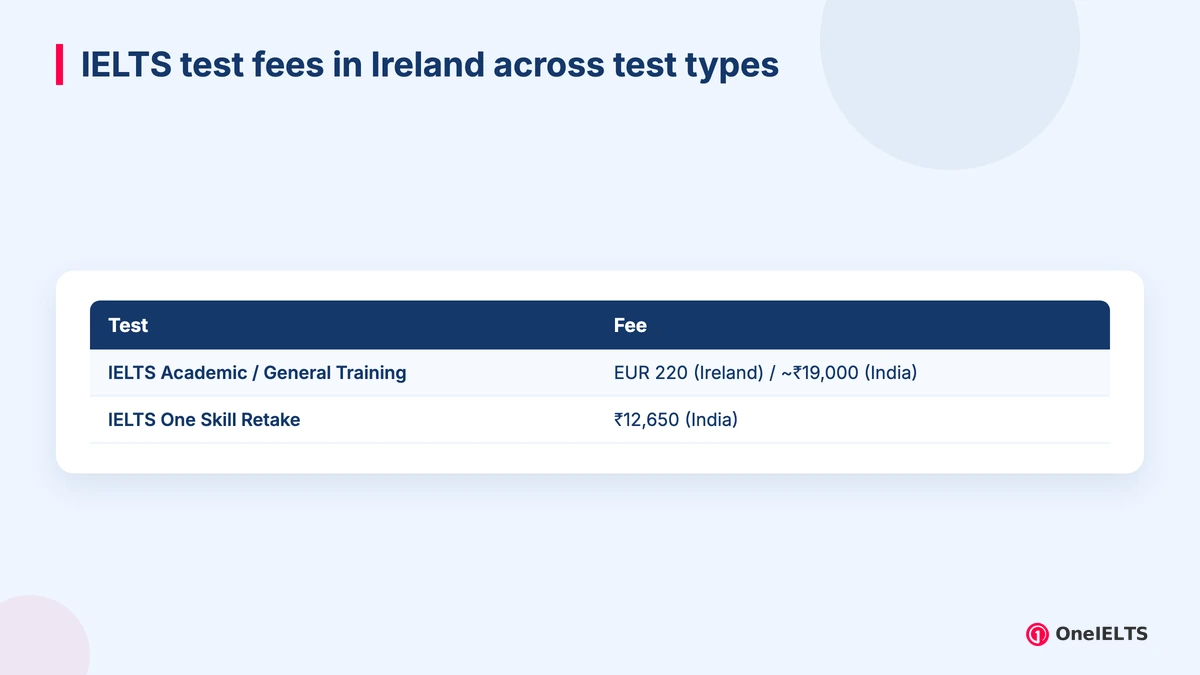
In India, IELTS Academic or General Training costs about ₹19,000 (the current IDP / British Council India fee), while sat in Ireland the fee is roughly EUR 220 — verify locally, since centres differ. The fee is the same whether you take computer-delivered or paper-based IELTS, so format does not change the price. Both IELTS Academic and IELTS General Training carry that single fee.
The IELTS One Skill Retake costs ₹12,650 (India), charged when you resit a single section. These fees are set by IDP and the British Council and change over time, so confirm the current figure before booking. The IELTS fees for Ireland appear in the table below.
| Test | Fee |
|---|---|
| IELTS Academic / General Training | EUR 220 (Ireland) / ~₹19,000 (India) |
| IELTS One Skill Retake | ₹12,650 (India) |
Last verified: 30 June 2026.
How Can You Get Permanent Residency (PR) in Ireland with IELTS?
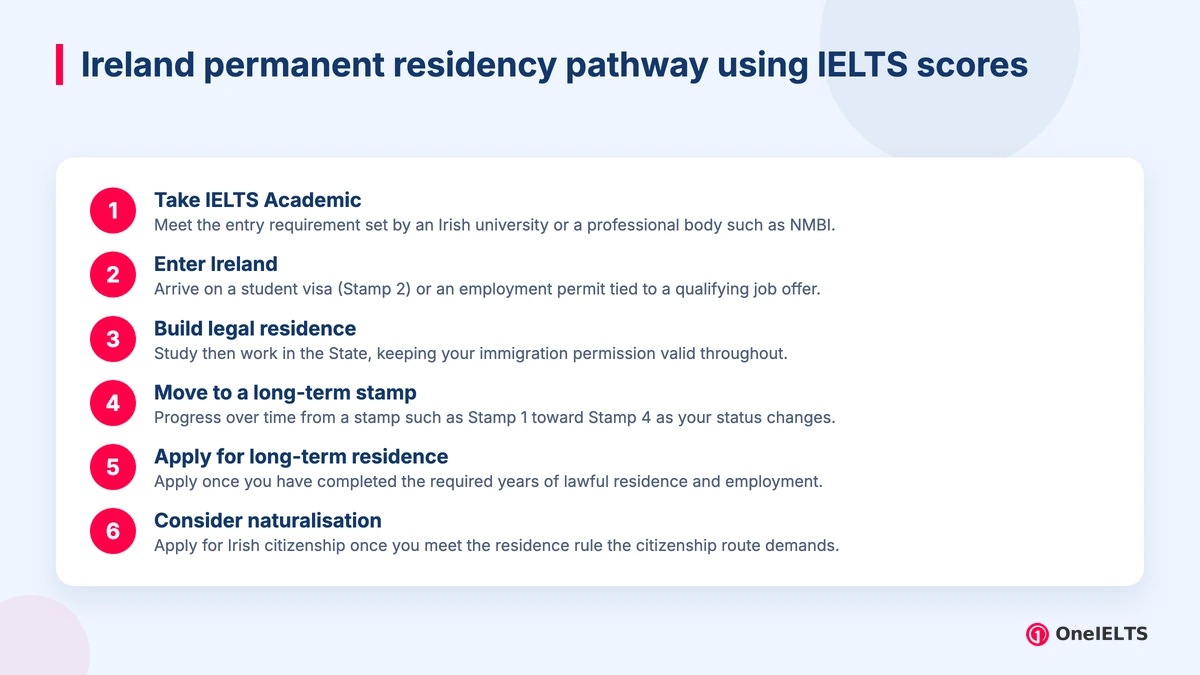
Irish Permanent Residency — long-term residence, often Stamp 4 — is residence-based, not test-based, so no IELTS band unlocks it. You earn it through continuous legal residence, living and working in Ireland for the required years. IELTS still matters at the start, because it gets you into the study or professional-registration route that begins your residence clock. The realistic IELTS-to-PR pathway in Ireland, ending in naturalisation, runs through the six stages below.
- Take IELTS Academic to meet the entry requirement set by an Irish university or a professional-registration body such as NMBI.
- Enter Ireland on a student visa (Stamp 2) or through an employment permit tied to a qualifying job offer.
- Build continuous legal residence by studying and then working in the State, keeping your immigration permission valid throughout.
- Move onto a long-term work stamp over time, progressing from a stamp such as Stamp 1 toward Stamp 4 as your status changes.
- Apply for long-term residence once you have completed the required years of lawful residence and employment in Ireland.
- Consider naturalisation as an Irish citizen once you meet the residence rule that the citizenship route demands.
What IELTS Band Score Is Required for Irish Permanent Residency?
Irish permanent residence sets no IELTS band — long-term residence (Stamp 4) is granted on years of legal residence, not an English test score. The IELTS scores you needed earlier were for university admission or professional registration, the steps that brought you to Ireland. English ability is still expected in practice, since you used it to study or register, but there is no IELTS requirement that gates the residence decision. For the wider picture of how bands work, see our IELTS band score guide.
Is IELTS Academic or General Training Better for Ireland?
For Ireland you should usually take IELTS Academic, since universities and professional bodies require it for university admission. IELTS General Training may suit some non-academic routes, but Academic is the safe choice for study and professional registration, and the version most Irish institutions name. Nurses and others registering with NMBI must submit IELTS Academic, or OET. If you are weighing the two formats, compare them in our IELTS Academic vs General Training guide.
When Does Your IELTS Score Expire for Ireland Applications?
An IELTS result is valid for two years from the test date for Irish study and registration. This two-year validity must still be live when the university or professional body assesses your file, not just on the day you test. An expired Test Report Form (TRF) is rejected outright, so time your test to your Irish university application or NMBI professional registration. The full rules sit in our IELTS score validity guide.
Can IELTS One Skill Retake Help You Reach the Score for Ireland?
Yes — One Skill Retake lets you resit a single section within 60 days to lift one band for Irish study or registration. One Skill Retake applies to computer-delivered IELTS Academic or General Training, so a paper-based result will not qualify. For NMBI registration you should confirm the regulator accepts a One Skill Retake combined result before relying on it. Read how the process works in our IELTS One Skill Retake guide.
Practice for the Real IELTS Exam
Apply what you’ve learned with free, exam-style practice:
- Take a full IELTS mock test
- Practice by section: Listening, Reading, Writing, Speaking
- Structure your essays with IELTS Writing templates