Your IELTS TRF records your four skill bands and your overall band score, carries a unique TRF number, and lets universities, employers and visa offices confirm your result. IDP and the British Council issue it in two forms. Computer-delivered candidates download an e-TRF, paper-based candidates receive one printed Test Report Form, and up to five copies go to institutions free of charge.
This page covers the document itself: what TRF stands for, release timing, contents, an annotated sample, the number decoded, downloading, the Additional Test Report Form, tracking, verification and two-year validity. Result types, country validity rules and sending steps live on our result, validity and send-to-university pages.
What Is an IELTS TRF?
IELTS TRF stands for Test Report Form, and the full form says what it is: the official score document that IDP or the British Council issues after your IELTS test. It shows your four skill bands, your overall band and a unique TRF number. IELTS doesn’t issue a pass or fail certificate. The report form states your level on the nine-band scale, and each organization decides whether that level meets its requirement.
One document format covers IELTS Academic, General Training and IELTS for UKVI. The electronic version is called the e-TRF. Universities, employers, professional bodies and immigration authorities read the TRF to confirm your English proficiency before they admit, hire, register or approve you.
When Is the IELTS TRF Released?
On a computer-delivered test, you can download the e-TRF once results are released, usually 1 to 5 days after the test. A paper-based test gives you one printed copy about 13 days after the test date, by post, courier or collection from the test centre. These windows come from ielts.org and the British Council, and our IELTS result page covers the full release rules.
The three ways a TRF reaches you differ in format and speed.
| Test mode | TRF format | How you receive it | Typical timing |
|---|---|---|---|
| Computer-delivered IELTS | e-TRF (PDF) | Download it from your IDP or British Council account after release | 1 to 5 days after the test, often within 2 days |
| Paper-based IELTS | Printed TRF | One printed copy by post, courier or collection from the test centre | About 13 days after the test date |
| IELTS One Skill Retake | Updated e-TRF | A new e-TRF in your account, with its own TRF number | Same window as computer-delivered results, usually 1 to 5 days |
What Does the IELTS TRF Contain?
The TRF shows your personal details and photo, test date and module, four skill bands, overall band score, CEFR level and unique TRF number. It also carries the centre and candidate numbers that tie the form to one sitting. Every field serves either identity, test record, score or authenticity.
Grouped by purpose, those fields fall into five blocks.
- Candidate details: your name, date of birth, sex, nationality, first language, ID number and photo, copied from your booking.
- Test details: test date, module (Academic or General Training), centre number and candidate number for your sitting.
- Scores: separate bands for Listening, Reading, Writing and Speaking, each reported in whole or half bands.
- Overall band score and CEFR level: the average of your four bands, plus its matching Common European Framework level.
- Administrator signature, validation stamp and TRF number: the marks that prove the form is genuine and traceable.
IELTS rounds the overall band to the nearest half band, so an average ending in .25 rounds up to the next half band (7.25 becomes 7.5), and .75 rounds up to the next whole band. Our IELTS band score guide shows the full method.
Check every personal detail the day the TRF arrives. Institutions reject a form whose name or date of birth differs from your passport.
What Does an IELTS TRF Sample Look Like?
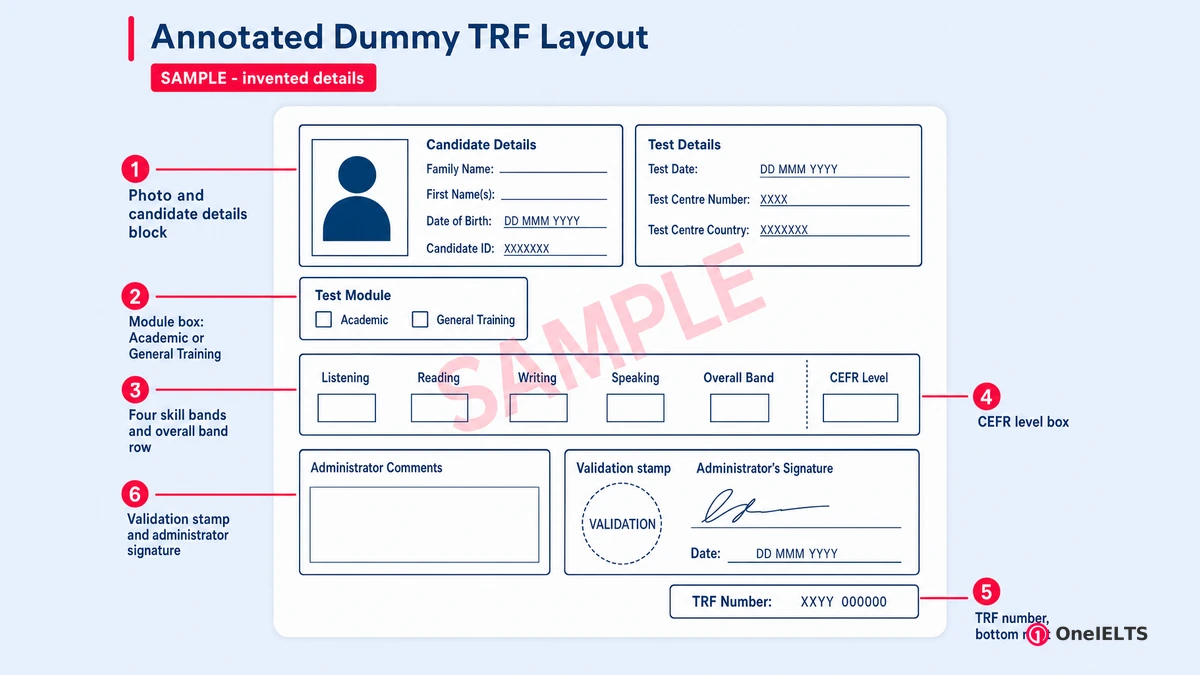
A sample TRF is a single page with your details at the top, a row of skill bands across the middle and the TRF number at the bottom right. The dummy above uses invented details only, with numbered annotated callouts on each zone so you can match your own document to it.
Each number on the dummy points to a fixed spot on the page, read from top to bottom.
- Photo and candidate details block, top left: your photo, name, birth date and ID number.
- Module box: ticked Academic or General Training, matching the test you actually sat.
- Four skill bands and overall band row, running across the middle of the page.
- CEFR level box, printed in the same row as your overall band.
- TRF number, bottom right: the reference institutions type into the results service.
- Validation stamp and administrator signature, in the lower section near the TRF number.
A paper TRF carries printed security features, while the e-TRF is a downloadable PDF with the same layout. Forms issued from 15 July 2026 also show the Ofqual logo and qualification title, per ielts.org. Compare these callout positions with an official sample from IDP or the British Council before you rely on them.
What Is the IELTS TRF Number?
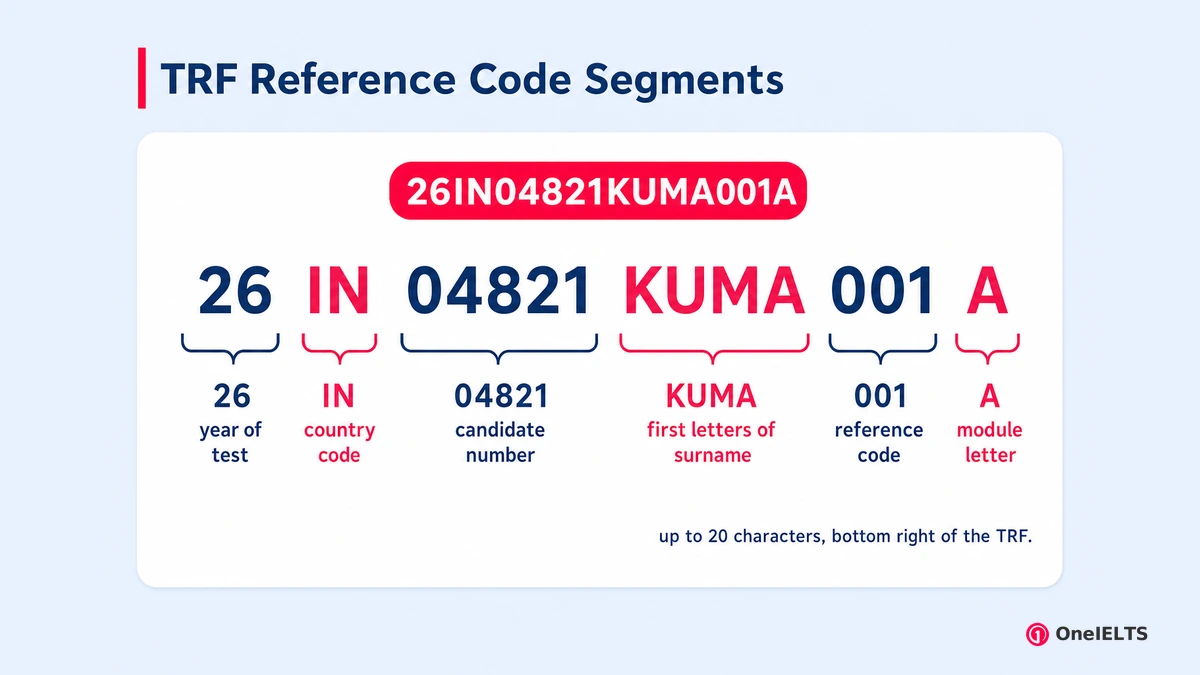
The TRF number is the unique reference of up to 20 letters and digits printed at the bottom right of every TRF. It identifies one candidate’s result for one test date, and institutions use it to verify that result. Every sitting gets a fresh number, including an IELTS One Skill Retake, which IDP confirms carries its own unique TRF number. Quote it exactly, with no spaces, on any application form.
Reading the dummy number 26IN04821KUMA001A piece by piece shows how the reference is built.
| Segment | Example | What it stands for |
|---|---|---|
| Year of the test (two digits) | 26 | The last two digits of the year you sat the test |
| Country code (two letters) | IN | The two-letter country code where you tested, IN for India |
| Candidate number | 04821 | Your candidate number at that centre, also printed under test details |
| First letters of the surname | KUMA | The first four letters of your family name, in capitals |
| Module letter (A for Academic, G for General Training) | A (last character) | A for Academic or G for General Training, matching your module box |
| Test centre and check characters | 001 | Reference code linked to the test centre number; IELTS publishes no key |
Source: the IELTS Results Service setup guide on ielts.org gives the length, the bottom-right position and a sample number, 17GB00595ZOLJY03G, whose pattern this dummy follows. IELTS doesn’t publish an official segment key, so treat the meanings as the widely reported pattern. Checked on 7 October 2026.
How Do You Check Your IELTS TRF Number?
Read it from the bottom right of your e-TRF PDF or paper TRF, or from the results page of your IDP or British Council account. If you’ve lost the document, the test centre that ran your test can give it to you.
You don’t need the TRF number to see your own result. The lookup asks for your passport number or ID number, with your date of birth or candidate number depending on the provider. The TRF number is what an institution enters to verify the result. Searches like “check IELTS result with TRF number” show how often candidates mix up these two keys.
Five places hold the number, starting with the documents themselves.
- On the e-TRF PDF: open the downloaded file and read the reference printed in the bottom-right corner.
- On the paper TRF: the same bottom-right position holds the number on the printed copy you collected.
- In the IDP IELTS candidate portal: log in, open your results, and the number appears with your scores.
- In the British Council Test Taker Portal: open your results and download the eTRF, which shows the number.
- From your test centre: for a lost TRF, contact the centre with your passport number and test date.
How Do You Download Your IELTS TRF?
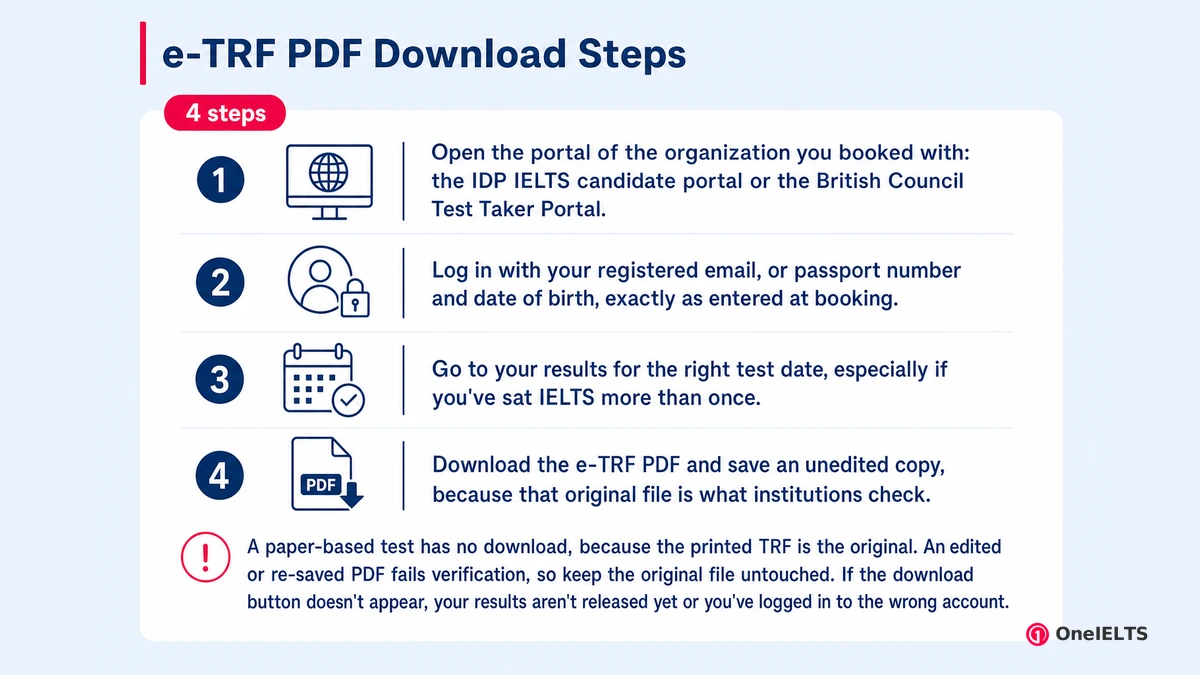
Log in to the account you booked with, open your results and download the e-TRF as a PDF. Only computer-delivered and One Skill Retake candidates get an e-TRF, and the PDF download appears only once results are released.
The four steps run from login to a saved original file.
- Open the portal of the organization you booked with: the IDP IELTS candidate portal or the British Council Test Taker Portal.
- Log in with your registered email, or passport number and date of birth, exactly as entered at booking.
- Go to your results for the right test date, especially if you’ve sat IELTS more than once.
- Download the e-TRF PDF and save an unedited copy, because that original file is what institutions check.
A paper-based test has no download, because the printed TRF is the original. An edited or re-saved PDF fails verification, so keep the original file untouched. If the download button doesn’t appear, your results aren’t released yet or you’ve logged in to the wrong account.
What Is an Additional Test Report Form (ATRF)?
An Additional Test Report Form (ATRF) is an extra official copy of your result that the test centre sends directly to an institution, beyond the free copies you named at booking. Up to five copies go free of charge, and after that you pay a fee per copy.
IDP India charges INR 350 per university for each electronic copy after the first five. The British Council in India lists INR 250 per address by post or electronically and INR 1,250 per address by international courier. Checked on 7 October 2026.
Centres accept requests only inside the two-year window from your test date. Since most institutions now receive results electronically, the ATRF is mainly a paper-test and courier matter.
How Do You Track Your IELTS TRF?
Track a paper TRF or an ATRF through the courier or post reference your test centre gives you. For e-TRF copies sent to institutions, check the results section of your IDP or British Council account. For a delayed TRF, contact the test centre that ran your test and quote your candidate number and test date.
Four kinds of delivery are worth tracking, each with its own reference.
- Paper TRF sent by post or courier: use the post or courier tracking reference your test centre gives you.
- Additional TRF sent to an institution: ask the test centre for the dispatch date and courier reference of each copy.
- Electronic copies sent to institutions from your account: the results section lists each organization you’ve sent results to.
- What to do if a TRF has not arrived: contact the test centre, quoting your candidate number and test date.
A replacement TRF is only possible within the validity window, so chase a missing copy early.
How Is an IELTS TRF Verified?
Institutions verify a TRF by entering its TRF number in the IELTS Results Service, which shows the result held on record. Many admissions offices still call it the Results Verification Service. Candidates don’t verify their own TRF, and only a registered organisation can use the service, after signing up on ielts.org.
An edited TRF, or one bought from an agent, fails here because the record shows the real scores and photo. IELTS also says it can’t investigate TRFs more than three years old.
An institution’s check runs through four comparisons.
- TRF number lookup in the Results Verification Service: the officer types the number and pulls up the official record.
- Name, date of birth and photo match: the record’s candidate details must match the applicant’s passport and form.
- Scores match the record held by IELTS: any band on your copy that differs from the record flags the form.
- Test date within the institution’s validity limit: most accept results up to two years old, some set less.
How Long Is an IELTS TRF Valid?
IELTS recommends that organizations accept a TRF for two years from the test date, and test centres don’t reissue or send copies after that. Some institutions and visa programs set a shorter or longer limit of their own.
So validity has two layers: the IELTS recommendation, and the institution policy or visa program that reads your result. The answers below cover when the validity window starts, how limits vary, sending near expiry and remarks.
When Does the Two-Year TRF Validity Start: Test Date or Result Date?
The two-year validity counts from the test date printed on the TRF, not from the day the result was released or the e-TRF was downloaded. The gap to the result date runs from a few days on computer to about two weeks on paper. It only matters near the two-year limit. Our IELTS result page explains release timing.
Does the Validity of the Test Report Form Differ by Country?
Yes, the two-year period is IELTS’s recommendation, and individual countries, visa programs and universities can apply their own limit. Australia accepts results up to three years old for skilled migration. Some universities set a university policy asking for a more recent score than the recommended period. Check each visa program in our IELTS score validity guide.
Can You Send Your TRF to a University After It Expires?
No, test centres stop sending TRF copies and Additional TRFs once the result is more than two years old, so you must send it while it is still valid. An expired TRF can’t be sent at all. A valid one can still fail if it lands after the university’s application deadline, so follow our steps to send your IELTS score to a university early.
Can You Get Your IELTS Exam Re-Scored Before the TRF Expires?
Yes, you can request an Enquiry on Results, but only within six weeks of the test date, and a changed score comes on a new TRF that keeps the original test date. So a remark does not reset the two-year validity. The fee is refunded if any band rises, which is also when a revised TRF arrives. See our IELTS Enquiry on Results guide.
Written by Fahimur Rahman, reviewed 7 October 2026.
Last verified: 7 October 2026
Practice for the Real IELTS Exam
Apply what you’ve learned with free, exam-style practice:
- Take a free IELTS mock test — all four skills, real exam timing, AI band scoring
- Start with the free mock test — one full test, no payment needed
- Practice skill by skill — Listening, Reading, Writing and Speaking sets